Cottage interior style, done well in Australia
What cottage interior style means in Australia in 2026: the three lineages, how it differs from farmhouse and cottagecore, what it costs, and how to do it well.
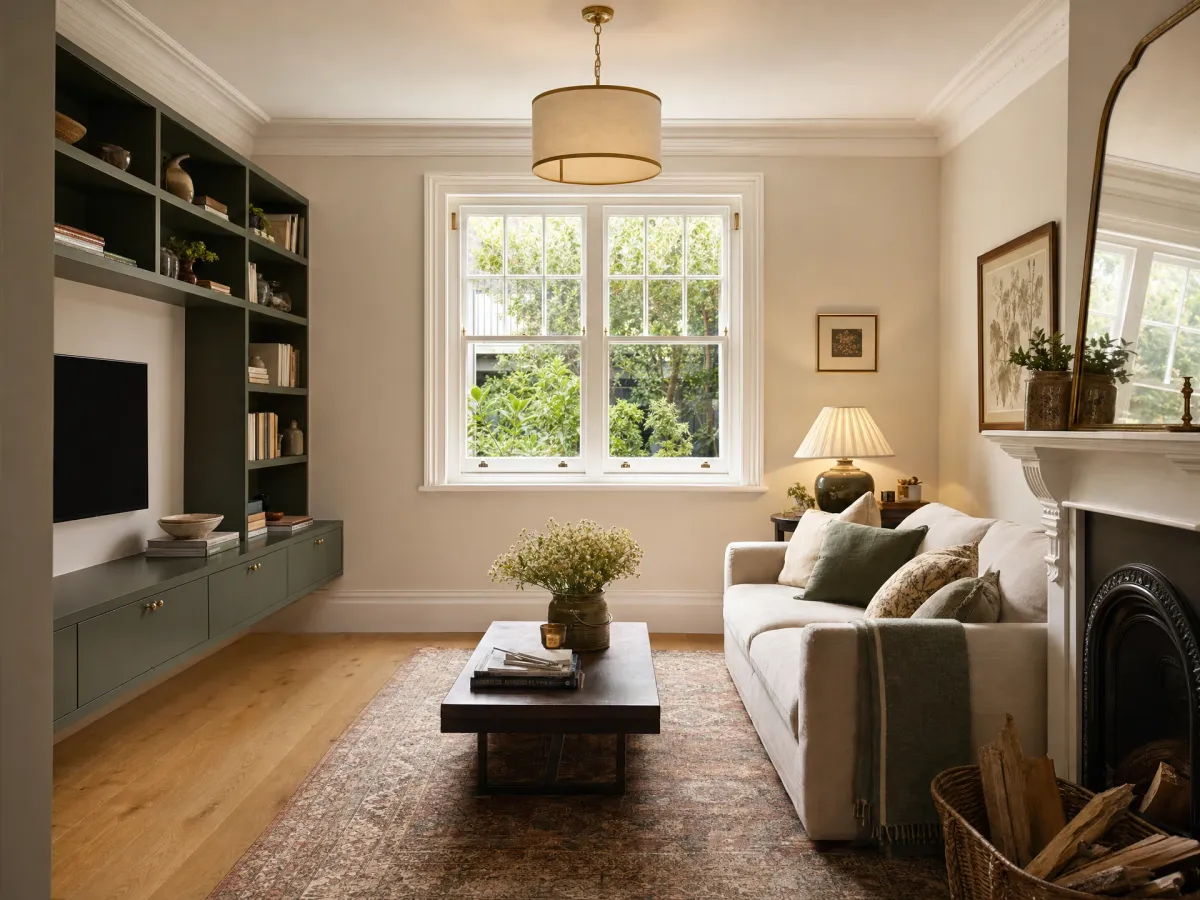
Anyone searching cottage interior style in Australia in 2026 is usually standing in one of two places. The first is inside an actual Australian cottage: a Victorian worker’s cottage in Fitzroy, Redfern or Paddington; a Federation cottage on a quiet street in Norwood, Subiaco or Coburg; a timber Queenslander cottage raised on stumps in Brisbane, Cairns or Toowoomba; a stone cottage in the Adelaide Hills, Bothwell or Berrima. The second is inside an ordinary suburban house, wanting the feel. In both cases the mental image is almost always the chocolate-box Cotswolds cottage from Pinterest, and the dominant online sources (Homes & Gardens, Livingetc, Wayfair, HGTV, English magazine content) authored for a different country and a different climate. That gap between the cottage the reader owns and the cottage the internet keeps describing is what most cottage content never bridges.
This guide is the deep answer for an Australian audience. It covers what cottage interior style genuinely is, the three lineages it carries (the English and European village cottage, the American and internet cottagecore version, and Australia’s own worker’s cottage and rural cottage tradition), the differences that separate cottage from farmhouse, country and cottagecore (which get used interchangeably online and are not the same style), what the 2026 version looks like against the whitewashed shabby-chic version most Pinterest boards still feature, the palette and material vocabulary in detail, how the style reads through a cottage kitchen, bathroom, living room and bedroom, what the Australian cottage garden looks like, what it costs to do well, and the mistakes that age it fastest.
It sits inside the broader interior design styles guide for Australia, where cottage is one of the major contemporary directions alongside Hamptons, French Provincial, farmhouse, coastal and Scandi. This page is the deep dive on cottage specifically.
What cottage interior style actually is
Cottage interior style is the contemporary expression of small, personal, decorated country and village houses. Its underlying brief is straightforward: build rooms that feel like they belong to a person who has lived somewhere for a long time, layered pattern and colour, kept the things that came with the house, and let comfort do more work than polish. According to Homes & Gardens’s primer on cottage style, the style embodies a fuss-free natural lifestyle and celebrates rustic use of materials, simplicity in design and the playfulness of colours and patterns; it is at its best when the room reads warm, lived-in and slightly quirky rather than styled to a plan.
The visible vocabulary in a cottage room is consistent across most credible interpretations of the style. Painted joinery in warm white, soft cream, muted sage, dusky blue or forest green carries the built-in cabinetry, the panelled doors and the trim. Timber runs through the floor (wide plank, oak or pine, sometimes lightly limed, more often left in its own honey or mid-tone), through low ceiling beams where the architecture allows them, and through smaller furniture pieces (a scrubbed pine dining table, a Welsh dresser, a linen chest, cane-seated chairs). Stone carries hearths, thresholds and the occasional floor (flagstone in an English-influenced cottage, honed sandstone or terracotta tile in an Australian rural one). Hardware runs aged brass, oil-rubbed bronze, hand-forged iron or brushed warm nickel; the matte-black-everything language of farmhouse reads a step too utilitarian for a cottage room. Textiles run linen, cotton, wool, jute and a confident use of pattern: floral and botanical wallpaper on a feature wall, small-scale florals or gingham on soft furnishings, ticking stripes on pillowcases, and rugs in either a faded traditional pattern (Persian, Aubusson, dhurrie) or a natural flatweave.
Three concepts sit underneath the style and explain why a well-resolved cottage room feels the way it does. Comfort is the primary brief: sofas are deep, chairs are slipcovered and comfortable, beds are layered with a linen sheet, a cotton quilt and a wool throw, and the room reads as somewhere a reader would want to sit for several hours with a book. Provenance is the assumption that objects have stories: the framed botanical print that was the grandmother’s, the ironstone jug picked up at a country auction, the linen sheets that were inherited, the chair that has been re-upholstered three times. A genuine cottage room is collected, not bought; or at least it reads as collected, which is a deliberate design move. Pattern is the third: cottage rooms carry considerably more pattern than farmhouse or coastal rooms do, and the pattern is where the style’s personality lives. According to The Rugs’s cottage-style guide, traditional patterns like gingham, plaid, ornate toile, paisley and delicate florals are core to the vocabulary, and dried or fresh flowers in vases add a note of the countryside inside the room.
Where cottage departs from related styles is in its relationship to scale and formality. A cottage room is small and personal; a Hamptons room is generous and formal. A cottage room is decorated and pattern-rich; a farmhouse room is restrained and utility-led. A cottage room is warm, mid-toned and interior; a coastal room is bright, breezy and outward-facing. A cottage room is layered and softened; a Scandi room is austere and pared-back. According to Livingetc’s cottagecore trend piece, the style shares an aesthetic vocabulary with English country style but is smaller in scale and more personal in intent, with a stronger sense that the room belongs to one particular person rather than to a house-and-garden magazine spread.
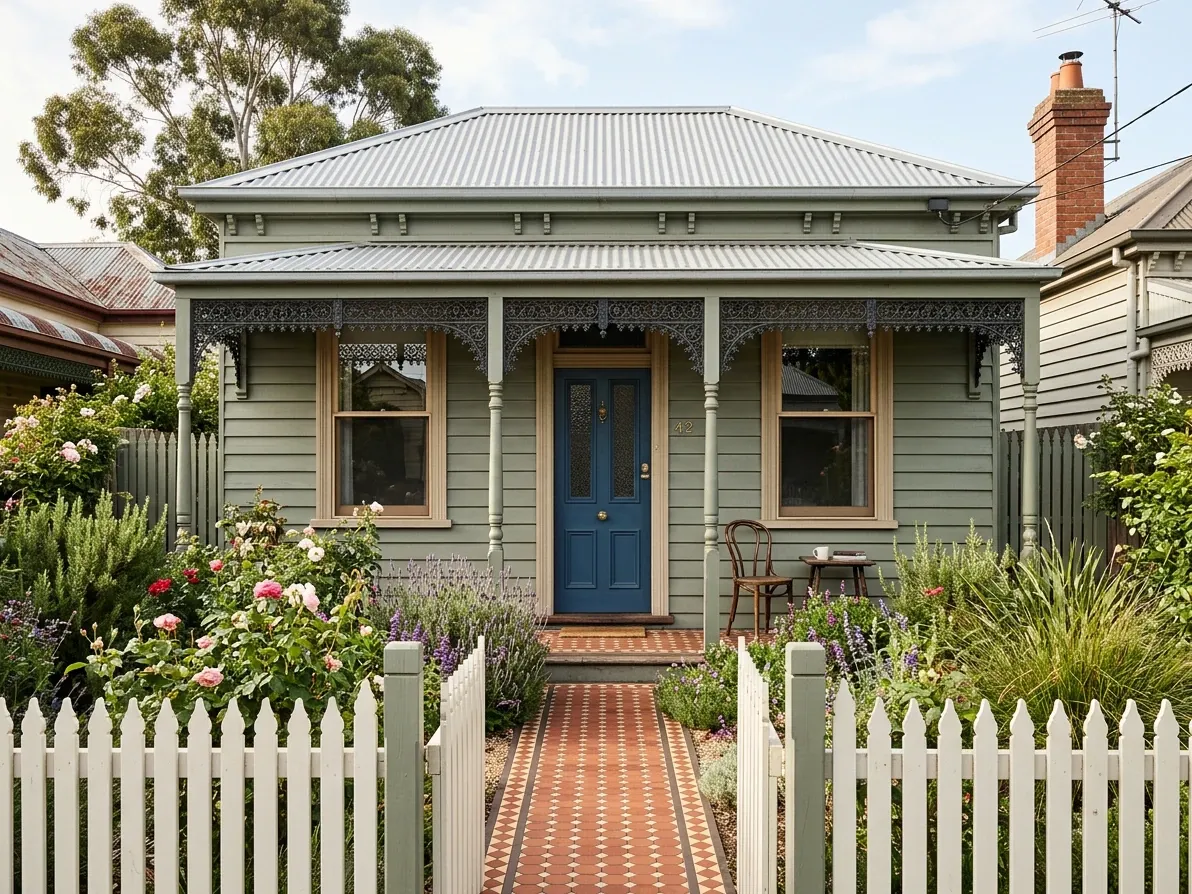
The Australian workers’ cottage carries the style honestly.
The three cottage lineages that meet in an Australian room
A cottage interior in Fitzroy, Norwood or Toowong in 2026 is carrying three histories at once, and it helps to understand all three before specifying one. The styles around it (Hamptons, French Provincial, coastal, Scandi) each refer to a single coherent tradition. Cottage is a hybrid by nature.
The English and European village cottage. The original cottage rooms were the everyday spaces of small labourer and tradesperson houses across the British Isles and Western Europe from the sixteenth to the nineteenth centuries, built from local materials around a working hearth. According to Love That Design’s history of English cottage interiors, the surviving vocabulary is easy to recognise: low ceilings crossed by exposed timber beams, thick lime-washed walls, stone or brick fireplaces at the centre of the plan, hardwood or flagstone floors, small-paned casement windows, painted joinery in soft chalky whites, and layered fabrics through wool, linen and cotton in a warm palette of cream, dusky blue, sage green and warm rose. The furniture is a mix of inherited and made-do pieces (a scrubbed pine table, painted Windsor chairs, a chintz-covered armchair, a linen press, a cast-iron bed), and the decoration leans on floral wallpaper, framed botanical prints, blue and white china stacked on open shelves and dried flowers in stoneware jugs. This is the lineage that most Australian searchers picture first when they think cottage, and it is the one most of the dominant online sources describe. It reads as warm, weight-of-history and unmistakably English; in a contemporary home it works best in the Melbourne worker’s cottage, the Adelaide stone cottage and the Southern Highlands weatherboard, less well in a Brisbane Queenslander or a Central Coast beach cottage.
The American and internet cottagecore version. The dominant 2026 reading of cottage on TikTok, Pinterest and Instagram is the version that emerged from the cottagecore aesthetic movement of 2018 to 2020 and hardened during the pandemic lockdowns. According to Homedit’s 2026 cottagecore trends piece, the aesthetic is described by its own designers as a rebellion against the sleek and sterile, moodier than the earlier lockdown-era version, heavier on history and committed to the idea that a home should feel like it has a heartbeat. The vocabulary is broadly consistent with the English lineage (floral wallpaper, cast-iron beds, quilted bedding, ceramics on open shelves, dried flowers) but reads slightly differently: more aspirational and photo-composed, more deliberately imperfect (the slight warp in the thrifted chair back, the faint stain on the inherited quilt, the visibly softened linen), and more likely to lean into darker moody variants like dark cottagecore, which according to Curated by Noor’s dark cottagecore explainer leans into deep greens, mushroom browns, gothic silhouettes and dim lamplight rather than the pastel whitewashed version most people still associate with the term. According to Home & Art Magazine’s 2026 profile, modern cottage core has emerged as the defining home style of 2026 and is replacing the whitewashed shiplap-led modern farmhouse as the dominant online residential aesthetic.
The Australian cottage. Australia has its own cottage vernacular and most overseas sources skip it entirely. According to Fat Shack Vintage’s definitive guide to Australian home styles, Australian residential architecture from the mid-nineteenth century onward carried a strong lineage of small detached and semi-detached cottages, built from timber, brick or stone according to region and rarely more than two rooms deep in their original form. The Victorian worker’s cottage of inner Melbourne, Sydney and Brisbane (built between roughly 1840 and 1900 to house workers employed in nearby mills, factories, docks and shearing operations) is the most recognisable of them: a narrow terrace or semi-detached facade with a small front verandah, tessellated tile path, cast-iron lacework, a pair of double-hung timber windows either side of the front door, a corrugated iron or slate roof, and inside a small hallway that runs the length of the house past two front rooms toward a kitchen and yard at the back. The Federation cottage (roughly 1890 to 1915) is a step larger, with a more complex hipped roof, a return verandah, coloured leadlight windows and rooms built off a central hallway. The timber Queenslander cottage (from around 1840 in Brisbane and the Darling Downs, according to Shelton Homes’ short history of Queenslander homes) sits raised on stumps for ventilation, with a corrugated iron roof, wide verandahs, tongue-and-groove timber cladding and casement windows. The stone cottage carries through Adelaide, the Barossa, Tasmania, the New England Highlands and the Southern Highlands, built from local sandstone, bluestone or limestone with slate or corrugated iron roofing. The rural weatherboard cottage carries through every state, sometimes on stumps in Queensland and Northern New South Wales, sometimes on brick piers or a stone base further south.
- Separate house70%
- Terrace or townhouse13%
- Apartment or other17%
A cottage interior in Australia in 2026 is at its strongest when all three lineages are visible in the room. The English layer carries the wallpapered feature walls, the painted joinery, the small-paned windows and the collected-china-on-open-shelves feel. The cottagecore layer carries the moodier deeper 2026 colour direction, the layered bedding and the aspirational imperfection. The Australian layer carries the building bones: the small-scale room proportions, the corrugated iron roof visible from the verandah, the timber tongue-and-groove wall panelling, the honey-oak or Australian hardwood floor, the terracotta or slate hearth, the cast-iron lacework at the verandah. A cottage room that draws on all three reads as a confident Australian room. A cottage room that copies only the Cotswolds layer reads as an imported one, and the mismatch is where most Australian cottage interiors go wrong.
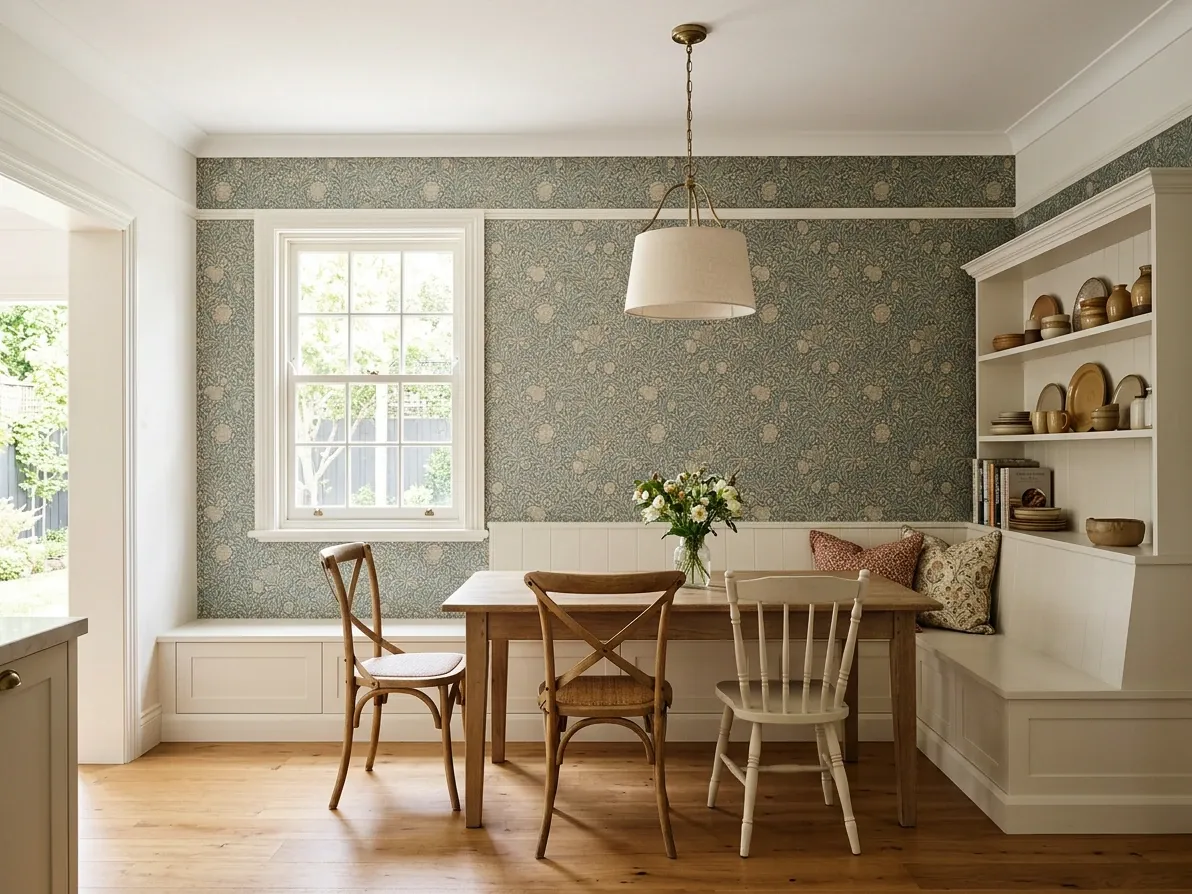
Cottage rooms carry more pattern than farmhouse rooms do.
Cottage vs farmhouse vs country vs cottagecore
Cottage is the most commonly confused of the small-house rural styles, because cottage, farmhouse, country and cottagecore get used interchangeably online and describe four different things. The working differences are worth knowing, because most search results conflate them.
Cottage vs farmhouse. Farmhouse is the working rural interior; cottage is the personal decorated village interior. Both share painted joinery, natural timber and a warm neutral base, which is why they blur together, but the everyday tests separate them cleanly. Look at the wall first: a farmhouse wall is almost always painted, usually white or a muted neutral, sometimes with a single V-groove or shiplap accent; a cottage wall carries wallpaper on at least one feature wall (a botanical, a small-scale floral, a chinoiserie, a toile), or a paler patterned soft furnishing throughout the room. Look at the object layer: farmhouse leans on working pieces (a butler sink, a scrubbed pine table, a hanging pot rack, matte black or oil-rubbed bronze hardware, cast-iron pans on open hooks); cottage leans on decorative pieces (a Welsh dresser stacked with china, framed botanical prints, a floral bedspread, aged brass or hand-forged iron hardware, a linen slipcovered armchair). Look at the palette: farmhouse runs restrained and warm-neutral (warm white, honey oak, deep green as an accent); cottage runs wider and more colourful (dusky blues, terracotta, warm rose, deep forest green, floral pastels, all in play together). According to Victoria Harrison’s Substack piece comparing the two, cottage style is smaller, cosier and more personal than farmhouse style, and draws less on utility and more on character. The neatest cabinet-door test: painted flat shaker or V-groove in a warm neutral reads farmhouse; painted beadboard or a raised-panel painted door in a colour that is not white or cream reads cottage.
Cottage vs country. Country is the older and broader parent style; cottage is the small-house subset. English and American country style both cover a wider range of house types (grand country estates, farmhouses, hunting lodges, rectories, country pubs) and lean into richer traditional decoration (deeper wood tones, heavier drapery, statement lighting, formal seating groups, hunting or equestrian references). Cottage is the working-class or small-village version of the same family, at a smaller scale and with less formal decoration. According to Country Village Shoppe’s country-vs-farmhouse comparison, country style leans into traditional charm with rich colours, bold patterns and a collected-over-time feel, embracing inviting colours like deep reds, warm blues and buttery yellows with florals, plaids and patchwork designs. Cottage sits inside that family but restrained by scale: fewer statement pieces, more small-scale layered detail. A useful working test: would the room read as right in a stately country house? Country yes, cottage usually no unless the cottage is dressed as the caretaker’s rooms rather than the drawing room.
Cottage vs cottagecore. Cottage is the interior style; cottagecore is the internet aesthetic movement. Cottage is a long-standing residential category that predates the internet by three hundred years and covers a specific set of building types and interior treatments. Cottagecore is a much newer term (coined on Tumblr around 2018, spread on TikTok during the 2020 to 2021 lockdowns, and covered by the Cottagecore aesthetic wiki as an aesthetic movement rather than an interior style specifically) that romanticises the imagined lifestyle around a cottage: baking bread, keeping chickens, growing vegetables, wearing prairie dresses, spending time in meadows. The visual vocabulary overlaps heavily (floral wallpaper, layered bedding, cast-iron beds, ceramics, dried flowers) because cottagecore borrows from the older cottage tradition, but cottagecore is broader and more aspirational: a bedroom shot on Instagram in a modern suburban house with cottagecore styling reads as cottagecore, but the room itself is not necessarily a cottage. The 2026 evolution of cottagecore into a moodier, warmer, less pastel and more genuinely-collected version brings it closer to the older cottage tradition, and the two are increasingly hard to separate.
Cottage vs French Provincial. French Provincial is the European-rural cousin of English cottage, with a distinctive furniture and material vocabulary of curved lines, decorative mouldings, distressed painted finishes, Aubusson rugs, brass and gilt details, and a softer pastel palette of duck-egg blue, mint, sage and custard. Cottage runs simpler in furniture (straight-lined Windsor and shaker pieces, painted flat panels, minimal ornament), more textural in wall treatment (wallpaper, tongue-and-groove panelling, beadboard) and slightly less pastel in palette. According to Brocante Ma Jolie’s primer on the differences between French farmhouse, French Provincial and French chateau, French Provincial reads like an elegant village house in Provence; cottage reads like a smaller village house elsewhere, usually English. Both share the wallpaper habit and the layered comfort priority, but the surface language reads distinctly different once the eye is trained.
Cottage vs Hamptons. Hamptons is the polished formal coastal-estate style; cottage is the personal decorated village-house style. Both use painted joinery and a warm palette, but the two diverge quickly. Hamptons leans into architectural decoration (deep cornices, wainscoting, shaker doors with raised inner panels, picture-frame glazing, statement pendants, polished mid-tone oak floors); cottage leans into softer wall treatments (wallpaper, beadboard, tongue-and-groove panelling), smaller-scale room proportions and a more collected object layer. According to ModularWalls’ coastal-vs-Hamptons comparison, Hamptons style is simplicity with grandeur, clean lines coupled with elegant design features within the moulding, cornices and cabinet hardware; cottage is the opposite brief on scale but shares nothing on grandeur.
Cottage vs coastal. Coastal is the sandy-blue outdoor-facing beach-house style; cottage is the interior-facing warm-toned village style. Coastal runs light, breezy and pale (rattan, jute, whitewashed timber, sandy neutrals, marine blues); cottage runs warmer, mid-toned and more decorated (painted joinery, floral wallpaper, aged brass, terracotta and forest green accents). Both share the small-house comfort priority but the material vocabulary and colour palette read distinctly different once the eye is trained.
How the 2026 version differs from the 2010s version
The whitewashed shabby-chic cottage that the late 2000s and 2010s built (chalk-painted furniture with the paint distressed off, wide-plank timber with a lime wash, pale pastels through every soft furnishing, rows of white porcelain jugs and mercury-glass candlesticks, mason jars used as vases, dried-hydrangea wreaths on every door, live-laugh-love or count-your-blessings signs above the mantel) is the version most Australian Pinterest boards still feature and that most craft-fair and homewares-shop content still references. It is also the version that is fading fastest from the leading 2026 trend reports. The genuine cottage vocabulary that sits underneath it (proportion, small-paned windows, wide-plank timber, painted joinery, layered pattern, botanical and floral wallpaper, aged metal, collected pieces) is not going anywhere. The whitewashed shabby-chic layer is.
According to Homes & Gardens’s 2026 colour cliches piece, designers are calling out the overly matched and coordinated cottage look as a cliche worth breaking, and the current direction leans toward pieces with different lines and colouration to keep a space interesting and personal. According to Cottages & Bungalows Magazine’s design-mistakes guide, the pattern-heavy overly-styled version of the early 2010s reads dated now, and the leading contemporary cottage interiors are the ones that resist forced coordination and let pieces earn their place individually.
The shift is documented across the leading 2026 forecasts. According to Home & Art Magazine’s 2026 forecast, modern cottage core has emerged as the defining home style of 2026, and it is decisively warmer, moodier and more personal than the whitewashed 2010s version. According to Homedit’s 2026 cottagecore trends, the style celebrates imperfection as sacred: the slight warp in a thrifted chair back, the faint stain on a quilt passed down through bloodlines, the gentle curve of a skirted ottoman that invites you to sink rather than perch. According to Cedora’s 2026 Australian interior colour trends, the direction across Australian interiors more broadly is a shift toward warm, earthy colours (brown, beige, terracotta, soft greens) that replace the cool greys that dominated the previous decade, and the neutrals themselves are warmer and layered (taupe, mushroom, creamy beige, Pantone’s soft white Cloud Dancer).
In practical terms, four shifts define the 2026 Australian cottage interior against the 2010s version.
The palette is warmer and deeper. The whitewashed pastel version has given way to warm whites, chalky creams, mid-tone honey oak, and a confident use of deeper colours: forest green and sage in cabinetry, dusky blue in bedrooms, terracotta in bathrooms and mudrooms, and a return of warm brown, mocha and biscuit red through soft furnishings and painted joinery accents. The walls are still mostly painted a warm white or wallpapered in a small-scale floral, but the joinery, the trim and one or two feature walls carry the deeper colours.
The whitewashing and distressing is dialled back. Furniture is left in its own timber tone (honey oak, mid-tone walnut, warm pine) rather than chalk-painted and sanded to a distressed finish, and the pieces that are painted are painted properly, in a considered saturated colour rather than a pastel wash. The visibly aged pieces are the genuinely inherited ones, not the freshly distressed ones. According to Curated by Noor’s dark cottagecore piece, the moodier direction leans on genuine wear rather than manufactured wear, which reads considerably more current.
The styling is less themed. The mason jars, the dried-flower wreaths, the porcelain-jug displays in rows of three, the live-laugh-love and count-your-blessings signs, the whitewashed-and-stencilled decorative boxes and the identical framed farmhouse prints are being replaced by a smaller and more honest object layer: a genuinely inherited framed botanical, a small stack of vintage books, a working ceramic pitcher on the kitchen bench, a growing potted geranium on a windowsill, a small handful of hand-collected pieces rather than a themed set. The room looks personal rather than styled.
The architecture earns the style. A 2026 Australian cottage interior leans into the building’s actual bones (the small-paned double-hung timber windows, the tongue-and-groove wall panelling, the cast-iron fireplace surround, the corrugated iron roof visible from the verandah, the honey-oak or Australian hardwood floor) rather than adding a whitewashed layer over a modern brick-veneer suburban room. The strongest Australian cottage interiors in 2026 are the ones that started with the building’s own vocabulary and layered the style on top of it, rather than the ones that started with a Pinterest board and imposed it on the wrong house.
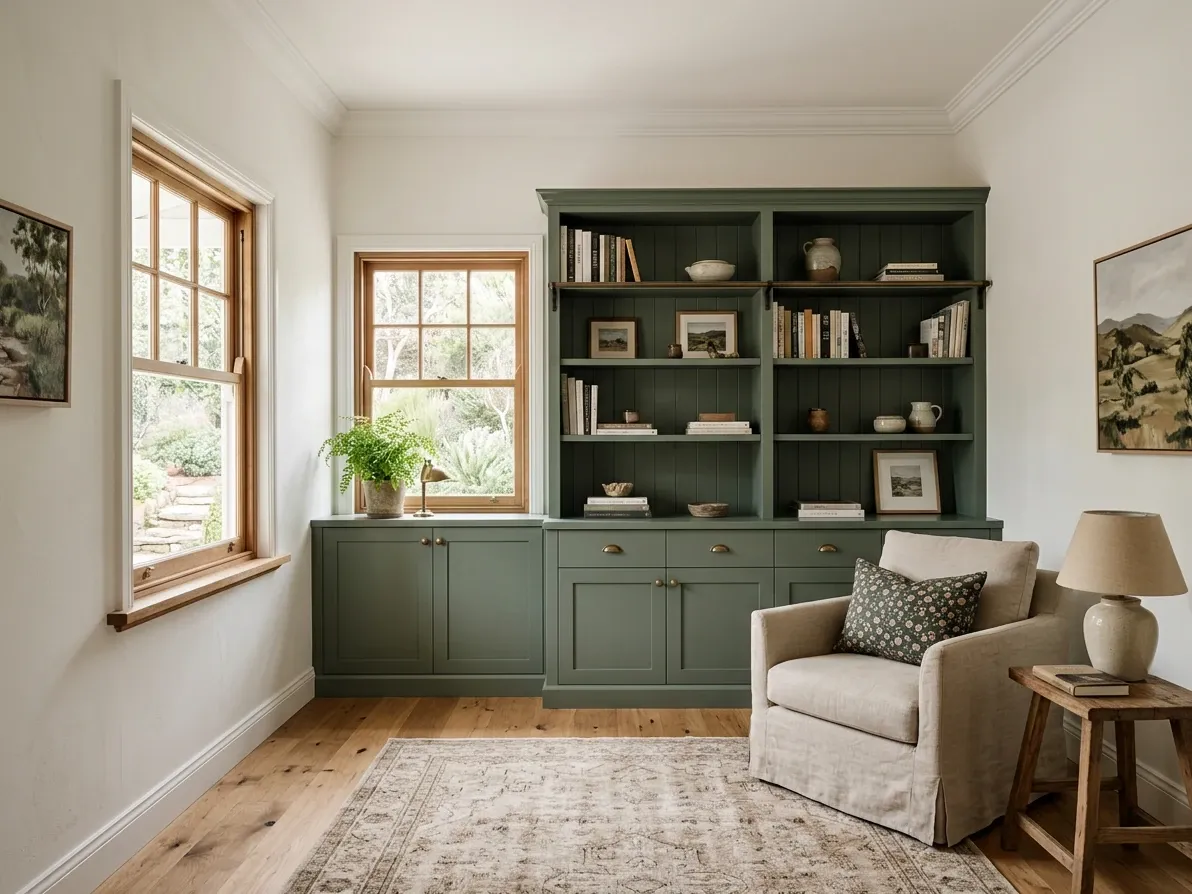
Warm white, honey oak and deeper accents anchor the 2026 palette.
The 2026 Australian cottage palette
The 2026 Australian cottage palette is built in four layers: a warm-white base, a timber and warm-neutral middle band, a considered pattern and wallpaper layer, and a saturated colour accent set. The base layer carries walls, ceilings and trim. Warm whites, chalky off-whites, soft creams, milk-paint whites and Pantone’s 2026 Cloud Dancer all read cleanly in the style; cool blue-white reads closer to Hamptons or Scandi. According to Homes & Gardens’s Farrow & Ball 2026 spring palette piece, the current direction is warmer chalky whites paired with rich chocolate browns and faded terracotta accents, which sits cleanly inside the 2026 cottage direction.
The middle band carries the timber and the warm neutrals. The dominant timber is oak, leaning honey, mid-tone or wide-plank rather than pale Nordic or polished walnut. European oak, American white oak, Australian Tasmanian oak and blackbutt all work; the distinction matters more in solid furniture pieces than in the floor. Pine, elm and beech read in the supporting layer for furniture and smaller joinery; reclaimed timber (old fence posts as a beam, milled floorboards as a wall panel, a repurposed hardwood benchtop) signals the cottage lineage cleanly and reads more current than distressed painted pieces. Terracotta tile carries kitchens, mudrooms and bathrooms in the more rural or Mediterranean-influenced cottages; honed sandstone or bluestone carries hearths, thresholds and the occasional floor in stone cottages further south. Warm-neutral upholstery (oat, warm greige, soft taupe, ivory, cream, faded natural linen) carries through slipcovered sofas and armchairs, dining-chair upholstery, curtains and bedding.
The pattern and wallpaper layer is where cottage genuinely diverges from farmhouse. According to William Morris & Co’s piece on Wallflower Cottage, the Morris & Co. archive of botanical, floral and Arts & Crafts wallpaper patterns (Willow Bough, Strawberry Thief, Golden Lily, Marigold, Blackthorn) remains the single most recognisable wallpaper vocabulary for a cottage interior; the patterns are available in Australia through Wallpaper Direct’s Morris collection and several other Australian retailers. Alongside Morris, small-scale florals from Sanderson, chinoiserie from de Gournay’s more restrained collections, and small ditsy prints from local retailers all sit in the style. The rule for use is restraint: one or two feature walls carry the wallpaper (the bedroom feature wall, the powder-room walls, a mudroom, the back of a Welsh dresser); the rest of the room stays plain. A cottage room with every wall wallpapered reads as a museum re-creation; a cottage room with one considered wallpapered wall reads as current and confident.
The accent layer is where the 2026 version diverges most from the 2010s version. The earlier cottage leaned on pastel whitewashed everything; the current version leans into saturated colour. Deep forest green, sage green, hunter green, olive carry painted joinery (a built-in dresser, a pantry cupboard, a vanity, an entry door) and a single feature wall most often. Dusky blue, denim blue, deep navy carry bedroom joinery and secondary accents. Warm browns (chocolate, mocha, walnut, espresso) carry through leather seating, timber furniture and accent joinery. Terracotta, faded rust, warm rose, blush and biscuit red carry the warmer accent set through cushions, ceramics, art and rugs. Mustard, ochre and warm wheat carry the sunniest end of the palette through smaller accents. According to James Hardie Australia’s 2026 modern-home colour direction, the broader Australian residential direction is toward biscuit reds, deep greens and weathered taupe anchored in honey oak, soft stone and brushed metal, which reads cleanly through both cottage and farmhouse interiors.
Hardware and metalwork run aged brass, oil-rubbed bronze, hand-forged iron, brushed warm nickel and, at the more traditional end, a warm-polished brass rather than a matte black. This is one of the working differences between cottage and farmhouse: farmhouse leans matte black or oil-rubbed bronze; cottage leans aged brass, hand-forged iron and warm nickel. Polished chrome and polished silver-toned finishes read against the style. Tapware in aged brass or unlacquered brass with cross handles, cabinet hardware in warm nickel or hand-forged iron, light fittings in seeded glass with a brass or bronze surround, and door hardware in hand-forged iron all sit in the style.
Stones lean warm and matte. Honed marble in restraint, honed travertine, honed limestone, soapstone and terracotta tile all read in the style. Polished natural stone works occasionally on a mantel or a hearth surround but reads against the style through a whole kitchen benchtop. According to Home Beautiful’s country cottage bathroom feature, the country cottage direction leans into Carrara marble tops paired with VJ panelling and brushed-platinum tapware, which reads as a more refined version of the same palette.
Textiles run on linen, cotton, wool, jute, chintz and small floral prints. Slipcovered linen sofas, linen or cotton cushions in warm neutrals with small-scale floral accents, ticking-stripe pillowcases, wool throws in warm neutrals, dhurrie or faded traditional rugs (Persian, Aubusson, kilim), and a single armchair upholstered in a small-scale floral or a chintz all sit cleanly in the style. Velvet is permitted in restraint (a single armchair in deep forest green or dusky rose velvet reads as current); heavy brocade, glossy silk and shiny synthetics all read against the style.
The 2026 version is more confidently coloured, more confidently patterned and more confidently textured than the 2010s version was, and the result reads warmer, more personal and considerably less themed. A useful working test: if the room reads better in a photograph at dusk under warm lamplight than at midday under direct sun, the palette is sitting in the right place.
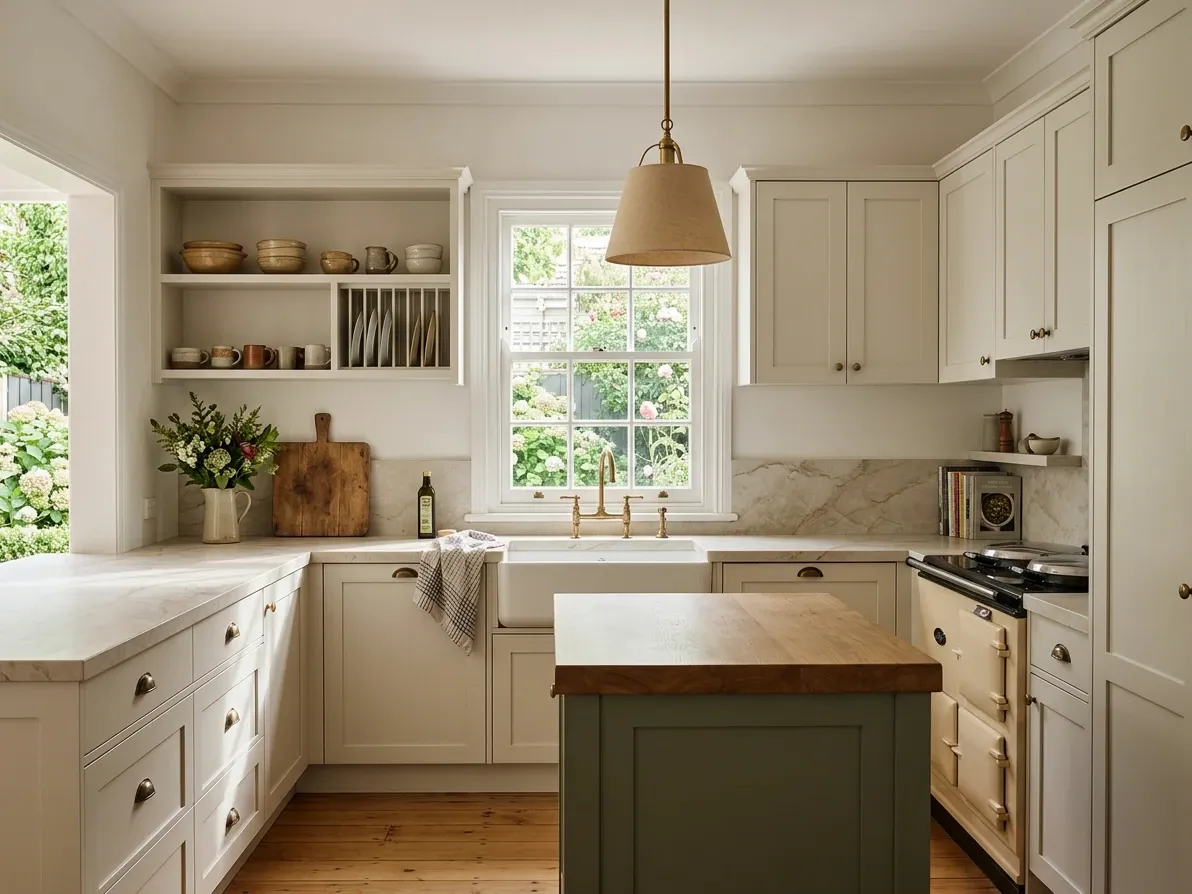
A shaker kitchen with a fireclay butler sink reads unmistakably cottage.
Inside an Australian cottage kitchen
The kitchen is where Australian cottage style lands hardest, because most Australian cottage renovations end up centred on the kitchen (the original workers’ cottage kitchens were tiny galleys at the back of the house and are almost always the first rooms owners renovate) and because the working brief (shaker or beadboard cabinetry, a butler sink, generous but not oversized bench, durable warm-toned benchtop, aged brass or hand-forged iron tapware, a freestanding cooker if space allows, open shelving with visible china, a Welsh dresser or a small sideboard) lines up cleanly with what most contemporary Australian cottage-owners actually want from the room. According to Home Beautiful’s country cottage kitchen feature, the defining elements are shaker or beadboard cabinetry, warm timbers, farmhouse sinks, open shelving and a strong connection to the garden or outdoor space.
Cabinetry runs in painted shaker, painted flat-shaker, painted beadboard or painted V-groove panel in warm white, soft cream, sage green, forest green, dusky blue or terracotta most often. The most successful 2026 Australian configurations use a two-tone scheme: warm white on the perimeter cabinetry with a deeper accent on the island or on the base cabinets, or warm white on the upper cabinets with a coloured cabinetry below. A single painted feature joinery piece (a built-in dresser at the dining end, a green-painted pantry cupboard, a dusky-blue base cabinetry under a warm-white bench) carries the colour without committing the whole room. According to Joyce Kitchens’ country kitchen guide, Australian country and cottage kitchens typically feature shaker doors, V-groove panelling, warm timbers, open shelving, simple cup handles and a farmhouse sink paired with efficient appliances.
The benchtop runs in a warm tone. Engineered stone in warm white, soft cream, sandy beige or a pale honed-marble look is the practical default; honed marble (Carrara or a warm-toned local marble), soapstone, honed limestone or solid timber (American walnut, Australian blackbutt or reclaimed hardwood) is the premium option. The benchtop sits darker than the cabinetry rather than disappearing into it, so the island reads as a piece of furniture. A traditional profile edge with a small timber cutting-board section at one end reads more cottage; a thick square-edged waterfall reads more contemporary and more towards farmhouse.
The splashback runs simple. Subway tile in a warm white or soft cream, small-format hex or fish-scale tile in a matt-glaze warm white or sage, full-height beadboard or tongue-and-groove panel painted in the wall or cabinetry colour, full-slab natural stone (honed Carrara, travertine or soapstone) or matte ceramic tile in a herringbone or basket-weave pattern all read cleanly. According to ABI Interiors’ cottagecore guide, colourful cabinetry paired with brass or copper hardware and a classic farmhouse sink brings a homely vintage-inspired feel into even the most modern cottage kitchen.
The sink is the single most recognisable kitchen-element in the style. The deep apron-front fireclay butler sink (also called a Belfast sink in its British form) sits flush with the benchtop edge and reads as the kitchen’s working centrepiece. According to Turner Hastings’ farmhouse butler sink guide, the durable fine fireclay versions handle Australian family kitchen use comfortably; the white finish is the dominant choice but sage, warm cream and matte black are all in current specification. Tapware runs aged brass, unlacquered brass or hand-forged iron with cross handles most often; bridge tapware in the same finishes over the sink reads as the more traditional option, and a single-handle gooseneck in aged brass reads as the contemporary one.
The appliances split into two camps. The traditional choice is a freestanding range cooker in a warm white, sage, dusky blue or deep green enamel with brass detailing (Falcon, Smeg Victoria, Belling, Stoves); the contemporary choice is an integrated cooktop and oven set into the bench with a feature rangehood in copper, brushed brass or matte black. Either reads in the style; the freestanding range is the more visibly cottage choice.
A cottage kitchen sits at the mid-range to upper end of the Australian kitchen renovation market. According to the Housing Industry Association, the national median for a kitchen renovation in Australia sits at around $30,000 to $35,000, with mid-range builds running roughly $25,000 to $45,000 and premium custom builds running $45,000 to $100,000-plus. According to Kitchen Shack’s 2026 cost guide, the national average kitchen renovation runs around $42,630 in 2026 with installation included. Cottage kitchens sit in the upper half of the mid-range band most often, because the shaker or V-groove cabinetry, the fireclay butler sink, the aged-brass tapware and the timber-or-stone benchtop all run a step more expensive than a flat-panel polyurethane kitchen at the same overall scope. According to Sparky.fyi’s 2026 cabinetry breakdown, shaker profile doors and drawer fronts range from approximately $400 to $900 per square metre and typically add 10 to 25 per cent over plain doors, and a farmhouse sink and tapware package runs $1,200 to $3,500. The article on kitchen renovations on a budget covers the budget-end execution in more detail, and the kitchen styles guide sits above cottage kitchens as the parent piece.
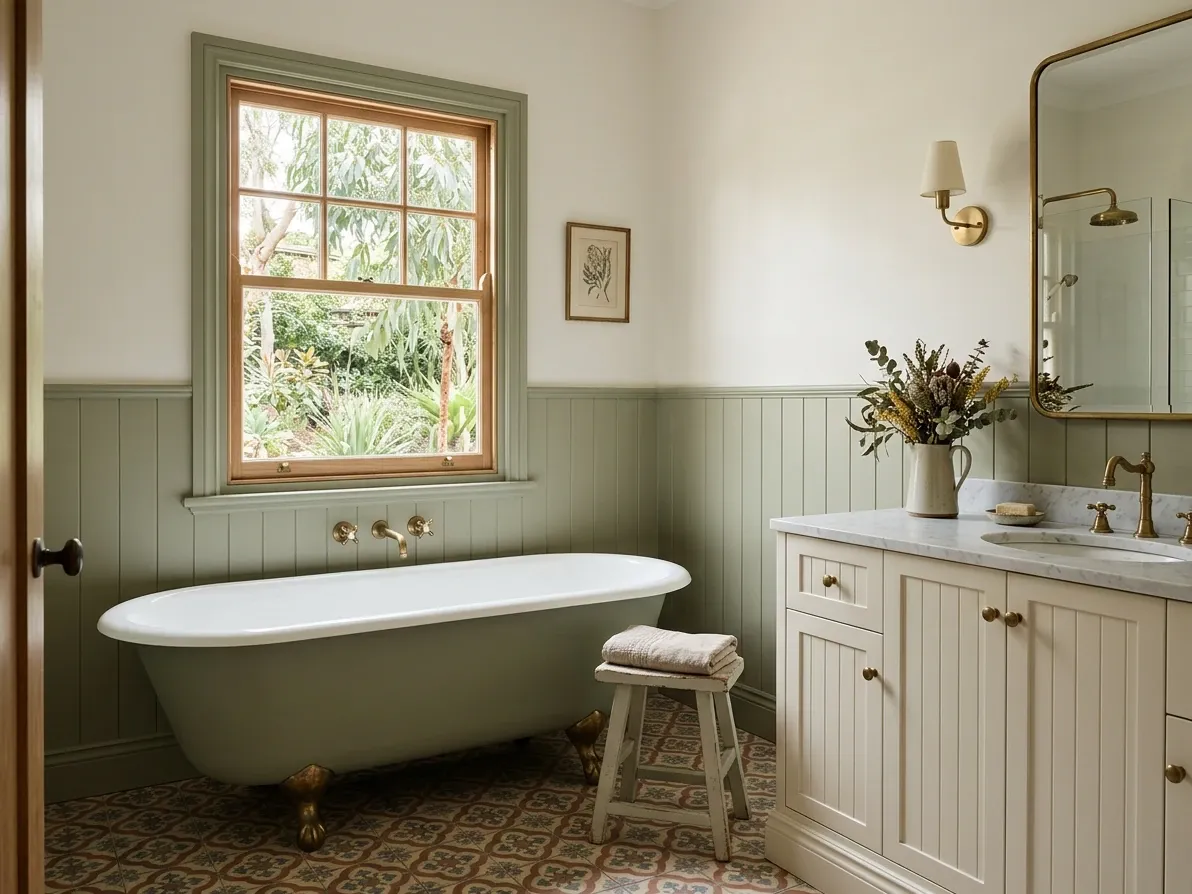
A clawfoot tub and VJ panelling anchor the cottage bathroom.
Inside an Australian cottage bathroom
The Australian cottage bathroom is one of the strongest rooms in the style, because the working brief (a compact footprint, tongue-and-groove or beadboard panelling, a freestanding tub, a pedestal or Shaker-style vanity, small-paned window, brass or hand-forged iron tapware, a warm-toned tile, a soft rug or a natural woven mat) suits the small original wet-area footprints in most Australian cottages better than any other style would. According to Home Beautiful’s country cottage bathroom feature, the country cottage bathroom is achieved with VJ panelling, vanities with Carrara marble tops and traditional tapware in finishes like brushed platinum and aged brass.
Wall treatment runs through full-height tongue-and-groove (VJ) panelling in a warm white or a muted sage or dusky blue, half-height beadboard wainscoting with the wall above painted or wallpapered, or a small-scale patterned wallpaper (a botanical, a chinoiserie, a small ditsy floral) above a half-height panel. The floor runs small-format encaustic tile in a muted pattern, hexagonal or fish-scale tile in a warm white, terracotta tile, honed limestone or a warm-toned porcelain in a large format. Underfoot heating is a genuinely worthwhile spend in cold-climate cottages (Southern Highlands, Tasmania, Adelaide Hills), where the original single-glazed windows and thin walls run cold in winter.
The tub is the centrepiece. A freestanding rolltop cast-iron bath with claw feet reads as the most visibly cottage choice; a freestanding acrylic slipper or oval bath on a plinth reads as the more contemporary version of the same idea. Both sit under or near a small-paned window with a garden view where possible. The tapware runs floor-mounted or wall-mounted in aged brass, unlacquered brass or brushed platinum with cross handles.
The vanity runs as a painted shaker or beadboard cabinet with a stone top (honed Carrara, warm-toned marble or engineered stone in a marble look) and a countertop basin, or a pedestal basin with a wall-mounted mirror above. According to the bathroom vanity guide, the traditional cottage vanity direction leans toward painted timber with visible legs, a stone top and a pedestal or countertop basin, which reads more decorative than the flat-panel or floating-vanity direction that dominates contemporary bathrooms.
The shower runs simple. A traditional shower rose with cross-handle tapware in aged brass, mounted at high level on a tiled wall, reads as the most cottage-appropriate version. A rainhead in the same finish reads as a permitted contemporary compromise. Frameless glazing sits neutrally in the style; framed glazing in a warm-brass or matte-black frame reads as more considered.
The soft layer carries the room. A small floral or striped Roman blind at the window, an aged-brass or antique-style mirror above the vanity, a warm-white slipper chair or a small painted stool in the corner, and a soft cotton or wool rug underfoot all sit in the style. Framed art (botanical prints, small watercolours, a mirror in an ornate warm-toned frame) hangs above the vanity or the towel rail. Toiletries and lotions sit on the vanity in a small ceramic or glass tray rather than lined up along the bench.
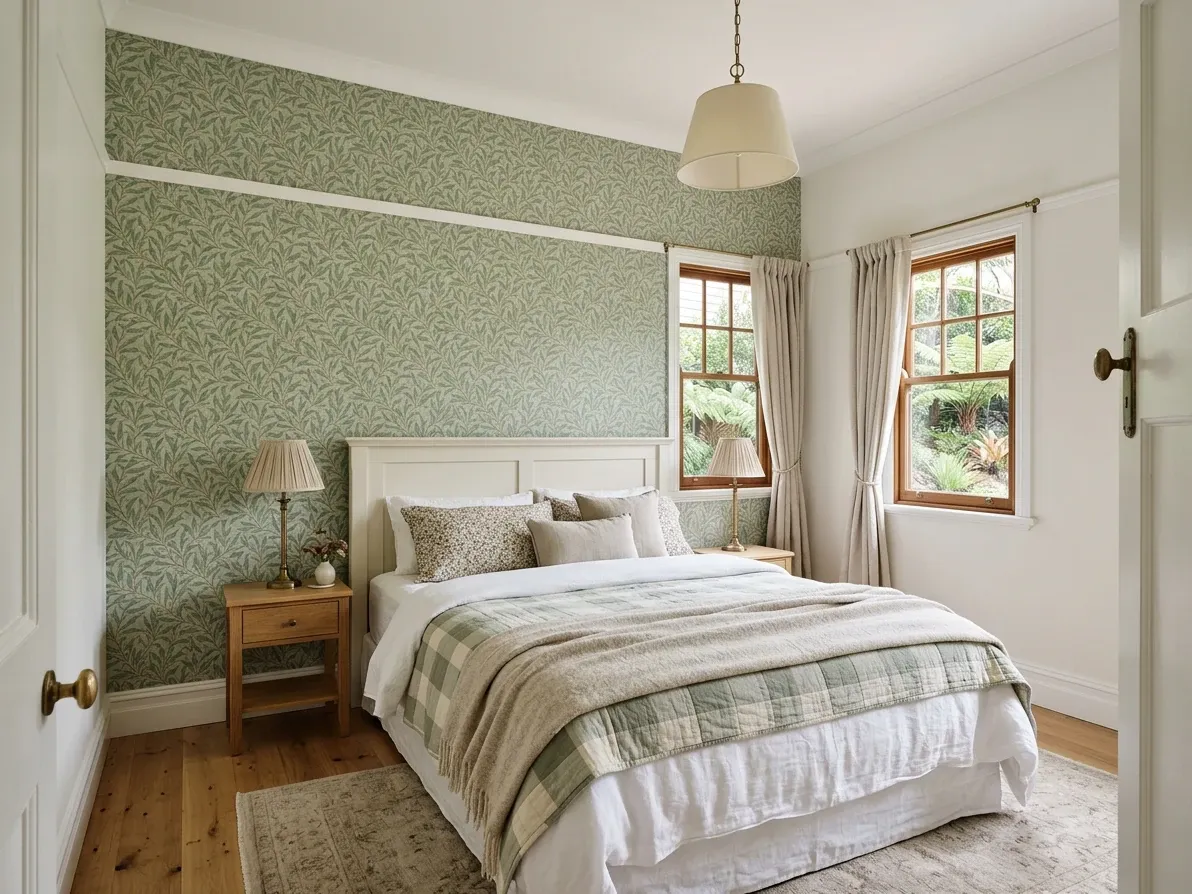
One botanical feature wall carries the whole bedroom.
Cottage living rooms, bedrooms and interior details
The cottage living room is the room where the style’s brief lands most naturally. The working priority is comfort: a deep slipcovered linen sofa (Belgian or French linen in an oat or warm white, or a small floral or ditsy print for the pattern-forward version), one or two comfortable slipcovered armchairs, an old-hardwood or reclaimed-timber coffee table, a considered mix of side tables (a small painted cabinet, a vintage occasional table, a plant-stand-turned-side-table), a faded Persian or dhurrie rug over a wide-plank timber floor, and a wall of framed art hung in warm-brass or aged-timber frames rather than a single statement piece. The centrepiece is the fireplace: a cast-iron surround in a Federation cottage, a timber mantel in a workers’ cottage, a stone hearth in a rural stone cottage. Where the original hearth has been removed a joinery-built mantel with a wood-burner or electric fire reads as a legitimate reconstruction rather than a gimmick, particularly in cool-climate cottages where a working fire earns its keep through winter.
The cottage bedroom is where wallpaper and pattern land hardest. The most successful contemporary Australian cottage bedrooms carry a botanical or floral wallpaper on the wall behind the bedhead (Willow Bough, Strawberry Thief, Marigold or a small-scale Sanderson floral), a cast-iron or painted timber bedhead in warm white or aged brass, layered bedding through a linen sheet, a cotton quilt and a wool throw, small-scale pattern in cushions and bolsters, and warm lamplight through table lamps in aged brass with linen or pleated cotton shades rather than overhead lighting. According to ABI Interiors’ cottagecore bedroom guidance, the direction is toward wrought-iron bedframes, weathered timber flooring, reclaimed timber bedside tables and antique brass cabinet handles, which reads as the moodier 2026 version of the same brief. Curtains run linen or cotton in a warm neutral or a small floral, on a warm-brass or timber pole, and puddle slightly at the floor.
The cottage dining room or dining zone (most Australian cottages have kitchen-dining rather than a separate formal dining room) carries a scrubbed pine or oak table with mismatched painted timber chairs, cane-seated chairs or bentwood chairs, a considered chandelier or pendant in aged brass with linen shades, a Welsh dresser or a painted sideboard against one wall, and a rug (a faded Persian, a dhurrie or a natural sisal) underneath.
Small architectural details do considerable design work in a cottage room. The cornice is generally simple (a small ogee or a plain rebate rather than the deep cornices of a Hamptons room); the skirting is generous but not oversized; the architraves are simple; the doors are panelled timber (four-panel or five-panel), often painted; the door hardware is hand-forged iron, warm brass or brushed nickel with visible thumb-latches or lever handles rather than modern round knobs; the window furniture runs as simple timber double-hung sashes or casement windows with brass latches. On the wall, small-scale details (a picture rail, a plate rail above the door head in the kitchen or dining room, a shelf running along one wall for displayed ceramics) add character that a contemporary interior lacks.
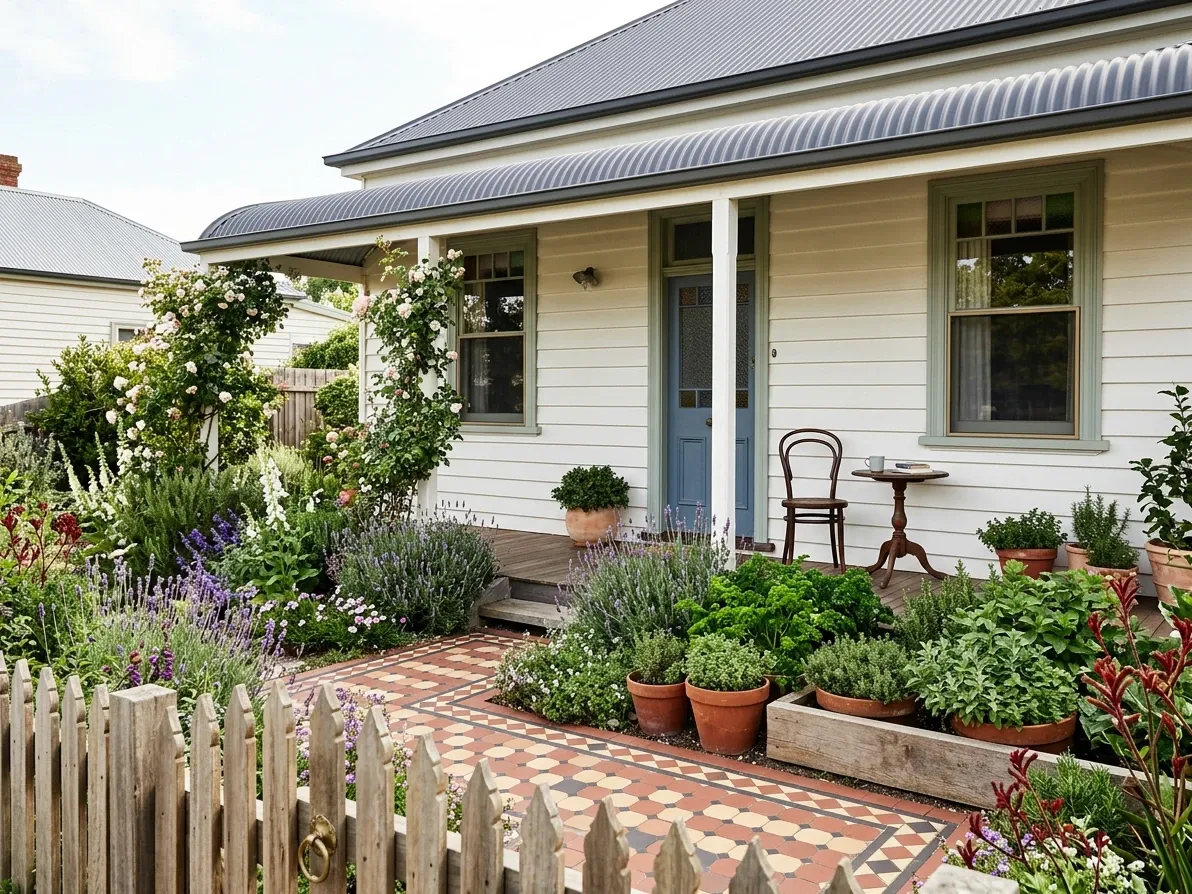
The cottage garden is a design layer, not an afterthought.
The Australian cottage exterior and garden
The exterior and the garden set the whole tone for what the interior can honestly do. A cottage interior in a modern rendered-brick suburban house on a bare front lawn is fighting the building at every step; a cottage interior in a Federation weatherboard on a garden lot half-buried in roses is doing quiet work with the building rather than against it.
The Australian cottage exterior vocabulary is consistent across regions. Weatherboard cladding (chamferboard, shiplap, or Cape Cod board) in a warm white, muted sage, dusky blue, deep charcoal or Federation-era heritage colour; a corrugated iron or slate roof at a generous pitch; a verandah running along the front or wrapping around one side, floored in tongue-and-groove timber or tessellated tile; cast-iron lacework on the verandah posts and eaves in a Victorian workers’ cottage; timber posts with turned-timber brackets on a Federation cottage; double-hung timber sash windows with small panes; coloured leadlight in the front door and upper sash in Federation cottages; a timber picket fence in warm white or a soft muted colour; a tessellated tile path running from gate to verandah; large clay pots either side of the front door planted with something seasonal.
Colour choice on the exterior sets the tone for the interior. The most common contemporary directions are: warm white weatherboards (Dulux Whisper White, Dulux Natural White, Haymes Antique White) with a muted charcoal roof and a soft muted door colour (sage, dusky blue, terracotta, warm rose); sage green or dusky blue weatherboards with a warm white trim and a corrugated iron or dark grey roof; or the heritage red-brick Federation exterior left as brick with warm-white timber trim and a matte black or forest green door. According to Renovating Mums’ 2026 Sydney exterior colour trends, the current Australian direction is toward warm, earthy exterior palettes with terracotta, warm charcoal and muted greens leading, which sits cleanly inside the cottage direction.
The cottage garden is a design layer in its own right. According to Casey Joy Lister’s guide to growing an English cottage garden in Australia, the style works genuinely well across most Australian climates when the plant list is adapted for local conditions: French lavender in humid Queensland rather than English lavender, drought-tolerant salvias and rosemary in dry inland climates, sturdy roses in most temperate zones, dahlias and hydrangeas in the cool-climate belt. According to Plantmark’s list of top cottage-style garden plants for Australian landscapes, the reliable planting palette runs through roses, hollyhocks, delphiniums, foxgloves, lavender, rosemary, catmint, salvia, dianthus, campanula, echinacea, sedum and geraniums, all layered together in mixed borders rather than lined up in tidy beds. A kitchen-garden strip alongside the verandah carrying parsley, rosemary, thyme, oregano, tarragon, marjoram, coriander, dill, sorrel and mint carries the style honestly (the working productive garden is central to the cottage-garden brief) and does real everyday work for the cook.
The overall discipline in the cottage garden is layered informality: mixed borders rather than blocks of a single planting, curved edges rather than straight ones, self-seeding annuals and perennials allowed to spread rather than every plant kept to its allocated spot, and productive plants (herbs, silverbeet, lettuce, tomatoes, dwarf fruit trees) mixed in with the ornamentals rather than banished to a separate vegetable patch. According to Home Beautiful’s Australian cottage garden feature, the strongest contemporary Australian cottage gardens layer traditional English cottage-garden plants with Australian native species (correa, banksia, kangaroo paw, native rosemary, wallum bottlebrush) to earn the local climate rather than fight it.
What a cottage interior costs to do well
Cost varies wildly with the starting point (a heritage-listed workers’ cottage in inner Melbourne with an early-1900s untouched floorplan is a different project from a suburban brick veneer that just needs styling), but the working ranges for the most common Australian cottage-renovation scopes sit in a consistent band across the industry sources.
The kitchen is the largest single spend in most cottage renovations. As noted above, the mid-range Australian cottage kitchen sits at around $35,000 to $45,000 (shaker cabinetry, engineered-stone benchtop, fireclay butler sink, mid-range appliances, standard installation) with premium builds running $45,000 to $90,000-plus (solid-timber or honed-natural-stone benchtop, freestanding range cooker, custom cabinetry, upgraded tapware) and budget-end fit-outs achievable at $20,000 to $30,000 (flat-pack or Ikea shaker cabinetry, laminate or budget engineered stone, standard sink and mid-range tapware). According to Sparky.fyi’s 2026 Australian cabinetry cost guide, a butler’s pantry (extremely common in Australian cottage renovations, both for the storage and for the style-appropriate off-kitchen work zone) adds $8,000 to $15,000 to the overall spend.
The bathroom typically runs $18,000 to $35,000 for a mid-range renovation and $35,000 to $70,000-plus for a premium build in a heritage cottage, with the premium end driven by the freestanding rolltop bath, the marble-topped painted vanity, the encaustic tile floor and the aged-brass tapware. Budget-end cottage bathrooms are achievable at $12,000 to $20,000 with careful specification.
The whole-home renovation of a small heritage cottage runs considerably wider. According to Co-Architecture’s 2026 Sydney renovation cost guide, a whole-house renovation of a standard three-bedroom, two-bathroom Sydney home costs $230,000 to $370,000 at a mid-range finish and $370,000 to $580,000 at premium finish with structural changes and high-end materials. Older Sydney and Melbourne cottages (Federation, interwar, Victorian worker’s cottage) frequently carry significant hidden cost risk: asbestos-containing materials in pre-1990 properties require licensed removal, sub-floor ventilation and timber-rot repair adds to the base scope, and heritage-conservation-area properties require a Development Application (DA) approved through council for any external work. Buying a cottage on the assumption it can be renovated for $150,000 is a mistake most first-time cottage-owners make once and never again.
The cosmetic-only cottage refresh (interior repaint in a considered warm-white and accent colour scheme, refinished timber floors, new soft furnishings, one or two wallpapered feature walls, aged-brass hardware swap through the kitchen and bathroom, replacement lighting) is genuinely achievable at $15,000 to $40,000 depending on scope, and produces the most dramatic style shift for the money in almost every cottage this article’s audience is likely to own. According to Cottages & Bungalows Magazine’s design-mistakes piece, the most common expensive mistake in a cottage renovation is over-scoping the structural work when a considered cosmetic pass would have delivered eighty per cent of the style shift for a fraction of the cost.
- Cabinetry18,00051%
- Benchtop5,50016%
- Sink and tapware2,5007%
- Appliances6,00017%
- Install and plumbing3,0009%
Common cottage-style mistakes to avoid
A well-resolved cottage interior is a considered piece of design; a poorly-resolved one reads as a themed set of Etsy purchases stacked on top of each other. The mistakes that produce the second version are consistent across most of the cottage rooms that show up in Australian real-estate listings.
Confusing the styling layer for the style. The single most common mistake: layering the mason jars, the live-laugh-love signs, the whitewashed distressed furniture, the dried-flower wreaths, the porcelain-jug rows and the count-your-blessings scripted-wood signs on top of any interior and calling it cottage. According to Homes & Gardens’s 2026 colour cliches piece, the overly matched and coordinated cottage look is the first cliche that designers are calling out for 2026, and the fix is to lean back into the material and architectural layer rather than the props aisle.
Whitewashing everything. The chalk-painted-and-distressed furniture look of the early 2010s has aged worse than almost any other cottage-interior direction, and it dates a room fast. The current alternative is to leave timber furniture in its own timber tone (honey oak, mid-tone walnut, warm pine) unless the piece is being painted properly in a considered colour (a saturated sage, a deep dusky blue, a warm terracotta), rather than sanded and washed to a distressed pastel finish.
Adding cottage details to a room that has none of the building bones. A cottage interior in a modern brick-veneer suburban house with high square rooms, no fireplace, no cornice, no picture rail and modern double-hung aluminium windows is fighting the building rather than working with it. The style leans hard on architectural detail (small-paned windows, timber joinery, panelled doors, a working fireplace, a picture rail, a plate rail); adding cottage soft furnishings to a room without those bones reads as costume. The fix is either to select cottage details that will do more work in a modern room (a wallpapered feature wall, a painted joinery cabinet, curtains rather than blinds, warm lamplight rather than downlights) or to accept that a different style will honour the building more.
Overdoing the wallpaper. One considered wallpapered wall in a room reads as confident and current; every wall wallpapered reads as a museum re-creation and closes a room down. The rule is restraint: one or two feature walls carry the wallpaper (the bedroom feature wall behind the bedhead, the powder-room walls, the back of a Welsh dresser, a mudroom); the rest of the room stays plain. In small cottages (workers’ cottage rooms, powder rooms) a full-height wallpapered room reads charming; in larger contemporary rooms it reads oppressive.
Ignoring the climate. English cottage style was designed for a damp cool climate with limited natural light, and it borrowed heavily on layered fabric and warm lamplight to compensate. Australian cottages sit across a much wider climate range (subtropical Brisbane, hot dry Adelaide, temperate Sydney and Melbourne, cool Tasmania and the Southern Highlands), and layering a full heavy-drapery English-cottage treatment onto a Brisbane Queenslander produces a room that reads oppressive in January. The fix is to lighten the fabric layer in warmer climates (linen and cotton rather than wool and velvet, unlined curtains rather than heavy drapes), lean harder on the timber and stone layer, and keep the wallpaper to a single feature wall rather than several.
Confusing period-appropriate with themed. A Victorian worker’s cottage in Fitzroy or Redfern with a fully-restored cast-iron fireplace, period-appropriate lacework, four-panel painted doors, honey-oak floors and a considered contemporary kitchen at the back reads as a confident piece of restoration. The same cottage with a themed set of Victorian-era decorations (a stuffed peacock under a glass dome on the mantel, a chaise longue in the front room, gold-framed portraits on every wall, heavy velvet drapes at every window) reads as a costume drama. Period-appropriate detailing is about the building’s bones and the considered restraint of one or two right pieces; theming is about layering multiple period references on top of each other until the room reads as a museum exhibit.
Buying everything new from one source. A cottage room read as a bought-set (all matching new furniture, all matching new textiles, all matching new accessories, all from the same retailer) misses the entire point of the style: cottage rooms are meant to read as collected over time. The fix is to buy a small handful of key pieces new (the linen sofa, the marble-topped painted vanity, the aged-brass tapware, the Morris & Co wallpaper) and populate the object layer from vintage, second-hand, inherited and hand-collected sources. A single trip to a good country auction, an estate sale or a well-run vintage store produces more visible personality than five trips to any homewares retailer.
Where cottage style fits in Australia in 2026
Cottage style in Australia in 2026 is at a genuinely interesting point. According to Home & Art Magazine’s 2026 forecast, modern cottage core has emerged as the defining home style of 2026 and is replacing the whitewashed shiplap-led modern farmhouse as the dominant online residential aesthetic. According to the broader Australian direction documented across Cedora’s 2026 interior colour trends and BUILD.com.au’s 2026 feel-of-home piece, Australian interiors are moving away from cold, perfect-looking interiors and becoming more personal, warm and lived-in, with a stronger emphasis on layered materials and considered warm-neutral colour. Both directions land cottage style in a stronger position than it has been in a decade.
Australia’s own cottage stock is genuinely well-suited to this direction. The Victorian worker’s cottage, the Federation cottage, the Queenslander cottage, the stone cottage and the rural weatherboard all carry the architectural bones the style needs (small-paned windows, timber panelling, panelled doors, working fireplaces, honey-oak or Australian hardwood floors, small-scale room proportions) and read as strong candidates for a considered cottage interior. According to The Design Files’ 2025 feature on Victorian cottage renovations, the strongest contemporary Australian cottage interiors are the ones that lean into the building’s original bones and layer the style on top rather than the ones that start with a Pinterest board and impose it on the wrong house.
The most useful angle for an Australian audience in 2026: cottage style is not a Pinterest-borrowed English aesthetic imposed on Australian houses, and it is not the whitewashed shabby-chic version most sources still show. It is a considered, warmly-decorated, small-scale interior direction that Australia has its own genuine tradition of, and that maps cleanly onto a considerable proportion of the country’s building stock. Done well, it produces some of the warmest and most personal rooms on the residential market, and it reads as unmistakably current in 2026. Done as a themed reproduction, it reads as an early-2020s Etsy listing. The gap between those two outcomes is the material and architectural layer; the fix, in almost every case, is to trust the building more and the props aisle less.
Frequently asked questions
What is cottage interior style in simple terms?
Cottage interior style is the contemporary expression of small, personal, warmly-decorated country and village houses. Its underlying brief is the opposite of the polished formal room: layered pattern and colour, painted timber joinery, small-paned windows, floral or botanical wallpaper as an accent, wide-plank timber or terracotta floors, cast-iron or timber bedframes, comfortable slipcovered furniture, and a strong sense that the room has been collected over time rather than bought as a set. In Australia in 2026 the reference is broader than the English chocolate-box cottage most people picture: it covers Victorian workers’ cottages in Melbourne and Sydney, Federation cottages in Perth and Adelaide, timber Queenslander cottages, stone cottages in the Adelaide Hills, and the country-village Cotswold reference that most of the online sources still default to. The 2026 version is warmer and moodier than the 2010s whitewashed-and-shabby-chic version, with deeper colours, less distressing and more genuinely collected pieces.
What’s the difference between cottage style and farmhouse style?
Farmhouse style is the working rural interior, built around utility, painted joinery, honest timber, matte black or oil-rubbed bronze hardware and a restrained warm-neutral palette. Cottage style is the small, personal, decorated village interior, built around comfort, pattern, colour, floral or botanical accents, softer aged brass or nickel hardware and a wider colour palette that reaches into deeper greens, dusky blues, warm terracotta and floral pastels. Farmhouse rooms look like they belong on a working property; cottage rooms look like they belong to a person who has lived somewhere for a long time and collected pieces along the way. Two practical tests: the wall (a farmhouse room is mostly painted white or a warm neutral; a cottage room often carries wallpaper on at least one wall, or a paler patterned soft furnishing throughout), and the object layer (farmhouse leans on working pieces like a butler sink, a hanging pot rack and a scrubbed timber table; cottage leans on decorative and inherited pieces like a floral bedspread, a display of ceramics on a Welsh dresser and a framed botanical print above the mantel).
Is cottage style still popular in 2026?
Yes, and it is gaining ground rather than fading. According to the Home & Art Magazine 2026 forecast, modern cottage core has emerged as the defining home style of 2026, replacing the whitewashed shiplap-led modern farmhouse that dominated the late 2010s and reaching well past its cottagecore internet-aesthetic origins. Google Trends data flagged in the 2022 Living Cozy interior report showed cottagecore as the year’s top interior design trend and searches for ‘dark cottagecore kitchen’ rose over 900% year-on-year in 2026 on Pinterest according to Homedit. The version that is growing is warmer, moodier, more genuinely collected and less themed than the 2020 lockdown-era cottagecore that first spread on TikTok, and it maps cleanly onto Australia’s own inner-city Victorian cottage and rural weatherboard vernacular.
Does cottage style suit Australian homes?
Yes, often more than it suits the American suburbs where the current online version is authored. Around 70 per cent of Australian private dwellings are separate houses and a further 13 per cent are terraces or townhouses, according to the 2021 Census, which gives most of the country the small-to-medium detached and semi-detached building stock the style was designed for. Australia’s own cottage vernacular runs deep: the Victorian worker’s cottage of inner Melbourne, Sydney and Brisbane; the Federation cottage of the interwar suburbs; the timber Queenslander cottage of the subtropical belt; the stone cottage of the Adelaide Hills, Tasmania and the Southern Highlands; and the weatherboard rural cottage across every state. The mistake most Australian cottage interiors make is copying the Cotswolds version straight off Pinterest rather than reading their own building for what it already is.
What colours and materials define a cottage interior?
The base is warm white, chalky off-white, soft cream or milk paint across ceilings and trim, layered with mid-tone honey oak, wide-plank pine or terracotta tile through floors. The middle band carries floral, botanical or ticking-stripe wallpaper on one or two feature walls, painted joinery in muted sage, dusky blue, deep forest green, weathered terracotta or biscuit red, and soft furnishings in linen, cotton, wool and jute. Metalwork runs aged brass, oil-rubbed bronze, hand-forged iron or a brushed warm nickel; polished chrome reads against the style. Cottage rooms carry more pattern than farmhouse rooms do, and the pattern is doing considerable design work: a William Morris or Sanderson botanical wallpaper on the bedroom feature wall, a small floral upholstery on a slipcovered armchair, a ticking-stripe pillowcase, a paisley throw. The 2026 direction is warmer and deeper than the 2010s take, with more use of deep green, warm brown, terracotta and dusky blue and considerably less whitewashed shabby-chic.
What does an Australian cottage kitchen renovation cost?
The bulk of Australian cottage kitchen renovations land between $25,000 and $65,000, with the median sitting around $35,000 to $45,000 for a mid-range shaker cabinetry build. According to Kitchen Shack’s 2026 cost guide, the national average for a kitchen renovation runs around $42,630 including installation, and the Housing Industry Association reports a typical Australian kitchen renovation at a median of $30,000 to $35,000 with mid-range builds running $25,000 to $45,000 and premium custom builds $45,000 to $100,000-plus. Cottage kitchens sit in the upper half of the mid-range band most often, because the shaker-style cabinetry, the fireclay butler sink, the bridge tapware and the timber or stone benchtop all cost a step more than a flat-panel polyurethane kitchen at the same overall scope. According to Sparky.fyi’s 2026 cabinetry breakdown, shaker profile doors typically add 10 to 25 per cent over plain doors, and a farmhouse sink and tapware package runs $1,200 to $3,500 on top.
What are the worst cottage-style mistakes?
Confusing the styling layer for the style. The 2010s and early-2020s cottagecore internet aesthetic reduced the style to a small handful of literal motifs (whitewashed everything, chalk-painted distressed furniture, three-in-a-row white porcelain jugs, live-laugh-love signs, mason jars, dried-flower wreaths on every door, floral bedding in every room) and a generation of Pinterest boards taught homeowners to layer them on top of any interior. A room covered in those motifs reads as themed and dated within eighteen months. The genuine cottage vocabulary the style was built on (proportion, small-paned windows, wide-plank timber floors, painted joinery, wallpapered accent walls, layered pattern and colour in restraint, working pieces that have honestly aged) is not going anywhere. The fix is not to strip every reference out; it is to lean into the material and architectural layer rather than the props aisle. Done that way, a cottage interior reads as warm, personal and unmistakably current. Done with mason jars and shabby-chic paint, it reads as an early-2020s Etsy listing.