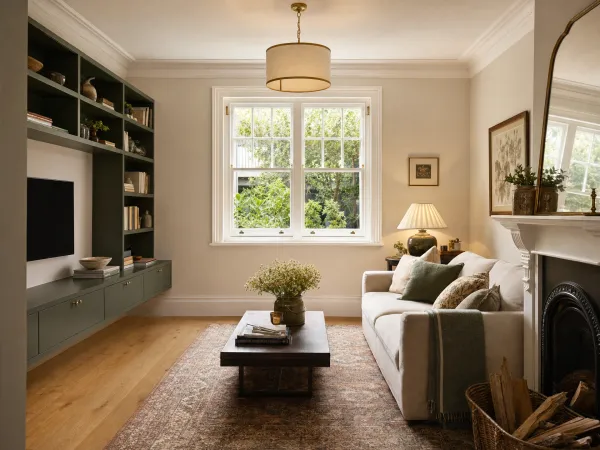
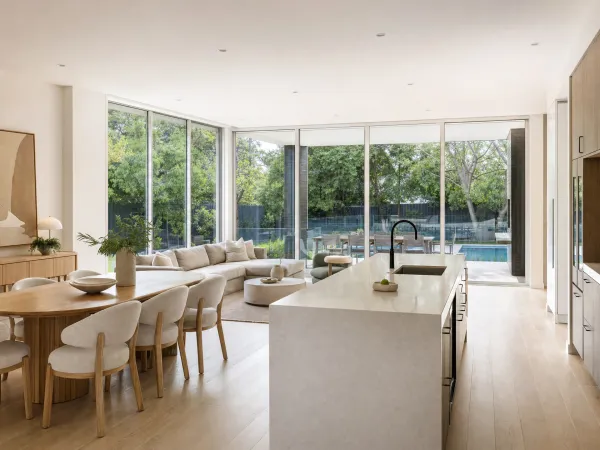
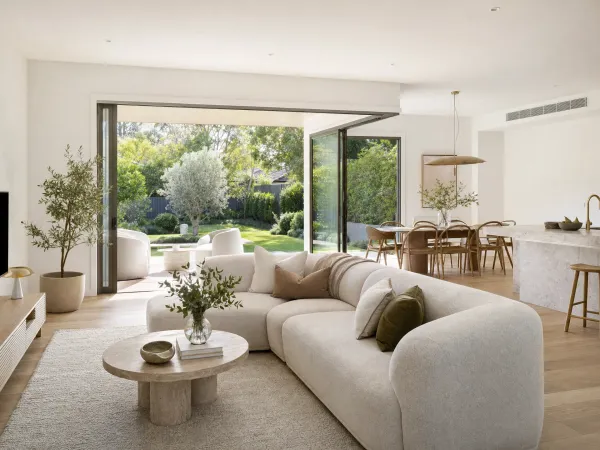
Japandi style: warm Japanese-Scandi minimalism
Japandi style, explained for Australian homes: what it is, why it works with our climate, and how to bring the calm Japanese-Scandi look into every room.
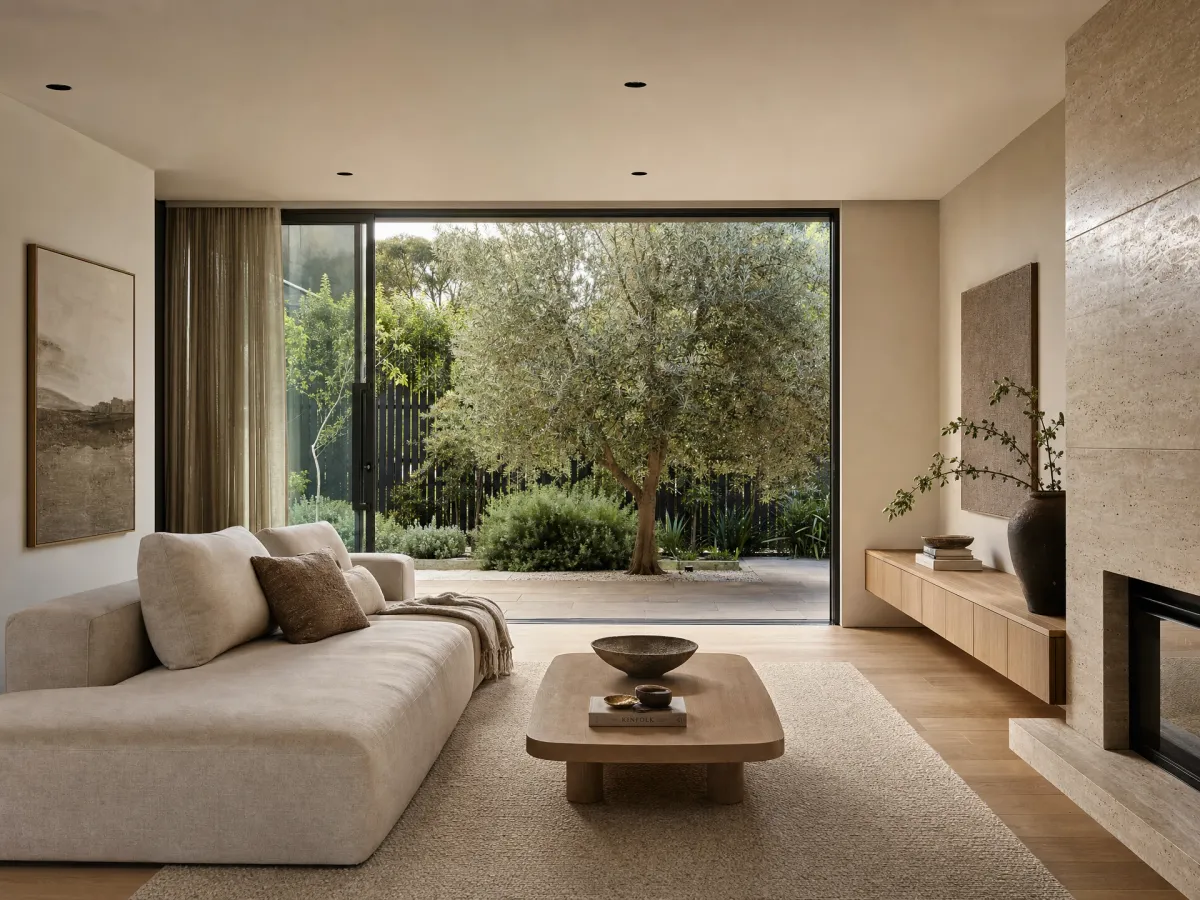
Every Japandi guide on the internet starts the same way: a portmanteau of Japan and Scandi, the words wabi-sabi and hygge, a pale oak bench, and a single ceramic bowl. That much is fine. What none of them tell you is what actually changes when you build a Japandi home in Australia, where the climate is different, the tradesmen have their own vocabulary, and the pale-oak flat-pack you were about to buy is a Scandi piece, not a Japandi one.
This guide answers that question room by room. It draws on the James Hardie Modern Homes Forecast 2026, developed with global trend forecaster WGSN, which nominates Japandi as one of the eight modern home styles shaping Australian residential design; the 2023 Houzz & Home Australia Renovation Trends Study for how Australians are actually spending on their homes; and the work of Australian designers like Steph Ottavio of Japandi Estate, whose Block 2023 win did more to bring the style into the mainstream local vocabulary than any magazine spread.
Everything below assumes you have already Googled the definitional stuff. This is the useful version.
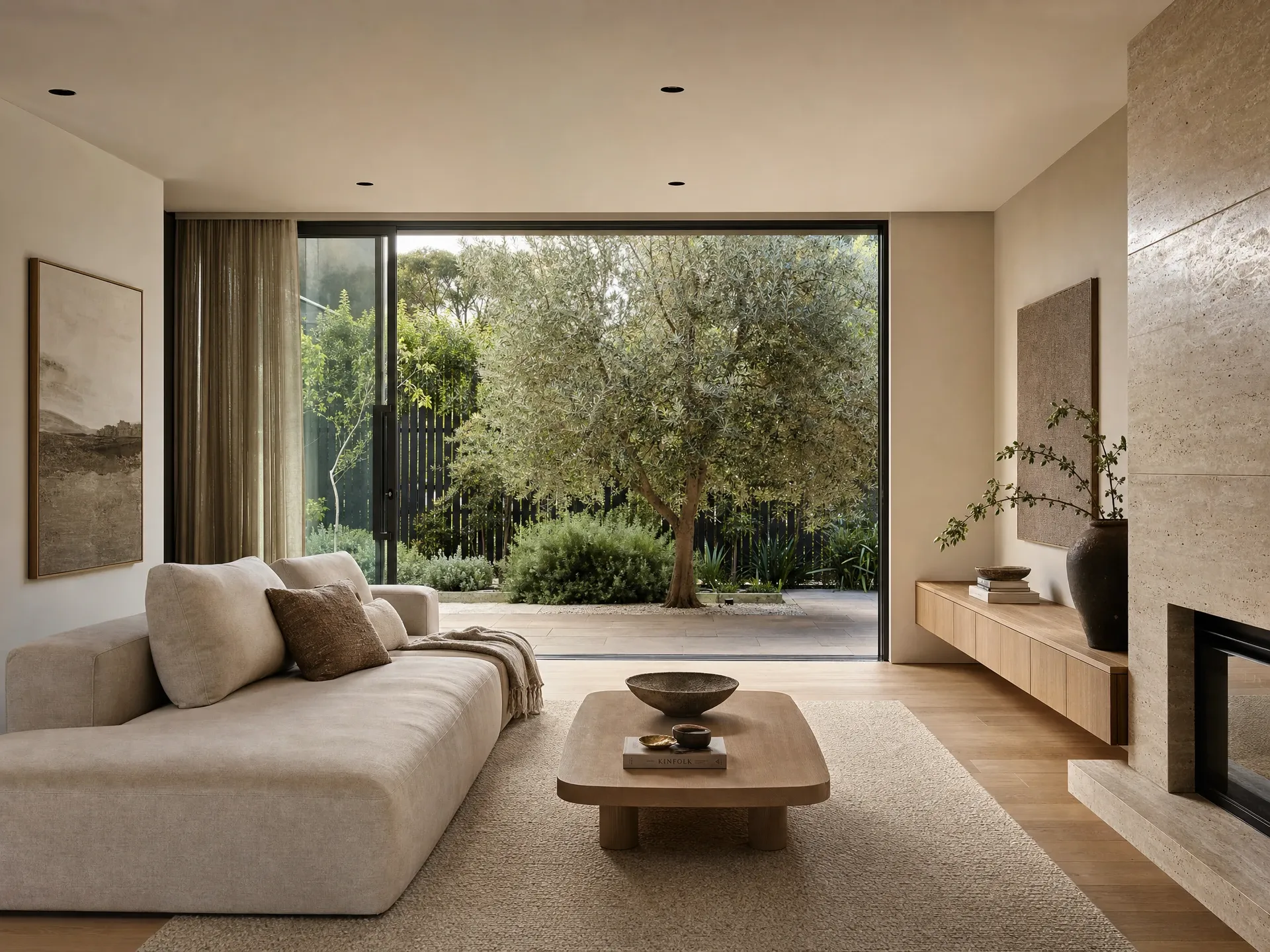
What Japandi actually is
Japandi is a hybrid of Japanese and Scandinavian interior design that has settled, over the last five years, into its own recognisable style. It borrows the pale timber, clean lines and functional furniture of Scandinavian design (a philosophy shaped by long, dark Nordic winters and the Danish concept of hygge, or warm togetherness) and marries them with the Japanese principle of wabi-sabi: finding beauty in imperfection, asymmetry, natural ageing and the quiet dignity of handmade objects.
The result reads, in a good room, as considered rather than sparse. A Japandi living room usually has less furniture than a Scandi one, and the pieces it does have look like they were chosen slowly. The palette is a shade earthier: mushroom, oat and stone instead of the near-white palette Scandi tends to default to. Accents are drawn from nature, muted rather than bright. Handmade ceramics, linen upholstery and a low timber bench do more emotional work than any pop of colour.
Home Beautiful’s digital editor Diana Moore, writing in her Japandi guide, quotes Steph Ottavio’s shorthand for the look: “Warmth, texture, cosiness, and connection with the outdoors, combined with clean lines, minimalism, and a decluttered life.” That covers it, and it points at what the style is trying to solve: how to keep the calm of minimalism without the coldness.
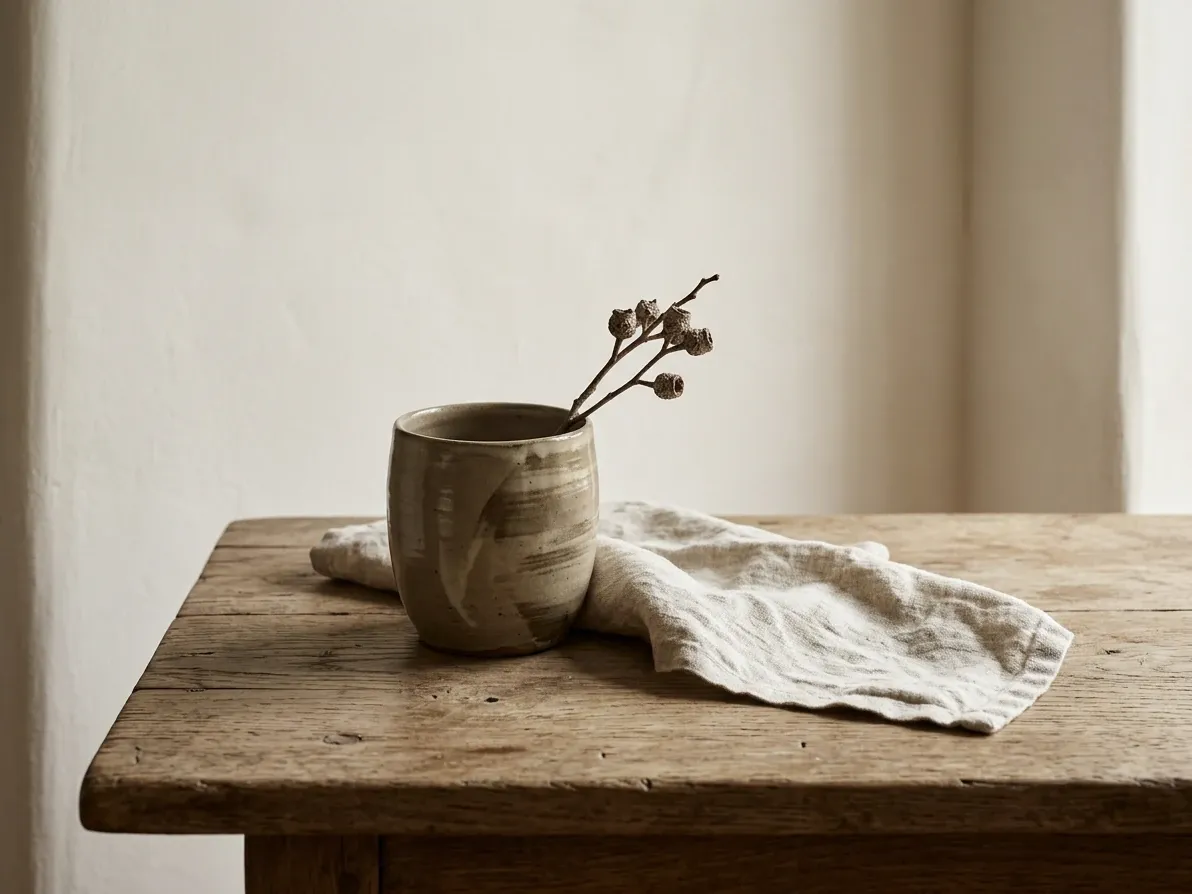
Wabi-sabi’s beauty of imperfection is what warms Japandi’s Scandi bones.
Japandi vs Scandi vs wabi-sabi, briefly
Three related terms get used interchangeably. They shouldn’t be.
Scandi is a design tradition from Denmark, Sweden and Norway, built around maximising the small amount of winter light those countries get. Its palette is deliberately bright: white, pale grey, blonde timber, occasional pastel. It leans on the concept of hygge, or warm togetherness, and the rooms it produces feel light, airy and family-driven. We have covered it in our Scandi home design guide for Australia.
Wabi-sabi is not a design style but a Japanese aesthetic philosophy, rooted in Zen Buddhism and traced back to the 15th century. It finds beauty in transience and imperfection: a cracked teacup that has been repaired, a piece of raw linen that softens over ten years, a stone that is slightly asymmetric. It does not prescribe a palette or a furniture silhouette; it prescribes an attitude to materials.
Japandi is the crossbreed. It takes Scandi’s silhouettes and functional restraint and applies wabi-sabi’s material attitude to them. That is why a Japandi room feels calm the way a Scandi room does, but earthier, quieter and less obviously designed. The palette runs darker, the timbers can be warmer, and the objects are more likely to look handmade than mass-produced.
If you are choosing between these three for your own home, the rough test is this: if you want your rooms to feel bright, family-loud and cheerful, that is Scandi. If you want them to feel intentionally imperfect, quiet and aged, that is closer to wabi-sabi. If you want the middle ground (calm, warm, considered, functional), that is Japandi.
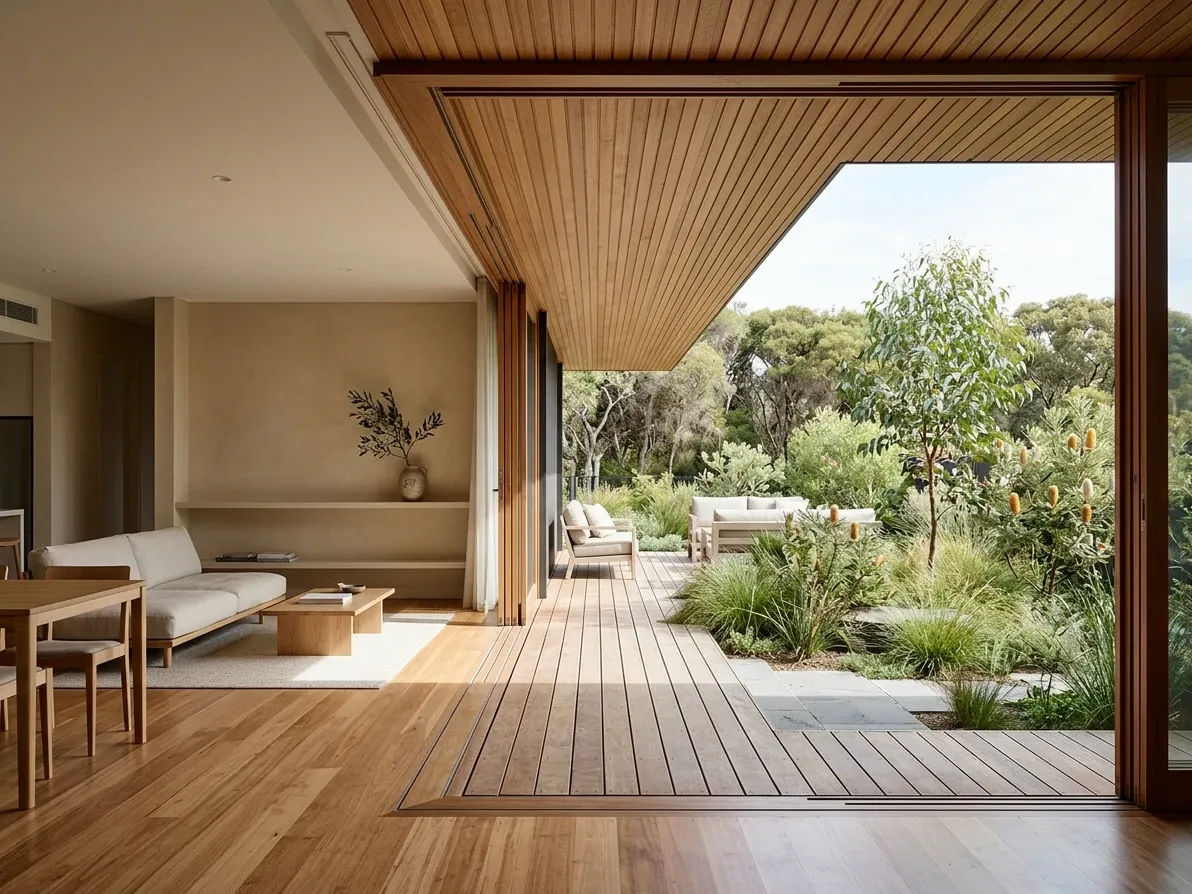
Deep eaves and indoor-outdoor flow are Japandi and Australian at once.
Why Japandi suits Australian homes
Japandi is not a Nordic style dropped into an Australian address. Several of its core moves are already how the best Australian architects are designing, and the alignment is the reason the style has grown roots here so quickly.
Deep eaves and overhangs, which are a Japandi signature borrowed from traditional Japanese architecture, are also how a well-designed Queensland or Sydney house shades itself in summer. Cross-ventilation, low-sill windows and courtyard planning, all listed as Japandi design features in the James Hardie forecast, are exactly what passive-design guidelines from YourHome recommend for hot Australian summers. Indoor-outdoor flow, the sliding-door move that is central to Japandi, is Australian by default: it is why almost every renovation brief involves knocking the back wall out and opening onto a deck.
Steph Ottavio, an architect and co-founder of Japandi Estate, told Home Beautiful that “Japandi perfectly fits the Australian lifestyle, offering tranquil outdoor spaces, serene interiors and thoughtful design for living, dining, sleeping and bathing.” That is not a marketing line: it is why Byron Bay, the North Shore of Sydney, coastal Victoria and the Perth hills are quietly filling with Japandi renovations. Sunbeam Studio, a Sydney interior firm, reports Paddington, Woollahra, Vaucluse and Bronte as suburbs where Japandi renovations are now regular briefs.
Australian renovation activity mirrors that priority mix. In the 2023 Houzz Australia study, 77% of renovating homeowners were working on interior spaces and 57% were touching outdoor areas at the same time, the exact indoor-outdoor combination Japandi is optimised for.
The Australian climate rewards Japandi’s material choices as well. Timber, stone, linen, wool, ceramics and rattan are all durable, breathable and repairable in a way that painted MDF and synthetic upholstery are not. That matters more here than in Copenhagen, because our summers are hotter, our humidity is higher and our sun is harder on finishes.
Passive-design habits sit inside the same brief. Almost half of Australian renovators (46%) name improving energy efficiency as highly important, and the four upgrades most commonly bundled into a renovation, new or upgraded windows and skylights, roofing, insulation and rooftop solar, are what turn a good-looking Japandi house into a comfortable one to live in through a hot summer. Japandi’s deep eaves, low-sill windows and thick-cavity walls make each of those upgrades easier to justify.
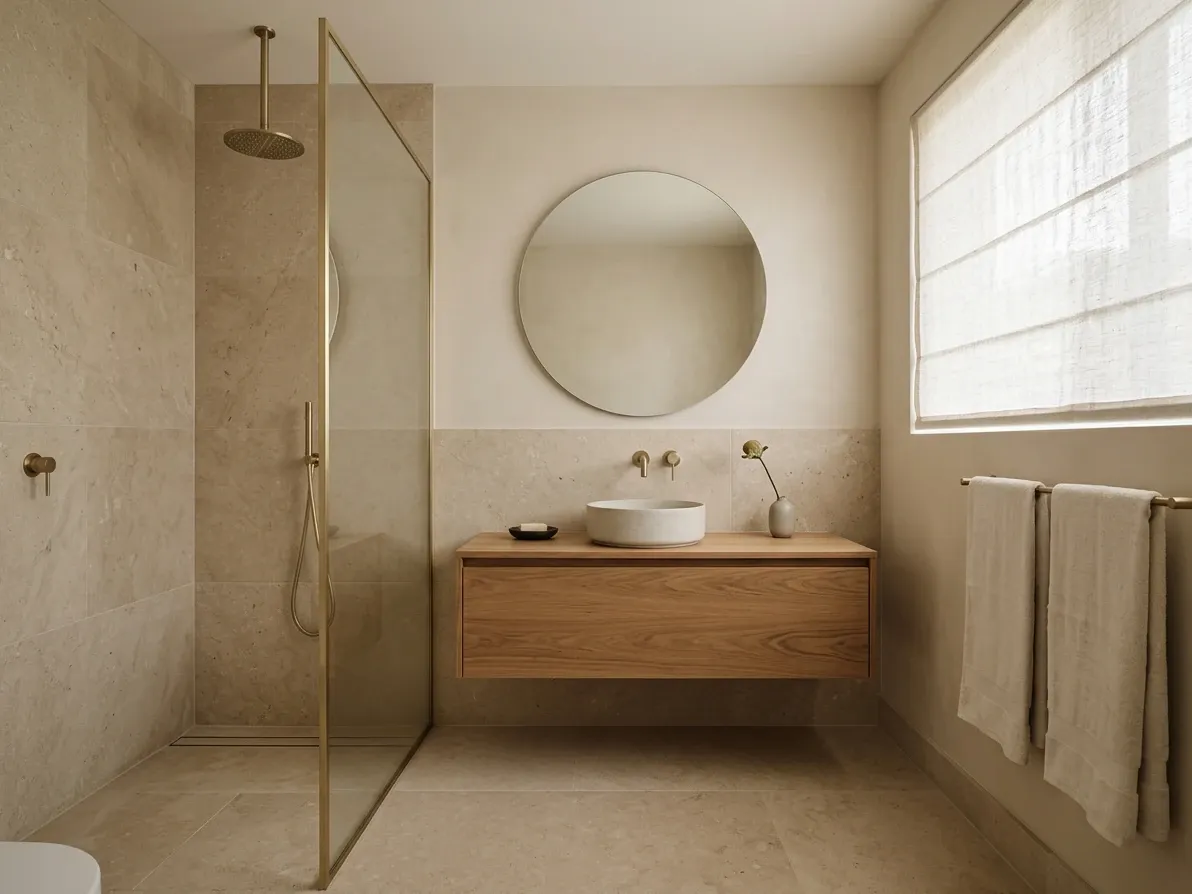
One tile, one timber, matte fixtures, and almost nothing on the bench.
The Japandi bathroom
The Japandi bathroom is the room that has driven the style’s search volume in Australia. It is also the easiest room to get wrong, because the temptation is to buy a matching Japandi bathroom set (matte black tapware, oak vanity, kit-kat tiles, ribbed glass basin, low stool with a rolled towel) and end up with a bathroom that reads as an image caption rather than a room.
The moves that actually make a Japandi bathroom feel Japandi, not “Japandi-styled”:
A single hero material. Pick one tile or one stone and let it carry the room, floor to wall to niche. Travertine, honed limestone, unglazed pale-porcelain or a warm oat-toned tile in a matte finish are the safest bets. Bathrooms that read as Japandi-styled from a photograph usually have three or four competing materials and no clear hero.
Timber for warmth, but not everywhere. A timber vanity is Japandi’s calling card, and one is enough. Pale oak, American walnut, or, if you want a locally grown alternative that reads similarly, Tasmanian oak or Blackbutt in a natural oil. Do not also add timber shelves, a timber bath tray and a timber stool: it stops reading as Japandi and starts reading as a sauna.
Wall-hung everything. Wall-hung vanities, wall-hung toilets and floating storage let the floor read as one clean plane, which is what makes a small Japandi bathroom feel bigger than it is. This matters most in Australian ensuites, which are often small (see our small bathroom design guide for the layout side of that).
Matte finishes, softened metals. Matte black tapware is the default, but brushed brass, gunmetal and even a soft chrome all sit comfortably in a Japandi bathroom. Polished chrome and high-gloss surfaces read as too commercial. Kit-kat tiles, when used, sit in the same tonal family as the wall behind them (no navy kit-kats against a bone-white wall).
One or two objects, not eight. A stone bowl. A ceramic vase with a single dried branch. A folded stack of two linen towels. That is the maximum object density in a Japandi bathroom. The number-one Japandi mistake, called out by Fabricakraft’s 2026 Japandi trend report, is over-accessorising: too many small objects on the same surface, all of them tasteful, none of them earning their place.
Natural light does the work. Where the window allows it, use a translucent linen blind rather than a heavy curtain or an opaque shade. Japandi bathrooms rely on soft daylight to bring out the texture of the tile and timber; a fluorescent LED downlight kills the mood.
For tile choice, our bathroom tile ideas guide has the tile-selection logic worth reading alongside this; for vanities, the bathroom vanity guide covers the timber-vanity spec in more detail.
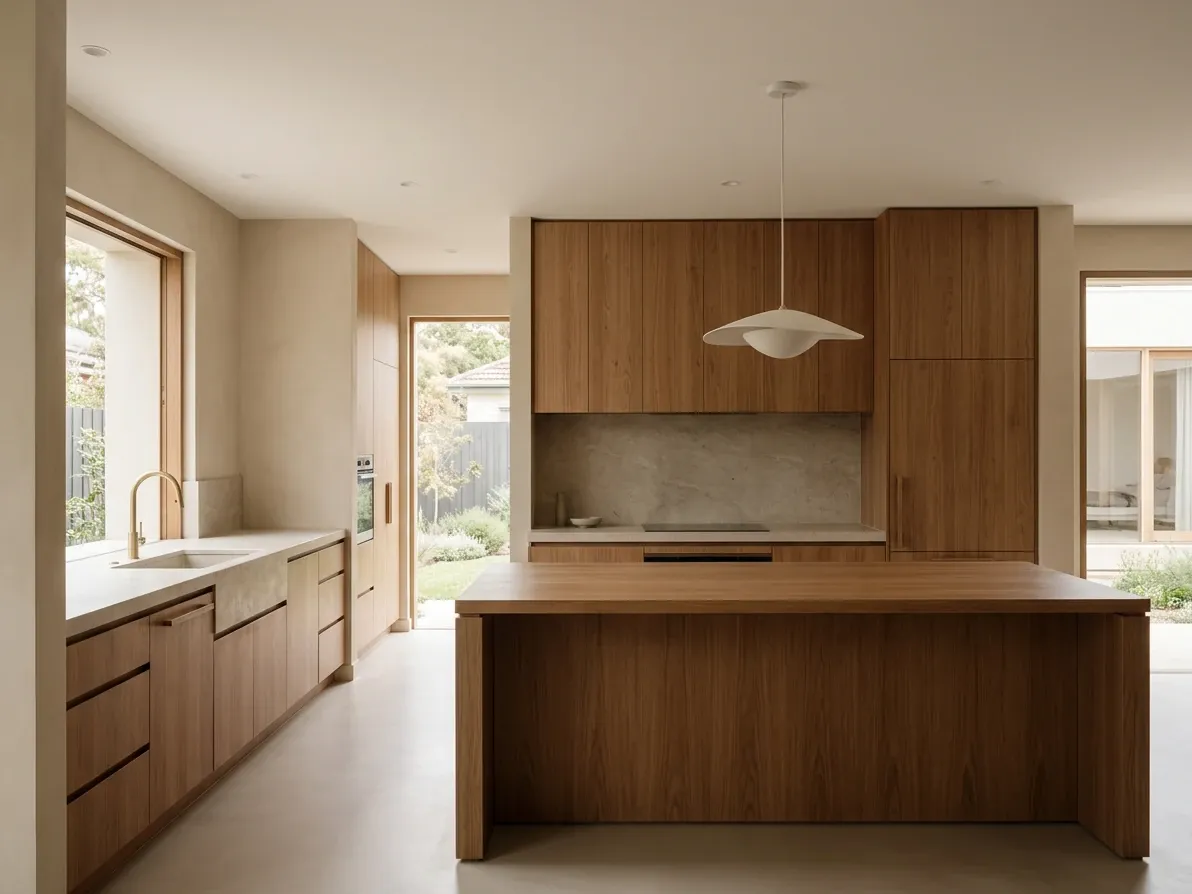
Timber cabinetry, hidden appliances, warm stone, no visible mess.
The Japandi kitchen
Japandi kitchens are where the style earns its money. A well-executed Japandi kitchen is one of the calmest rooms you can build, and it also solves a real problem: how to make a large open-plan Australian kitchen (which most new Australian kitchens are) feel restful rather than busy.
The key move is concealment. Japandi kitchens hide the working parts of the room: appliances behind cabinetry, small appliances behind pocket doors or in a butler’s pantry, cords out of sight, bins integrated. The 33% of Australian renovators who name the kitchen as their top priority (per the 2023 Houzz Australia study) tend to over-invest in the visible parts of a kitchen and under-invest in the storage that stops the visible parts looking cluttered. In a Japandi kitchen the ratio is the other way around.
Cabinetry is where the biggest single decision sits. Timber-veneered doors in oak, walnut or a warm mid-tone stain are the classic Japandi choice; matte laminate in warm putty or mushroom is a lower-budget substitute that reads similarly at a distance. Handleless cabinets, or push-to-open with a shallow recess, keep the elevation quiet. Avoid a mix of finishes (dark island, white perimeter) that fights the room’s monochrome logic.
Benchtops run warm rather than cool. Honed limestone, travertine, quartzite in a soft creamy tone, or timber (usually paired with a stone island as an insert) all sit comfortably. Polished black granite, brilliant Calacatta or a cool grey engineered stone will fight the palette.
Splashbacks should almost always be the same material as the benchtop, run up as a slab, with no join. That single move accounts for more of the Japandi kitchen’s calm than any single other spec. Handmade zellige-look tiles in warm cream or oat can also work.
Lighting is warm-white (3000K), diffused, and, where possible, layered: recessed downlights kept away from the ceiling grid pattern, plus a single sculptural pendant over the island. Overlit kitchens read as commercial; the Japandi kitchen wants gentle shadow.
Open shelves for a handful of considered pieces, or none at all. Full-height concealed pantry storage is more Japandi than a wall of styled open shelves.
For the underlying kitchen-style comparison, our kitchen styles guide covers where Japandi sits against Hamptons, shaker, country, contemporary and modern kitchens.
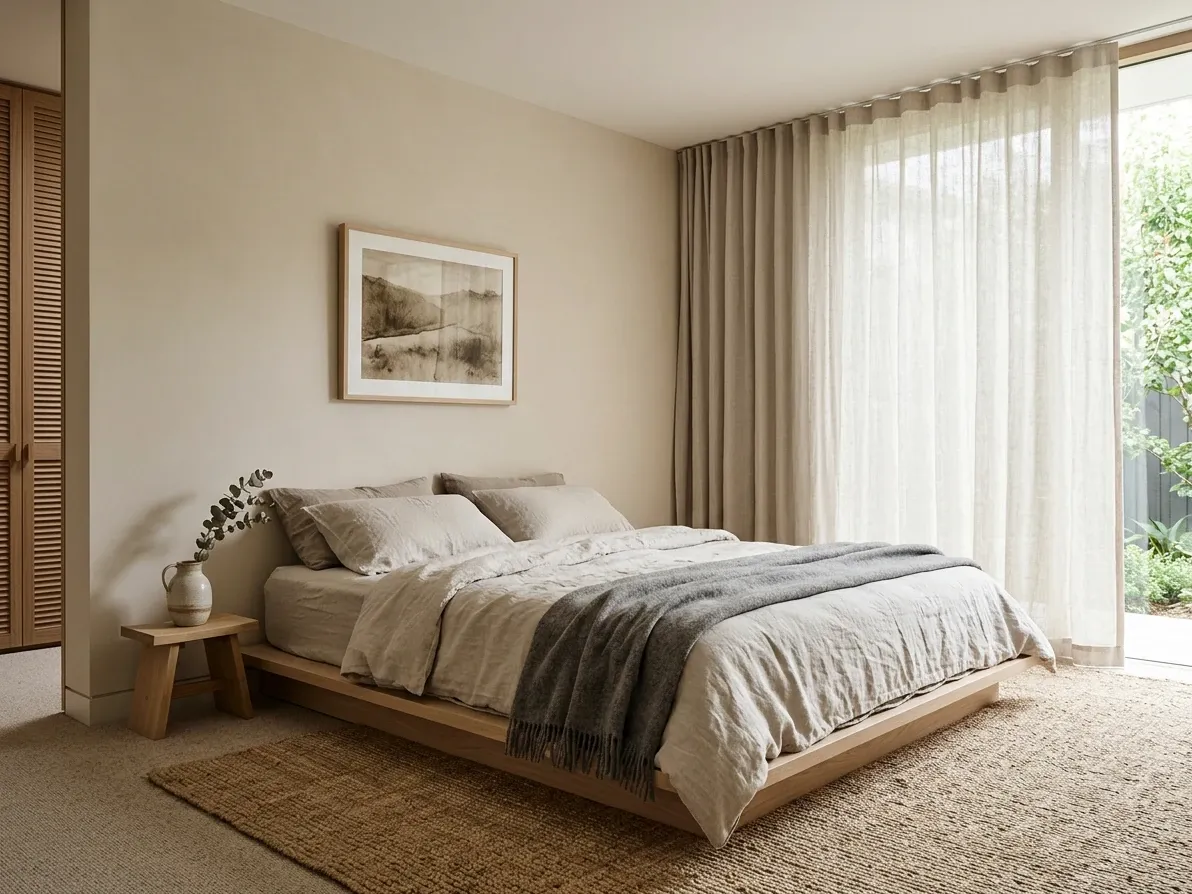
Low bed, linen bedding, one artwork, and the rest of the room quiet.
The Japandi bedroom
The Japandi bedroom is the easiest room in the house to get right, because the brief is essentially “less”. A low-profile bed frame close to the floor, linen bedding, one or two textured layers, one or two objects, and a natural-fibre rug is the complete recipe.
The specifics that separate a good Japandi bedroom from a photo-of-a-Japandi-bedroom:
Bed height matters more than bed material. A low platform bed (a genuine 300-500mm off the floor, not a standard divan) is what does the calming work. Any timber (oak, walnut, ash, Tasmanian oak) reads Japandi if the frame is low and the silhouette is simple. A tall Hamptons-style upholstered bedhead in Japandi linen is not a Japandi bed.
Linen, not cotton. Washed linen in oat, stone or a soft charcoal is the default. Layered: a linen fitted sheet, a rumpled top sheet in the same tone, a natural-wool blanket at the foot, one or two linen pillows. The rumpling is deliberate; wabi-sabi permits, even encourages, softness that shows use.
One artwork, hung low. Japandi walls are quiet. If you hang art, it should be one piece, usually landscape, in a natural-tone frame, and hung slightly lower than you would in a Scandi or Hamptons bedroom. Multiple prints in gallery format is more Scandi than Japandi.
Curtains or linen roller blinds, not heavy drapes. A Japandi bedroom relies on soft daylight through unlined linen. Blackout linings can be added, but the visible fabric should look and feel light.
Our bedroom design guide covers the rest of the room-layout logic; the palette, materials and object density on top of that are what turn a good bedroom into a Japandi one.
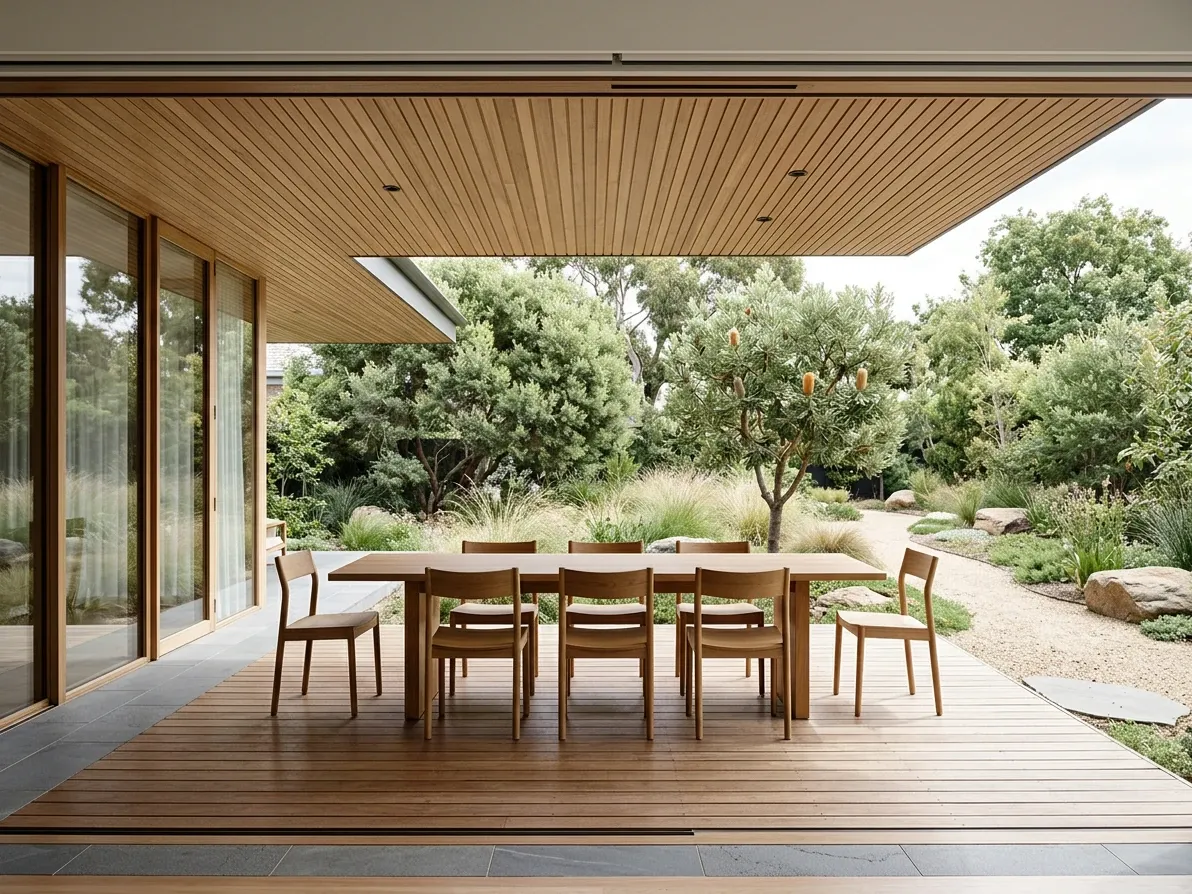
Timber decking, native planting, and one long low table under deep eaves.
Japandi living, dining and outdoor rooms
Living rooms are where Japandi is most often misread. The temptation is to strip a room back until it looks like a hotel foyer. That is not Japandi; that is minimalism. A living room that feels Japandi has three or four generously proportioned pieces (a low, deep sofa in cream or oatmeal linen, a solid timber coffee table with slight imperfections, one or two low-slung chairs, a large natural-fibre rug) and the confidence to leave the rest of the room quiet.
The Japandi sofa is low and modular, upholstered in a natural fibre, and sized generously enough that one person can lie down without folding. A Hans Wegner-style timber-armed lounge chair is a Japandi staple; so is a low, rounded-edge timber coffee table. Rugs are wool, jute or a wool-linen blend, always neutral, always big enough that the sofa’s front legs sit on it.
Dining rooms follow the same rules with a longer, lower table. A solid timber refectory-style table, a set of six softly curved timber chairs or a mix of timber chairs and one bench, and a single sculptural pendant is the entire recipe. Runners, table settings and centrepieces stay off the table when it is not in use.
Outdoor rooms are where Japandi and modern Australian architecture meet most cleanly. Deep eaves, timber decking (Blackbutt, Spotted Gum or Merbau all suit), stone paving in a warm bluestone or travertine, and a courtyard planted with native evergreens, ornamental grasses and one or two carefully placed feature trees is a Japandi-Australian alfresco brief in one sentence. The James Hardie 2026 forecast calls this out explicitly, with a landscaping brief developed with Matt Leacy of Landart Landscapes that favours native planting, layered greenery and passive-cooling landscape moves.
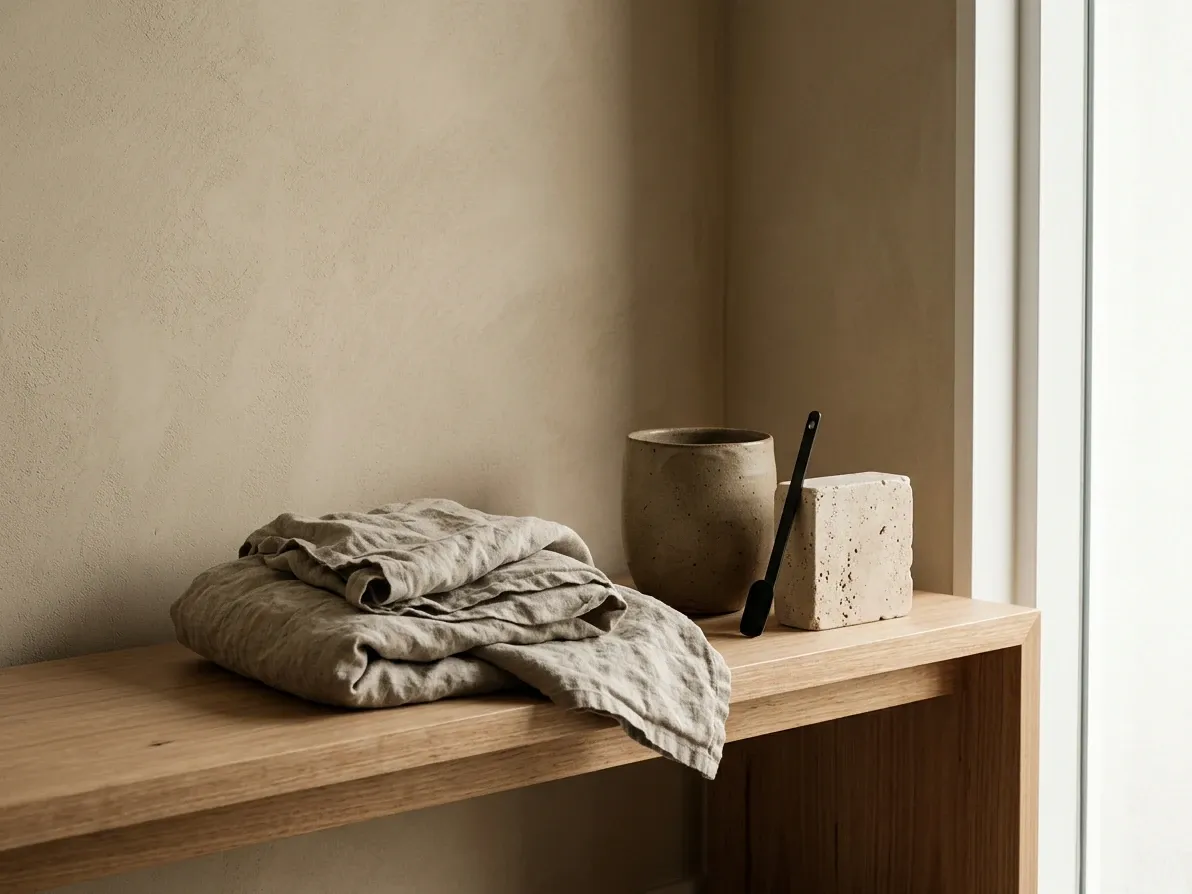
Materials do more work than colour in a Japandi room.
Colour palette, materials and textures
The Japandi palette is not white. That is the first correction most Australian homeowners make when they start on a Japandi brief.
The foundation runs through five to seven warm neutrals: mushroom, oat, sand brown, stone grey, off-white, soft ash and, at the darker end, warm charcoal or ink. These do not need to be spread evenly. A Japandi living room might be 60% one warm neutral (walls, larger textiles, floor rug), 30% a slightly darker or slightly warmer relative (upholstery, secondary rugs, timber), and 10% a considered accent (deep terracotta, muted moss green, a single black object, or a rich walnut). The rule is that no accent should shout.
Materials are the second lever, and Japandi is unusual in that materials do more work than colour. The five materials that appear in almost every Japandi room, in some combination, are timber, stone, linen, ceramics and rattan or cane. The Making a Green Life by Lily 2026 Japandi update adds a useful sixth to that list for 2026: matte metal, usually blackened steel or brushed brass, in small hits.
The trap is treating those materials as a checklist and installing one of each in every room. The reality is that a good Japandi room usually leans on two of them heavily (say, oak and linen), touches a third (a single stone piece) and uses the others sparingly. Layering many materials at once is Boho, not Japandi.
Textures matter more than in almost any other style. Because the palette is quiet, the visual work is done by the difference between materials: the smoothness of honed stone against the tooth of raw linen, the softness of a wool rug against the crispness of oak. Where all your finishes are the same texture (all matte, all soft, all flat), the room reads as bland. Where they are the same colour but different textures, the room reads as Japandi.
Furniture and where to shop in Australia
The Japandi furniture market has grown fast enough in Australia that you do not need to import to get the look. The specialists worth knowing:
- Japandi Estate (japandiestate.com) is Steph and Gian Ottavio’s studio, born out of their 2023 Block win. Furniture and textile range is small but consistently on-brief.
- APATO (apato.com.au) imports high-end Japanese designer furniture and lighting into a Melbourne showroom, and is where to look for authentically Japanese pieces rather than Japandi-styled Australian ones.
- Cocolea (cocolea.com.au) does luxury bespoke furniture out of Melbourne with a strong Japandi-adjacent range.
- IconByDesign (iconbydesign.com.au) carries a broad Japandi-labelled collection of oak beds, chests and dining tables at more accessible price points.
- Castlery (castlery.com/au) is Singapore-founded, factory-direct, and has a Sydney showroom where you can test pieces before ordering, plus an explicit Japandi collection.
Mainstream retailers with a good Japandi-adjacent range include Freedom, Temple & Webster, Koala, Lifely, Kave Home and, at the entry-level end, IKEA. Handmade ceramics from Australian potters (Pepo Ceramics, Fairweather Studio, Simone Karras) are worth building a small collection of over time.
The Japandi rule for shopping is: never buy the set. Buying a matching Japandi bed, bedside, mirror and rug from a single retailer produces a room that reads as a catalogue page. The point of the style is slow curation, so a mixed source list (an oak dining table from one place, hand-thrown ceramics from another, a wool rug from a third, a vintage Japanese woodblock print) is closer to the intent.
Common Japandi mistakes to avoid
Every Japandi guide lists the same mistakes: pure white walls, over-accessorising, matching sets, buying too fast. Those are all correct. The ones that specifically catch out Australian homeowners are worth spelling out:
Treating “warm minimalism” as a colour of paint. Japandi is not “which mushroom Dulux should I paint the walls”. The style comes from the material choices and the object density, not the paint chip. A room with cheap laminate cabinetry painted in the right shade of mushroom is not a Japandi room; a room with genuinely warm timber, linen textiles and one considered object is, even if the walls are pure white.
Overheating the room with too much warm timber. In Australia’s stronger natural light, a floor-plus-wall-plus-ceiling-plus-cabinetry combination in the same mid-oak reads as sauna-hot. Pull one of those planes back to a pale plaster wall or a soft paint colour, and the timber pieces gain the space to breathe.
Using cool grey where the palette wants warm grey. This is the single most common Australian error. The Japandi palette is warm-based; a cool grey couch, or a cool grey polished-concrete floor, will fight every warm-timber piece you put around it and read as unfinished rather than restrained.
Buying the “Japandi collection” from a single big-box retailer. Every mistake above compounds when the entire room comes from one range. Even a single vintage piece, or one handmade ceramic, breaks the catalogue-page feel that catalogue-page furniture creates by definition.
Forgetting maintenance. Natural materials look their best when they are cared for, and the wabi-sabi tolerance for wear does not extend to neglect. Timber benches, floors and vanities need oil, not neglect; linen upholstery needs washing; woven baskets need airing.
Rushing. More than any other style, Japandi rewards slowness. Fabricakraft’s 2026 Japandi trend report names impatience as the top mistake. If you buy the whole room in a fortnight, it will read that way for the ten years after.
If you want to see how any of this looks before you commit to buying or renovating, reIMG can produce a photorealistic 3D visualisation of a Japandi version of your existing room or floor plan from a single reference photo. Being able to see the palette, the timber and the object density in your own space before you spend on it is what separates a Japandi brief that lands from one that turns into an expensive Scandi.
Frequently asked questions
Is Japandi the same as minimalism?
No. Minimalism is defined by reduction, and a Japandi home shares that restraint, but the point of Japandi is warmth, not emptiness. A truly minimalist room can feel clinical; a Japandi room is meant to feel calm and lived-in, with soft light, textural fabrics, and handmade objects doing the emotional work that a strict minimalist scheme leaves out.
What’s the difference between Japandi, Scandi and wabi-sabi?
Scandi is the light, bright, hygge-driven look built for long Nordic winters. Wabi-sabi is a Japanese philosophy that finds beauty in imperfection, ageing and asymmetry. Japandi sits between them: it borrows Scandi’s clean lines, pale timber and functional furniture, then layers on the wabi-sabi appreciation of handmade, imperfect, quietly ageing materials. The Japandi palette is a shade earthier and moodier than a classic Scandi one.
Does Japandi work in a small Australian bathroom or apartment?
Yes, and small spaces often suit Japandi better than large ones. The style’s restraint (few objects, matched materials, tucked-away storage) is exactly what a compact ensuite or one-bedder needs. In a small Japandi bathroom, that means one timber vanity, one calm tile, matte black or brushed brass tapware, wall-hung fixtures to keep the floor clear, and no more than one or two ceramics on the bench. The result feels larger, not smaller.
What colours are used in a Japandi home?
Warm neutrals do the heavy lifting: mushroom, oat, sand, stone, off-white, soft ash grey. Accents are muted and drawn from nature, most often warm timber, deep charcoal or ink, olive or sage green, terracotta and, occasionally, a soft blue. Anything high-contrast (bright white against jet black) or cool (icy grey, brilliant white) breaks the mood.
Which timbers suit a Japandi Australian home?
Pale to mid-toned oak is the default, and it works with almost any accent. American walnut adds a warmer, deeper note where you want the palette moodier. Locally, Blackbutt, Tasmanian oak and Victorian ash all sit in the same tonal family and have the advantage of being widely available, more affordable than European oak, and comfortable in the Australian climate.
Where can I buy Japandi furniture in Australia?
The specialist retailers are Japandi Estate, Cocolea, APATO, IconByDesign and Castlery, which all carry the pale timber, low-profile silhouettes and linen upholstery the style relies on. Mainstream picks show up at Freedom, Temple & Webster, Koala and IKEA. Building slowly (one considered piece at a time, from mixed sources) is more Japandi than buying a matching set from one store.
Is Japandi going to date?
The base of the style (pale timber, natural materials, handmade objects, restrained colour) has been part of both Japanese and Scandinavian design for decades, and neither tradition has aged badly. What will date is the surface trend layer: Instagram-perfect single ceramic bowls, matte black everything, and identical low bed frames from the same three retailers. If the room is built around good bones and slowly collected pieces, it should hold up.