Bathroom vanity: timber, stone, fit and finish
How to choose a bathroom vanity in Australia in 2026: mount, material, top, basin, dimensions, storage, tapware and what each tier actually costs.
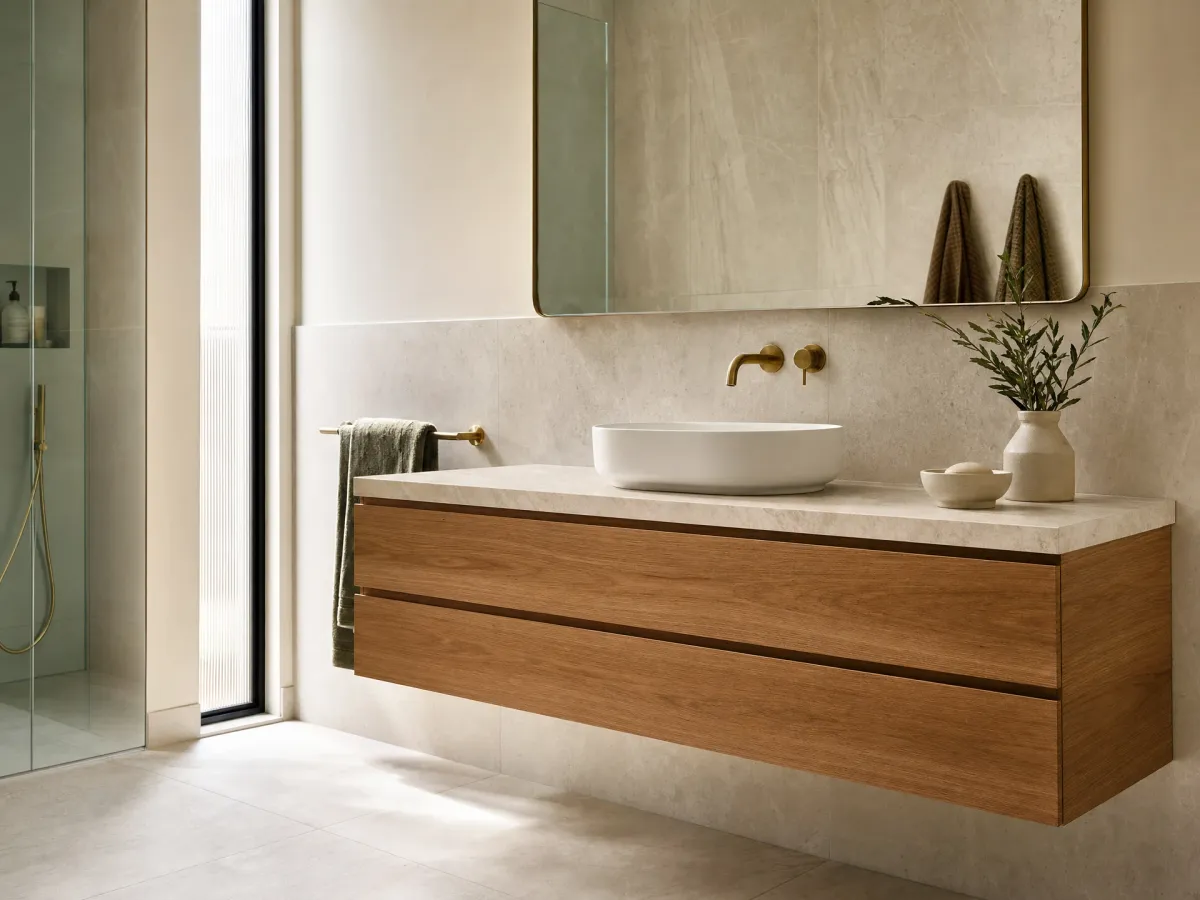
The vanity is the only piece of joinery in a bathroom you stand in front of every morning, the largest single object after the bath, and the surface every visitor lays a hand on. It is also the decision most renovators make last, in a tile showroom, on a phone, between two other appointments. The result is the bathroom that looks expensive in the photos and slightly off in the room: a stone top half a tone cool of the floor, a basin three centimetres too far back, a drawer that catches the plumbing.
There is no shortcut around the choices, but there is an order. The vanity is one object made of four decisions (how it mounts, what the cabinet is made of, what the top is made of, how the basin sits on it) plus a string of smaller ones (dimensions, height, storage interior, tapware, hardware). Made in order, those decisions reinforce each other. Made out of order, they fight.
This guide works through them in the order they actually matter, with what each tier costs in Australia in 2026, what the engineered stone ban changed, and the specific regrets that show up over and over in showroom feedback.
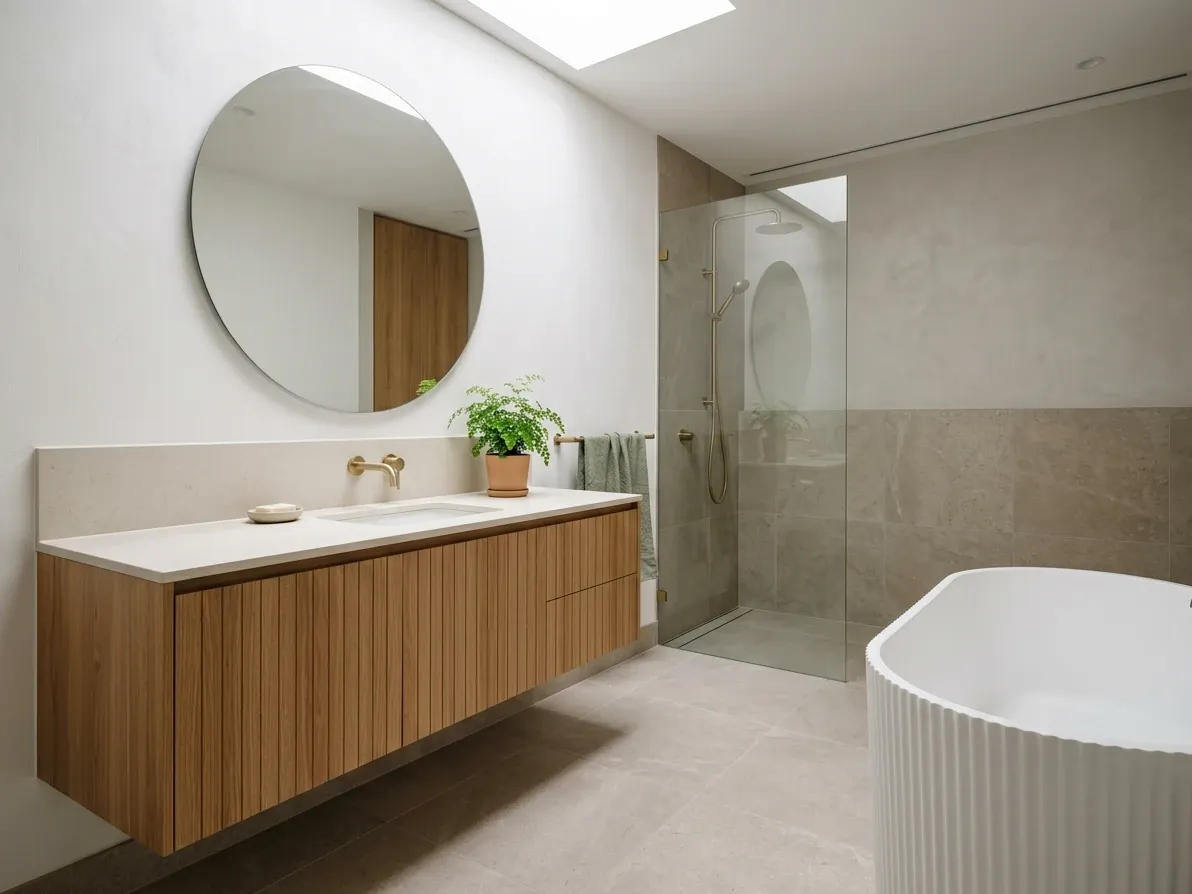
The vanity sets the room’s visual centre and its daily rhythm.
What a vanity is actually doing in the room
A vanity does three jobs at once, and the way it does each one drives the choice. It carries the basin and tapware, so it has to lock to plumbing in two specific locations. It stores everything you use daily, so its internal volume and access pattern matter more than its frontage. And it sets the visual centre of gravity for the bathroom, because it is usually the longest horizontal object in the room and the only piece of joinery the eye can really land on.
Get the first job right and the room functions. Get the second right and the bathroom stops feeling cluttered. Get the third right and the room reads as one designed object instead of a collection of fittings. Most poor vanity decisions come from solving only one of the three. A bargain flat-pack solves storage but reads as flat. A sculptural basin on a thin floating slab reads beautifully but holds nothing. A heavy traditional cabinet looks substantial but eats half the floor area in a 3 square metre ensuite.
The four decisions, made in this order
People talk about choosing a vanity as if it is one decision. It is four, in this order, with everything else falling out of them.
Mount. Floating (wall-hung) or freestanding. This is the decision the rest of the vanity sits inside, because it changes what the wall has to carry, where the plumbing comes through, how the floor reads, and what dimensions are even possible.
Cabinet material. Solid timber, timber veneer, 2pac polyurethane, laminate, thermolaminate. Each has a different cost, a different resistance to moisture and steam, and a different mood.
Top. Porcelain slab, sintered stone, natural stone, timber, laminate. The engineered stone ban knocked the most common Australian mid-range answer out of the catalogue from July 2024; the replacements are not interchangeable.
Basin. Undermount, semi-recessed, above-counter, integrated. The basin choice is the one that decides where the tap goes, how splash behaves, and how the top has to be cut.
Below each decision, the small ones (dimensions, height, storage interior, tapware) follow.
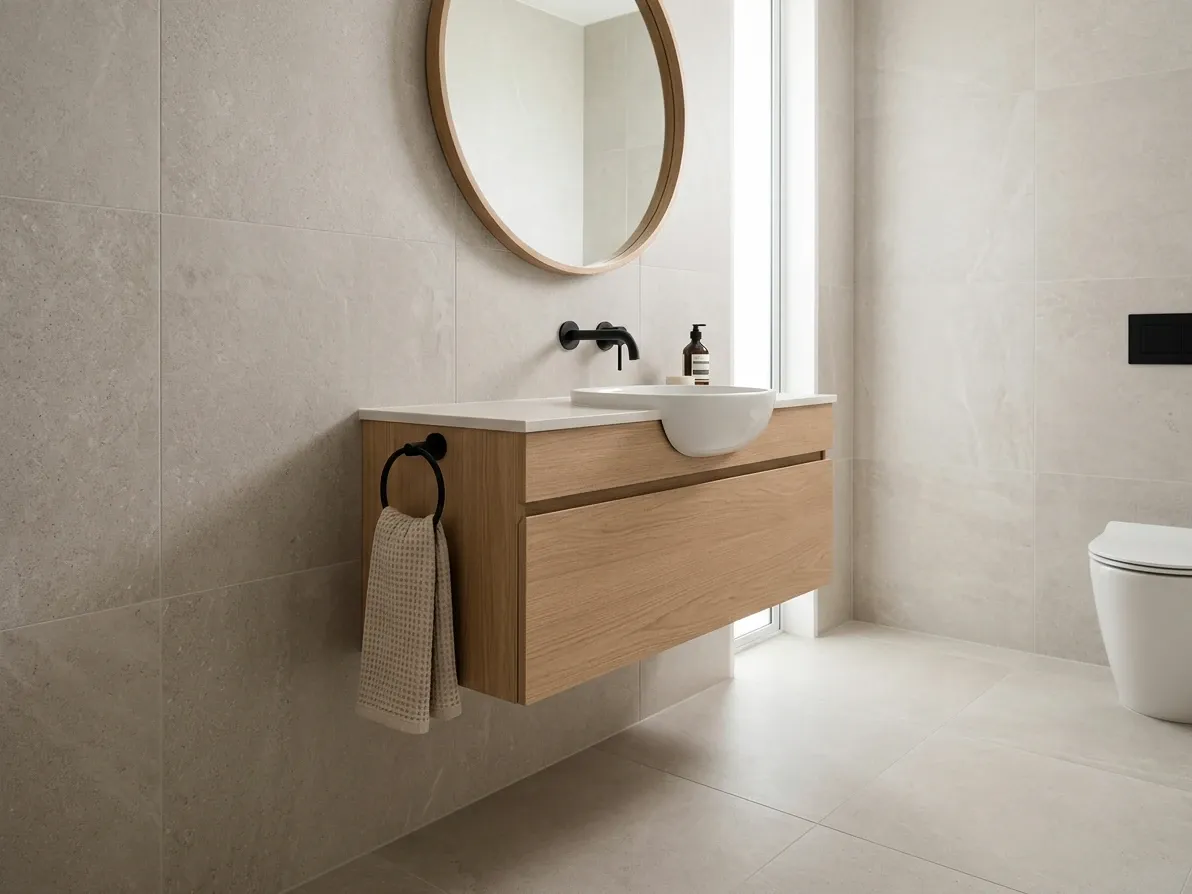
Floor running unbroken under the cabinet reads larger than a kicked base.
Decision 1: how it mounts
Floating and freestanding are not equivalent options. They produce different rooms, cost different amounts to install, and impose different constraints on what comes next.
Floating (wall-hung) vanities
A floating vanity is bolted into the studwork behind the wall and carries everything on that fix. The floor tile runs unbroken underneath it, which is the visual move that makes a small Australian bathroom feel larger: the eye reads the full floor area rather than meeting a kickplate. The wall-hung format is also the easier of the two to keep clean (no kick-space gap collecting hair, no skirting to scrub) and lets you set the rim height anywhere from 800 mm for shorter adults and accessible bathrooms to 950 mm for taller users.
The cost is structural. The wall has to be a stud wall with timber or steel framing capable of carrying 80 to 120 kg once the cabinet, stone top, basin and a full bay of stored items are mounted. Most modern Australian bathrooms have this; pre-1980 brick or hebel-block bathrooms often need a structural fix during the renovation. Installed labour for a floating vanity runs 10 to 20% above a freestanding equivalent because of the anchor work.
Where floating wins: any small bathroom, any minimalist or contemporary style, any room where the floor tile is doing visual work, any room that needs to read modern. The trend has been moving steadily toward wall-hung formats across Australian showrooms since 2018, and 2026 sees floating units the default in new builds and contemporary renovations.
Freestanding vanities
Freestanding vanities sit on the floor like furniture, with a closed kick base or visible legs. The cabinet can run flat to the floor (kick-base) for the most storage, or be lifted on slim metal legs or timber stiles for a lighter look. Floor tile stops at the cabinet edge or runs underneath if a leg-stand format is chosen.
What freestanding wins is install simplicity (no structural anchor), more usable internal volume at the same width (the kick area becomes drawer or cupboard space), and the warmer, more traditional read that suits Hamptons, French Provincial, country, farmhouse and heritage bathrooms. A freestanding shaker vanity in soft white still belongs in a Queenslander bathroom in a way a floating slab does not.
Where freestanding wins: heritage homes, traditional styles, larger bathrooms where the floor area is generous enough that the kick line does not matter, family bathrooms where storage volume matters more than visual lightness. For renovators who want to keep the option of moving the vanity later (rental conversions, granny flats, modular fit-outs), freestanding is also the cleaner choice because nothing is bolted into the wall.
The mount decision drives the next two. Floating limits how heavy the top and basin combination can be (most floating units cap at about 50 kg of top weight before the wall fix gets nervous), which can rule out heavy natural stone slabs in a 1500 mm-plus format. Freestanding has no such cap.
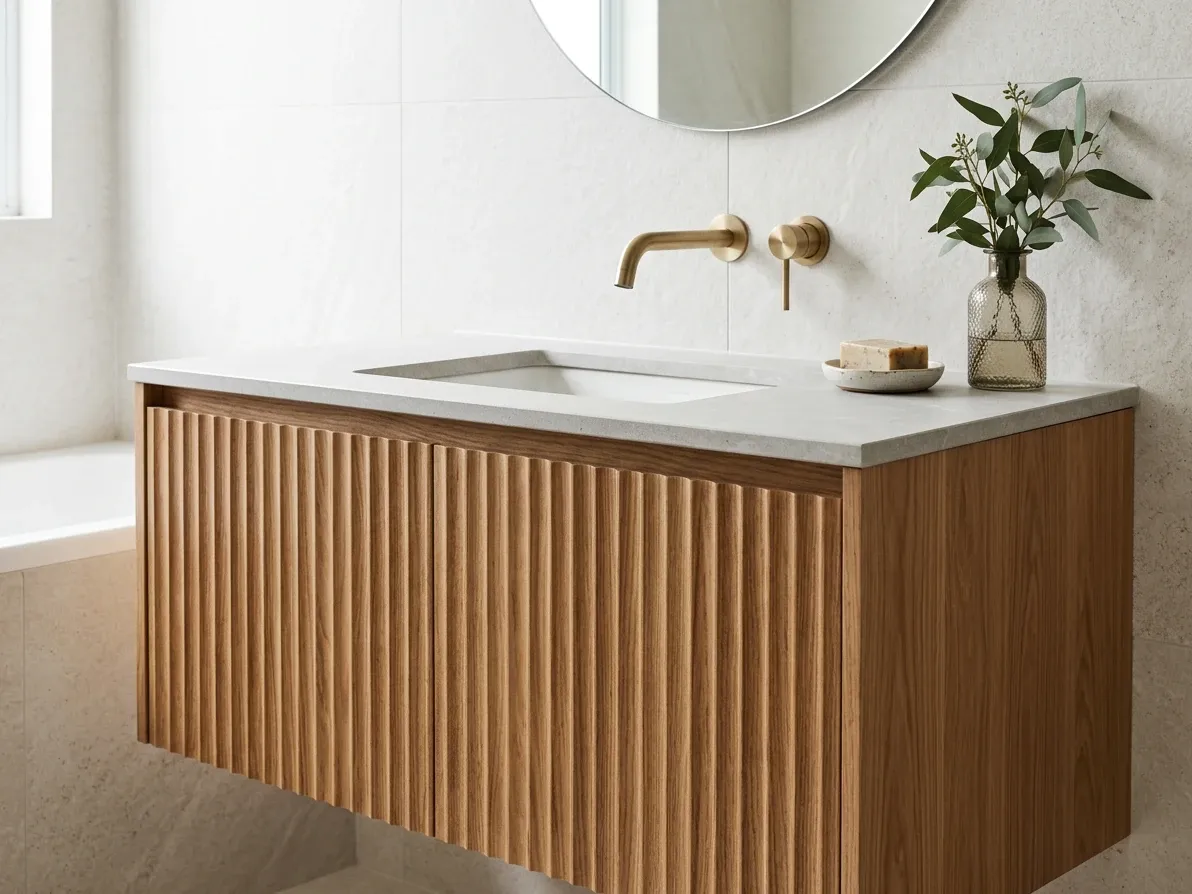
Timber adds warmth a tiled room can’t carry on its own.
Decision 2: what the cabinet is made of
Five materials cover almost every Australian bathroom vanity, and the price ladder between them is wider than most people expect.
Solid timber
Real timber, almost always Australian hardwood for marine-grade bathrooms: American oak, blackbutt, Tasmanian oak, marri, jarrah, walnut. The grain reads as warmth in a room dominated by hard tiled surfaces, and the texture works against the trend toward cold minimalism that defined the 2010s. A properly sealed solid timber vanity from a maker like Bombora Custom Furniture, Jarrimber or Royal Vanities holds up for 15 to 25 years in a ventilated Australian bathroom.
The weakness is movement. Solid timber expands and contracts with humidity, which means panel joins can show seasonal hairlines and a high-shine finish can crack at the edges over a decade. The trade response is to laminate solid timber over a stable MDF core for the carcass and leave solid timber for the door fronts and any visible surface; that combination eats most of the movement problem without losing the look. The other constraint is finish: an oiled or matte timber finish ages gracefully, a high-gloss timber finish does not.
Installed price tier: $4,000 to $12,000 for a 900 to 1200 mm vanity, top excluded.
Timber veneer
A thin layer of real timber bonded to an MDF or marine ply core, finished with the same oils, lacquers or 2pac topcoats as solid timber. Veneer is the way to get the real-grain look at roughly half the cost, with better dimensional stability because the substrate handles the movement. American oak, walnut and Tasmanian oak veneers are the most common in Australian bathroom catalogues.
Veneer’s honest weakness is the edge. A factory-edged veneer panel shows a seam where the front face meets the side, and water sitting on a poorly detailed edge can lift veneer over years. Quality bathroom joiners now use post-form veneer (the veneer wraps the edge in one continuous piece) on visible corners. Ask before specifying.
Installed price tier: $2,500 to $7,000.
2pac polyurethane
Two-pack polyurethane paint sprayed onto a moisture-resistant MDF substrate and oven-baked, usually in three or more coats. 2pac is the most popular mid-range cabinet finish across Australian bathroom suppliers because it gives the smoothest, most seamless paintable surface on the market, lets you specify any colour at any sheen (matte, satin, gloss), and has no edge strips that can lift. The finish is more forgiving than melamine or laminate, scratches can be touched up locally, and 2pac handles humidity better than thermolaminate.
The trade-offs are cost (2pac runs 15 to 25% above an equivalent laminate vanity), lead time (the spray-and-bake cycle adds one to two weeks), and scratch sensitivity (2pac chips more easily than a hard laminate if you drop a heavy tapware fitting on it). The 2pac sweet spot in 2026 is a soft matte or low-sheen satin in a warm white, mushroom, sage, charcoal or warm bone; high-gloss white 2pac reads as last decade.
Installed price tier: $2,500 to $6,500.
High-pressure laminate
A laminate sheet bonded to a particleboard or MDF core, finished with a separate edge strip. Modern laminate is denser, harder and far more convincing than the laminate of fifteen years ago. The current generation of super-matte and anti-fingerprint laminates from Polytec, Laminex and Formica gets within touching distance of a 2pac finish for half the price. Laminate is also the hardest of the cabinet finishes (resists fingerprints, knocks, chemicals) and the right choice for rental fit-outs and family bathrooms where a five-year-old is the dominant user.
The weakness is the edge: even a well-detailed laminate shows a thin seam where the strip meets the face, and around a basin or against a stone top, a hairline gap can collect grime. Specify ABS or PVC edging with hot-melt or PUR adhesive, not the cheaper paper-tape edge that lifts within a few years.
Installed price tier: $1,200 to $3,500.
Thermolaminate (vinyl wrap)
A vinyl film heat-pressed onto an MDF substrate. Thermolaminate is the cheapest finish that can hold a shaker profile (the vinyl wraps the routed groove in one piece), which is why it dominates the entry tier at Bunnings, Kaboodle and Reece. It looks acceptable when new but is the finish most likely to lift around heat sources and along bottom edges over time.
The honest fix for thermolaminate is to keep it well away from the shower glass run-off, ensure the bathroom is ventilated within Australian Standard requirements (an exhaust fan rated for the room volume), and accept that 7 to 10 years is the working lifespan before doors start to look tired.
Installed price tier: $600 to $1,800.
For most Australian mid-range bathrooms in 2026, the practical choice sits between a high-end laminate and 2pac, with timber veneer as a feature wall or pantry-bank accent the way it does in kitchen joinery. The premium default is full 2pac with a timber veneer feature panel or solid timber drawer fronts.
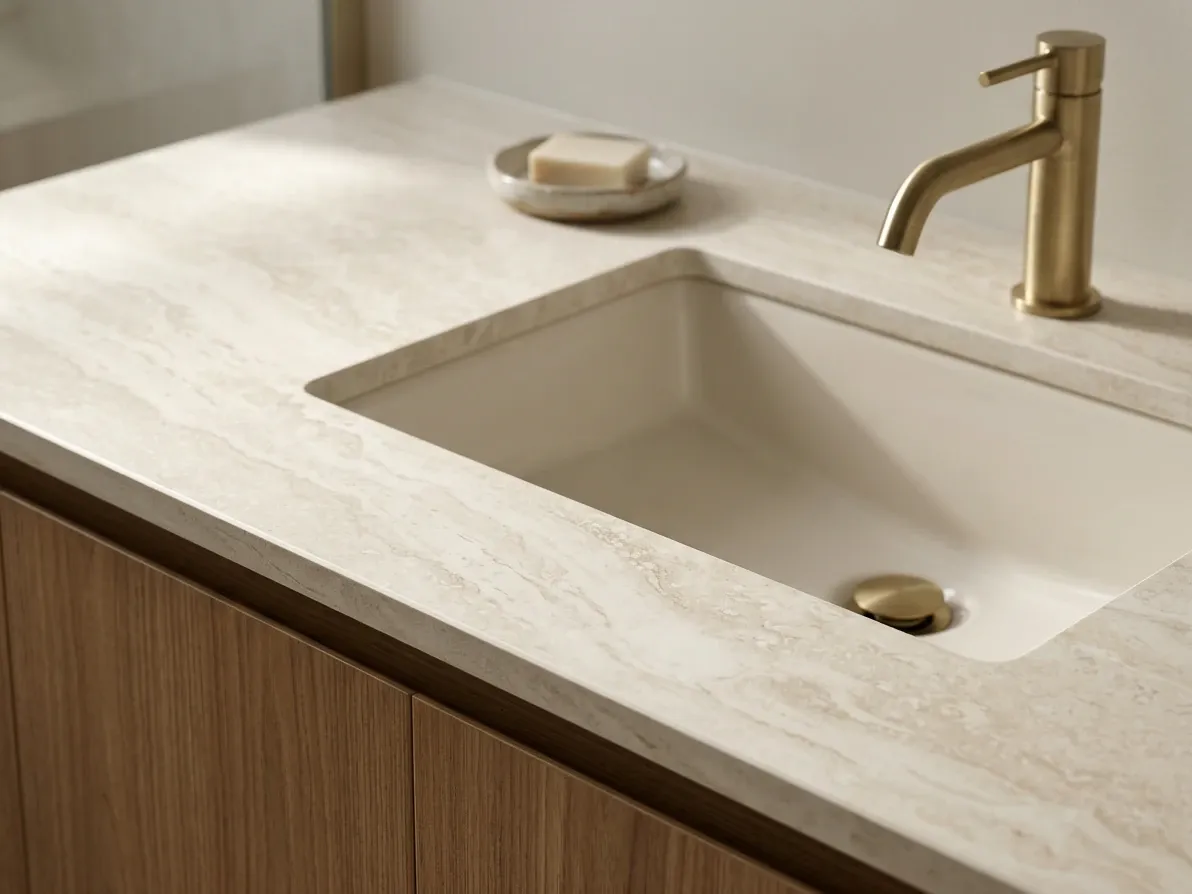
Porcelain replaced engineered quartz as the default mid-range top.
Decision 3: what goes on top
The vanity top decision changed permanently in 2024.
The Australian engineered stone ban took effect on 1 July 2024 for use, supply and manufacture, and on 1 January 2025 for import. The ban was driven by accelerated silicosis cases in stonemasons exposed to crystalline silica dust during cutting and grinding; engineered quartz often carried more than 90% crystalline silica. The legal effect on vanity tops is direct: any new engineered quartz benchtop (the Caesarstone Classic range, traditional Smartstone quartz, Silestone quartz) can no longer be installed in an Australian bathroom or kitchen. Existing installs can be repaired, modified or removed under controlled conditions, but the previous default mid-range top is no longer on the table.
What replaced it splits into five practical categories.
Porcelain slab
Porcelain has become the post-ban default for mid-range Australian vanity tops. It is sintered at high temperature from clay and minerals, has water absorption under 0.5%, is non-porous (no sealing required), and the current generation of large-format porcelain from brands like Dekton and the new Caesarstone Mineral and Porcelain collections is crystalline-silica-free and fully ban-compliant. Stone-look porcelain (marble-look, travertine-look, honed-limestone-look) now reproduces the appearance of natural stone convincingly enough to pass a designer-led showroom test.
Porcelain slabs come in 6, 12 and 20 mm thicknesses. 12 mm is the typical vanity top, 20 mm where you want a thicker visual reveal. Fabrication is more demanding than quartz was (slabs chip more easily during cutting, and edge profiling needs specialist tooling), so installed porcelain runs 10 to 20% above what engineered quartz used to cost. The pay-off is the lowest-maintenance, most heat-resistant, most stain-resistant top on the market.
Installed price tier (top only, 900 mm vanity equivalent): $850 to $1,800.
Sintered stone
Sintered stone (Lapitec, Neolith, some Dekton ranges) is a related ceramic-and-glass composite manufactured under heat and pressure. It performs similarly to porcelain in everyday use, is also non-porous and ban-compliant, and is marginally tougher at the surface for impact resistance. The visual range is slightly narrower (fewer marble-look options), and prices run roughly parallel to porcelain.
Installed price tier (900 mm equivalent): $900 to $2,000.
Natural stone
Marble, granite, travertine, limestone, slate. Real natural stone is back in mid- to high-end Australian bathrooms because the engineered-quartz replacement is now porcelain rather than quartz, and the price gap to genuine marble has narrowed. The most popular choices are honed (matte-finished) Carrara marble for traditional bathrooms, travertine for warm-Mediterranean bathrooms, limestone for transitional rooms, and granite for heavy-duty family bathrooms.
The honest trade-off is maintenance. Marble and travertine are porous and absorb bathroom products (toothpaste, makeup remover, hair dye, perfume) into the stone, where they can leave permanent stains. They need a penetrating sealer applied every 6 to 12 months and an etching-resistant attitude to acidic spills. For households where the bathroom user is willing to wipe up immediately and seal twice a year, marble is genuinely beautiful and ages with character. For households where someone will leave a hair-dye drip on the stone overnight, porcelain in a marble-look is the safer call.
Installed price tier (900 mm equivalent): $1,200 to $3,500.
Solid timber
A solid timber vanity top is the warmest option, and works particularly well over a timber-front cabinet in a Japandi, Scandi or coastal bathroom. Use a hardwood (American oak, blackbutt, walnut, marri) sealed with a marine-grade oil or hard wax, and ventilate the bathroom properly. Specify the top with a slight overhang so water runs off the edge rather than wicking into the cabinet face.
Timber tops do age. Water rings around the basin, oil staining from hair products and the slight darkening of the wood over years are part of the look. For the right room they read as patina. For the wrong room they read as wear. Decide which side of that line your household is on before specifying.
Installed price tier (900 mm equivalent): $900 to $2,400.
Laminate
Modern high-pressure laminate tops are flatter, denser and more convincing than the laminate of the 1990s. A stone-look laminate top (Polytec or Laminex) on a flat-pack cabinet is the budget answer that still looks acceptable, and is fine for a guest bathroom or a granny-flat ensuite. It is not the answer for a main bathroom you want to last 20 years.
Installed price tier: $250 to $600.
For most Australian mid-range bathrooms in 2026, porcelain slab is the default vanity top. Natural stone is the upgrade where the household will maintain it. Timber is the warmth accent where the design earns it. Laminate is the budget answer where the bathroom is provisional or the renovation budget went elsewhere.
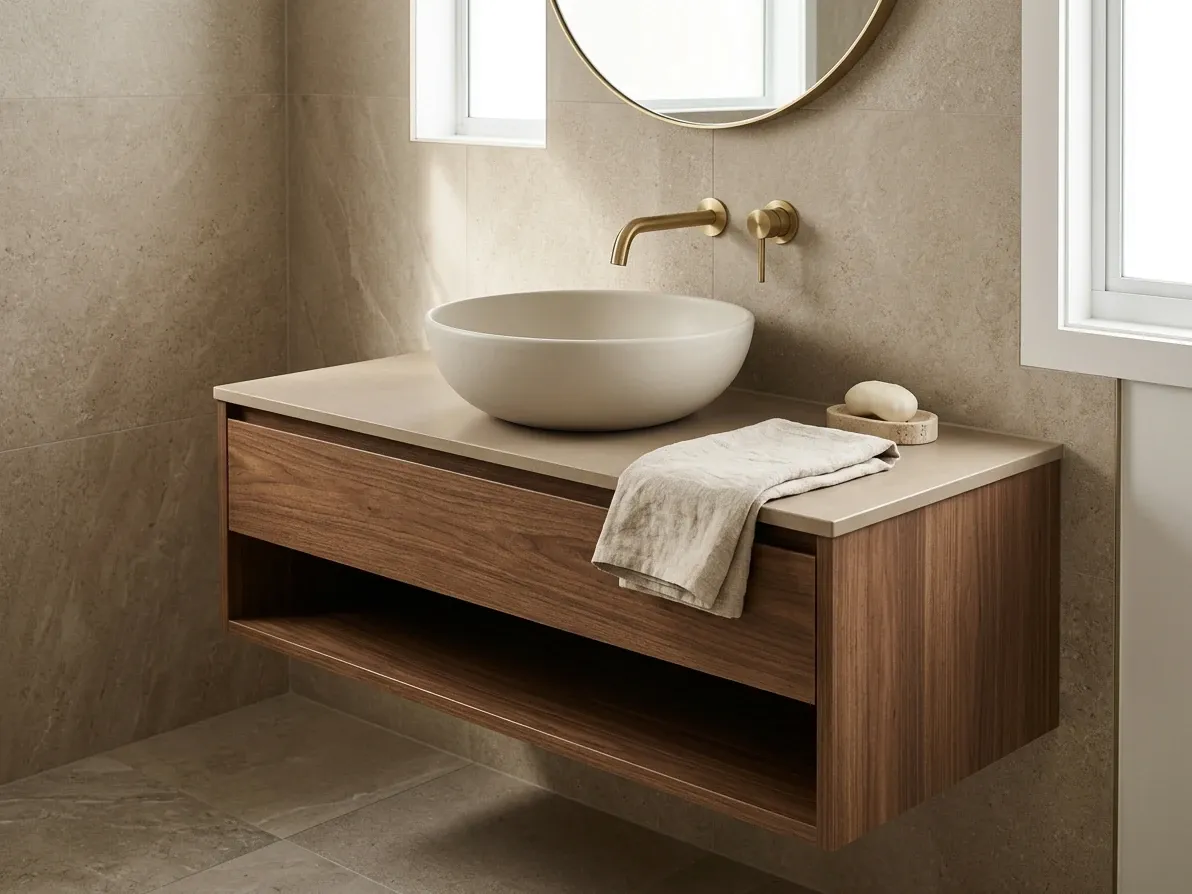
Above-counter basins read as objects; deck-mounted basins read as fittings.
Decision 4: how the basin sits on it
The basin choice decides where the top is cut, where the tap goes, and how splash behaves. There are four basin formats in regular Australian use, each with a different visual read and a different splash pattern.
Undermount basin
The basin sits below the top, glued to the underside. The top is cut with a precise hole the same shape as the basin opening, and the resulting edge is exposed stone. Undermount is the cleanest visual format: the eye reads the top as one continuous plane with a hole cut in it, and there is no rim catching dust or product.
The trade-off is the cost of the cut (a precise undermount cut in porcelain or stone adds $300 to $600 to the top fabrication) and the load it puts on the seal. Undermount basins must be glued and bracketed in compression so the silicone joint never carries the basin weight; cheap installs fail at this joint within 5 to 10 years.
Where undermount wins: mid- to high-end bathrooms, stone or porcelain tops, family bathrooms where wiping the bench clean matters.
Semi-recessed basin
The basin sits partly in the top and partly above it, with the front portion (usually 80 to 100 mm) projecting out over the cabinet front. Semi-recessed is the answer for shallow vanities (under 460 mm deep) where a full inset basin would not fit, and it is now common in narrow ensuites and powder rooms.
The visual read is somewhere between an above-counter basin and an undermount: the basin is visible as an object but does not project as much as a full vessel. Semi-recessed basins also keep the tap on the back deck of the vanity rather than wall-mounting, which is the more forgiving plumbing answer for retrofit renovations where the wall plumbing rough-in is fixed.
Installed price tier (basin alone): $150 to $600.
Above-counter (vessel) basin
The basin sits entirely on top of the bench, like a bowl on a table. Above-counter basins are the most sculptural format and the dominant look in higher-end Australian bathrooms through 2024 and into 2026, in ceramic, glass, stone or concrete. The visual move is to treat the basin as an object rather than a fitting, which works particularly well with a slim wall-hung vanity in a warm timber.
The trade-offs are tap height (you need a basin mixer tall enough to clear the basin rim, which means a taller tap or wall-mounted tapware), splash (water splashes further off a raised basin than out of a recessed one, so the bench has to be wider or finished in a wipe-clean material), and cleaning around the basin base (where the basin meets the bench is a permanent fingerprint zone).
Installed price tier (basin alone): $200 to $1,500.
Integrated (moulded) basin
The basin and the top are a single moulded piece in one material, usually solid surface (Corian, Hi-Macs), polymarble or moulded ceramic. There is no join between basin and top, no silicone bead, no seam to clean. The result is the cleanest functional surface in the catalogue: the bench, the basin sides and the basin floor are one continuous surface that wipes down in a single pass.
The visual trade-off is that the look is softer than an undermount or vessel basin, and the format limits your choice of bench material to whatever can be moulded. The maintenance trade-off is that solid surfaces can scratch under abrasive cleaning and matte solid surface develops a soft sheen over years.
Installed price tier (top + basin combined, 900 mm): $700 to $2,200.
Most mid-range Australian bathrooms in 2026 specify either an undermount basin in a porcelain top or an above-counter ceramic basin on a slim wall-hung timber vanity. Integrated basins are the family-bathroom sleeper pick where wipe-down hygiene matters more than visual drama. Semi-recessed earns its place in narrow rooms where geometry forces it.
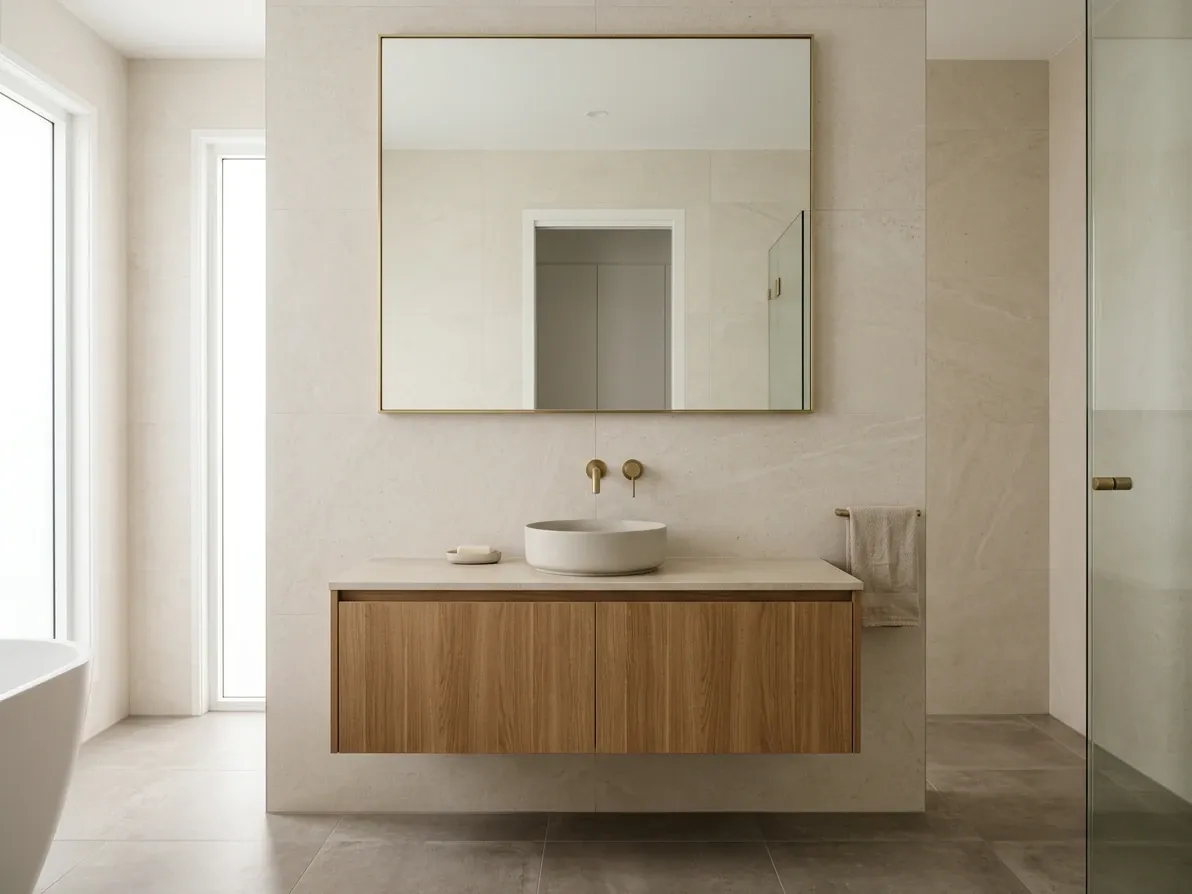
900 mm is the comfort default; 850 mm still right for shared family use.
Dimensions and height
Three numbers describe an Australian vanity: width, depth and height.
Width
Standard catalogue widths are 600, 750, 900, 1200, 1500 and 1800 mm. 900 mm is the volume choice for a single basin in a main bathroom, 600 to 750 mm for compact ensuites and powder rooms, and 1500 mm-plus for double basins. The smaller AU bathroom is also driving demand for slimline 400 to 550 mm wide units in powder rooms and under-stair ensuites.
Going custom on width adds 20 to 40% to the cost over modifying a catalogue size, per several Australian flat-pack and joinery suppliers. The cleanest spec is to design the room around a catalogue width if you can; the wall length between the shower and the door rarely dictates a non-standard vanity.
Depth
Standard depth is 450 to 550 mm, with slimline options under 460 mm available for narrow rooms. The deeper end (500 to 550 mm) gives more bench around the basin and more drawer volume; the shallow end (380 to 460 mm) fits where the room cannot afford the floor area. For any depth under 460 mm, a semi-recessed basin is usually the answer, because a full inset basin needs about 470 mm of top to sit in cleanly.
Height
The traditional 850 mm Australian vanity is now competing with the 900 mm comfort height that matches a kitchen bench, and for most adults 900 mm is the more ergonomic answer. The shorter 800 to 820 mm formats that defined 1990s and 2000s bathrooms forced a daily stoop that 2026 buyers will not accept.
The current spec across most Australian bathroom showrooms:
- 800 to 830 mm: accessible bathrooms designed under AS 1428.1 (knee clearance, basin rim height for seated use).
- 850 mm: family bathrooms shared with children, where shorter users need to reach the basin.
- 900 mm: master bathrooms, ensuites and adult-only powder rooms. Now the most common spec in Australian new builds.
- 920 to 950 mm: taller-than-average households. Custom only.
Wall-hung vanities let you set the height during install. Freestanding vanities lock the height to the factory dimension. If household members vary in height significantly, default to 880 mm as the compromise rather than splitting the difference at install.
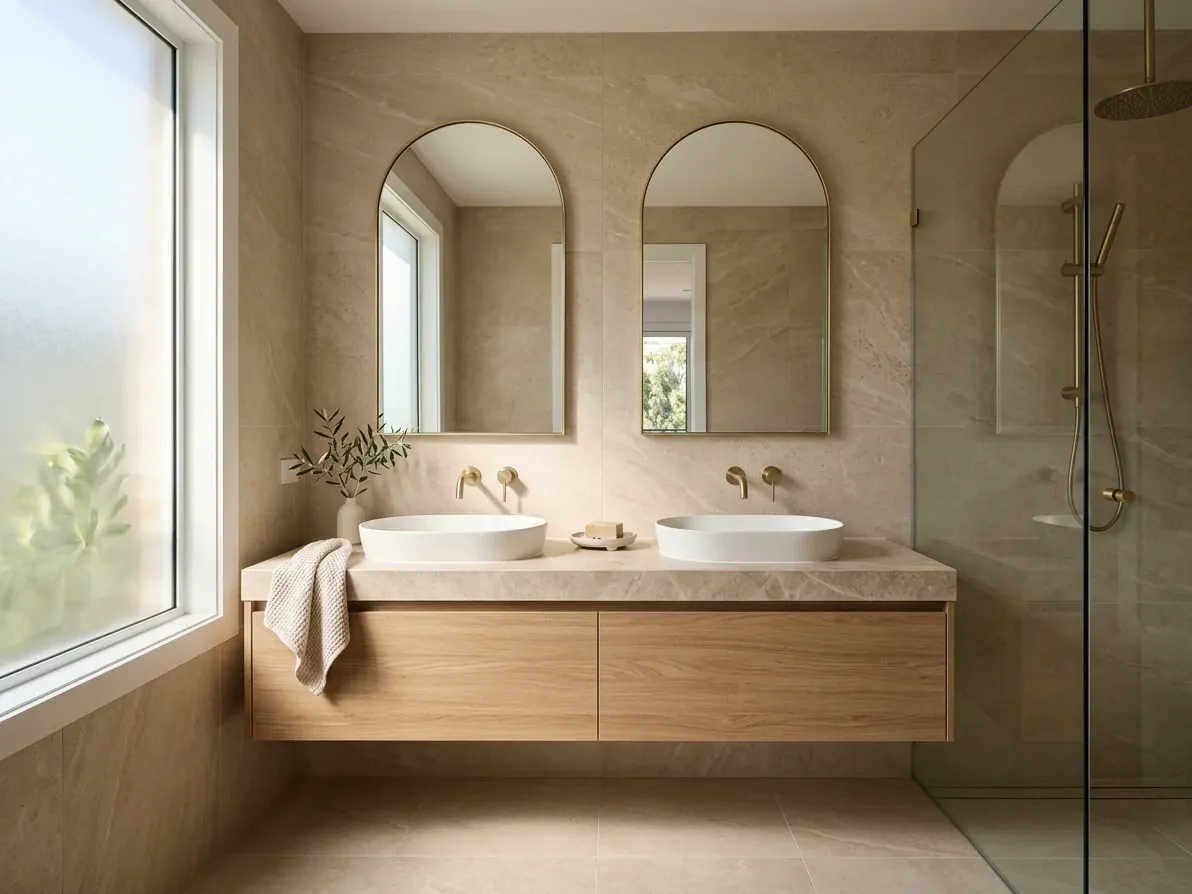
Double vanities want 1500 mm minimum; 1800 mm is the comfortable answer.
Single or double in an ensuite
Double vanities are popular in Australian master ensuites and resell well, but only in rooms wide enough to carry them. The functional minimum for two basins to work is 270 to 300 mm of clear edge-to-edge separation between them, which means a 1500 mm vanity is the floor and 1800 mm is the comfortable answer.
A 1200 mm double basin vanity exists in catalogues but produces a frustrating room: two basins sitting almost touching, no bench between them, and both users elbow-clashing on a busy morning. The cleaner spec at 1200 mm is a single 1200 mm basin centred on a wide bench. At 1500 mm the math just works; at 1800 mm there is meaningful bench between and outside the two basins.
The other practical constraint is the plumbing. Two basins double the supply and waste connections, which adds $400 to $900 to a renovation plumbing bill. The cabinet itself can usually carry two basins on one slab top without significant fabrication penalty, but the plumbing wall behind has to be sized for the rough-in.
The honest test for double vanities: if you and another adult use the bathroom at the same time more than three mornings a week, doubles earn their place. If not, a single 900 to 1200 mm vanity with a generous bench reads better and stores more.
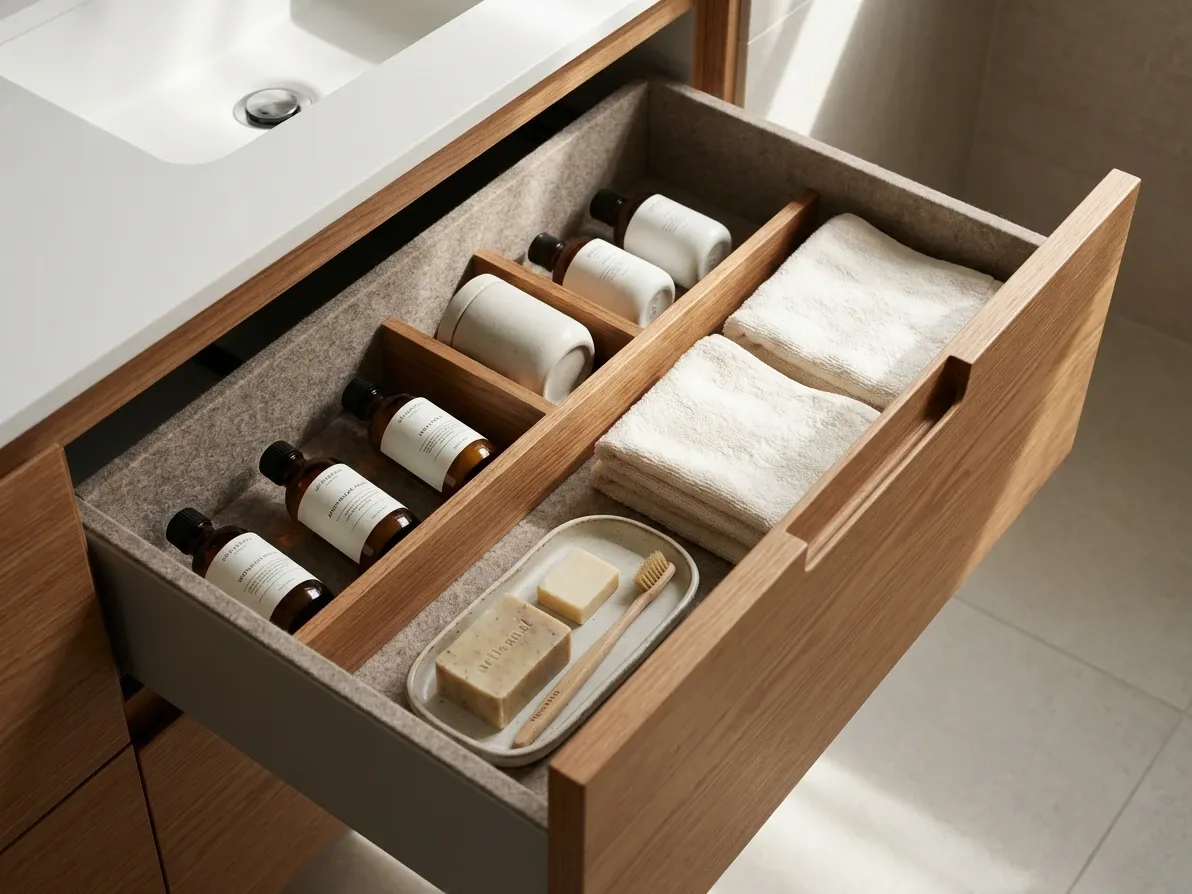
Drawers beat cupboards for daily access in almost every bathroom.
What goes inside
Drawers or cupboards is the second-biggest decision after the four above, and the one most flat-pack buyers default into by accident.
Drawers
Drawers let you see everything in storage as you pull them out, give you usable volume right to the back, and remove the daily reach into a dark cupboard. Soft-close runners from Blum or Hettich carry a lifetime warranty on the mechanism and stay smooth for decades. The cost premium is real (drawer hardware adds 20 to 30% to the cabinet price over a comparable cupboard) but the ergonomic gain is daily.
The constraint is the basin and plumbing. The trap and supply pipes under a basin take up the upper drawer area, which means the top drawer is usually a “false front” (a fixed panel that looks like a drawer face but does not open) and the second drawer down has to clear the trap with a notch cut into the back panel.
Cupboards
Cupboards earn their place for tall items the drawer cannot fit: cleaning bottles, hairdryers on tall stands, laundry baskets, vacuum attachments. They are also the natural answer under the plumbing where the trap and supply pipes are anyway. The honest weakness is the dark back corner that nobody reaches into; everything in the back third of a vanity cupboard becomes invisible.
The mixed default
The cleanest spec for an Australian family bathroom vanity is a small false drawer at the top under the basin, one shallow usable drawer (for everyday products), one deep drawer (for towels or larger items), and a cupboard or open shelf under the plumbing for the items the drawers cannot hold. That combination uses every centimetre of internal volume and means the back corner of the cabinet is the cupboard’s responsibility, not the drawer’s.
For wall-hung vanities under 750 mm wide, the format usually becomes one shallow drawer and one deep drawer with no cupboard. The plumbing has to be tucked into a back service void to make this work, which is a choice the cabinetmaker makes during fabrication.
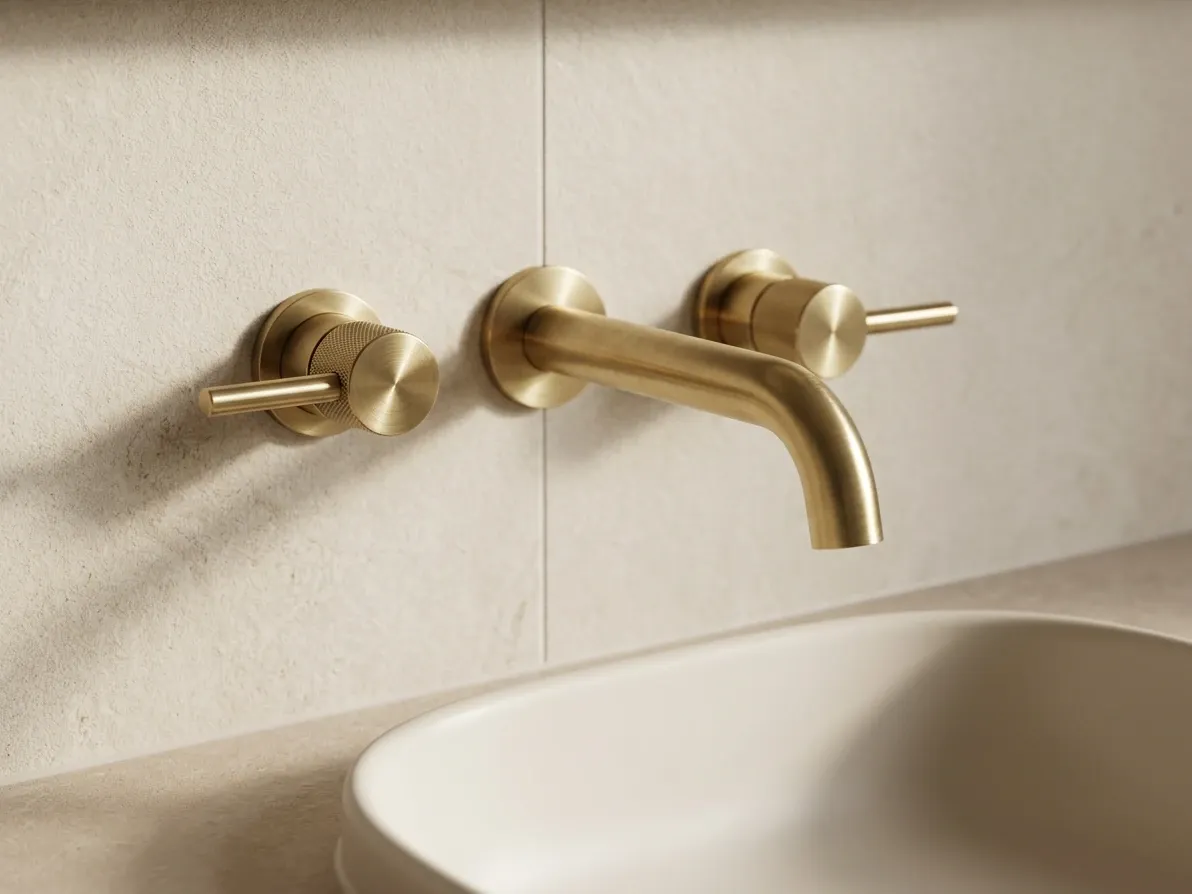
Wall-mounted tapware frees the bench but locks in the rough-in.
Tapware and where it goes
The tap decides where the top is cut, and the top decides what the tap can be.
Deck-mounted tapware
The standard format: the tap sits on the back of the vanity top behind the basin, plumbed up through the cabinet. Deck-mounted basin mixers are the volume answer in Australian bathrooms and run $150 to $1,500 depending on brand and finish.
The constraint is the bench depth behind the basin. The tap needs about 80 to 100 mm of clear bench behind it for the spout to clear the basin rim, which means a shallow vanity (under 460 mm deep) cannot comfortably take a deck-mounted tap without crowding the basin. Plan the tap and basin together rather than ordering them separately.
Wall-mounted tapware
The tap is plumbed through the wall behind the vanity, with the spout projecting out over the basin and the handles mounted on the wall above the bench. Wall-mounted formats free the bench surface entirely, which is the visual move that makes a slim wall-hung vanity read as architecture rather than a fitting.
The cost is the rough-in. Wall-mounted tapware needs the plumbing run inside the wall to be sized and positioned before the wall is tiled, which means it has to be specified at the very start of the renovation. Retrofitting wall-mounted tapware to an existing wall is possible but expensive (the wall has to be opened, re-plumbed, re-waterproofed and re-tiled), so almost all wall-mounted installs are part of a new build or a full bathroom strip.
Wall-mounted also pairs naturally with above-counter and integrated basins, where the basin rim sits high enough that a deck-mounted tap would need an unusually tall mixer.
Tap finishes
The 2026 default across Australian bathroom showrooms has moved firmly away from polished chrome (which reads as 2010s) toward brushed brass, matte black, gunmetal, brushed nickel and warm gold. Pick one metal family for the room and use it consistently across tapware, towel rails, robe hooks, mirror frames, drawer pulls and visible hinges. The bathroom that mixes brushed brass tapware with chrome rails and black robe hooks reads as unfinished even when every individual piece is beautiful.
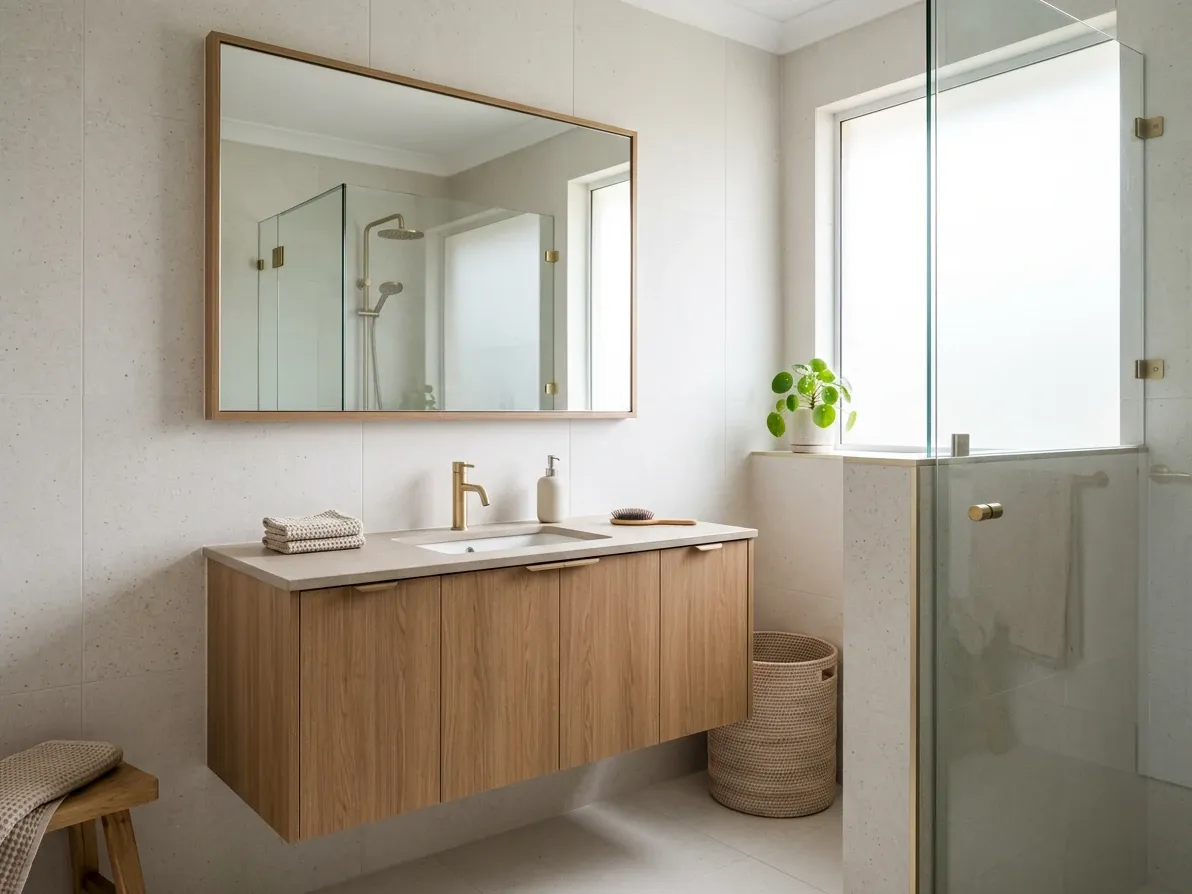
Semi-custom joinery is the tier most mid-range renovations land in.
What each tier actually costs
Vanity, top, basin and tapware combined sit at 12 to 18% of a typical Australian mid-range bathroom renovation, which the HIA Kitchens and Bathrooms Report puts at around $22,000 to $26,000 nationally in recent reporting cycles. That means a $26,000 main bathroom renovation typically spends $3,100 to $4,700 on the vanity assembly.
Four practical tiers cover the market.
Flat-pack (DIY or installed)
A flat-pack vanity from Bunnings, Kaboodle, IKEA or Freedom Furniture in laminate or thermolaminate with a basic stone-look top and a budget basin and tap. $400 to $1,500 for the cabinet alone, $1,500 to $3,500 fully installed. Good for: rental fit-outs, secondary bathrooms, granny flats, provisional installs. The honest weakness: 7 to 10 year working life and limited size choices.
Ready-made from a bathroom showroom
A pre-designed vanity from a major Australian bathroom retailer (Reece, Beaumont Tiles, ABI Interiors, Highgrove Bathrooms, Wellsons, Caroma) with a stone or porcelain top and a brand-name basin and tap. $1,500 to $4,500 installed. Good for: most family main bathrooms, single ensuites, mid-range renovations where the rest of the bathroom is also mid-range.
Semi-custom joinery
Your sizes, your choice of door style and finish, a supplier basin and tap, fabricated by a local kitchen and bathroom joiner. $3,500 to $8,000. Good for: any room where catalogue widths do not fit, any household that wants a specific colour or door style not in the ready-made catalogues, any bathroom where the vanity is the design centrepiece.
Fully custom (bespoke)
Designer-spec joinery in solid timber, 2pac or veneer, with a designer basin (Apaiser, Victoria + Albert) and premium tapware (Brodware, Sussex, Astra Walker), often integrated with custom mirrors and joinery elsewhere in the bathroom. $8,000 to $25,000 and above for double or signature vanities. Good for: high-end renovations, master ensuites, heritage homes where the vanity has to match other custom joinery, any room where the vanity is doing significant visual work.
The midpoint of the tier ladder runs $1,000 (flat-pack DIY), $2,500 (flat-pack installed), $3,000 (ready-made showroom), $5,500 (semi-custom), $14,000 (fully custom). The biggest jump on the ladder is from semi-custom to fully custom; the smallest is from flat-pack installed to ready-made showroom.
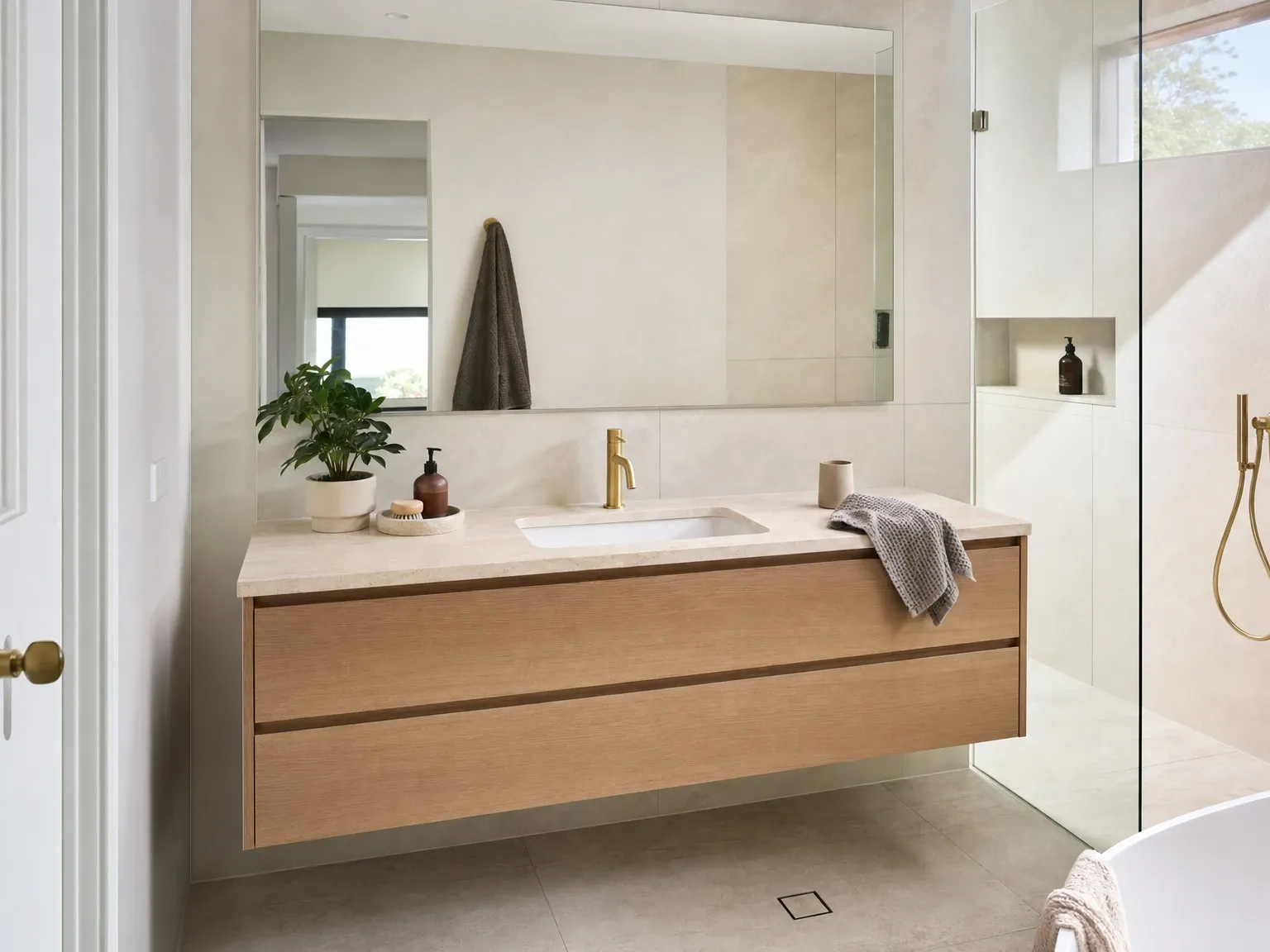
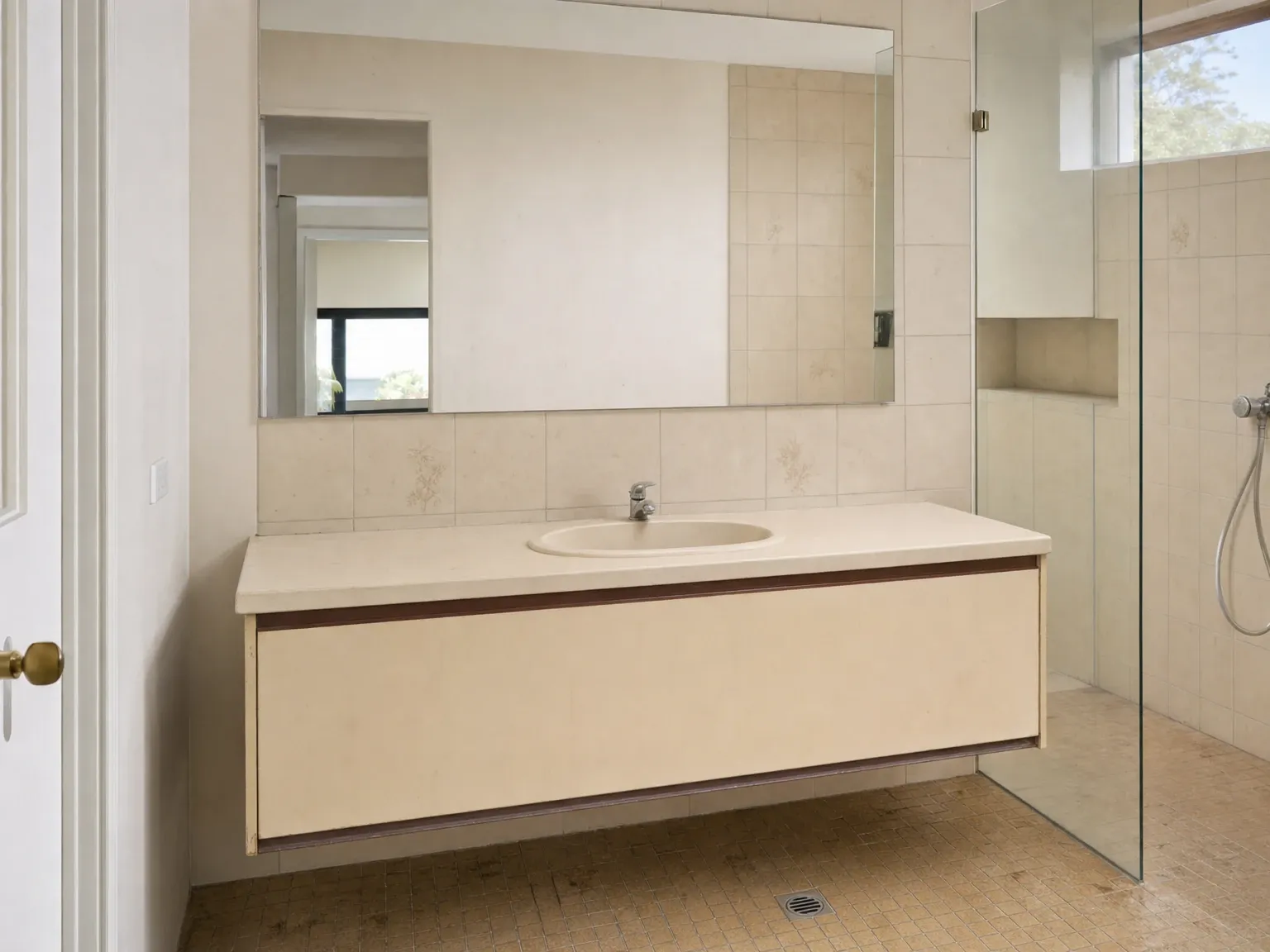 Before
After
Before
After
Common regrets
Five vanity decisions show up over and over as regrets in Australian bathroom renovation post-mortems.
The vanity is too narrow for the way the room is used. A 600 or 750 mm vanity sized to fit a small bathroom forces a cramped basin with no bench around it. When the rest of the room (the shower, the bath, the toilet) takes the available space, the vanity is the first thing squeezed, and the result is a basin with no room to put a face cloth, a soap dispenser or a toothbrush next to it. Where possible, push to 900 mm minimum on any vanity that is the primary basin in a household.
The basin is too far back. Centring the basin on a 500 mm-deep vanity puts the rim 280 mm from the front edge, which forces a reach every time you wash your hands. The honest fix is to push the basin forward (within the fabrication constraints) so the rim sits 180 to 220 mm from the front edge. Above-counter basins on slim wall-hung vanities naturally solve this; undermount basins on standard cabinets need it specified.
The top runs cool of the room. Choosing a stark white or cool grey top in a bathroom with warm timber floors, warm tile or natural light produces a top that fights the rest of the room. The fix is to choose the top last, against the rest of the palette, not as the first decision. Where possible, take a sample home for 48 hours and look at it in the bathroom under the lighting you actually use, the way the bathroom decor guide suggests for textiles and finishes.
There are no drawers. A vanity with only cupboards and no drawers makes everyday access painful and pushes everything onto the bench. The drawer hardware premium is small compared to the daily quality-of-life gain.
The plumbing fights the cabinet. Specifying a deep drawer under the basin without checking what the plumber’s trap and supply pipes need produces a drawer that cannot close. The fix is to design the cabinet around the plumbing rough-in, not the other way around: get the plumber and the cabinetmaker on the same drawing before fabrication starts.
Picturing it before you buy
Vanities are the single piece of bathroom joinery most renovators get wrong, because there is no easy way to see how a specific cabinet, top and basin combination will read in the actual room until it is installed. The 3D visualisation industry exists in large part to close this gap, and a quick photorealistic render of the planned vanity in the planned room, against the planned tiles, removes the largest single source of bathroom-renovation regret. It is the cheapest, lowest-risk version of changing your mind before the joinery arrives.
Frequently asked questions
What is the most popular bathroom vanity size in Australia?
900 mm wide is the most common single-basin vanity size in Australian bathrooms, with 600 mm running second for compact ensuites and powder rooms and 1200 mm running third for main bathrooms where storage matters. Standard vanity widths are 600, 750, 900, 1200, 1500 and 1800 mm, with double-basin units sensible from 1500 mm and ideally 1800 mm. Standard depth is 450 to 550 mm, slimline options sit under 460 mm for narrow rooms, and floor-mounted height is 850 to 900 mm with 900 mm increasingly specified as the comfort default for taller adults and master ensuites.
What’s the difference between a floating and a freestanding vanity?
A floating (or wall-hung) vanity is fixed to the wall with no contact with the floor, so the floor tile runs underneath it. A freestanding vanity sits on the floor like furniture, hiding the floor tile beneath it. Floating units make small bathrooms feel larger because the eye reads the full floor area, simplify cleaning along the skirting and let you set the vanity rim height anywhere between 800 and 950 mm during install. They need a stud wall or noggin strong enough to carry the load (usually around 100 kg with a stone top and full drawers) and cost more to install. Freestanding vanities are easier to install, often offer slightly more storage in the kick area, and read warmer in traditional or heritage-style bathrooms.
Can you still get an engineered stone vanity top in Australia?
No new engineered stone (quartz) benchtops, panels or slabs can be supplied, installed or manufactured in Australia from 1 July 2024, and the import ban took effect on 1 January 2025. The ban applies to vanity tops the same way it applies to kitchen benchtops. The legal alternatives are porcelain slab, sintered stone, natural stone (marble, granite, travertine), solid timber, laminate, ceramic and the new crystalline-silica-free engineered surfaces (Caesarstone Mineral, Smartstone, Essastone re-formulations). Existing engineered stone vanities already in your home can be repaired, modified, removed or disposed of under controlled conditions; the ban only stops new installs.
What is the best material for a bathroom vanity in Australia?
For the cabinet itself, 2pac polyurethane on a moisture-resistant MDF substrate is the sturdiest mid-range default for an Australian bathroom, with solid Australian hardwood (oak, blackbutt, Tasmanian oak, marri) the premium option where you want grain and warmth. Thermolaminate and high-pressure laminate are the budget options and now look acceptable in matte finishes, but their weakness is moisture lift around edges and at any kicked or scuffed corner. For the top, porcelain slab is the best all-round choice post-engineered-stone-ban: non-porous, heat-resistant, stain-resistant and now available in convincing marble and stone looks. Natural stone (honed marble, travertine, limestone) is the luxury choice but needs sealing twice a year and stains from common bathroom products.
Should the vanity be 850 mm or 900 mm high?
900 mm is now the practical default for adults in master bathrooms and ensuites, and 850 mm remains the right choice for family bathrooms where children use the room daily. The shift toward 900 mm reflects average adult height creeping up and kitchen benches sitting at 900 mm; matching the two heights through the house reduces the awkward stoop that older 800 to 820 mm vanities forced. For accessible bathrooms, AS 1428.1 requires a basin rim height between 800 and 830 mm with knee clearance underneath, which usually means a wall-hung vanity with no doors or a basin sitting on a slim shelf rather than a full cabinet.
Drawers or cupboards inside a bathroom vanity?
Drawers are the better default for daily-use items in an Australian bathroom because you can see everything from the front as you pull them out, you do not have to bend down or reach into the back of a cupboard, and they make the most of every centimetre of internal volume. The trade-off is cost: drawer hardware (runners, soft-close mechanisms) adds roughly 20 to 30% to the cabinet price. Cupboards earn their place for tall items (cleaning bottles, hairdryers on stands, laundry baskets) and for the area under-sink where plumbing reduces drawer depth anyway. The cleanest spec in most family bathrooms is a small false drawer at the top under the basin, one usable shallow drawer, one deep drawer for towels, and a cupboard under the plumbing.
How much should a bathroom vanity cost in Australia in 2026?
A flat-pack vanity from Bunnings, IKEA or Freedom runs $400 to $1,500 for the cabinet alone, or $1,500 to $3,500 installed with a basin and tapware. A ready-made vanity from a bathroom showroom with a stone or porcelain top sits between $1,500 and $4,500. Semi-custom joinery (your sizes, choice of door style and finish, supplier basin) is $3,500 to $8,000. Fully bespoke joinery in solid timber or 2pac with a designer basin and premium tapware starts at $8,000 and runs above $20,000 for double vanities or signature pieces. Vanity, top, basin and tapware combined typically take 12 to 18% of a mid-range Australian bathroom renovation budget.
Should you go for a single or double vanity in an ensuite?
Go double only if the ensuite is at least 2.5 m wide and you can fit a vanity of 1500 mm or, ideally, 1800 mm. Two basins on a 1200 mm vanity sit too close to be useful and read as cramped. The minimum useful spacing is 270 to 300 mm of clear basin-edge separation, which is hard to achieve under 1500 mm of total vanity width. Where the room allows it, double vanities add real morning-routine value and resell strongly in master bathrooms. Where it forces a compromise (a narrower vanity, less bench space, no drawers), a single 900 to 1200 mm vanity with a generous bench is the smarter call.