Bathroom decor ideas: styling a finished room
How to style a finished Australian bathroom in 2026: vanity tableau, textiles, plants, art, lighting, scent, hardware and a spend-by-spend guide.
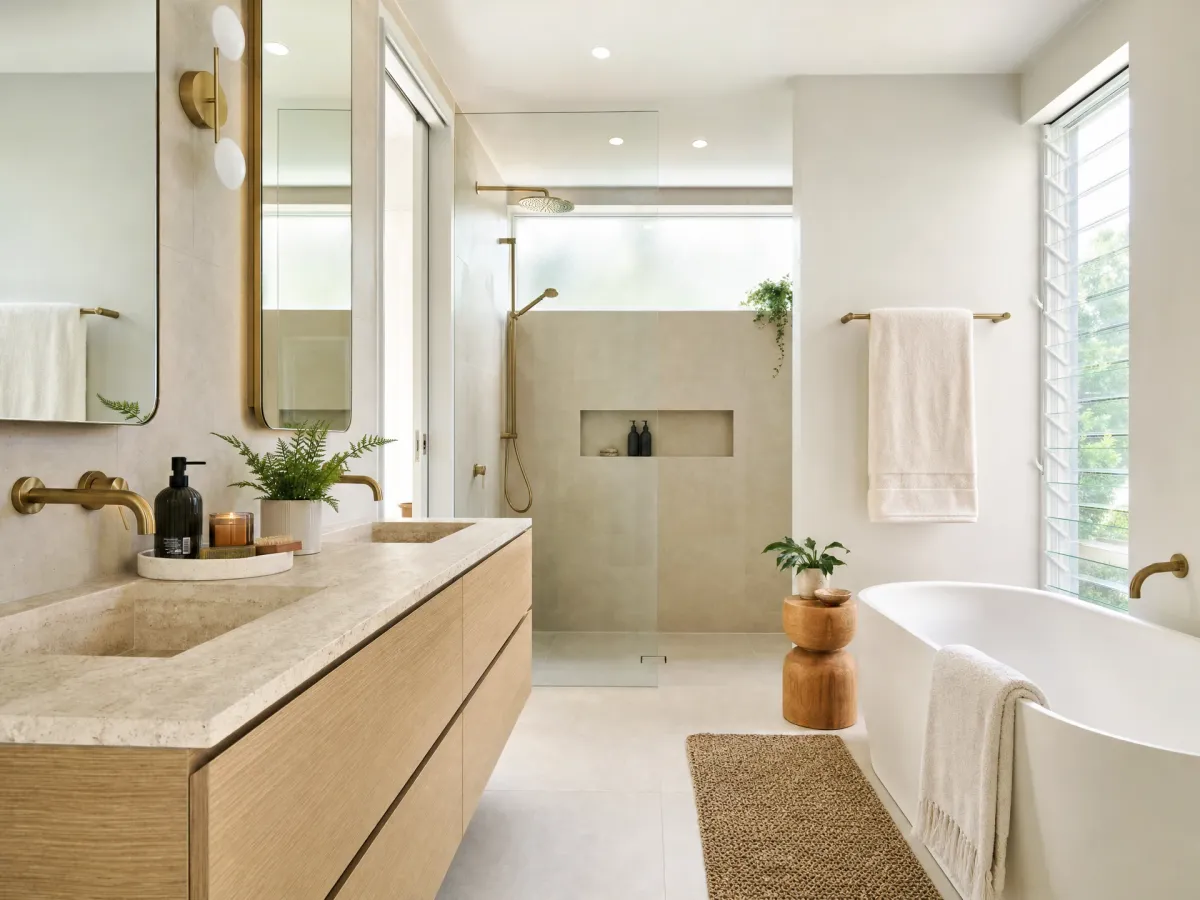
A finished bathroom is rarely a styled bathroom. The tiles are in, the tapware is fixed, the vanity is mounted. Then the room sits there, immaculate and slightly empty, while the rest of the house catches up. This is the article for that moment. It covers what to do with the room you have, not what to do if you start again.
The wedge most decor articles miss: a bathroom is not a small living room. It has almost no soft surfaces, very little wall space free of splash zones, and ventilation, humidity and Australian sun habits that rule out half of what works elsewhere. Styling a bathroom is its own discipline. Get the textiles, the vanity tableau, the plant choice and the hardware family right and the room reads as designed. Skip any of those and it reads as unfinished, regardless of how expensive the tile was.
This guide works through every decor layer in order: vanity styling, textiles, plants, art, lighting and scent, hardware swaps, the five Australian style families, what each budget tier actually buys, and the mistakes that keep finished bathrooms looking incomplete. It closes with a renter’s playbook for anyone who can’t drill a hole.
What styling actually adds to a finished bathroom
A renovated bathroom delivers the architecture. Styling delivers the experience. The architecture is fixed (tiles, tapware, vanity, mirror, screen, bath), and once it is in, the only lever left is the soft and styled layer that sits on top of it. That layer is the difference between a bathroom photographed for a real estate listing and the same bathroom an hour after the homeowners move in.
Three things shift the moment styling is added. The room reads as warmer because soft textures (towels, a mat, a plant) bounce light differently from hard surfaces. The room reads as occupied because everyday objects (a candle, a hand cream, a folded face washer) signal a life lived in it. And the room reads as edited because the styled vanity, the curated shelf and the chosen art establish intent. A bathroom with none of those signals reads as a display home; a bathroom with all of them reads as a home.
The cost of styling is also disproportionate to the impact. A full mid-range renovation in Australia runs around $22,000 to $24,000 in 2026 according to the Housing Industry Association’s renovation data. A complete styling overhaul of the same finished room (textiles, vanity tableau, art, plant, hardware swap) runs $500 to $2,000. The styling spend is one to ten percent of the renovation spend and changes the daily experience of the room more than the last $5,000 of tile selection did.
Same room, two energies: what styling actually does
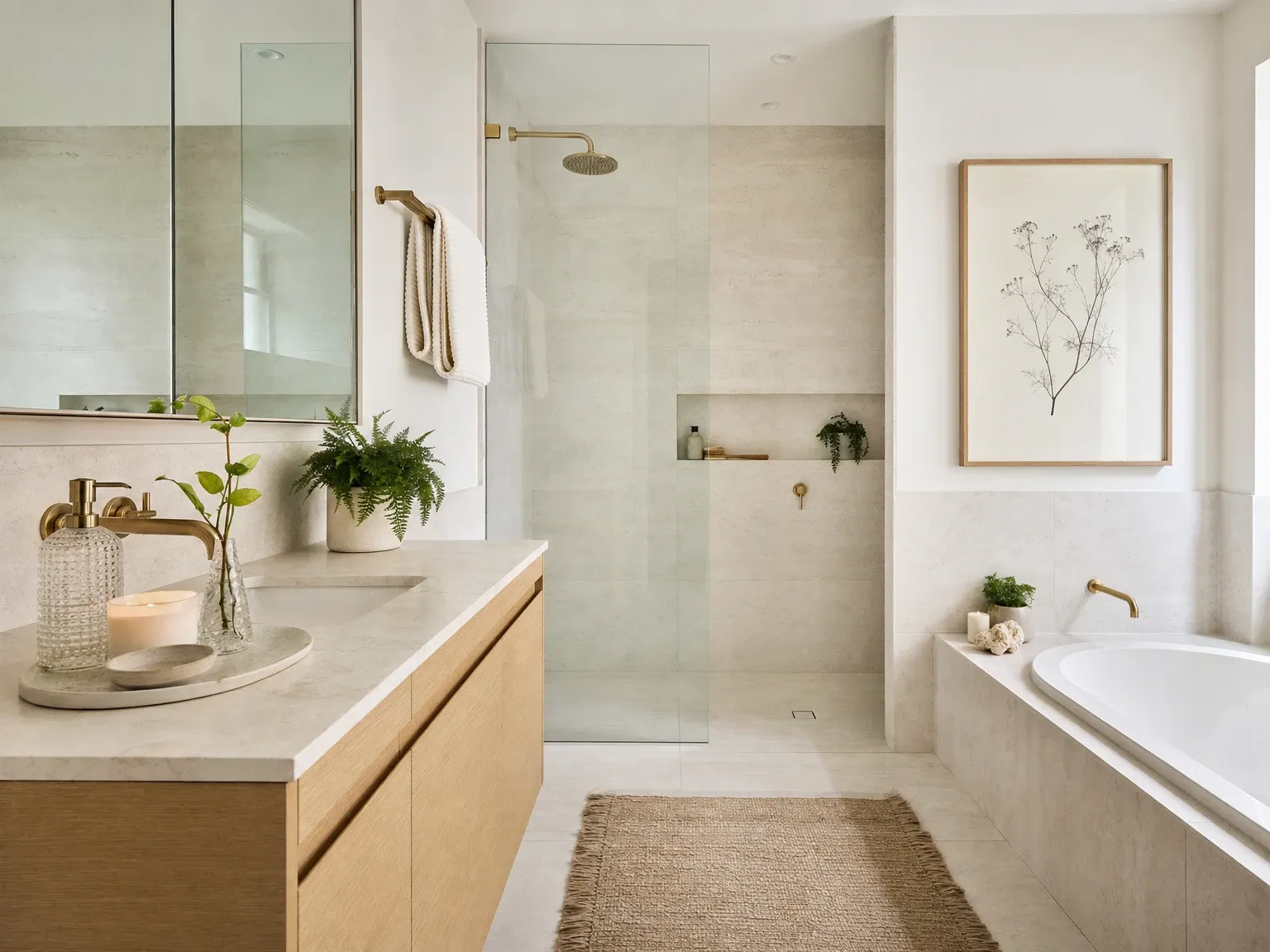
 Before
After
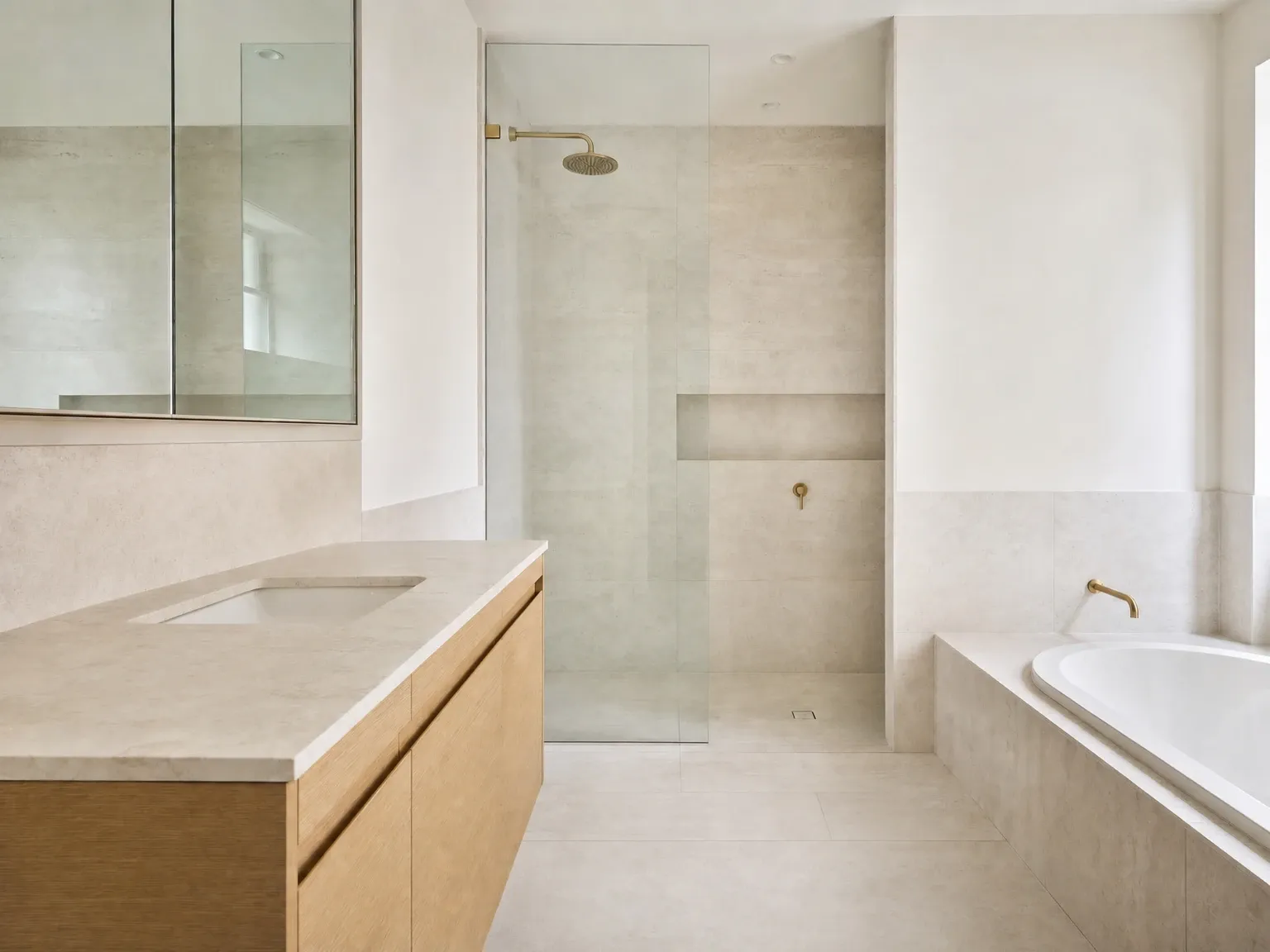
Before
After
The split before-and-after at this point in the article is the same bathroom with and without its decor layer. Same tiles, same vanity, same tapware. One side: an empty vanity, a bare hook, no plant, no candle, no mat. The other side: a folded towel on the rail, a styled tray on the bench, a small fern on the windowsill, a bath mat underfoot. Nothing in the room has been renovated. The room is photographed an hour apart.
The lesson is in the gap. The decor layer is everything that follows in this guide and almost nothing in the budget. If you are looking at a finished bathroom that feels flat, you are looking at the second image without the first. Work through the sections below in roughly the order they appear; the vanity tableau and the textiles do the most work and should land first.
Start with the vanity: the one tableau every visitor sees
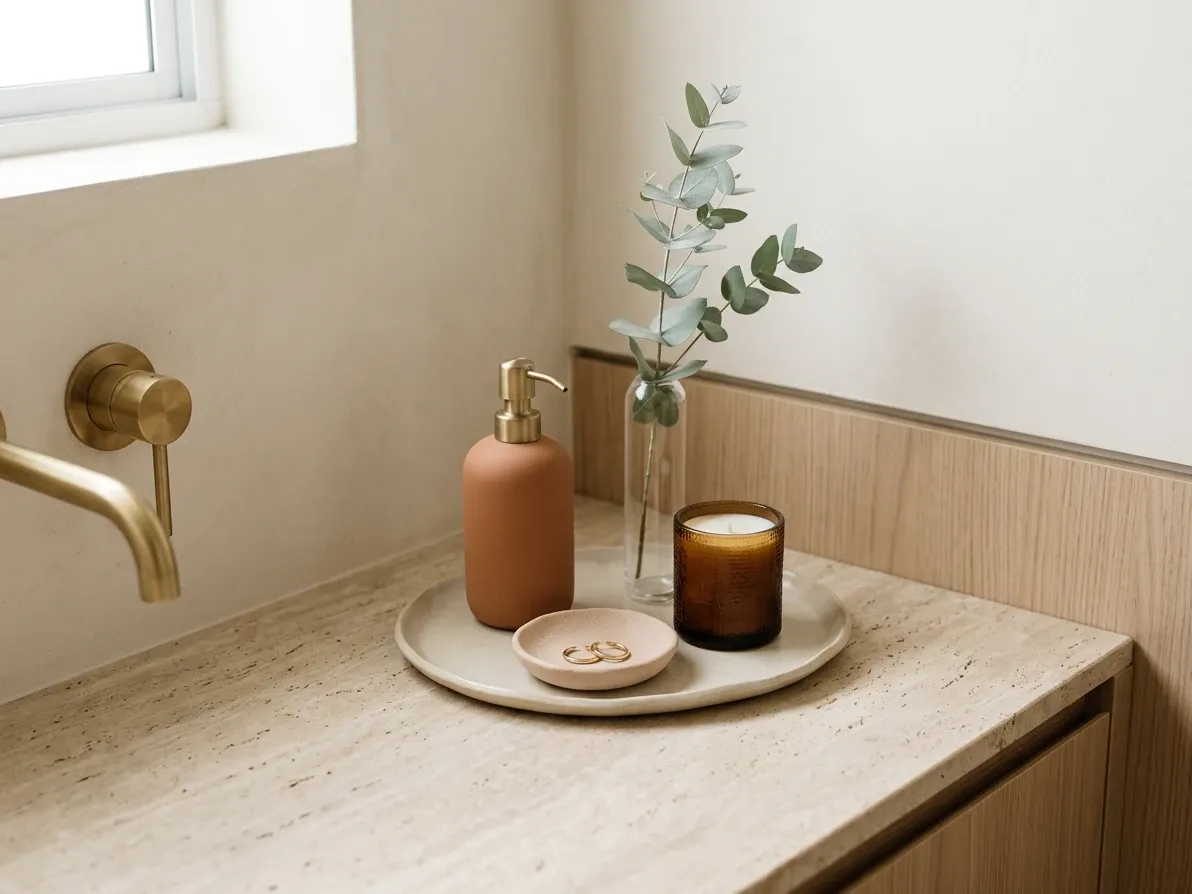
Tray, candle, decanted soap, single stem. Style in odd numbers.
The vanity is the first thing the eye lands on when a bathroom door opens. If the vanity is styled, the room reads as styled. If the vanity is scattered with toothpaste, deodorant cans and a hairbrush still loaded with hair, the room reads as unstyled regardless of what else is going on. Begin here.
The frame is the styling triangle: a tray as the anchor, three to five objects on it, varied heights, varied textures. Trays make small things look intentional. A square or rectangular tray in stone, ceramic, sealed timber or metal sits at the back corner of the bench and corrals the everyday objects (hand soap dispenser, hand cream, perfume) into one composition. Without the tray those objects read as scattered; with the tray they read as a vignette.
Three to five objects, never more. Style Curator in Australia phrases the rule succinctly: odd numbers, mixed heights, mixed scale. A taller object (a vase with a single stem, a candle in a glass cloche, a slim bottle of decanted hand soap) anchors the back. A medium object (a brass cup holding makeup brushes, a small ceramic dish for rings) sits in front. A short, wide object (a folded face washer, a flat ceramic dish, a folded hand towel) grounds the front edge. Texture differences matter as much as height differences: a metal tray, a glass bottle and a sealed timber lid feel intentional next to each other in a way that three glass bottles do not.
Decant the everyday products. The single highest-leverage move in vanity styling, hands down. Soap, shampoo, conditioner and body wash live in their original supermarket packaging, all clashing brand colours and 18-month-old promotional copy. Move them into matching glass or ceramic pump bottles, label them lightly (or not at all), and the bench reads as a hotel rather than a chemist run. The cost is $20 to $60 for a full bathroom set at Adairs, Aura Home, Kmart or Mecca, and the visual impact is closer to a $2,000 renovation. The same logic applies to face washers and small towels: rolled and stacked beside the tray, in one tonal family, rather than thrown over the rail in mismatched colours.
Edit ruthlessly. Whatever cannot be styled should not be on the bench. The toothbrush goes in a single ceramic cup, not in a free toothbrush holder that came with the toothbrush. The hairbrush goes in a drawer. Razors, deodorants and travel-size hotel shampoos do not appear in the styled zone at all. If the bathroom has a drawer or shelf, use it. If it does not, edit harder.
The tray defines the styled zone; everything outside the tray is unstyled by default and stays out of view of the door.
The textiles layer: towels, mat, robe
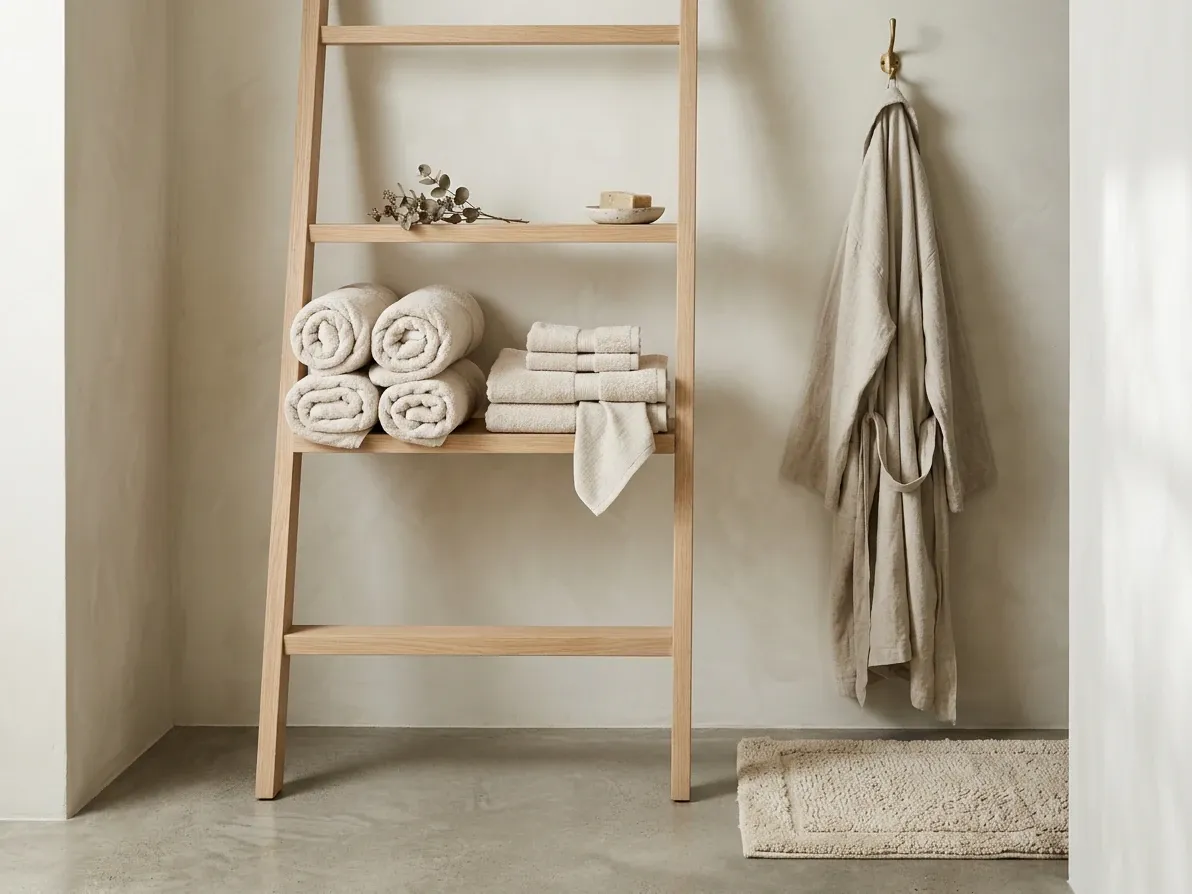
Towels in one tonal family. Single accent, never five.
After the vanity, the second visual layer is the textiles. Bathrooms have almost no soft surfaces (no rug, no curtains, no couch cushions), so the towels, the bath mat and the robe end up doing the work of every soft surface in another room. A coordinated textile set lifts a bathroom by more than the cost suggests.
Towels in one tonal family, not five colours. Pick a base tone (warm white, oat, sand, sage, terracotta, charcoal) and buy three to four matching bath towels, three to four matching hand towels and a few face washers in the same range. Mixing prints and colours from different sets reads as a share-house. A single consistent palette across all the towels reads as a hotel. White is the safest hotel default and pairs with any tile palette; off-white or stone reads warmer in a 2026 bathroom and hides marks better than pure white.
The fold and the position matter. Rolled towels in a basket on a shelf, stacked towels on a freestanding ladder rack, or single folded towels on the rail; pick one approach and use it consistently. Snowe’s step-by-step guide on towel rolling is the cleanest reference, although the trick is doing it the same way every time so the stack reads even. The towels on display are a styling layer; the towels in everyday use can be older or different and live in a closed cupboard.
A bath mat over the bare floor. The mat is more important than people credit. A bare tile floor at the edge of the shower reads as cold and unfinished, especially in winter on a porcelain or stone tile. A cotton, linen or sustainable bamboo mat in the same tonal family as the towels closes the textile circle and lifts the floor visually. Non-slip backing matters in an Australian bathroom (children, elderly relatives, wet feet); look for natural rubber or latex backing on cotton mats, which according to Drew and Jonathan’s bath mat review holds up better than gel or microfibre. Replace the mat every 12 to 18 months; the bottom dyes from damp tile over time and the styling slips.
A robe behind the door does the rest. A single linen or waffle-weave robe in the towel family hangs behind the door or off a wall hook and is one of the highest-leverage objects in any bathroom because it telegraphs use. The bathroom is read as something a person lives in, not a showroom. Aura Home, Adairs, Bed Threads and In Bed all carry adult robes in warm neutrals for $80 to $180 in 2026.
Plants that actually live in an Australian bathroom
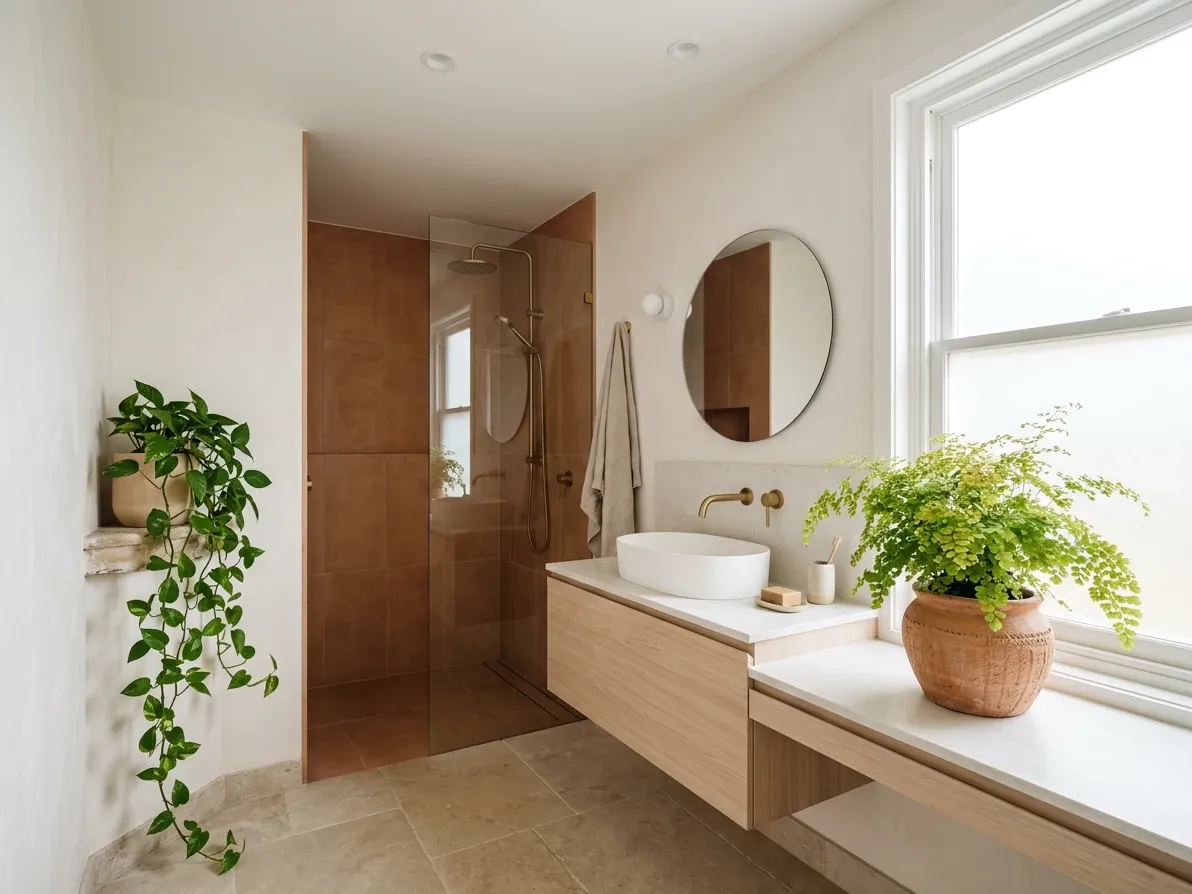
One or two plants, never a jungle. Pick for light first.
A live plant is the single fastest way to take an over-tiled bathroom from clinical to warm. It also fails fast in a bathroom if the species is wrong. Bathrooms in Australia are humid by default (showers, baths, no airflow when the door is shut) but vary wildly in light, from a bright north-facing window to a windowless internal ensuite. Pick for both conditions.
The reliable performers in Australian bathrooms, confirmed by Flower Power’s plant guide and consistent across multiple Australian nurseries: Boston fern, birds nest fern, maidenhair fern, peace lily, pothos (devil’s ivy), ZZ plant, snake plant, monstera (in a brighter bathroom), philodendron, and air plants. Ferns love the humidity; the showers and steam mimic their native subtropical rainforest. Snake plants and ZZ plants tolerate the lowest light and will survive in an internal ensuite where everything else turns brown. Pothos trails from a high shelf and softens the architecture without taking up bench space.
Choose by light first, humidity second. A bathroom with a real window (frosted or clear) takes ferns, peace lilies and maidenhairs happily. A bathroom with no window or a tiny vent opening needs ZZ, snake or pothos. Putting a maidenhair fern in a windowless ensuite is buying a slowly dying object; putting a ZZ plant in a bright bathroom is wasting the light. The Grow Centre, Cheeky Plant Co. and most local nurseries label plants by light and humidity tolerance; check the label rather than buying on looks.
Pots matter as much as plants. The plastic nursery pot stays inside a ceramic, stone or sealed-timber decorative pot, never on display. A terracotta pot brings warmth and wicks away excess moisture, which suits ferns. A textured stone-look ceramic suits a modern Australian palette. A glazed white or off-white pot reads coastal or Hamptons. Mix pot materials across the bathroom if you have more than one plant (a terracotta on the windowsill, a ceramic on the floor) so the plants do not read as a matching set bought on one trip.
One or two plants is enough. A small bathroom (3 square metres or less) usually wants one. A larger bathroom (5 square metres plus) can take a trailing plant on a high shelf and a floor-standing plant in a corner. More than that turns the room into a planted feature rather than a styled bathroom, which most people do not want long term because watering and rotating plants becomes a chore.
What to put on the walls (and what humidity will destroy)
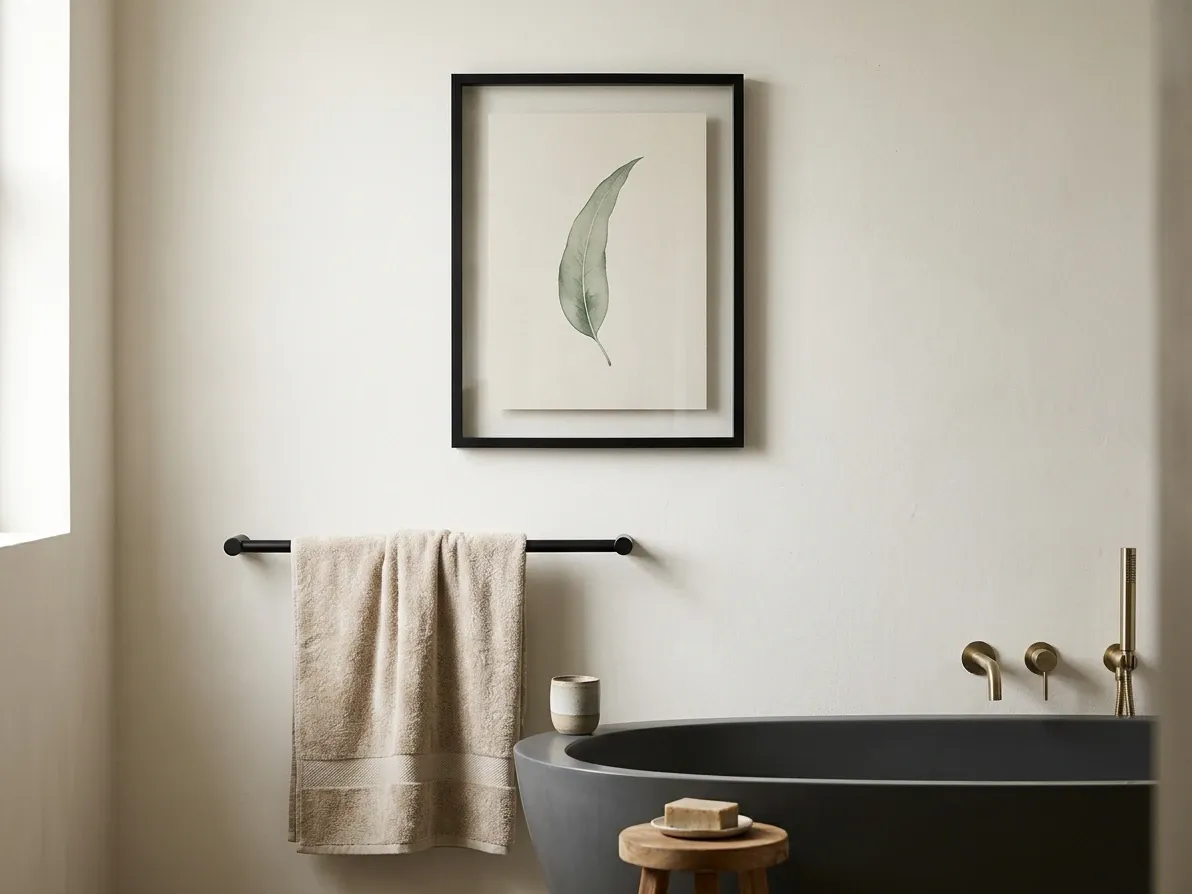
Frame for humidity. Hang away from splash zones.
A bathroom usually has one or two pieces of wall art at most. Splash zones rule out most of the wall, the mirror dominates one large section, and the room is too small for a gallery wall to read as anything but cluttered. Place art carefully and the room lifts; place it badly and it warps within a year.
Choose moisture-resistant formats. As Frame Destination’s risky areas guide sets out, the safe formats in a bathroom are framed prints behind glass or acrylic in a sealed metal, painted MDF or sealed timber frame; acrylic-mounted prints; metal prints (aluminium does not warp or rust); and treated canvas with a protective coating. The dangerous formats are original oil paintings (the surface absorbs moisture), unframed paper, untreated timber frames, watercolours behind ordinary glass and anything with delicate fabric or textural elements. If a piece of art matters to you, do not hang it in a bathroom regardless of how good it would look there; humidity is patient.
Place art away from splash zones. The safe walls in a typical Australian bathroom are above the towel rail, above the toilet, opposite the mirror and along the wall behind a freestanding bath. The risky walls are next to the shower (constant micro-spray when the door is opened), next to the basin (toothpaste, soap, water marks) and any wall the exhaust fan ducts over (chronic warm humid air). Apex Art Lab’s bathroom art notes sit consistent with this: choose walls farther from water sources.
The subject is freer than people think. Botanical prints, abstract watercolour reproductions, black-and-white photography, charcoal sketches, line drawings and small landscape prints all work in bathrooms. Avoid anything aggressively maximalist (the room is too small to absorb it) or anything that reads as overly literal to bathroom function (no “wash” or “soak” word art; no toilet humour signs). One medium-scale piece (40 by 50 cm) often outperforms three small prints in a row because the small bathroom does not have wall space to support a gallery rhythm.
The mirror is the other wall element worth thinking about. A frameless flush mirror reads as a builder default; a framed mirror in timber, brass or matte black reads as a chosen object. If the existing mirror is fine but bland, a round or arched timber-framed mirror added on the opposite wall (or replacing the existing if budget allows) is the single highest-impact wall change in most bathrooms. Wattle Court’s 2026 trend roundup tracks this clearly: rounded and pill-shaped mirrors with timber or brass framing are dominant in published 2026 Australian bathrooms.
Lighting and scent: the atmosphere layer
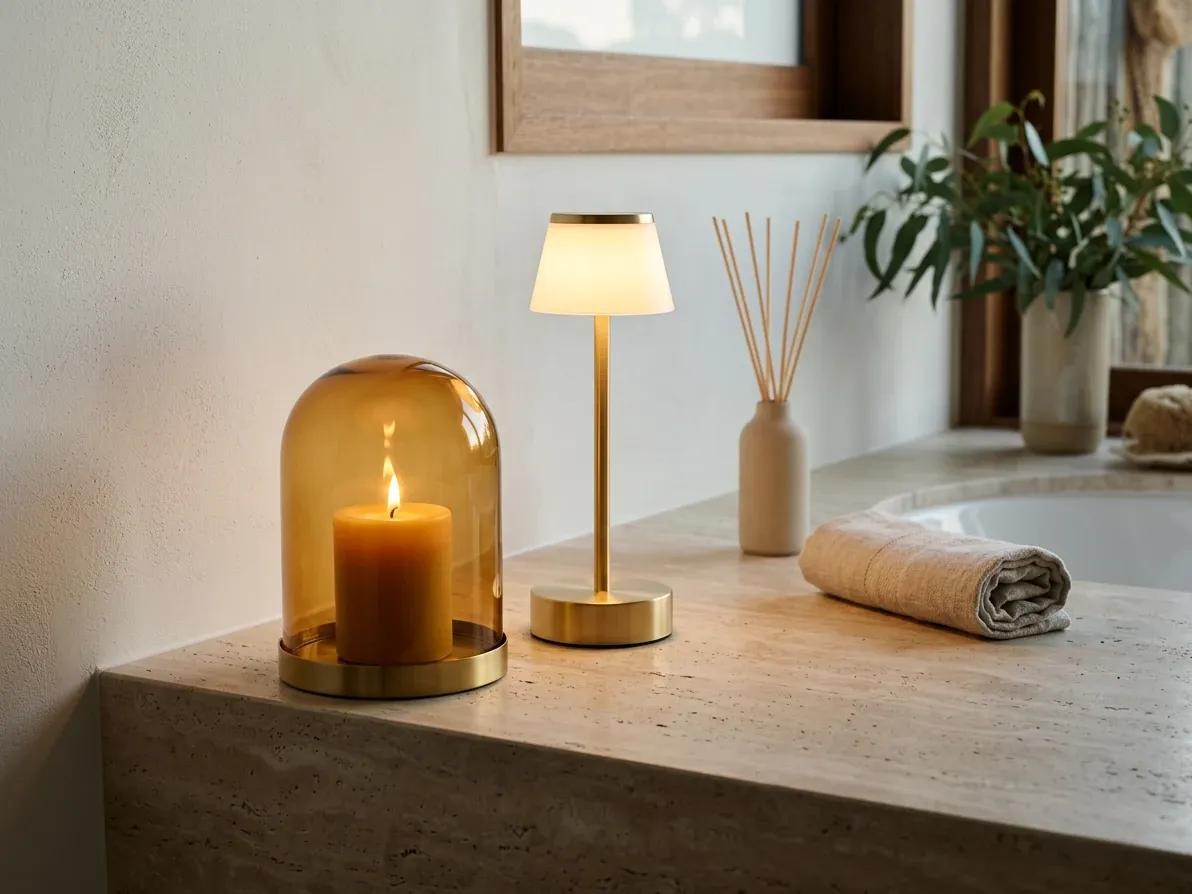
Add one source below the ceiling line. The room softens.
A renovated bathroom is usually overlit. The downlights are bright enough for a make-up application at 7am in winter and there is nothing else. The result feels clinical at any other time of day. Adding a second lighting layer and a deliberate scent layer changes the room from a functional zone to a place anyone would willingly spend twenty minutes in.
Layer the lighting. The overhead light is task lighting, not mood lighting. A small lamp on the bench, a wall sconce above the vanity, a candle on the bath ledge or a strip of LED tape under the vanity float (rendering a soft glow at floor level) all add a layer below the ceiling that softens the room at night. Cordless table lamps in waterproof or splash-resistant finishes have grown sharply in 2026; The Blue Space’s 2026 trend brief lists portable lighting as a defining feature of premium bathrooms this year. If running an electrician is not on the table, a $80 cordless rechargeable lamp on the vanity does the same job.
Candles do real work. A single candle on the bath ledge or vanity adds warmth, scent and movement at no installation cost. Pick fragrance carefully (bathrooms are small and saturate fast); soft notes like fig, eucalyptus, sandalwood, vanilla or unscented are safer in a confined space than heavy florals or anything sweet. Aje Athletica, Glasshouse, Maison Balzac, Ecoya and Sohum all carry bathroom-suitable Australian candles in the $30 to $60 range. A glass or stone cloche over the candle stops it gathering dust between uses and reads as more deliberate when the candle is unlit.
A reed diffuser is the always-on scent layer. Even when the candle is out the diffuser quietly works the room. Match the diffuser scent to the candle (same brand, same fragrance family) so the room never smells of two competing perfumes. Replace the reeds every three to four months; the older reeds clog and the scent drops sharply.
The exhaust fan is your friend, not your enemy. Run it every shower for at least 20 minutes afterwards. A bathroom that smells musty is not a bathroom anyone wants to style; ventilation is the precondition for everything else in this section. The Australian National Construction Code requires either an exhaust fan extracting at 25 litres per second ducted outside or a window equal to at least 5% of the floor area. If your bathroom predates that and the ventilation is poor, the candle and diffuser are masking a real problem; fix the ventilation first.
Small hardware swaps that punch above their price
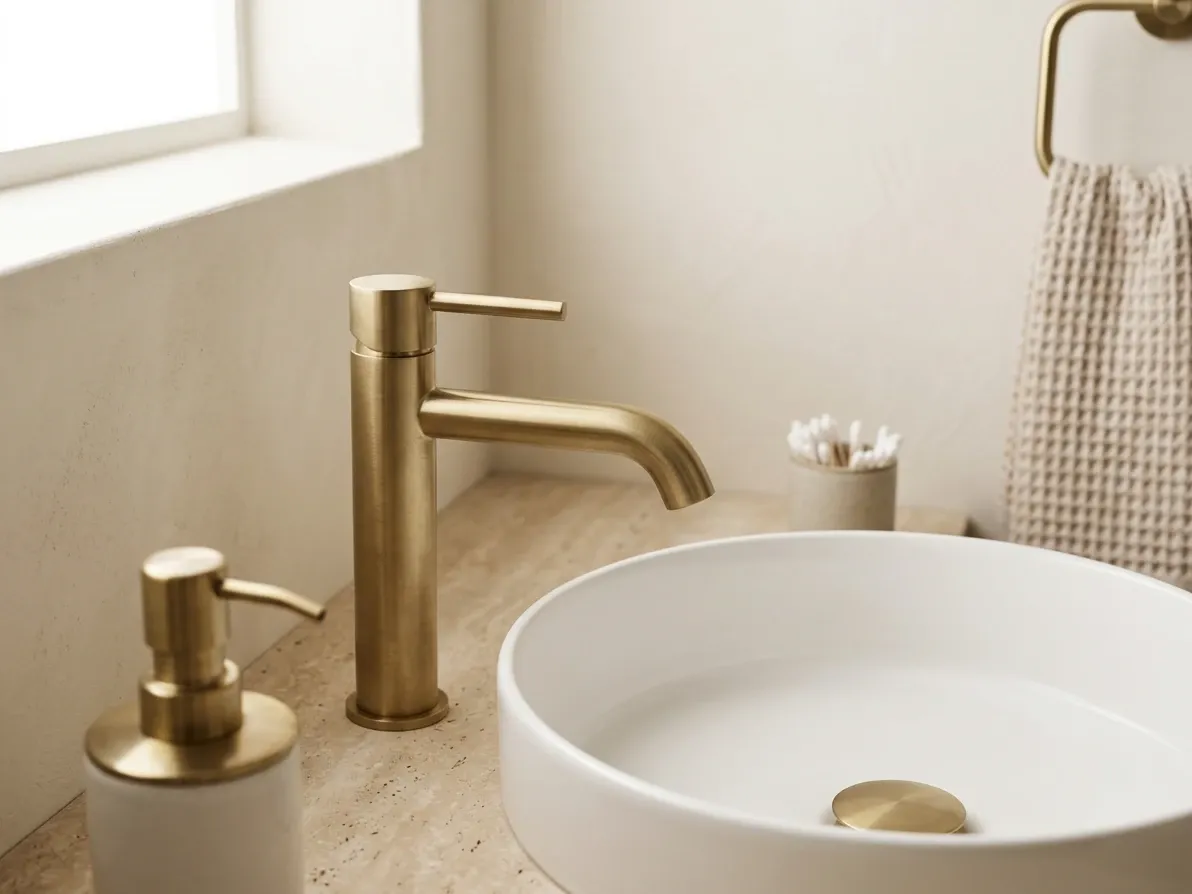
Pick one metal family. Carry it across every piece.
Hardware is the most-touched and least-considered element in most Australian bathrooms. The robe hook, towel ring, towel rail, hand-towel ring and visible cabinet handles get used every day, but most homeowners keep whatever the builder originally installed in chrome or brushed nickel. Swapping these out, as a coordinated set in a different metal, lifts the bathroom by more than a new mirror would and costs around $300 to $600 across the whole room.
Pick one metal family and use it consistently. The four dominant 2026 Australian finishes, per the Faucet Strommen finish brief and Style Curator’s tapware survey, are matte black, brushed brass, brushed nickel and gunmetal. Matte black is the single most-specified finish and remains a long-term design staple. Brushed brass has settled in as a warm modern favourite. Gunmetal has emerged as a deliberate alternative to matte black for homeowners who want depth without the flatness. Brushed nickel reads classic and forgiving. Pick one, then carry it through the towel rail, towel ring, robe hook, toilet roll holder and cabinet handles. Mixing finishes is fine when it is deliberate (matte black plus a brushed brass accent is the most common 2026 pairing), but mixing finishes accidentally because each piece was bought separately reads as unconsidered.
Match the existing tapware. The tapware sets the metal family for the room. If the tapware is matte black, the hardware is matte black or matte black with a brushed brass accent. If the tapware is chrome, the hardware is chrome or brushed nickel. Adding brushed brass hardware to a chrome-tapware bathroom does not lift the room; it creates a clash. The exception is if the chrome tapware is on the way out and the hardware is the first step of a slow swap.
Replace the toilet roll holder, the robe hook and the towel ring before the rest. These three are the easiest to swap (no plumbing, no electrical, simple wall fasteners), cost the least (each is $30 to $80 in a matching finish), and visually punch above their price because they sit at eye level. The towel rail is the biggest piece and usually requires re-drilling the mount, so leave it to last. A coordinated set from ABI Interiors, Phoenix, Meir or Nero across all four items runs $250 to $450 in 2026 and changes the room more than most $1,000 furniture pieces would.
A new tap is the final move. The bathroom mixer tap is the longest-touched object in the room. A $250 to $500 replacement tap in the matching hardware finish, fitted by a licensed plumber for $150 to $250 in labour, is the highest-leverage single replacement in a finished bathroom. The visual lift is comparable to a $5,000 vanity replacement and the room reads as deliberately styled rather than landlord-issued.
Decorate by style: five Australian looks that work
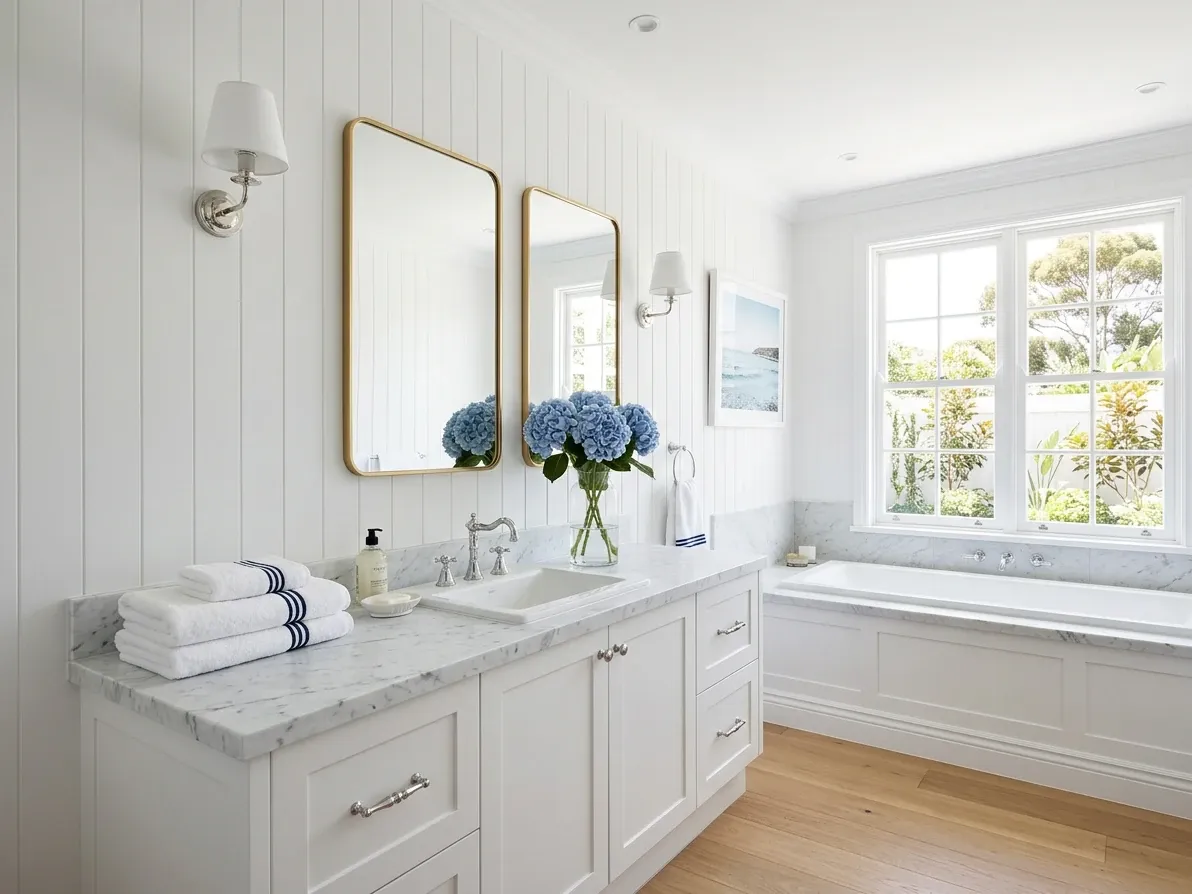
Hamptons: VJ panelling, marble, polished chrome, blue-and-white linen.
Bathrooms read as styled when the soft layer (towels, plants, art, hardware, candle, mat) sits in one coherent style family. Five looks dominate Australian bathrooms in 2026 and each one suggests a specific decor palette. Pick the one that matches the architecture of your room (or the look you want it to read as) and follow the palette consistently across every layer above.
Modern Australian. Warm minimalism with an Australian native lens. Palette: warm off-white walls, sand or oat tones, honed travertine accents, brushed brass or organic brass hardware, soft sage or eucalyptus in the towels and plant choices. Plants: Boston fern, birds nest fern, native flowering stems in a stoneware vase. Art: line drawings, abstract botanical prints, charcoal landscape sketches. Candles: eucalyptus, fig, native botanical scents. Materials: terracotta, ceramic, light oak, brushed brass, stone. Avoid: stark white, polished chrome, glass shelving, anything that reads as ten years ago. Reece’s modern Australian brief sums up the broader direction.
Hamptons. Coastal east-coast US calibrated for Australian light. Palette: crisp white walls with VJ or shiplap panelling, soft greys, navy or pale blue accents, polished chrome or brushed nickel hardware, fresh white towels with navy stitching or a blue-and-white stripe. Plants: orchids, peace lilies, hydrangea stems in a glass vase, gardenia in a small pot. Art: blue-and-white botanical prints, framed coastal photography, gold-framed mirrors. Candles: gardenia, lily of the valley, salt-air fragrances. Materials: white painted timber, marble, polished chrome, blue-and-white ceramics, beaded shaker vanity handles. Nero Tapware’s Hamptons bathroom hub is the most consistent Australian Hamptons reference.
Coastal. Lighter, more relaxed than Hamptons, leaning Byron Bay and northern beaches. Palette: warm white walls, raw timber accents, rattan and woven natural fibres, soft sand and sea-blue towels, brushed nickel or chrome hardware. Plants: kentia palm, peace lily, trailing pothos. Art: black-and-white surf photography, framed beach scenes, line drawings of waves. Candles: ocean breeze, salt, coconut, vanilla. Materials: rattan, raw timber, linen, woven baskets, blue-and-white ceramic. Avoid: anything that reads as nautical-themed cliché (no anchor prints, no rope-handle baskets, no shell mirrors).
Japandi. The clean overlap of Japanese minimalism and Scandinavian warmth. Palette: warm off-white walls, pale timber, charcoal accents, oat or natural linen towels, matte black or aged brass hardware. Plants: a single small bonsai, a sculptural snake plant, a single twig of cherry blossom in a ceramic vase. Art: ink wash prints, single-line drawings, framed handmade paper. Candles: hinoki, cedarwood, yuzu, green tea. Materials: pale timber, paper, linen, matte black metal, handmade ceramic. The Japandi rule is restraint; if in doubt, remove rather than add. Nero Tapware’s Japandi guide sets the look out cleanly.
French Provincial. Refined, traditional, soft and warm. Palette: warm off-white or soft cream walls, marble accents, brushed brass or polished nickel hardware, white towels with embroidered or scalloped detail, soft pink, sage or pale blue accents. Plants: lavender stems in a stoneware crock, a small fern in an antique brass pot, eucalyptus branches in a glass jar. Art: framed botanical illustrations, vintage perfume bottles styled on the vanity, an oval gilt-framed mirror. Candles: lavender, rose, fig, neroli. Materials: marble, brushed brass, white painted timber, hand-painted ceramic, antique mirror. French Provincial bathrooms tolerate a slightly fuller styling than Japandi or modern Australian because the look is traditionally decorative.
The discipline is consistency across every layer. A modern Australian bathroom with a Hamptons towel set in navy and white reads as confused. A French Provincial bathroom with matte black hardware reads as mid-renovation. Once a style is picked, every styling decision lines up with it, including the candle scent and the colour of the soap dispenser.
What different budgets actually buy
A bathroom styling reset can be done at almost any budget. The categories scale, but the order does not: vanity tableau and textiles first, then plants and lighting, then hardware, then a tapware swap if the budget reaches. The following spending tiers are illustrative starting points and assume off-the-shelf product from Adairs, Aura Home, Kmart, IKEA, Bunnings, ABI Interiors and similar mid-market Australian retailers in 2026.
At around $200, the basics shift. New matching bath towels and hand towels (Adairs or Sheridan outlet, $80), a new bath mat ($40), a styling tray and candle ($40), and a small plant in a ceramic pot ($40). The vanity reads as styled, the floor reads warmer, the room smells like a bathroom anyone would relax in.
At around $500, the room is meaningfully restyled. Towels and mat as above ($120), a tray with a candle and a decanted hand-soap dispenser ($90), two plants in chosen pots ($120), a single framed print above the towel rail ($80), a reed diffuser ($60), an upgraded ceramic toothbrush holder and a soap dispenser ($30). The room reads coherent across textiles, scent, plants and the vanity tableau, with one wall decision starting to lift the architecture.
- Towels & bath mat$16032%
- Vanity tableau$12024%
- Plants & pots$8016%
- Art print$8016%
- Hardware swap$6012%
At around $1,000, hardware joins the project. Everything from the $500 tier plus a coordinated robe hook, towel ring and toilet roll holder in a chosen finish ($250), and a new framed timber, brass or matte black mirror over the basin ($300) if the existing one is dull. The room reads as deliberately styled, not just freshened. A first-time visitor reads the bathroom as designed rather than functional.
At around $2,000, the metal family carries through and a few statement pieces enter. Everything from the $1,000 tier plus a coordinated towel rail and hand-towel ring ($200), a new bathroom mixer tap in the matched finish plus plumber’s labour ($400 to $600), a quality robe ($150) and a second piece of art or a sculptural vase ($150). At this tier the bathroom is doing the daily work of a $20,000 renovation; the architecture has not changed but the read of the room has.
Beyond $2,000, the diminishing returns flatten quickly unless the spend goes into a full vanity replacement, a new mirror with integrated lighting or new bench surfaces. Those are renovation moves, not styling moves, and belong in a different planning conversation.
Mistakes that keep finished bathrooms looking unfinished
A finished bathroom that still feels flat is almost always carrying one or more of the following mistakes. Each is easy to fix once you can name it.
The everyday products are still in their packaging. Toothpaste tube, branded shampoo bottle, hand-cream tub from the supermarket: all visible on the bench, all clashing colours, all signalling clutter regardless of how clean the room actually is. Decant the products. Hide what cannot be decanted in a drawer or vanity cabinet.
The towels are mismatched. A bath towel from a 2019 holiday, a hand towel from the previous tenant, a face washer in a third colour. Even pulled neatly onto a rail, the inconsistency reads. Replace the visible set as one purchase in a single tonal family; the older mismatched towels can live in a closed cupboard for everyday use.
The mirror is the builder default. A frameless mirror glued flush to the tile reads as a price point. A framed mirror, a leaning mirror against the wall or an arched timber mirror reads as a design choice. This is among the highest-leverage single changes in any bathroom.
The lighting is a single overhead downlight. No lamp, no sconce, no candle. At night the room reads as an operating theatre. Add one source below the ceiling line and the room takes on warmth.
The plant is fake and dusty. A silk fern with a layer of grey dust on top reads worse than no plant. Either commit to a live plant in a species that tolerates the bathroom or skip plants entirely and rely on a fresh stem of eucalyptus in a vase, replaced every two to three weeks.
The art is a $5 print in a $3 frame. A bathroom is small enough that the eye lingers on whatever is on the wall. One well-chosen mid-scale framed piece is worth more than three cheap ones. If the budget is tight, a single framed botanical from a charity shop or a printed photograph in a quality frame outperforms a $10 wall poster.
The hardware is half-and-half. Chrome tapware, brushed brass robe hook, matte black towel ring. A bathroom with three different metals reads as a parts-bin job. Pick one family and replace the outliers.
The bath is unstyled. A blank tub against a blank wall is a missed opportunity. A small side table or stool, a stack of two books, a rolled towel and a candle next to a freestanding bath transforms the most photogenic object in the bathroom from utility to feature.
The bathroom smells musty. No amount of styling outperforms a poorly ventilated bathroom. Run the exhaust fan after every shower for 20 minutes, leave the door open afterwards, and replace silicone seals when they start growing mould rather than scrubbing them weekly.
Decorating a rental bathroom without losing your bond
A rental bathroom rules out most of the structural changes (tapware, hardware, mirror, paint, drilled fixtures) but every other layer in this guide is reversible and bond-safe. The renter’s playbook is tighter than an owner’s but lands a real visible result.
Textiles do most of the work. New bath towels, hand towels, a bath mat and a robe in one tonal family transform a rental bathroom for under $200 with no agent approval needed. This is the highest single lift available to a renter.
A styling tray on the existing vanity is invisible to the lease. The decanted products, the tray, the candle and the small dish all leave with you when you move. The vanity returns to its original state with one wipe.
Plants are non-negotiable and free of damage. Choose a freestanding pot rather than a hanging fixture (a hanging plant needs a screw in the ceiling) and the plant moves with you.
Peel-and-stick options exist for the splashback and floor. Houzz Australia’s reversible-renter brief covers the catalogue: removable wallpaper above the splashback, peel-and-stick floor tiles that sit over the existing tile without adhesive damage, and stick-on framed mirror panels. Test a small section before committing to a whole wall; cheap peel-and-stick can leave residue on older tile.
A leaning mirror against the wall is the easiest mirror upgrade. A 1.5 metre tall framed mirror leaned against a wall (with a discreet anti-tip strap if the bathroom is near a heavy door) gives a designed-in look with zero drilling. A timber-framed full-length mirror runs $200 to $400 and moves with you to the next rental.
A freestanding storage piece adds the vanity drawer that a builder-default rental usually lacks. A small timber stool next to the bath, a ladder rack against the wall, a thin timber side table with one drawer; all of these add storage and styling without damaging anything fixed.
Shower curtain over a glass screen, only if there isn’t one. Most Australian rentals have a glass shower screen by default, in which case skip this. If the bathroom has only a curtain rail, replace the existing vinyl curtain with a textured fabric one (linen, waffle weave or canvas, in the towel tonal family) and the read of the room jumps immediately.
The aim is a rental bathroom that looks styled while you live in it and goes back to original the day you hand the keys back. None of the above damages a tile, drills a wall or affects the bond.
If you are selling, leasing or photographing the bathroom in question, the soft layer above is also exactly what virtual staging adds to a real estate photo: a clean shot of the finished bathroom in, towels, plants and a styled vanity rendered on, in a few hours rather than a styling day. reIMG does this for Australian agents, photographers and landlords when the room is already finished but unstyled at the listing moment.
Frequently asked questions
What is the cheapest way to make a finished bathroom look styled?
Replace the textiles and add one vanity tableau. New towels, a new bath mat and a styling tray with a candle, a small ceramic dish and a single stem of greenery will move the room more than anything else for under $200. The reason it works: a bathroom has very few soft surfaces, so the towels and mat read instantly, and the eye is drawn to the vanity the moment you walk in. Style those two zones first and the rest of the room follows.
How many plants should you put in a bathroom?
One or two, not a jungle. A small trailing plant on a high shelf, a single fern on the vanity, or a tall snake plant in the corner is usually enough. More than that and the room starts to feel cluttered, especially in the average 3 square metre Australian bathroom. Choose species that genuinely tolerate humidity and low light, not whatever was on sale at Bunnings. Boston ferns, birds nest ferns, pothos, peace lilies and ZZ plants are the reliable performers in Australian bathrooms.
Can you hang real art in a bathroom?
Yes, but choose the materials. Framed prints behind acrylic or glass in a moisture-resistant frame (metal, painted MDF, sealed timber) hold up well in a properly ventilated bathroom. Acrylic prints, metal prints and canvas prints with a protective coating tolerate humidity even better. Avoid original oil paintings, unframed paper, untreated timber frames and any work with delicate textural elements. Hang art away from direct splash zones (above the towel rail, opposite the mirror, above the toilet) rather than next to the shower or basin.
What’s the most overlooked decor decision in a bathroom?
Hardware. The robe hook, towel rail, towel ring and visible cabinet handles are touched daily and read at every glance, but most homeowners keep whatever the builder installed. Swapping chrome for brushed brass, gunmetal or matte black in a coordinated set across the room costs around $300 to $600 and lifts the bathroom more than a new mirror would. Pick one metal family and use it consistently across the tapware, hardware and accessories.
Should the towel colour match the wall colour?
Not exactly, but they should sit in the same tonal family. Pure white walls take warm whites, soft greys, sage, terracotta or charcoal towels well. Off-white walls take richer tones. Colour-block towels in a single accent shade read more deliberate than a mix of patterns and prints. Keep the number of accent colours in the room to one or two; bathrooms are small, and a third colour starts fighting for attention.
How do you decorate a rental bathroom without damaging it?
Stick to reversible changes. Replace the shower curtain, swap the bath mat, add a freestanding storage piece, decant your everyday products into matching bottles on a vanity tray, hang a leaning mirror against the wall, and bring in a plant. Peel-and-stick tiles applied over an existing tile splashback come off cleanly if you choose the right brand. Avoid drilling, painting or anything that needs a screw. The aim is a bathroom that looks pulled together for as long as you live there and goes back to original the day you hand the keys back.
What looks dated in Australian bathrooms in 2026?
Pure stark white-and-chrome schemes with no warmth, glass shelves crowded with bottles in their original packaging, mismatched towel sets, dusty silk plants, dollar-store wall art, wicker baskets in dye-stained colours, and stick-on vinyl decals on the mirror or tiles. The 2026 direction is warm minimalism: warm neutral palette, one or two living plants, edited surfaces, decanted everyday products, and natural materials like stone, timber and ceramic over plastic and glass.
Is a freestanding bath worth styling around?
Yes, if you have one. The freestanding bath is the strongest sculptural object in most bathrooms, and styling around it amplifies the effect. A small side table or stool with a stack of books, a candle and a folded towel reads as deliberate and lifted. A floor mat in a natural fibre underneath, a single piece of art on the wall behind, and the room becomes a destination rather than a wash space. Keep the styling sparse; the bath should still be the focal point.