Kitchen cabinets: what to choose and what to skip
Materials, door styles, colours, hardware and what cabinets actually cost in Australia in 2026. The single decision that defines the kitchen.
What this guide is for
Cabinetry is the single biggest line item in a kitchen renovation, generally between 30 and 40% of the total budget. On a national median Australian kitchen reno of around $35,000 in 2026, that is $10,500 to $14,000 on the boxes and doors alone, before a single appliance is fitted. It is also the decision that does the most to set whether the room reads as confident, dated, or somewhere uneasily in between, because cabinetry is what your eye hits first when you walk into the kitchen.
Most of what is online about kitchen cabinets is either a colour roundup (‘40 white kitchens we love’), a thin trend post, or a product page for one brand. None of it puts the whole decision together. This guide does. It works through what cabinets are actually made of, which door style suits which kitchen, whether white is still the answer (the 2023 Houzz Australia Kitchen Trends Study says it still leads at 52%, with green, black and grey closing the gap), how hardware changes the way the room feels every single day, what the four cabinet tiers actually cost in Australia in 2026, and the mistakes we keep watching renovators make.
We run a 3D visualisation service used by Australian builders, agents and designers, and we mention it once where it earns its place. Everything else is what we would tell a friend who is about to brief their first kitchen company.
The five decisions inside one decision
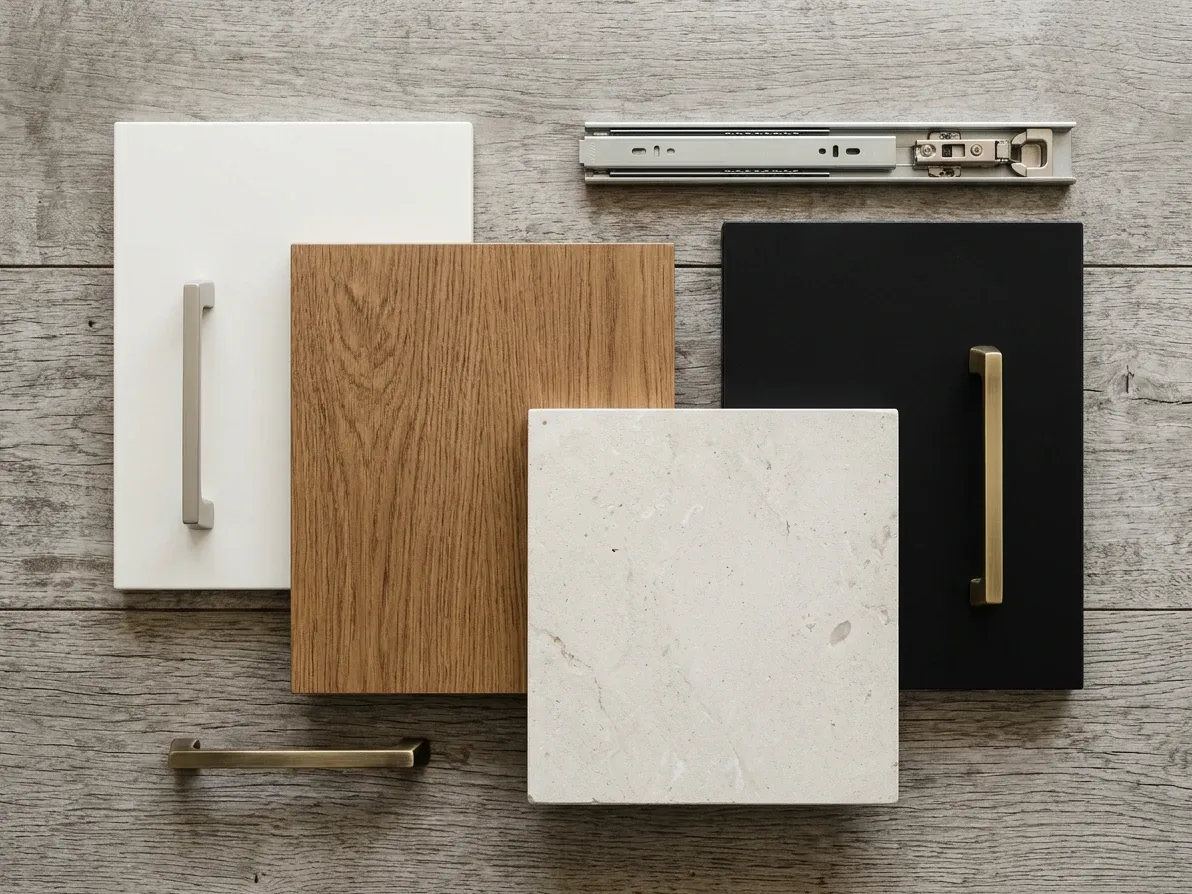
Carcass, door, profile, colour, hardware. Five decisions, one cabinet.
People talk about ‘choosing cabinets’ as if it is one decision. It is five, in this order:
The carcass material (the box behind the door). The door material and finish (laminate, 2pac, timber veneer, real timber). The door profile (slab, shaker, handleless, profiled). The colour and finish (and whether you go one-tone, two-tone, or a timber accent). The hardware (handles, runners, hinges, mechanisms).
Almost every cabinet conversation collapses these into one (‘we’re going white shaker’), which is fine as a starting point but hides the trade-offs that decide whether the kitchen actually performs. A white shaker on a particleboard carcass with thermolaminate doors and cheap runners costs a third of a white shaker on a moisture-resistant MDF carcass with 2pac doors and full-extension Blum drawers, and they look identical the day they are installed. Five years in, they do not.
The rest of this guide walks the five decisions in order.
What cabinets are actually made of
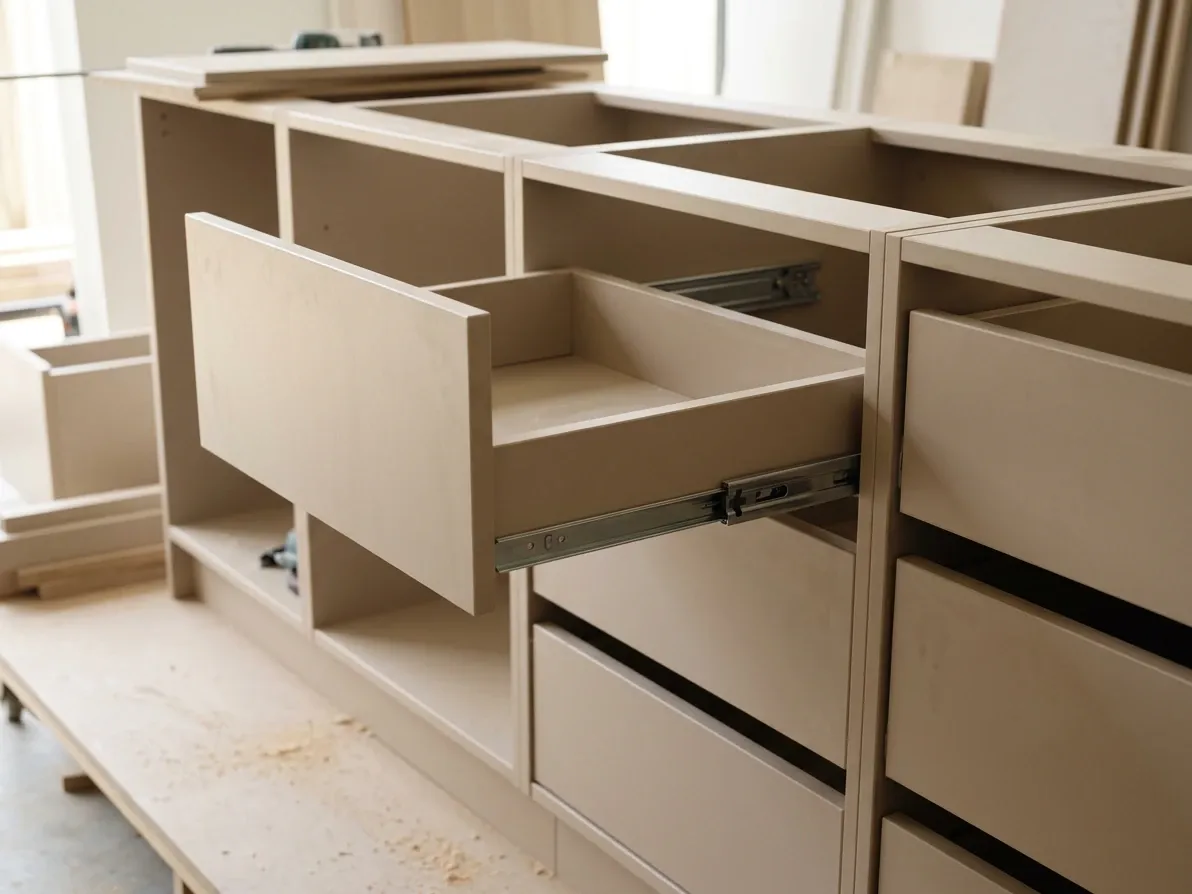
The carcass usually outlasts the doors, the doors usually outlast the hardware.
The carcass
The carcass is the box your doors and drawers attach to. Almost every Australian kitchen built since 1990 uses a melamine-faced board carcass: a particleboard or MDF core with a melamine paper bonded to both sides. Solid timber carcasses still exist in bespoke joinery but are rare and expensive.
Three carcass specifications matter:
Board type. Standard particleboard (cheaper, lighter) versus moisture-resistant MDF or MR particleboard (denser, holds screws better, handles humidity). For under-sink cabinets and any cabinet against an exterior wall, moisture-resistant board is the only sensible choice. Most quality Australian cabinet makers now spec MR board throughout.
Thickness. 16mm and 18mm are the two standard thicknesses. 18mm is structurally stiffer and lets you hang full-extension drawers without flex. For tall pantry cabinets and base cabinets carrying stone benchtops, 18mm earns its premium. Flat-pack brands typically use 16mm, which is fine for upper cabinets but sometimes feels under-spec in the bases.
Edge banding. A real ABS or PVC edge band, applied with a hot-melt or PUR adhesive, is what stops the board edges from absorbing moisture or chipping. PUR-bonded edges look like one continuous surface; cheaper edge tapes show a hairline join and can lift over time.
The door material
This is where the visible kitchen lives, and where the cost ladder splits.
Thermolaminate (vinyl wrap). A flexible vinyl film heat-pressed onto an MDF substrate. It is the cheapest finish, lets the manufacturer make routed shaker profiles in a single piece, and looks acceptable when new. The honest weakness is heat: vinyl can lift at the edges around ovens and dishwashers if the door is not properly detailed, and direct sunlight through a window can fade the colour over years. Mint Kitchen Group notes that 2pac generally holds up better than thermolaminate under both sunlight and heat, which lines up with what we hear from joiners.
Laminate. A high-pressure laminate (HPL) sheet bonded to a particleboard or MDF core, finished with a separate edge strip. Laminate is harder than a 2pac surface and resists fingerprints, bumps and household chemicals well, which is why it is the default for family kitchens and rental fit-outs. Modern laminate decors get very close to the look of real 2pac or timber, and the new generation of super-matte and anti-fingerprint laminates from brands like Polytec and Laminex genuinely change what is possible at the laminate tier. The honest weakness is the edge: even a well-detailed laminate has a thin seam where the edge strip meets the face, where a 2pac door is paint-wrapped on all sides.
2pac (two-pack polyurethane). Polyurethane paint sprayed onto an MDF substrate and oven-baked, usually in three or more coats with a sanding pass between each. 2pac gives the smoothest, most seamless finish on the market, lets you specify any colour and any sheen, and has no edge strips to lift. The trade-offs are cost (a 2pac kitchen typically runs 15 to 25% above a laminate-equivalent), repair (small chips can be touched up, which laminate cannot, but a 2pac surface scratches more easily than a hard laminate), and time (the spray and bake cycle adds 1 to 2 weeks to manufacturing lead time).
Timber veneer. A thin layer of real timber bonded to an MDF or ply core. American oak, walnut, Tasmanian oak and ash are the popular Australian veneers. Veneer gives real timber grain at roughly 30 to 50% of solid timber cost, and a single matched veneer flitch lets a joiner book-match doors across a long cabinet run so the grain reads as one continuous piece. The weakness is that veneer is fragile at the edges and shows wear in a way painted finishes do not. It is also the most premium option of the four, with installed pricing typically 25 to 50% above 2pac.
Solid timber. Reserved mostly for shaker frames (the rail and stile around the recessed centre panel) and for handle pulls or open shelving. Almost no Australian kitchen is fully solid-timber today because of movement (timber expands and contracts with humidity, which warps panels and cracks paint), cost (4 to 8x veneer for the equivalent look), and weight.
For most Australian kitchens in 2026, the practical choice is between a high-end laminate and 2pac, with timber veneer as the accent. The mid-range default is laminate doors on bases with a 2pac island. The premium default is full 2pac with a veneer feature wall or veneer pantry bank.
Door styles and what they each say
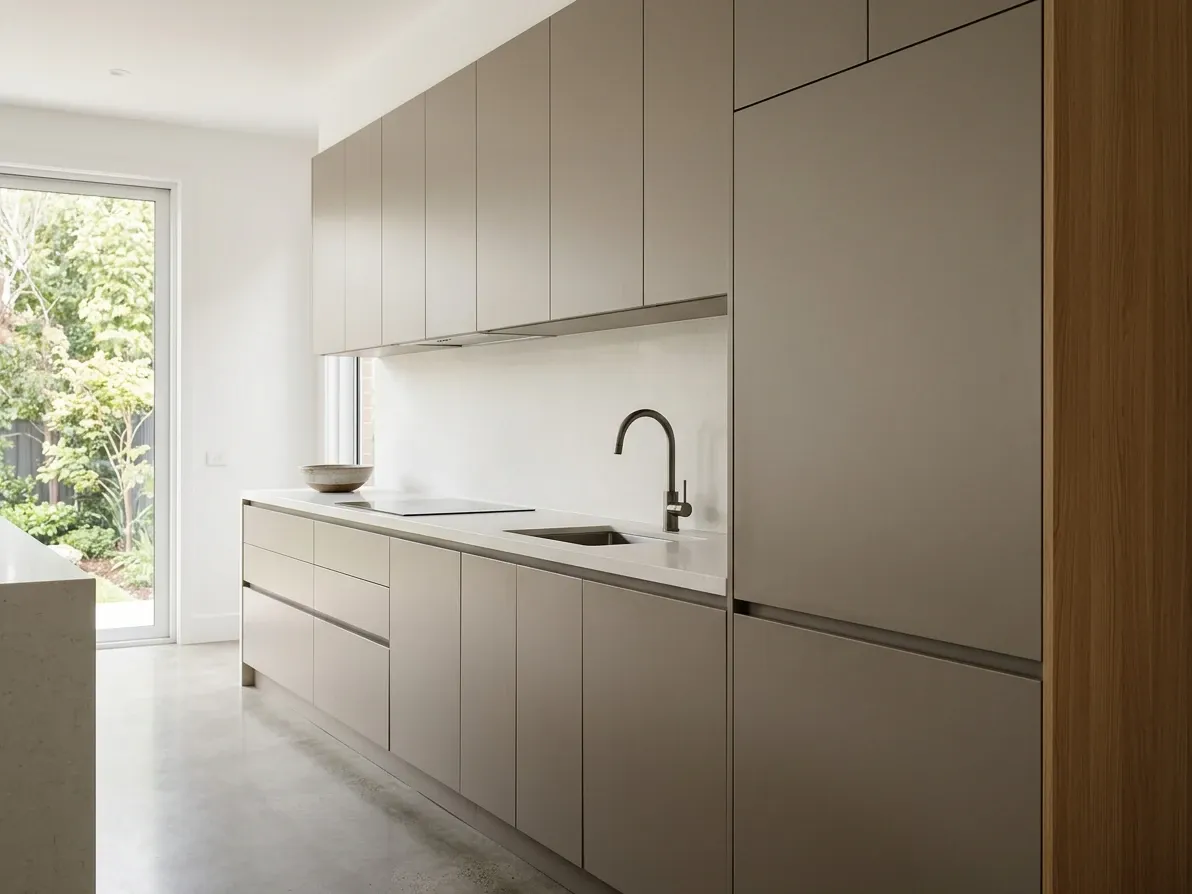
A handleless run reads as one architectural object.
You walk into a kitchen and the door profile registers before colour does. It tells you, instantly, what style the kitchen is. There are essentially four profiles worth considering.
Slab
A single flat panel with no contours, frames, or applied detail. Slab is the cleanest, most modern door, the easiest to wipe down (no grooves to catch grease and dust), and the natural partner of handleless cabinetry. It pairs with everything from minimalist Japandi to warm contemporary to a deliberately stark industrial kitchen. Custom slab doors in Melbourne run roughly $120 to $280 per door depending on material and finish, per Fit My House, which makes slab the most cost-effective premium door on the market.
When slab fails: in heritage and traditional homes (Federation, Victorian, Queenslander), a stark slab can feel imposed on the architecture. A low-profile shaker is usually a better fit there.
Shaker
A five-piece door with a recessed centre panel framed by simple square-edged rails and stiles, descended from American Shaker furniture. Shaker is the safer, more versatile choice in Australian homes and the most popular cabinetry style in the country, per Vitality Kitchens. It reads classical with white or cream, transitional with sage or warm navy, and surprisingly modern with deep charcoal or black. It also resells well to the broadest range of buyers, which matters if your time in the home is finite.
Most shaker doors in Australia are now one-piece routed MDF rather than the traditional five-piece assembly, which costs less, holds finish better, and looks identical to the eye. Custom shaker doors typically run $150 to $350 per door in Melbourne.
Where shaker frustrates: those recessed grooves do catch grease in a working kitchen, and a deep-profile shaker with heavy moulding feels overworked in a modern Australian home. A low-profile shaker with a narrow rail and a square inside edge is the modern compromise that holds up best.
Handleless
Not strictly a door profile but a cabinet system. Three approaches dominate in Australia:
J-pull is a routed finger pull along the top edge of the door, so the door itself is essentially slab. It is the most everyday-forgiving of the three and works particularly well in busy family kitchens.
Shadow-line (Sharknose) runs a continuous horizontal channel between the upper and lower cabinet runs, with the door tops chamfered to act as the finger pull. It gives the cleanest visual line of any handleless system but is unforgiving of any joinery imperfection.
Push-to-open uses a spring mechanism behind the door, so the front is completely flush with no finger pull. It is the cheapest of the three handleless systems but is best avoided directly in front of a sink or cooktop where you stand and lean while working, because incidental contact opens the door.
Handleless typically adds 10 to 15% to the cabinetry budget. The visual payoff is real: when done well, an uninterrupted plane of joinery reads as a single architectural object rather than a wall of cabinet doors.
Profiled and traditional
Raised-panel doors, beaded shaker, mullioned glass uppers, applied moulding, scribed end panels. These belong in deliberately traditional, French Provincial, country or heritage kitchens where the architecture earns them. They are also the easiest door to date badly: a heavy raised-panel kitchen specified in 2005 reads, in 2026, as if it was specified in 2005. If you are designing a heritage-style kitchen, go to it knowing the profile is the defining choice and that traditional has its own slower trend cycles inside it.
Cabinet colour: is white still the answer?
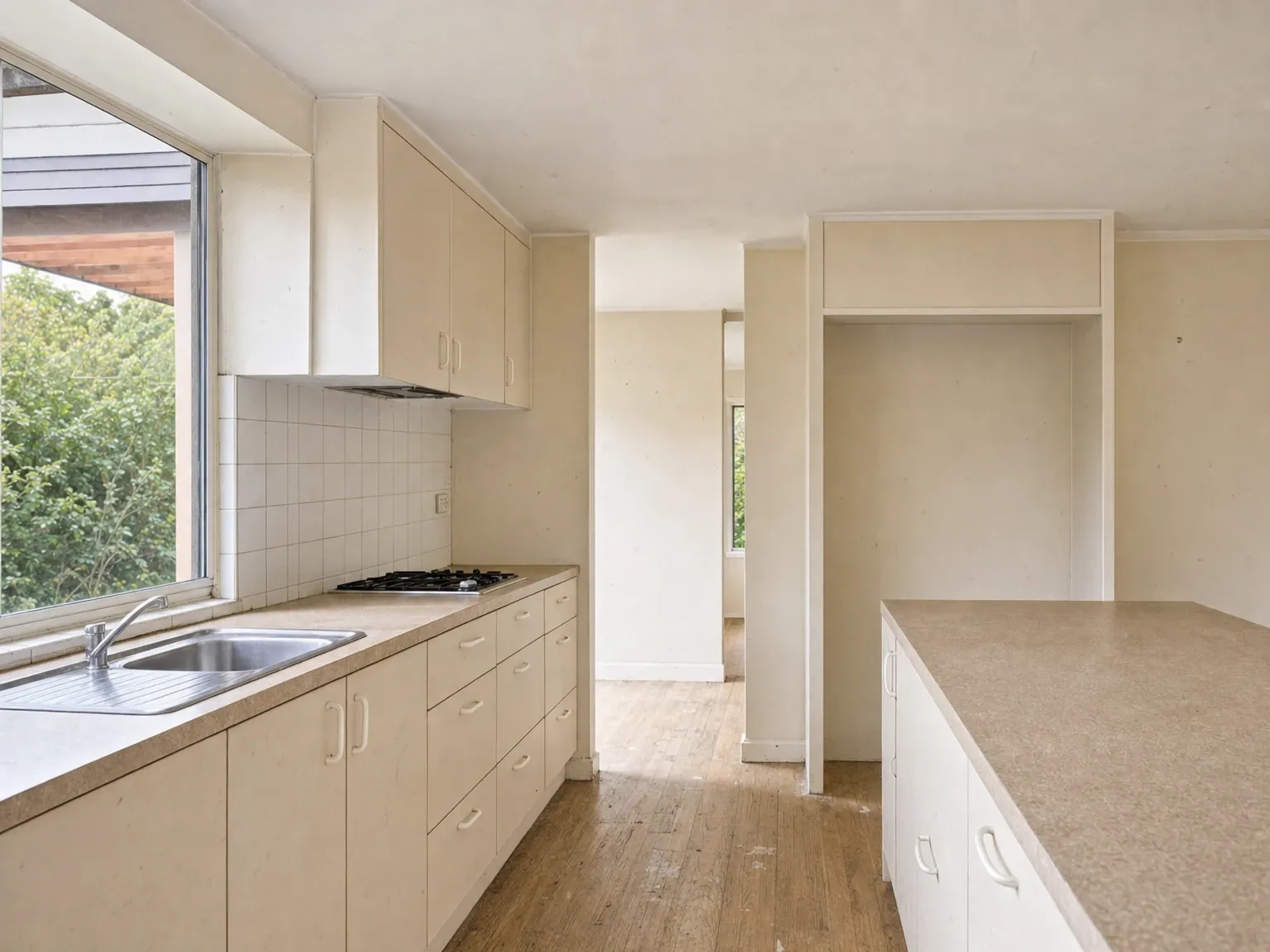 Before
After
Before
After
White is still the most popular kitchen cabinet colour in Australia by a long way. The 2023 Houzz Australia Kitchen Trends Study, based on 473 surveyed Australian homeowners, found white on 52% of renovated kitchen cabinets, with black at 8%, green at 6% and grey at 6% making up the bulk of the contrast palette.
That is one in two new Australian kitchens specified in white cabinets, which makes it the only colour with majority share.
- White52%
- Black8%
- Green6%
- Grey6%
- Other28%
What is also true is that white is shifting. Through 2025 and into 2026, the warm-white and off-white end of the spectrum (warm white, antique white, mushroom, soft greige, linen) has taken share from the cool-bright gloss whites that defined the 2010s. The kitchen retailer Kinsman has called 2026 the year of warm whites, beiges, olives and soft greys, and that mirrors what we see in showrooms across the country. The Houzz study also showed white turning up everywhere else in Australian kitchens, not just on cabinets, which is why some of the recent reaction against white kitchens reads as fatigue more than rejection.
The case for white in 2026 remains strong on four fronts. It reflects more light than any other colour, which still suits small kitchens, basement kitchens and any room with limited natural light. It pairs with almost any benchtop, splashback, floor and hardware finish, which makes it the most forgiving colour if other choices are not yet locked. It dates more slowly than any current accent colour because it has been the default kitchen cabinet for almost a century. And it resells well: Australian and international research consistently finds white kitchens sell faster and for more, with one Zillow analysis cited across the industry showing white-kitchen homes sold for around 2% more than equivalent homes.
The case against white in 2026 is twofold. It shows everything (smudges, grease, scuffs, water spots), so a busy family kitchen in pure white requires meaningfully more wipe-down maintenance than the same kitchen in a mid-tone laminate. And cool gloss white now reads as a dated specification, even though warm matte white does not.
If you are going white, three rules of thumb hold up:
Specify warm white, not cool white. A cool-white cabinet under the warm LED downlights almost every Australian kitchen now uses can read green or grey. A warm white reads as the colour you actually picked.
Specify matte or super-matte, not gloss. Gloss white was the 2010s. Matte white is current and pairs better with honed stone benchtops and natural timber accents.
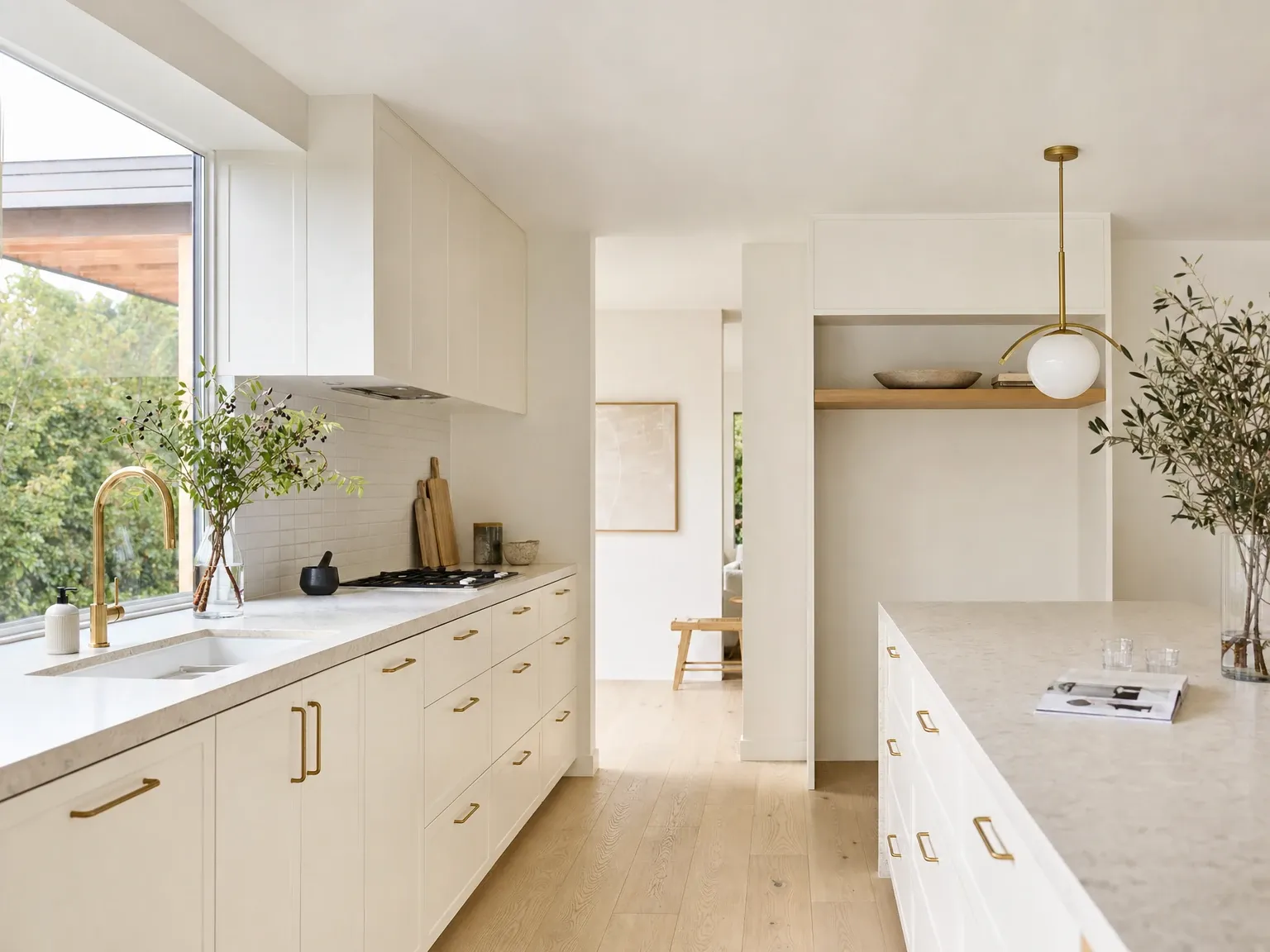
Pair white with at least one warm material: a timber-veneer island, oak open shelving, a warm-toned brass or aged-brass handle, or a honed limestone benchtop. A fully white kitchen with stainless steel hardware and a cool-grey benchtop is the room people are reacting against.
If you are not going white, the colours with momentum in Australia in 2026 are warm green (sage, olive, deep forest), warm navy and inky blue, warm charcoal, mushroom and clay-toned neutrals, and deep terracotta or burnished bronze. The 2023 Houzz data above is roughly where Australian kitchens sit now, but the warm-neutral and earthy-green end of the chart is where the trend line is pointing.
Two-tone and the contrasting island
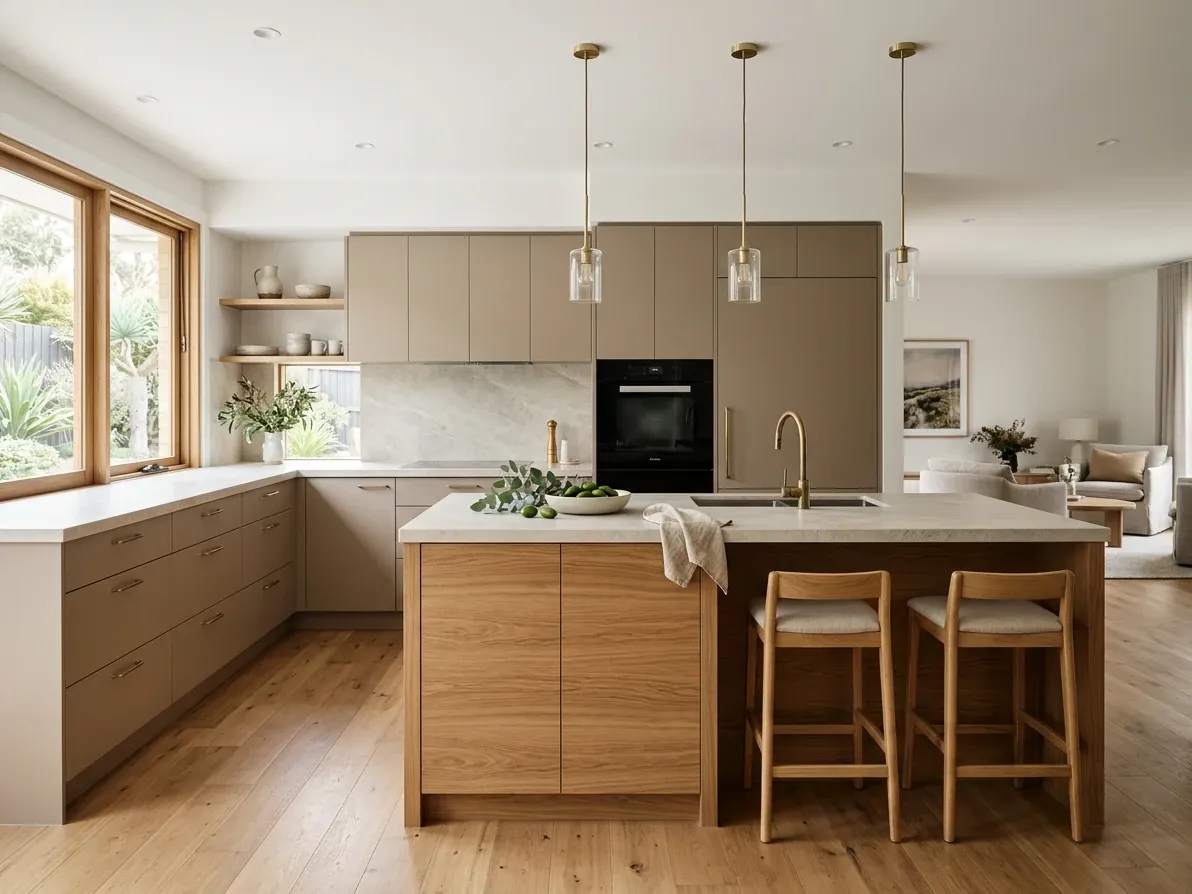
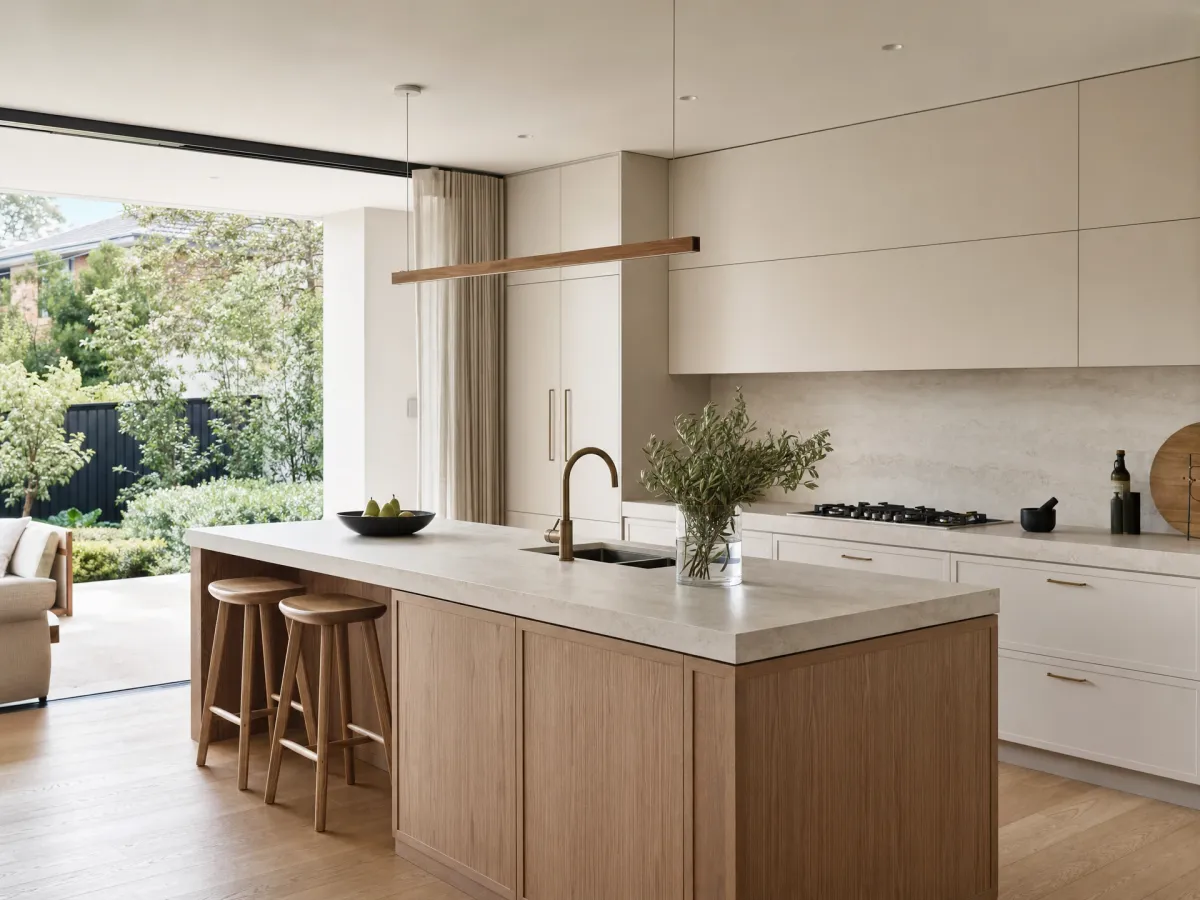
Warm-neutral perimeter, timber-veneer island, one contrast doing the work.
Two-tone kitchens (one colour on the perimeter, a second on the island or pantry bank) have moved from trend to default for any kitchen of reasonable scale. The contrasting island is the most enduring and most timeless of the two-tone moves because the island is a defined object rather than a split run, so the contrast reads as deliberate rather than uneven.
In Australian kitchens in 2026, the combinations that hold up best are:
A warm-white or warm-neutral perimeter with a timber-veneer island, almost always American oak crown veneer, walnut or Tasmanian oak. This is the warm-modern default and has staying power.
A warm-white perimeter with a deep navy, forest green, or charcoal island. The contrast is bolder but still holds in five years because the perimeter is the neutral and only the focal point is the trend colour.
A timber-veneer perimeter with a stone-clad waterfall island. This inverts the usual hierarchy and reads as architecture rather than decoration.
What dates fastest in two-tone kitchens is a hard split between upper and lower cabinets (dark lowers, white uppers all along one wall), particularly when both runs are a current trend colour. The combination tends to read as a phase rather than a kitchen.
If you want a third tone for the pantry bank, that needs to be either a timber that ties to the island or a neutral that ties to the perimeter. A perimeter, an island and a pantry bank in three different statement colours is one tone too many.
Hardware and the way drawers feel
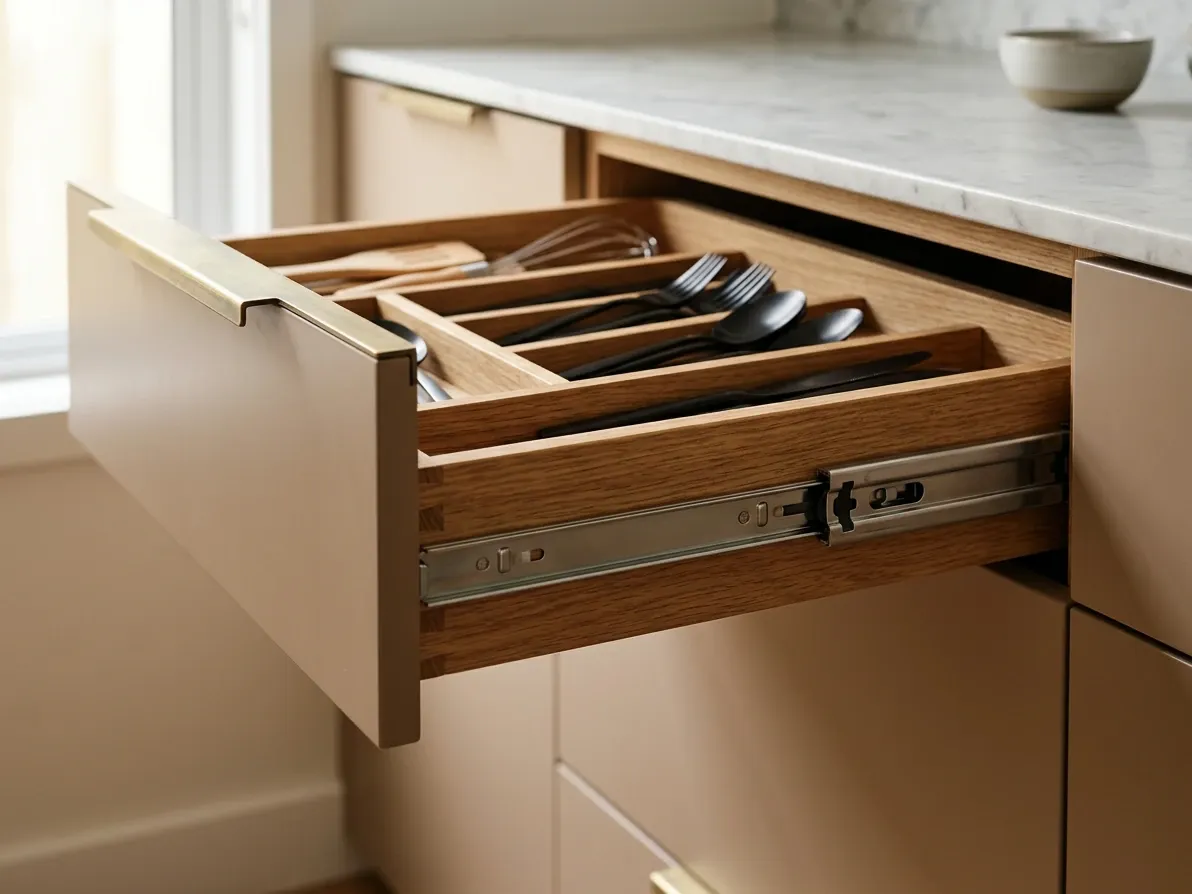
The drawer is where you feel the budget every day.
You touch your kitchen hardware thousands of times a year. It is the difference between a kitchen that feels considered and one that feels cheap, and it is the cheapest place to upgrade or downgrade a kitchen budget.
Drawer runners
This is where to spend. Quality drawer runners, almost universally Austrian-made Blum Movento or Tandem with soft-close, come with a lifetime warranty on non-electrical parts and full-extension travel that exposes the back of the drawer. They take heavy loads (40 kg and up per drawer is standard) without sag or bind, and they keep their movement after years of daily opening.
Cheap drawer runners start to sag and stick within 5 to 10 years of family use, particularly in deep drawers loaded with crockery. They are also the part of a flat-pack kitchen that tells you it is a flat-pack: an unweighted drawer that wobbles as it slides closed reads as cheap from across the room.
For a mid-range cabinetry spec, allowing for Blum or equivalent across every drawer typically adds $40 to $80 per drawer over budget hardware. On a kitchen with 12 drawers, that is $500 to $1,000 of extra budget that you feel every single day for the next 20 years. It is one of the best upgrades on this list.
Hinges
Standard concealed hinges (the European-style six-way adjustable hinge originally pioneered by Blum) are now the default across almost every Australian cabinet maker. The two specs that matter are the hinge angle (110-degree is standard, 165-degree allows the door to open clear of adjacent drawers) and the soft-close mechanism (an integrated damper, usually Blumotion or equivalent, that stops the door from slamming).
For an island where doors face into a walkway, 165-degree hinges are worth the small premium because they let the door swing fully clear when you are loading or unloading.
Handles
The single most exchangeable element of the kitchen, and the one most worth changing later if your taste shifts. Two principles hold:
Match the handle finish to the tapware finish, not to the appliance finish. A brass handle with a brass tap reads as deliberate; a brass handle with a chrome tap reads as accidental. Stainless and brushed steel handles pair with stainless tapware.
Match the handle shape to the door profile. Thin tubular bar handles suit slab and modern shaker. Cup pulls and knobs suit traditional shaker, Hamptons and French Provincial kitchens. Edge or finger pulls suit handleless designs. A heavy traditional cup pull on a slab cabinet reads as a mismatch.
If you are torn between two handle options at brief stage, specify the cheaper one and budget for an upgrade in year two. Handles are the easiest mid-life refresh in any kitchen.
Push-to-open and electronic systems
Push-to-open mechanical drawers and Blum’s Servo-Drive electric system (where the drawer opens at a light touch of the door front) are both increasingly specified in handleless kitchens. Electric systems carry a warranty premium and add wiring inside the cabinet, and our experience is they are worth it on rubbish-bin pull-outs (where your hands are usually full) and somewhere they are not on the every-drawer spec.
Layout, storage and the deep drawer
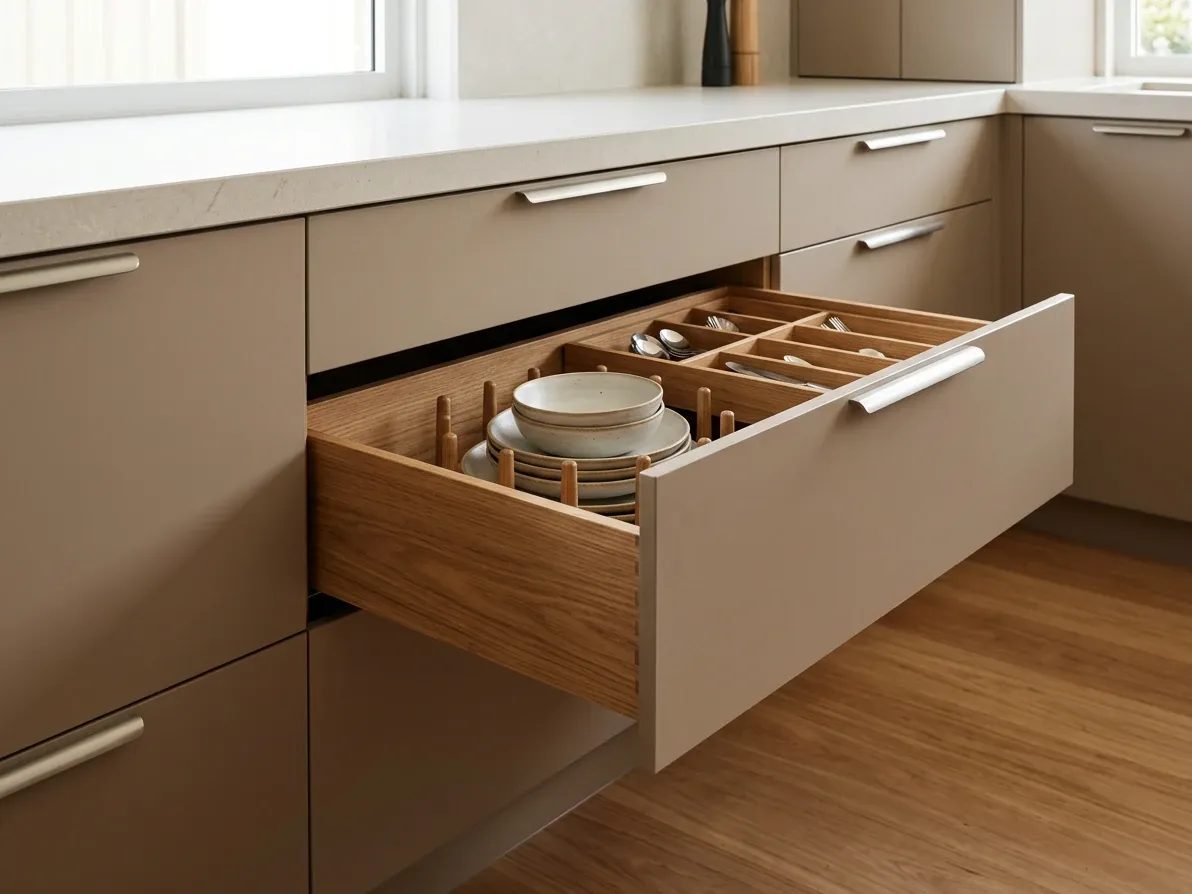
Three drawers, one bank, everything visible at a glance.
Cabinet layout follows the kitchen layout, not the other way around. The big decisions sit at the kitchen-design level (galley, L-shape, U-shape, island, single-wall) and live in our separate kitchen renovation ideas guide. At the cabinet level, three decisions matter most.
Drawers over cupboards in the base run
For a working kitchen in 2026, deep drawers under the benchtop have almost completely replaced cupboards with shelves. The reason is access: you reach into a drawer once and see every item, where a cupboard requires you to crouch, pull things forward and look behind them. A 600mm or 900mm wide drawer bank holds more usable storage than the equivalent cupboard because you do not lose the back-corner deadzones.
The standard modern Australian base run is three drawers of decreasing depth: a shallow top drawer for cutlery and utensils, a medium-deep middle drawer for plates and bowls (a sliding internal divider stops the plates sliding around), and a deep bottom drawer for pots, pans and bulk dry goods. This handles 80 to 90% of household storage with no crouching and no rummaging.
The exception is under-sink, where the plumbing fights drawers. A pull-out under-sink drawer with a notched back panel that clears the trap is doable and worth the small premium.
Pantry: walk-in, cabinet or both
The 2023 Houzz Australia data showed 53% of homeowners installing pantry cabinets and 27% adding a walk-in pantry. Both have their place.
Cabinet pantries (a tall built-in run, typically 600 to 900mm wide, with internal drawers or pull-out shelves) work hardest when floor space is tight. A well-fitted cabinet pantry with internal drawers and a half-shelf for cookbooks stores roughly as much as a small walk-in, in less floor space. It also keeps a clean architectural front wall, which suits modern kitchens where the joinery is the look.
Walk-in pantries (and the bigger butler’s pantry, with its own benchtop and sometimes a second sink, dishwasher or fridge) are the choice when you want a working zone hidden from the open-plan living area, when you bulk-cook or entertain at scale, or when storage matters more than polish. A butler’s pantry has become almost standard in premium new builds because it lets the public kitchen stay clean while the messy work happens behind a door.
If your kitchen has the space, the strongest combination is a cabinet pantry for daily-use dry goods plus a walk-in or butler’s for bulk, small appliances and overflow. If it does not, a well-designed cabinet pantry on its own handles most households.
Internal cabinetry: the corners and the awkward gaps
The two cabinet zones that earn their keep with internal joinery are corner cabinets and tall pantries.
In corner cabinets, the choice is between a blind corner (a deep cupboard you reach into with no aid), a magic corner or LeMans pull-out (hardware that swings the contents out to you), or a corner drawer (specialist drawers that fan into the corner space). LeMans and magic corners cost roughly $400 to $800 per cabinet over basic shelving and are the difference between a working corner and a forgotten one.
In tall pantries, pull-out wire baskets and shelves from brands like Tansel sit on quality runners and bring the back of the pantry forward so you can see what is there. The trade-off against a fixed shelf is mostly cost: a six-drawer pull-out pantry unit runs $400 to $1,200 depending on width, where a fixed-shelf pantry of the same width is closer to $150 to $300.
The strongest rule of thumb across the kitchen: every cabinet zone you have to reach into blind, you will eventually stop reaching into. Pay the upgrade to make it visible.
What cabinets actually cost in Australia in 2026
Cabinet pricing is messy because the four tiers (flat-pack DIY, flat-pack installed, semi-custom, fully custom) overlap heavily at the edges, and the same flat-pack kitchen from Kaboodle, IKEA or Bunnings can range from $3,000 to $13,000 depending purely on whether you swing the screwdriver yourself.
The four tiers as the Australian market actually prices them:
Flat-pack DIY. $3,000 to $8,000 in materials for a standard 10 to 15 square metre kitchen. Brands include Kaboodle (Bunnings), IKEA Metod, and a long tail of online flat-pack sellers. You assemble the carcasses, hang the doors, fit the hardware and install the kitchen yourself. It is the cheapest path to a new kitchen by a wide margin, and the finish quality of mid-tier flat-pack has improved noticeably since 2020. The honest reality is that flat-pack assembly is genuinely time-consuming (allow 40 to 80 hours for a competent DIYer) and that getting the install plumb, level and flush is the part that separates a kitchen that looks tradesman-fitted from one that looks DIY.
Flat-pack installed. $5,000 to $13,000 for the same product fitted by a kitchen installer. You pay roughly $2,000 to $5,000 in labour over the DIY material cost. This is the cleanest mid-budget path because you get the finished install without learning flat-pack joinery, and the design constraints (off-the-shelf cabinet sizes) keep you out of trouble with overly ambitious custom plans.
Semi-custom (modular). $11,000 to $20,000 installed for a standard kitchen. Brands include Kitchen Connection, Wallspan, Polytec, Smith & Smith and the regional equivalents. You design from a modular catalogue with hundreds of cabinet sizes, door profiles, finishes and hardware options, but the manufacturing pipeline is standardised, so lead times and pricing are predictable. This is the default mid-market spec for most Australian renovations.
Fully custom joinery. $20,000 to $40,000+ installed. Made by a local cabinet maker, joiner or design-build firm to a drawn specification. Every dimension, finish and detail is bespoke. You pay for the joiner’s time and design input as well as the materials, and lead times often run 8 to 16 weeks from sign-off. Custom is where the kitchen earns its premium when the architecture is unusual, when the brief is genuinely specific, or when the budget supports a full timber-veneer specification.
Most of the gap between tiers is labour, design and detail, not material. A well-detailed laminate kitchen at the semi-custom tier can outperform an under-detailed 2pac kitchen at the custom tier on both look and life. The single biggest predictor of cabinet satisfaction five years out is not which tier you bought; it is how well the joinery was specified and how well the install was finished.
The mistakes we keep watching
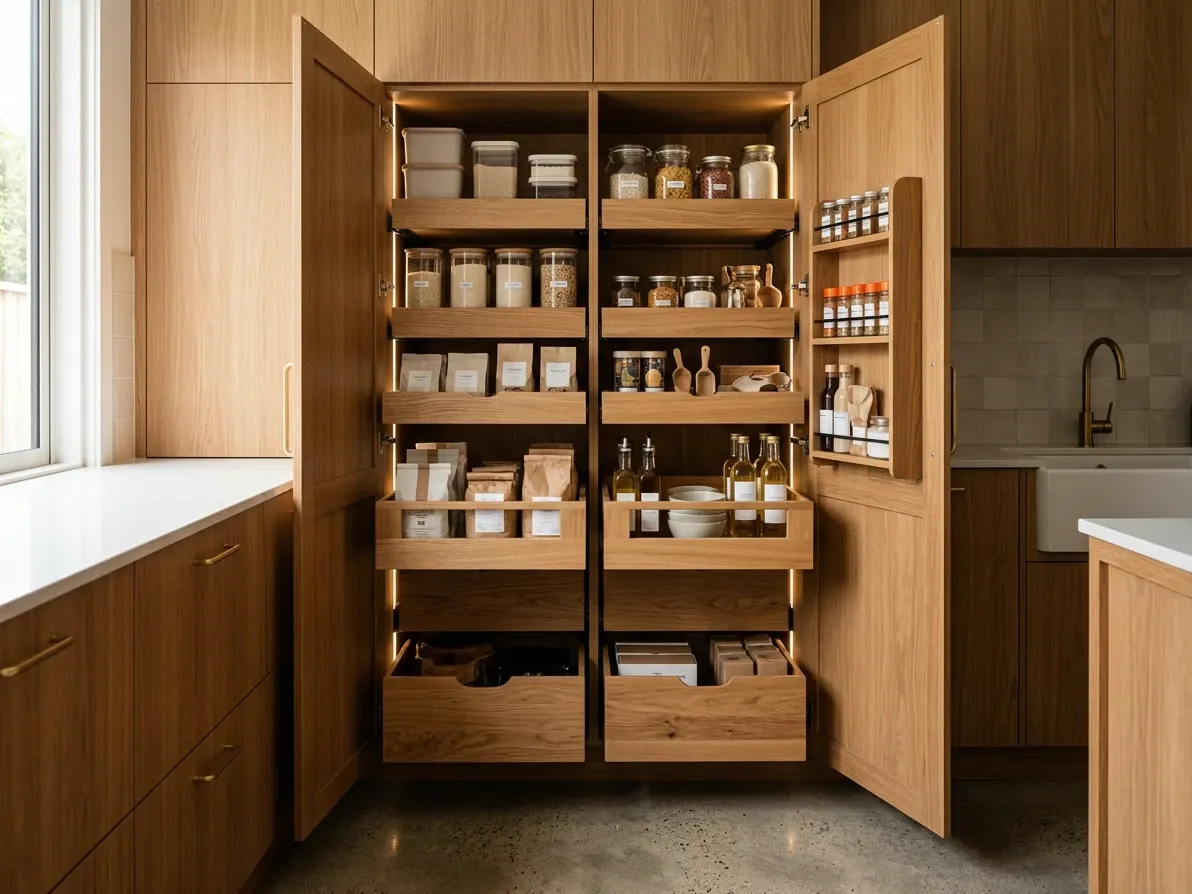
A pantry designed as backbone, not leftover.
A few patterns repeat across the renovations we visualise. None of them are obscure. All of them are avoidable.
Specifying gloss white in a sunny north-facing kitchen. Gloss white shows every fingerprint and every grease splash, and under bright afternoon light it reads as glare more than as a colour. A matte or super-matte finish in the same warm-white tone solves this completely.
Choosing the door profile and colour before settling the carcass spec. The cabinet you see is doors and hardware. The cabinet you live with is the carcass behind them. Locking the door profile and finish before agreeing on board thickness, edge bonding, runner brand and hinge spec is a recipe for an attractive kitchen that does not feel solid.
Two-tone splits that fight the architecture. A horizontal upper-versus-lower colour split on a single wall reads as imposed unless the architecture already has a horizontal break (a tile band, a window line) to anchor it. A contrasting island in the middle of the room reads as deliberate because it has its own physical edges.
Pantry as an afterthought. The pantry is often the last cabinet on the drawing and the first one renovators wish they had spent more on. Whether you go walk-in or cabinet, design it as the storage backbone of the kitchen rather than as the leftover at the end of a run.
Skimping on under-sink and behind-rangehood detailing. Both are wet zones in disguise. Moisture-resistant board, properly silicone-sealed back panels and a removable plinth panel under the sink (so you can reach the trap without dismantling the joinery) cost almost nothing extra at specification and save thousands at the 10-year mark.
Going custom for the wrong reason. Custom is worth the premium when the kitchen genuinely demands non-standard sizes, an unusual layout, or premium finishes that the semi-custom catalogue does not carry. It is not worth the premium when the only difference is the badge on the invoice. A well-detailed semi-custom kitchen is a better outcome than an under-detailed custom one at the same cost.
Picking a colour from a 100mm sample under showroom lighting. A cabinet sample in your kitchen, on the wall it will live on, under the actual downlights you have, at the time of day you cook, is the only honest test of how the colour will read. Order full-size door samples wherever a supplier offers them.
Picture the kitchen before you commit
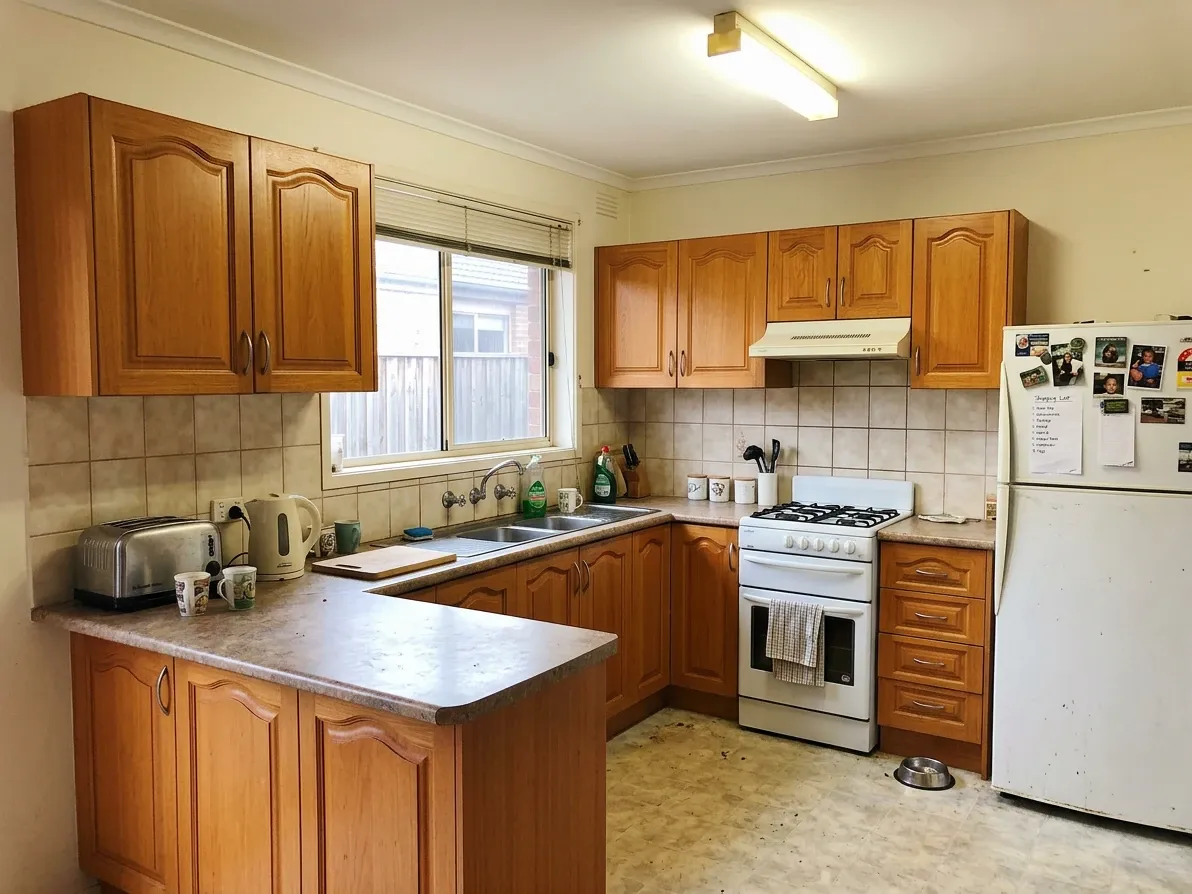
The cheapest part of a $35,000 kitchen renovation is the part where you change your mind, and the most expensive part is the part where you change your mind after the joiner has cut.
We run a 3D visualisation service used by Australian builders, agents and designers that turns a phone photo of your existing kitchen and a brief into a photoreal image of the finished room with your selected cabinets, benchtop, splashback and finishes, typically inside 24 hours. The point is not to sell the service; the point is that any renovator can now picture their actual kitchen with their actual selections before they sign the joinery contract, and the cost of doing so is roughly one tenth of one percent of the renovation budget. Whether you use us or anyone else, see the kitchen before you commit.
Frequently asked questions
How much do kitchen cabinets cost in Australia in 2026?
Flat-pack cabinets you install yourself run $3,000 to $8,000 for a standard kitchen. The same flat-pack range installed by a kitchen fitter sits between $5,000 and $13,000. Semi-custom cabinetry from a modular brand installed by a joiner is $11,000 to $20,000. Fully bespoke joinery starts at $20,000 and runs above $40,000 for premium homes. Cabinetry is the biggest single line item in any kitchen renovation, generally 30 to 40% of the total budget, so on the national median kitchen reno of around $35,000 (and $42,630 in Victoria per the HIA Kitchens and Bathrooms Report 2024/25), you are spending roughly $10,500 to $14,000 on cabinetry alone.
Are white kitchen cabinets going out of style in Australia?
No, but white is no longer the only safe answer. The 2023 Houzz Australia Kitchen Trends Study had white at 52% of all cabinet specifications, still the leader by a wide margin, with black (8%), green (6%) and grey (6%) bringing the contrast. The shift through 2025 and 2026 has been toward warmer whites, mushroom, sage and earthy neutrals over crisp gloss white, and toward two-tone kitchens where a darker island or pantry bank sits against a lighter perimeter. White still resells well, still suits small kitchens, and still pairs with almost anything. It just is not the automatic default it was a decade ago.
What’s the difference between laminate, thermolaminate, 2pac and timber veneer cabinets?
Laminate is a hard plastic sheet pressed onto an MDF or particleboard core, finished with an edge strip. It is the most durable and the most affordable, and a good laminate looks closer to 2pac every year. Thermolaminate (sometimes called vinyl wrap) is a vinyl film heat-pressed onto MDF and is the cheapest finish, but it can lift around heat sources like ovens and dishwashers if poorly detailed. 2pac (two-pack polyurethane) is paint sprayed onto MDF and oven-baked, giving the smoothest seamless finish and the widest colour range, but it is the most expensive and shows scratches more readily than laminate. Timber veneer is a thin layer of real timber bonded to an MDF or ply core, giving real-grain warmth at a fraction of solid timber cost. Solid timber is mostly reserved for shaker rails and stiles in heritage joinery.
Shaker or slab cabinets for an Australian kitchen?
Shaker (a framed door with a recessed centre panel) is the safer choice if you want something that holds up across changing trends and appeals to the broadest range of future buyers. It works in Hamptons, French Provincial, coastal, country and contemporary kitchens. Slab (a single flat panel with no profiling) is the modern default and pairs naturally with handleless cabinetry and integrated appliances. Slab is cleaner to wipe down because there are no grooves to catch grease. Shaker carries a small premium of $30 to $60 per door over slab because of the extra routing and finishing. Both are essentially future-proof in Australian homes through 2030.
Walk-in pantry or pantry cabinets?
Both have their place. According to Houzz Australia 2023, 53% of homeowners installing pantry storage chose cabinet pantries (tall built-in joinery) and 27% added a walk-in pantry. Pantry cabinets are the better choice when floor space is tight, when you want a clean architectural front wall, or when you have already invested in deep drawer banks elsewhere. Walk-in pantries (and their bigger cousin, the butler’s pantry) are the choice when you want a working zone hidden from the open-plan living area, when you cook a lot at scale, or when storage is genuinely the priority over polish. A well-fitted cabinet pantry with internal drawers stores roughly as much as a small walk-in, in less floor space.
Are handleless kitchen cabinets worth it?
Handleless cabinetry adds roughly 10 to 15% to the cabinetry budget, but the visual payoff is significant: an uninterrupted plane of joinery that reads as one architectural object rather than a wall of cabinet doors. The three handleless systems used in Australia are J-pull (a routed finger pull along the top of the door), shadow-line or Sharknose (a continuous channel between cabinet runs), and push-to-open (a sprung mechanism). Push-to-open is the cheapest of the three and is best avoided directly in front of a sink or cooktop where you lean while working. J-pull is the most forgiving for everyday use. Handleless reads beautifully in modern and contemporary kitchens but can feel out of place in heritage homes where a shaker with a real handle suits the architecture better.
How long do kitchen cabinets last?
Well-built cabinets in a moisture-free Australian kitchen typically last 20 to 30 years for the carcass and 15 to 25 years for the doors and drawer fronts. The carcass (the box behind the door) usually outlasts everything else, which is why kitchen refacing (replacing only doors, drawer fronts, hardware and benchtop while keeping the existing carcass) is a real option at the 15-year mark if the layout still works. Hardware is the part that fails first. Quality soft-close runners from brands like Blum come with a lifetime warranty on non-electrical parts, but cheap drawer slides start to sag and bind within 5 to 10 years of daily use. The single biggest factor in cabinet lifespan in Australian kitchens is water exposure under the sink, not age.