Bedroom design and decoration that works
A practical Australian bedroom guide for 2026: layout maths, paint colours that actually help you sleep, lighting layers, storage and the styles that work here.
Why this guide exists
Bedroom content online splits cleanly into two unsatisfying buckets. The first is the inspiration feed: endless Pinterest boards, Houzz galleries and Instagram saves with no information about how the rooms were planned, what they cost, what stays comfortable to live in and what was staged for one photograph. The second is the trade content: builder calculators, mattress retailer copy and the same dozen “10 bedroom ideas” listicles recycled across hundreds of sites. Neither answers the question Australians actually arrive with, which is some version of how do I make this specific bedroom, in this specific Australian house, work and feel good every day.
This guide is the long version of that answer. It covers what a bedroom is supposed to do (sleep first, store second, sanctuary third), the layout maths that decide whether a room functions or just photographs, the paint colours that support or wreck sleep, the four-layer lighting set that quietly separates good bedrooms from cheap-feeling ones, what the storage strategy looks like in a country where 76 per cent of dwellings still have three or four bedrooms, the soft-furnishing layering that finishes the room, the style directions that work in Australian houses, the mistakes that age a bedroom fastest, and what it costs to redo one in 2026.
It sits inside the broader interior design styles guide for Australia, and links across to the dedicated coastal, Hamptons and French Provincial deep-dives when the bedroom belongs to one of those style families.
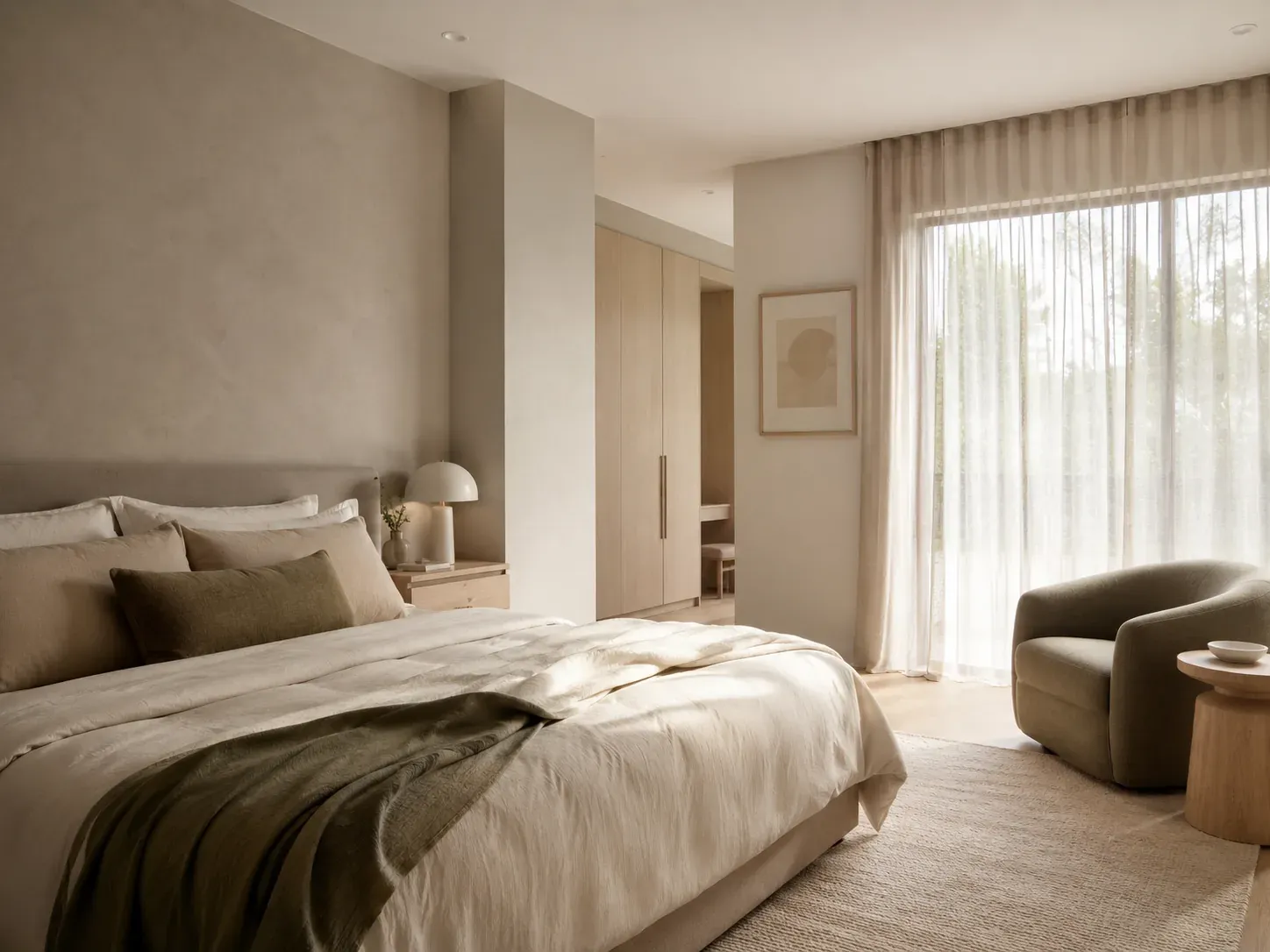
Sleep first. Storage second. Sanctuary third. The order matters.
What a well-designed bedroom actually does
A bedroom has three jobs and most poor bedrooms fail one of them.
The first job is sleep. Everything else is secondary to whether the room lets you fall asleep, stay asleep and wake up rested. The Sleep Health Foundation recommends seven to nine hours per night for adults, and its 2025 Asleep on the Job and follow-up surveys found that roughly 27 per cent of Australian adults report less than seven hours and nearly half (46 per cent) say poor sleep is directly impacting their ability to work or study. A bedroom that runs too warm, lets in too much light, carries the wrong colour temperature or sits next to a noisy living room will not fix that on its own, but it is one of the few sleep variables most people can actually change.
The second job is storage. A bedroom that has nowhere to put clothes, books and the contents of a life ends up with everything on the floor and the back of a chair, and a beautifully decorated room that lives in that state stops feeling beautiful within a week. Storage is the unglamorous half of bedroom design and the half that disproportionately decides whether you actually enjoy living in the room.
The third job is sanctuary. The bedroom is the room you should be most able to close the door on the rest of the house in. That argues for low visual complexity, soft surfaces, restrained colour, layered lighting and a sense of being held rather than performed in. It is the opposite of the kitchen and the living room, which are designed for activity and display, and it is why bedroom styling that copies kitchen or living-room moves usually feels off.
Get the three jobs right and the room reads as quietly luxurious regardless of budget. Miss one of them and no amount of styling rescues the room.
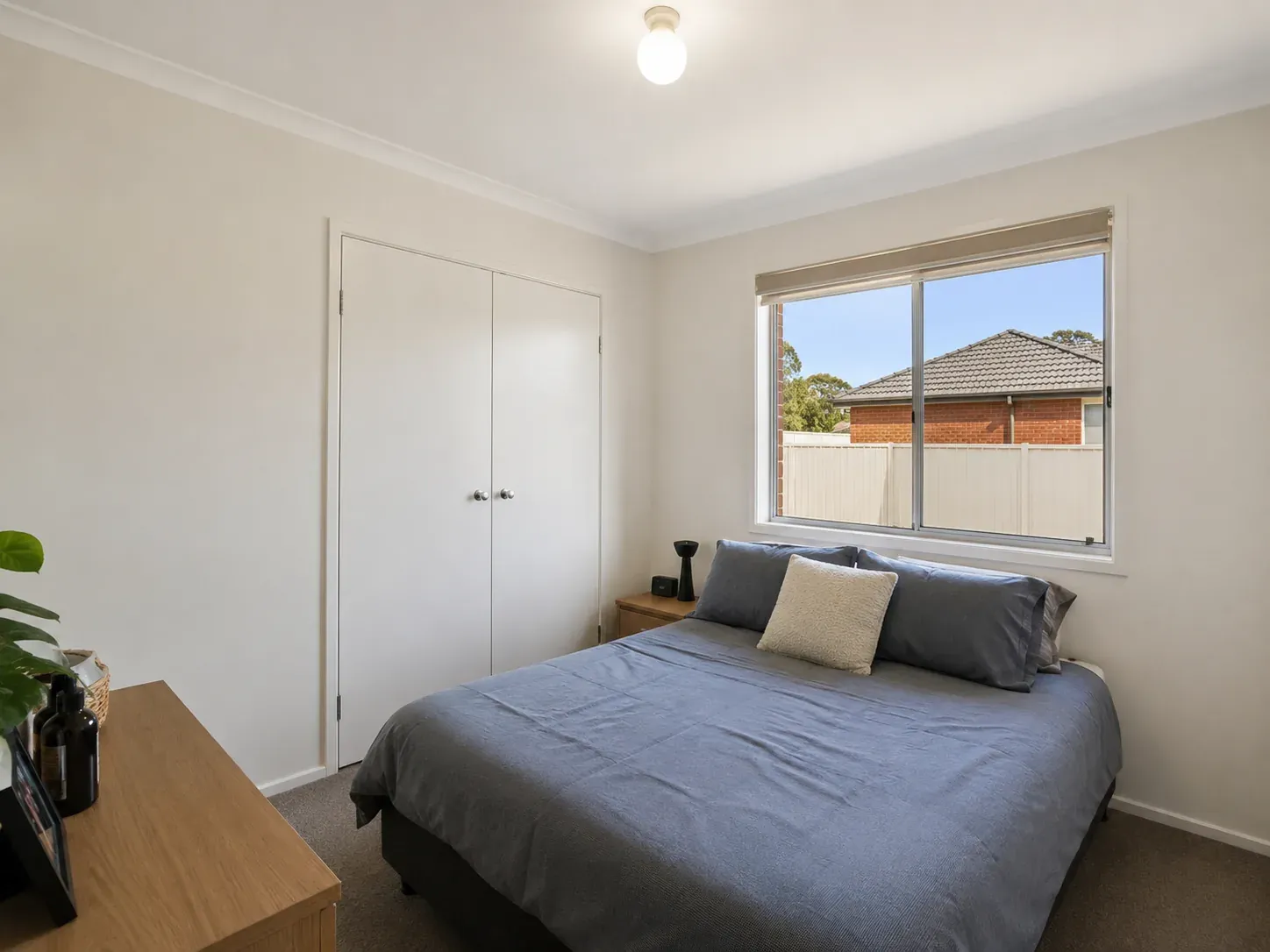
The real Australian bedroom: 9 to 12 square metres, one window, one wardrobe.
The bedroom most Australians are actually working with
The Australian housing stock matters because it sets the baseline. According to the Australian Bureau of Statistics 2021 Census, 42.6 per cent of occupied private dwellings have three bedrooms, 33.1 per cent have four or more, and 24.3 per cent have two or fewer. The three-bedroom detached house is still the modal Australian dwelling, with most separate houses (around 89 per cent) carrying three or four bedrooms and most flats and apartments (around 82 per cent) carrying one or two.
- 2 bedrooms or fewer24%
- 3 bedrooms43%
- 4 or more bedrooms33%
The size assumption that follows is just as important. According to multiple Australian builder guides including Build Sydney and SJD Homes, the average secondary bedroom in a new Australian build measures around 3.2 m by 3.0 m, and the average master sits at around 4.2 m by 3.9 m. The National Construction Code treats anything below 6.5 square metres as not habitable, and anything under 8 square metres reads as small in practice. The comfortable floor for fitting a queen bed, two bedsides and a wardrobe without the room feeling congested is around 10 square metres.
The implication is that the bedroom most Australians are decorating is not the magazine bedroom. It is a 9 to 12 square metre rectangular box with one window, one door, one wardrobe nook, a 2.4 m ceiling and a queen bed planned into the centre of one wall. Almost every layout decision in this guide is built around that case, with notes for the larger master and the genuinely small (under 8 square metre) box.
Start with the bed: size, placement and the geometry of the rest of the room
The bed is the largest object in the room and it decides everything that follows. Size first, then placement, then dressing.
Size
Australia has its own standard mattress dimensions, which differ slightly from US, UK and European sizing. The Sealy size chart and the Bedbuyer 2026 guide both confirm the same numbers. Single beds are 92 cm by 188 cm, king single beds 107 cm by 203 cm, double beds 138 cm by 188 cm, queen beds 153 cm by 203 cm, king beds 183 cm by 203 cm, and super king beds 203 cm by 203 cm. The queen is the de facto Australian standard. According to Bedbuyer’s national sleep and bedding survey of more than 1,000 Australian adults, around 61 per cent of Australians sleep on a queen, 21 per cent on a king and the remainder is spread across king single, double, single and super king.
- Queen61%
- King21%
- All other sizes18%
That 61 per cent figure matters because almost every piece of bedroom furniture sold in Australia (frames, bed linen, mattress protectors, bedheads, valances, throws) is sized and priced around the queen as default. If you choose a king, you are buying in a thinner part of the market with longer lead times and higher prices. If you choose a non-standard size (a long single for a guest room, or a super king for a primary), you are looking at custom linen and a smaller furniture catalogue. None of that should stop you choosing the right bed for your body and your room, but the queen earns its share for a reason.
Placement
The placement rule that matters most across both interior design and sleep psychology is the same: the headboard belongs against a solid wall, ideally facing the door but not directly in line with it. Designers describe this as the commanding position. The reasoning is part feng shui (you want to see what is coming into the room without being in its path) and part practical (a headboard against a window is colder, draughtier and noisier; a bed in front of the door competes with the door swing). Homes & Gardens’ bed placement guide sets out the rule in detail.
The other placement decisions follow from the wall the bed lands on. Bedside tables and table lamps need symmetrical clearance, ideally 60 to 75 cm on each side and 90 cm if you can spare it, both for comfort getting in and out of bed and so the room reads balanced. Wardrobe doors (whether hinged or sliding) need their full opening arc clear of the bedside tables. The room door needs an 80 cm clear arc into the room without colliding with the bed footprint. If any of those three clearances are missing, the room will feel cramped no matter how well it is styled.
Dressing
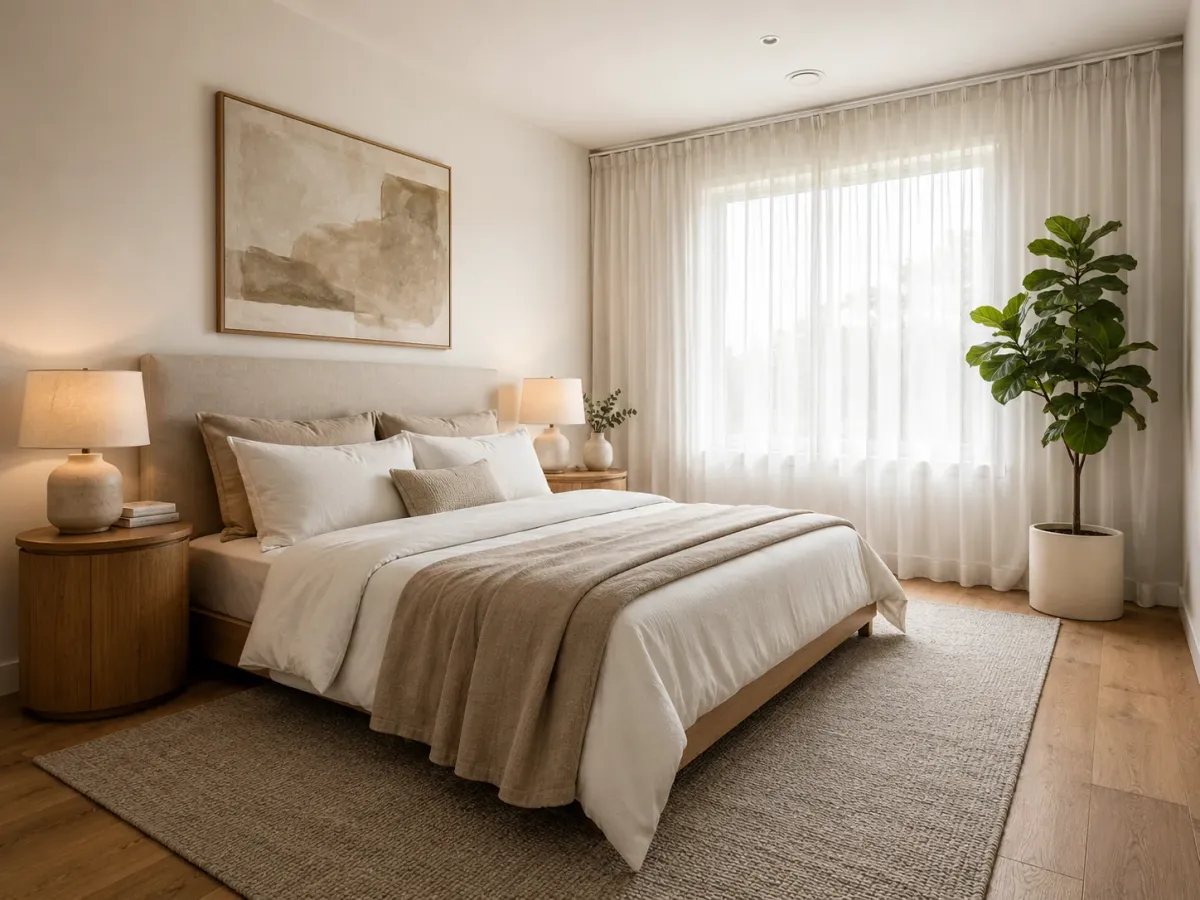
A made bed is the visual anchor of the room, and the dressing is what separates a well-styled bedroom from a styled-once-for-photos bedroom. The professional formula is a stack of layers that read in cross-section: a fitted sheet, a flat sheet, a quilt or duvet, a coverlet or blanket folded at the foot of the bed, two sleeping pillows on each side (standard or king), a row of two or three European pillows (65 cm by 65 cm) behind them for height, and a smaller decorative cushion or bolster in front. The classic styling rule of three works well: two same-size pillows, then a smaller third in front, in a triangle formation. The whole bed reads about 30 to 40 cm above the headboard line when complete.
Don’t overdo it. The bed should look like it gets slept in. Too many decorative cushions (more than four front of the sleeping pillows on a queen) is the single clearest indication that the room was styled for a photograph rather than for living in.
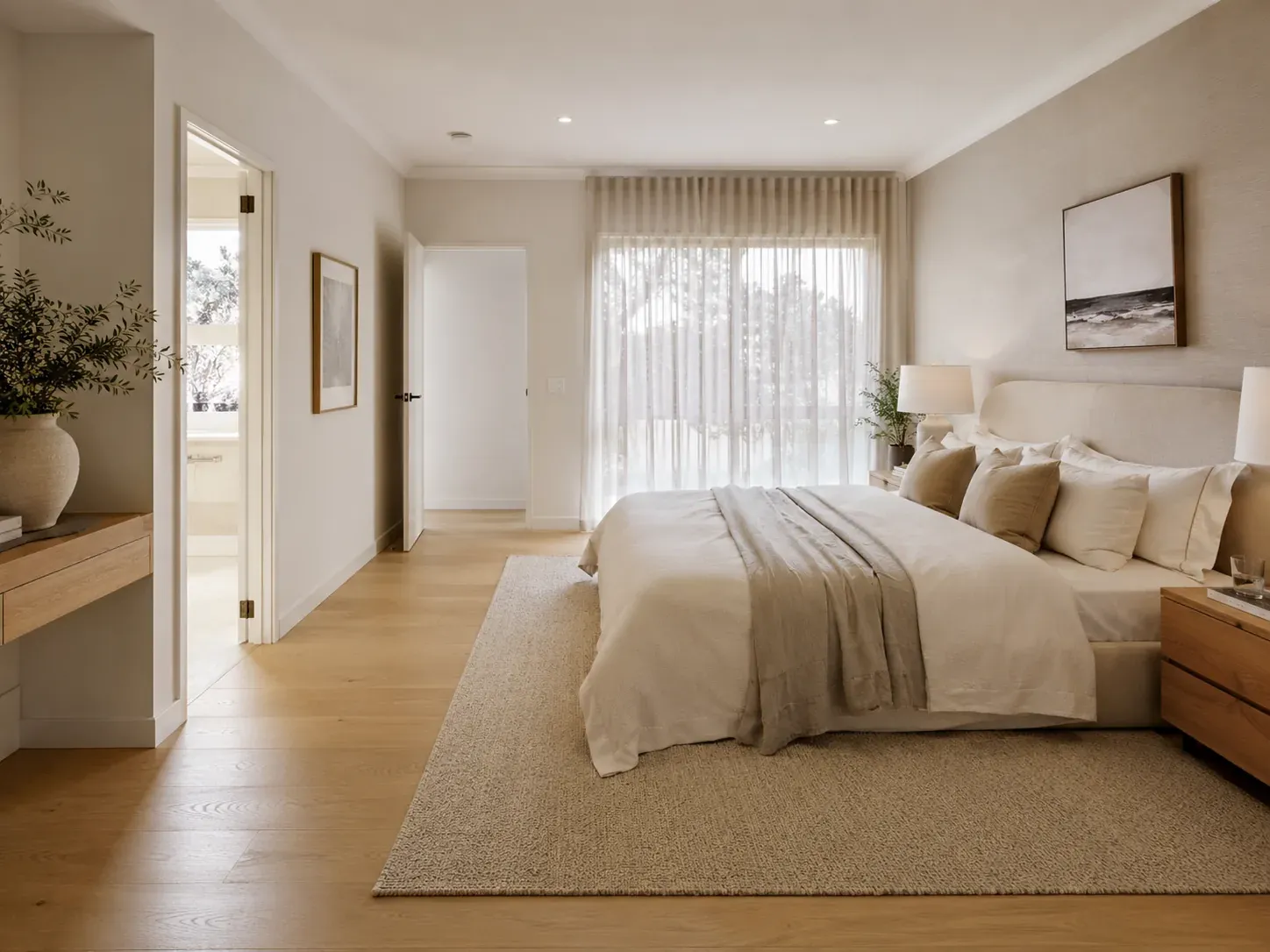
60 to 75 cm of clear walking space each side. The path to the door is the test.
Layout: the maths that decides whether the room works
The 9 to 12 square metre Australian bedroom has a small set of repeating layout problems. They are not difficult to solve, but they get solved badly more often than they get solved well, because the easy fix (push the bed to the wall, shove the rest of the furniture wherever it fits) ignores the egress and clearance rules.
The simple test that works for any bedroom layout is to draw the room on graph paper at a 1:30 scale (1 cm equals 30 cm in real life), cut paper rectangles for every piece of furniture (mattress footprint plus a 5 cm frame allowance, bedside tables, wardrobe footprint plus full door swing, any chair, any desk), and physically arrange them on the paper. Five minutes with scissors prevents most of the layouts that go wrong. If the door swing collides with a bedside, the bed needs to move. If the wardrobe doors will not fully open without hitting the bed, the wardrobe needs sliding doors or the bed needs to move. If you cannot fit 60 cm on the access side of the bed, the bed is too large for the room.
A long, narrow bedroom is the most common difficult shape in Australian housing, particularly in older terraces, converted garages and small apartments. The fix is almost always to centre the bed on the long wall (not the short wall) so the room reads wider than it is long, push the wardrobe to the short end and use vertical storage rather than horizontal. In a small square room, push the bed to the back wall opposite the door and treat the two sides symmetrically. In a master with an awkward window position, a corner placement with the headboard at an angle is usually worse than accepting an asymmetric bedside on the window side and committing to it.
The single most important rule in any layout is that the path between the door and the bed must be clear, in a straight line, and at least 60 cm wide. The room you walk into at night when you are half asleep is the room you have to live in.
For master bedrooms specifically, the 3D floor plans guide covers how to test layout options in three dimensions before you commit to a build. Two-dimensional plans hide circulation problems that become obvious the moment you see the room rendered properly.
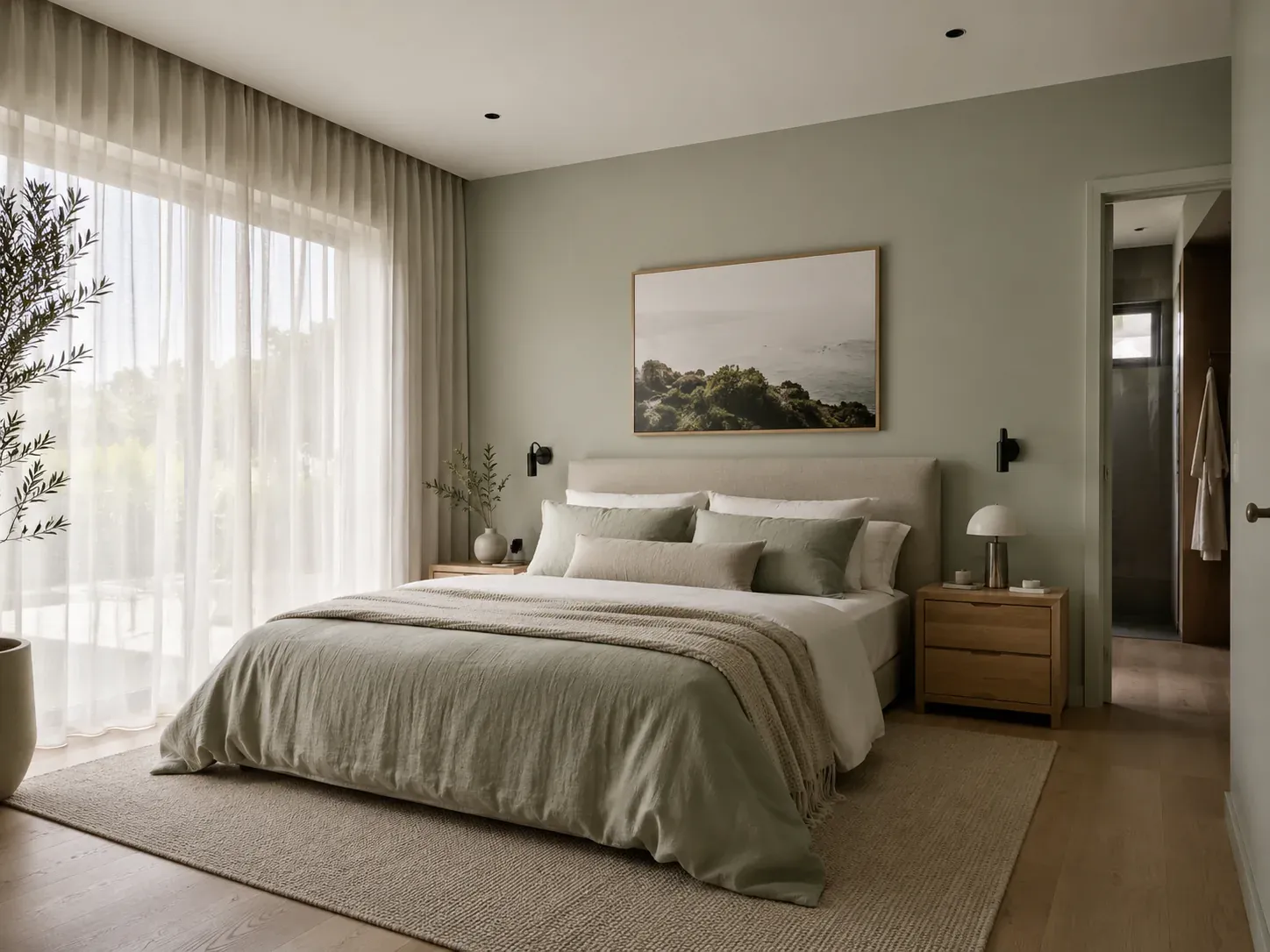
Cool, soft and low-saturation. The wall colour does half the work.
The colour palette: what supports sleep, what wrecks it
The bedroom paint colour decision is one of the few interior design choices with peer-reviewed research behind it, and that research is consistent enough that most designers and most paint manufacturers now agree on the same broad direction.
The most cited study is a Travelodge survey of 2,000 households across the UK, which measured average sleep duration by reported bedroom paint colour. People sleeping in blue bedrooms averaged 7 hours 52 minutes, the longest of any colour group, with 55 per cent reporting they wake up feeling happy. Yellow followed at 7 hours 40 minutes, green at 7 hours 36 minutes and silver at 7 hours 33 minutes. Purple bedrooms came last by a wide margin at 5 hours 6 minutes. The mechanism is well understood: the retinal ganglion cells in your eyes are most sensitive to blue, so a blue field reads to your brain as a calm, low-threat environment and lowers heart rate and blood pressure accordingly. Bright, saturated colours (red, orange, intense purple) have the opposite effect and read as stimulating.
The Australian translation of that research is not “paint every bedroom blue”. It is “stay on the cool, soft, low-saturation side of the spectrum, and avoid the loud end”. Warm whites and creams, soft greys, muted sage and eucalyptus greens, dusty blue-greys, warm taupes and oatmeal neutrals all work. Saturated jewel tones (ruby, emerald, sapphire) and intense warm colours (terracotta, mustard, coral) make better living-room and dining-room walls than bedroom walls, with one exception: very deep, muted versions of those colours (a desaturated forest green, a near-black inky teal, a deep aubergine) read as enveloping rather than energising when used across all four walls, which is why the “moody cocoon bedroom” trend works when it works.
According to Q Paint’s 2026 Australian colour forecast, the Australian interior palette is moving away from cool greys and stark whites toward warmer earthy tones, sage and eucalyptus greens, sophisticated muted pastels (soft mauve, blush, dusty blue) and rich grounded browns. All of those are sleep-compatible. The trend that contradicts the sleep research (saturated terracotta, deep red, mustard yellow) belongs in living rooms and studies, not in bedrooms.
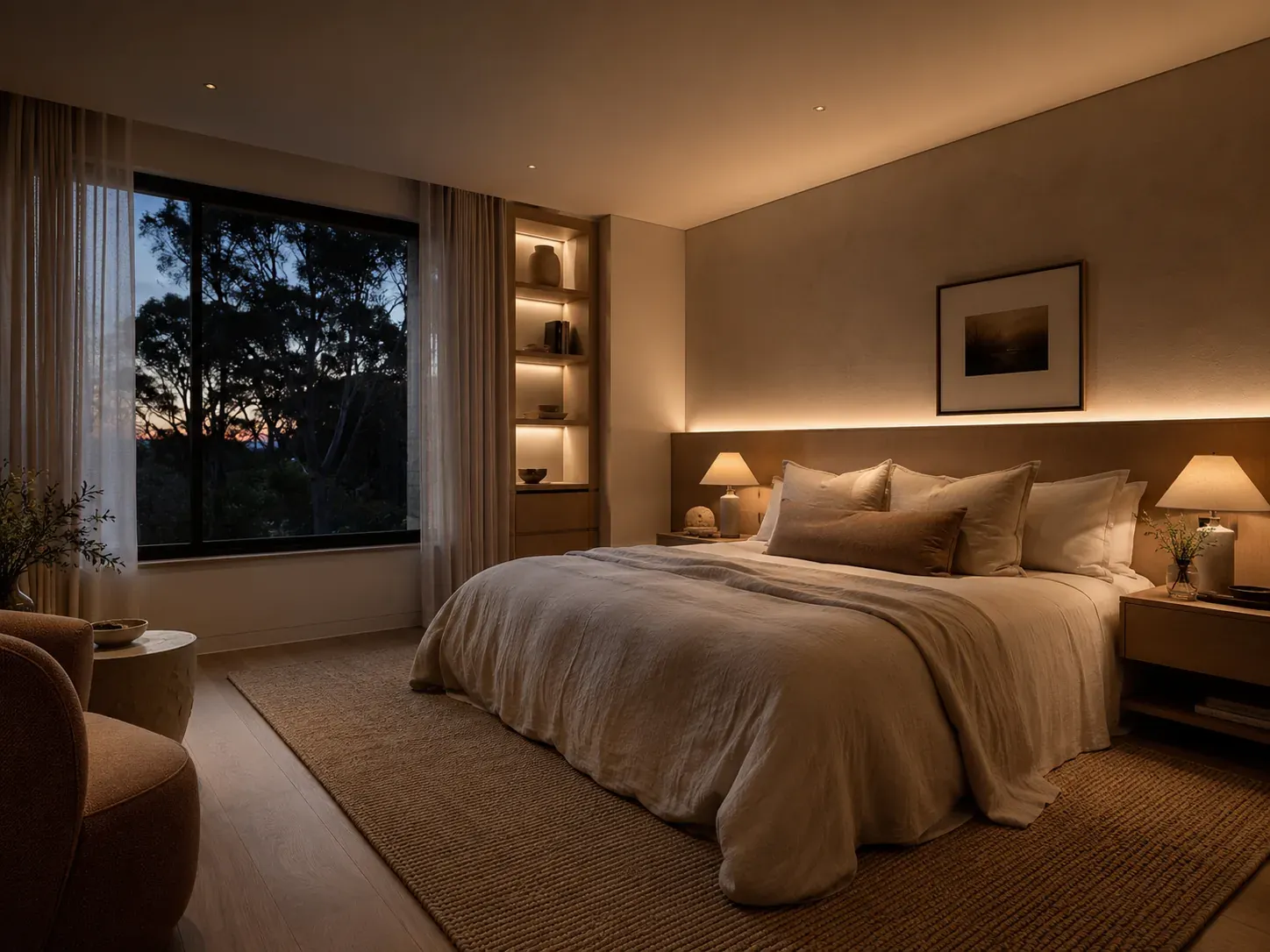
Three layers, three dimmers. Avoid the single ceiling downlight.
Lighting: the layer most bedrooms get wrong
A bedroom lit by a single ceiling downlight is a bedroom lit badly. The professional standard is a three-layer set: ambient, task and accent, each on its own switch and ideally on its own dimmer.
Ambient lighting is the general background light that fills the room. In an Australian bedroom with a 2.4 m ceiling, that almost always means a flush or semi-flush ceiling mount, occasionally a low-profile chandelier or pendant if the ceiling is higher. The trap to avoid is a single high-output downlight that lights the room from above with harsh shadows. A pair of flush mounts, or a downlight on a heavy dimmer, fixes it.
Task lighting is the focused light you need for specific activities, almost always reading in bed and getting dressed. Bedside table lamps, wall-mounted swing-arm sconces or pendant lights hung above each bedside are all good options. The decision between them is a function of how much bedside table space you have: in a small room with narrow bedsides, wall-mounted sconces or pendants free up the table for a glass of water and a book; in a larger room, table lamps add softness and styling weight. Either way, one per side, ideally switched independently so each person can read without lighting the other.
Accent lighting is the small layer that finishes the room. A floor lamp in a reading corner, a picture light over the bed, an LED strip behind the headboard or under the bed frame, a small lamp on a chest of drawers. It is not strictly necessary, but it is the layer that separates a bedroom that feels like a hotel suite from one that feels like an Ikea catalogue.
The colour temperature across all three layers should sit between 2700K and 3000K. Cooler than 3000K reads as office light and disrupts the melatonin cycle in the hour before sleep. Warmer than 2700K reads as orange and dated. According to the Sleep Foundation’s bedroom environment guidance, keeping the bedroom dim in the hour before sleep meaningfully improves sleep onset, which is why every layer benefiting from a dimmer matters more than it does in any other room.
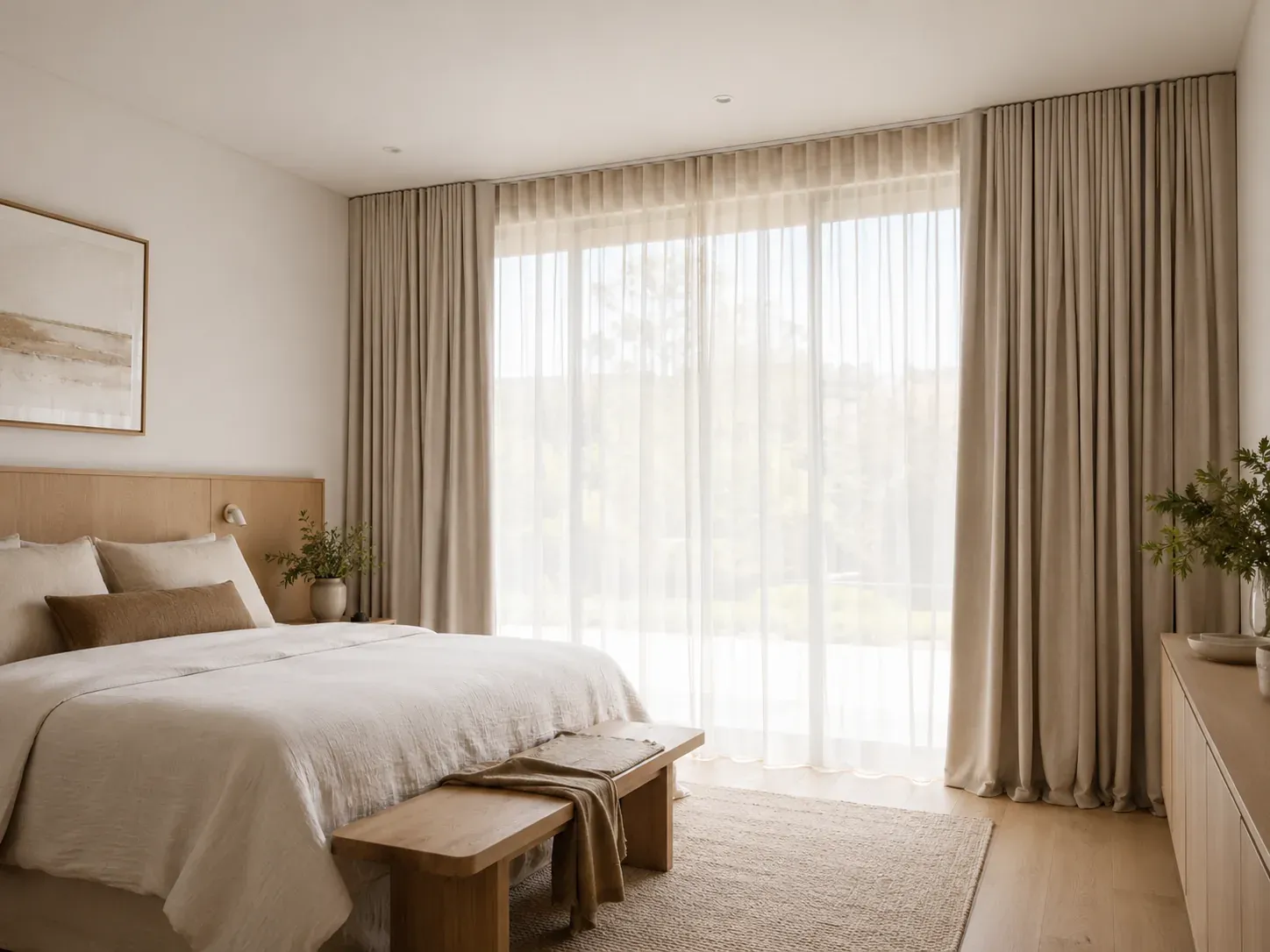
Sheer plus blockout. Hung near the ceiling, breaking at the floor.
Window treatments: light, privacy, sleep
The window treatment decision is partly aesthetic and partly functional, and the functional half deserves more weight than most homeowners give it.
Functionally, a bedroom window needs to do three things: control morning light, control privacy at night and control summer heat gain. The Australian climate adds two complications: west-facing rooms in Brisbane, Sydney, Perth and Adelaide cop intense afternoon sun for most of the year, and bedrooms next to street lights or with neighbours close need full blockout for sleep. According to the Sleep Health Foundation, a dark, cool, quiet bedroom is one of the foundations of good sleep hygiene, with a recommended room temperature between 16 and 19 degrees Celsius.
The two-layer solution that works in most Australian bedrooms is a sheer curtain or roller shade for daytime light control and privacy, paired with a blockout layer for night and afternoon heat. Sheers on the inside, blockout on the outside is the standard track configuration. Roman blinds in blockout fabric are a good single-layer option in smaller rooms or rooms where a full curtain run would overpower the wall. Plantation shutters work but cost more and lock you into a more traditional look. Bare blinds without a softening layer are the most common bedroom mistake, because they leave the room looking unfinished and do nothing for the wall acoustics.
Aesthetically, curtains should be hung from at least 15 cm above the architrave (ideally near the ceiling line) and should run to the floor with a slight break. Mid-window curtains, curtains hanging from the architrave itself or curtains that hover above the floor all read as dated, regardless of fabric.
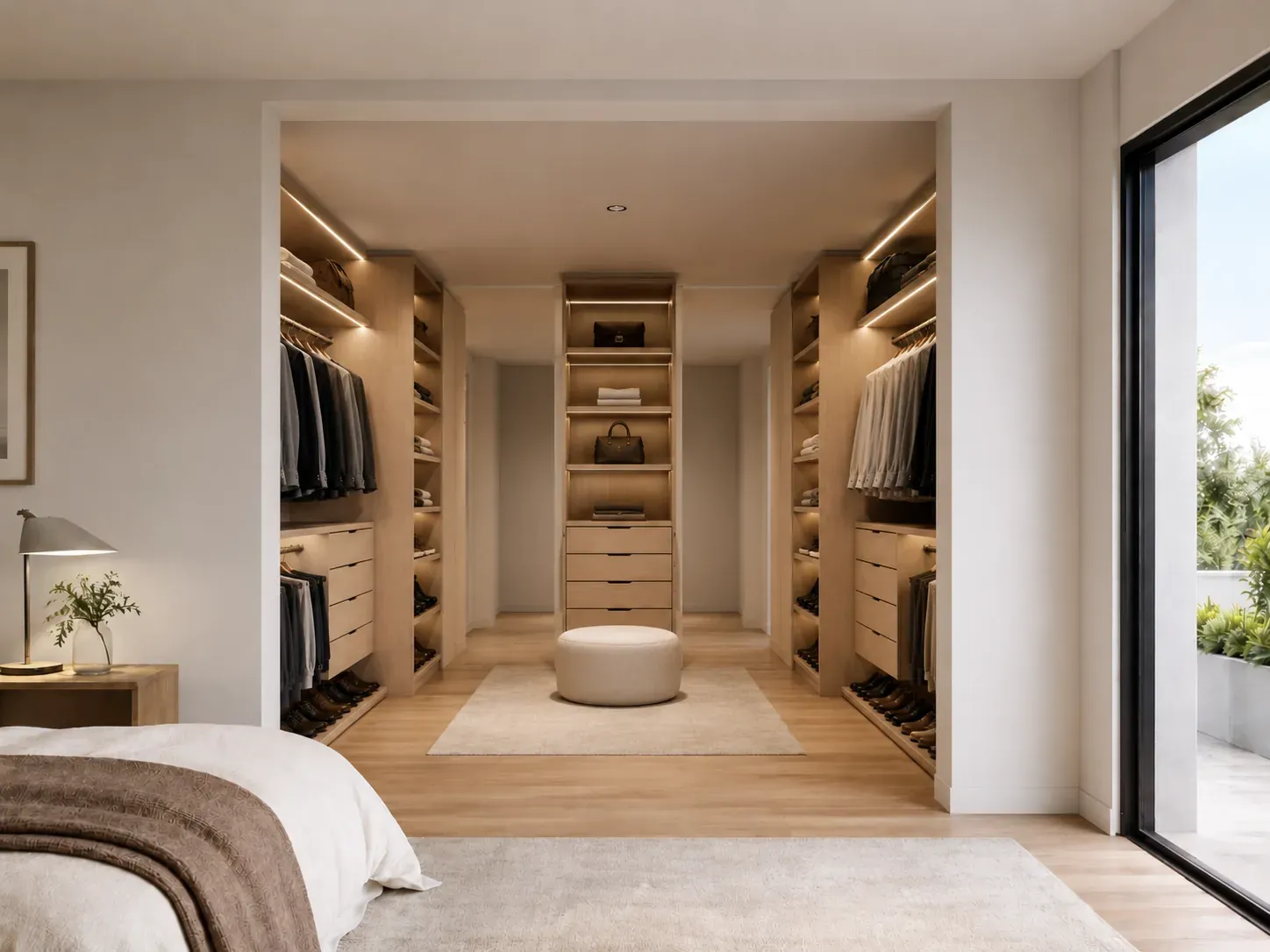
Two hang heights, a shelf stack, drawers and shoe storage. Liveability lives here.
Storage: the unglamorous half of the room
Storage is the half of bedroom design that decides whether you enjoy living in the room a year after you finish it. There is a hierarchy.
Built-in robes are the standard in any Australian home built or renovated in the last 30 years. A full-height robe with internal organisation (hanging at two heights for short items, single hang for long, a shelf stack for folded clothes, drawer banks for underwear and socks, shoe shelving at the base) does more for daily liveability than any other single piece of bedroom storage. The decision between sliding doors and hinged doors is mostly a function of clearance: sliding doors save the door swing arc but show only half the wardrobe contents at once; hinged doors show the whole wardrobe but need 60 cm of clear floor in front. Walk-in robes are aspirational for most Australian masters but only make sense when the room is large enough to give them at least 1.5 m by 2 m of floor without compromising the bedroom itself.
Freestanding wardrobes are the right call when built-ins are not possible (rentals, heritage rooms, character spaces). The mistake to avoid is the cheap flat-pack wardrobe that visibly is one. A solid timber or solid metal-framed wardrobe earns its presence in the room and reads as furniture; a thin laminate flat-pack reads as a problem.
Bed-base storage is the highest-value storage move in any small bedroom. A queen storage bed with a gas-lift base or two large drawers replaces an entire tallboy in a tight room and reads as a regular bed when closed. The trade-off is that some storage beds carry a slightly heavier frame profile, but for any bedroom under 10 square metres it almost always pays for itself.
Bedside table drawers are non-negotiable in a primary bedroom. Open shelves on a bedside look good in styling shots and collect everything you do not want on display in real life.
Vertical surfaces are underused. A picture ledge above the bed, a wall-hung shelf or a hanging plant frees up the floor and adds visual height to a room with a low ceiling.
The rule of thumb is that you need roughly 1.5 linear metres of hanging space and 0.5 cubic metres of folded and drawer storage per person, and the room either has it or it does not. If it does not, the room will feel cluttered regardless of styling.
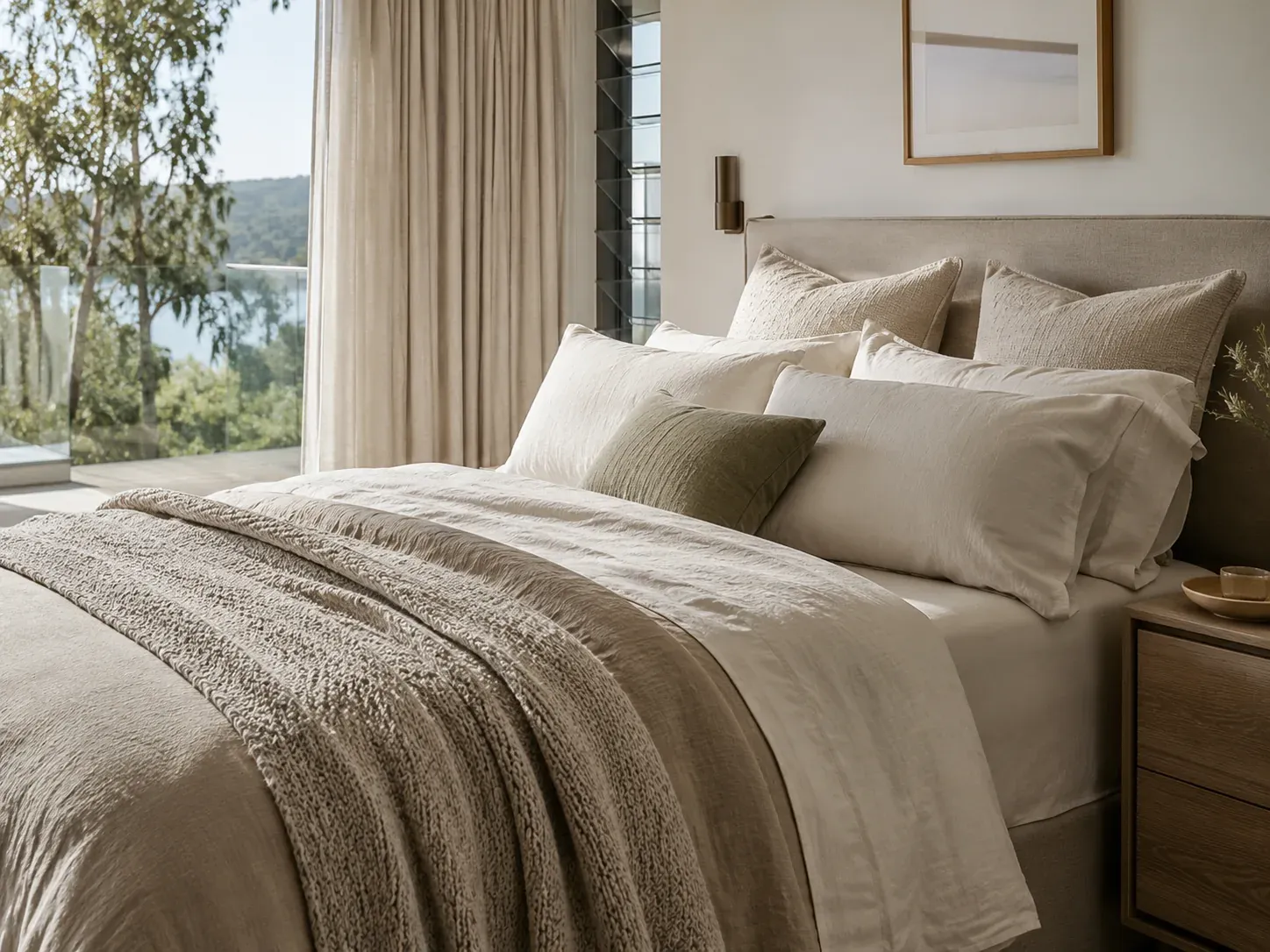
Cross-section of a made bed: sheets, quilt, throw, sleepers, euros, accent.
Texture, rugs and soft furnishings
The bedroom is the room where texture matters most. Hard, flat finishes (painted plasterboard, polished floors, glass, matt laminate) read as cold in a room that is supposed to feel held. The soft layers (rug, bedding, curtains, cushions) are what warm the room up.
The rug is the single biggest textile decision. The rule is that the rug should extend at least 60 cm beyond the bed on both sides and at the foot, so that when you swing your legs out of bed your feet land on the rug not the floor. The standard sizes that achieve this are 2.4 m by 3.0 m or 2.4 m by 3.4 m for a queen, and 2.7 m by 3.6 m for a king. Smaller rugs (1.6 m by 2.3 m runners along the foot of the bed only) work in a tight room but read as undersized in a larger room.
Match the rug fibre and pattern to the style of the bedroom, not to a default. Wool and cotton suit most modern Australian bedrooms; a vintage Persian or Turkish rug suits a French Provincial or eclectic bedroom and adds the colour the rest of the room is missing; a flatweave or hand-tufted geometric suits a contemporary or Scandinavian bedroom; a sheepskin layered at the foot of the bed warms a Japandi or minimalist bedroom without breaking the discipline. Jute and sisal belong in coastal and barefoot-luxury rooms and read scratchy underfoot when you step out of bed, so they are a poor default for the rug under a bed (they suit hallways, entries and beach-house living rooms better than bedrooms).
The bedding palette should sit within two or three steps of the wall colour. A bed dressed in saturated jewel tones against a soft white wall fights the wall and reads loud; a bed dressed in warm whites, oatmeals, soft greys and one accent tone reads calm and considered. Mix at least three textures (washed linen sheets, a brushed cotton coverlet, a chunky throw, a velvet cushion) so the bed has tactile depth without colour noise.
Curtains, cushions and throws are the cheapest way to refresh a bedroom seasonally. Painting walls and replacing furniture is the expensive way.
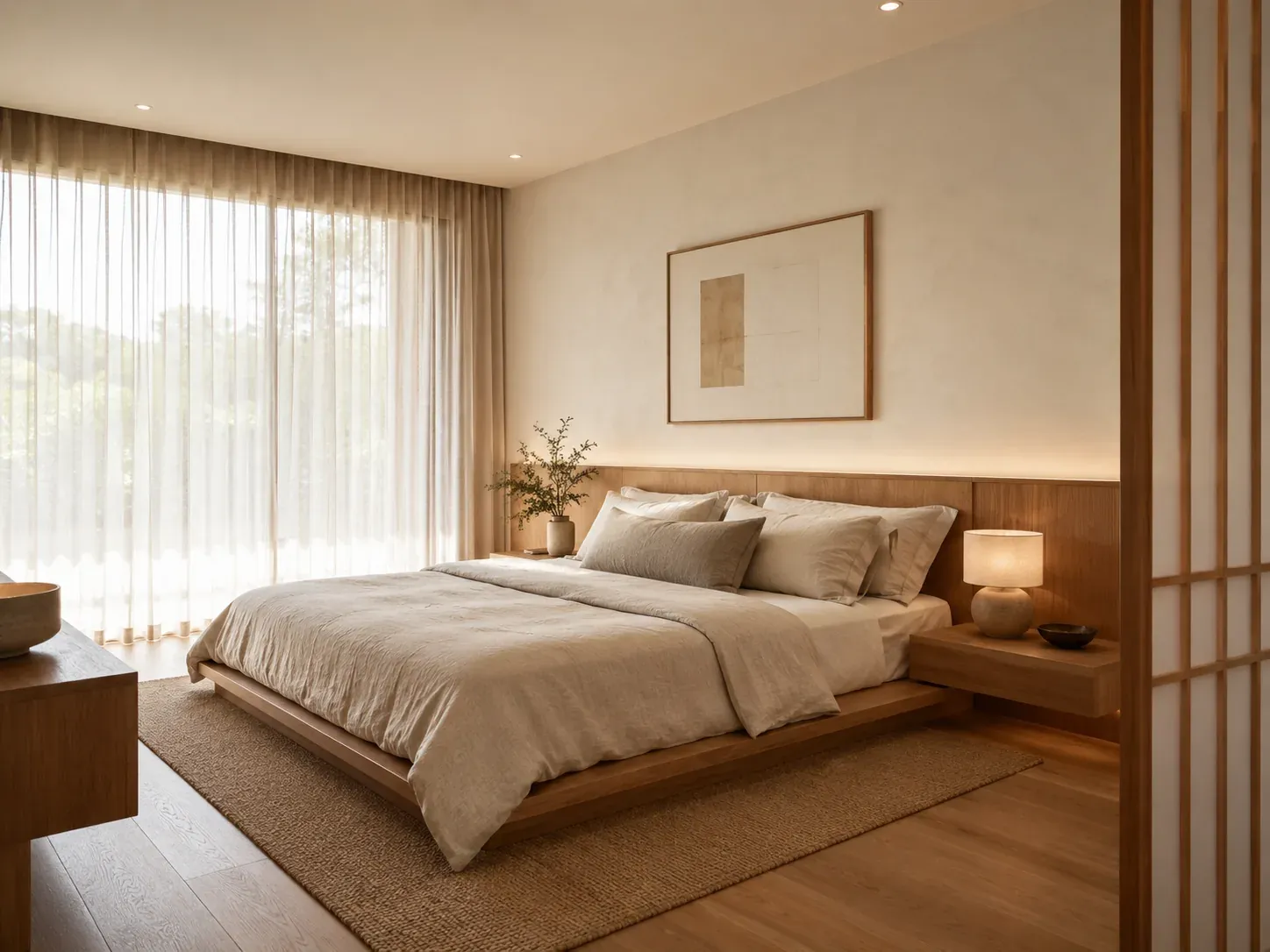
Japandi: warm timber, paper-toned walls, intentional restraint.
Style direction: the four that work in most Australian bedrooms
Most Australian bedrooms read well in one of four broad style directions. The right one depends on the rest of the house, the orientation of the room, the natural light it gets and the look you actually want to live with.
Coastal is the easiest win in most Australian homes. Warm white walls, light timber or whitewashed floors, linen bedding in oatmeal and soft white, a jute or wool rug, woven cane or rattan side furniture, soft sage or dusty blue accents through cushions and art, sheer curtains over a blockout layer, and one piece of weathered timber or a piece of native flora art. The colour and material palette is forgiving, the look reads light and contemporary, and it sits well in almost any Australian climate. The full breakdown is in the coastal style guide for Australia.
Modern Australian is the closely related direction that strips back the coastal references and leans harder on natural materials, indoor-outdoor connection and a quietly contemporary frame. Pale timbers, neutral linens, soft greens, restrained black accents, large windows treated minimally, and a bias toward calm over ornament. It reads as the native modern bedroom rather than an imported European or American look.
Hamptons is the more formal traditional direction. Cool whites and warm whites layered together, shaker-panel built-in joinery, a cool navy or sage accent, a deep upholstered bedhead, classic table lamps with crisp linen shades, a vintage rug and considered styling. The look needs higher ceilings and better architectural detailing to land cleanly and is harder to do well in a 2.4 m ceiling project home, but it pays off in older houses with the bones to support it. The full breakdown is in the Hamptons style guide for Australia.
Japandi is the warm-minimalist direction that has earned a permanent place in Australian bedroom design over the last five years. Pale to mid-tone timber, paper-toned walls in warm white or oatmeal, a low platform bed with restrained linen bedding, one or two intentional decorative objects (a ceramic vase, a paper lamp, a folded throw), no surface clutter and significant negative space. It rewards discipline and punishes any tendency to over-style. When it works it is the calmest bedroom direction available; when it does not it reads as empty.
French Provincial, Mid-Century Modern, traditional and contemporary glamour all work in Australian bedrooms too. The four above are the ones with the highest hit rate in the stock that most Australians actually live in.
The mistakes that age a bedroom fastest
Eight mistakes recur across Australian bedroom decoration. They are easy to fix and worth knowing before you spend money.
The first is too much matching timber furniture in one room. A bedhead, two bedsides, a tallboy and a bench all in the same timber and finish reads like a furniture-shop catalogue and flattens the room. Mix at least one fabric or upholstered piece (a linen bedhead, an upholstered ottoman at the foot of the bed) into the timber set.
The second is bedside lights doing all the work. A single ceiling downlight plus two bedside lamps is not enough lighting in a bedroom. Add an accent layer (a floor lamp in a reading corner, a picture light over the bed, a small chest-of-drawers lamp).
The third is an undersized rug. A rug that ends before the bed starts, or one that only covers the foot of the bed, reads as a temporary placeholder. If the budget will not stretch to the right size, no rug is better than the wrong-size rug.
The fourth is curtains hung too low. Hanging curtains from the architrave makes the wall look shorter; hanging them near the ceiling line and running them to the floor makes the wall (and the room) look taller.
The fifth is a feature wall that does not earn its place. A feature wall behind a bed in a quiet, otherwise plain room is good; a feature wall behind a bed in a room that already has busy bedding, statement curtains and gallery walls is one element too many.
The sixth is a cluttered open bedside. Open shelving on a bedside reads beautifully on Instagram and reads as a phone-charger-and-old-tissues situation in real life. Drawers solve it.
The seventh is one paint colour everywhere. The wall colour and the ceiling colour should usually differ (most often ceiling in a slightly cooler or lighter version of the wall colour), and the trim should be a separate decision again. A single colour across walls, ceiling and trim reads as a rental.
The eighth is too many decorative cushions. Three to five front of the sleeping pillows on a queen is the upper limit. Beyond that, the bed reads as styled-for-photo and the cushions live on the floor every night anyway.
What it costs to redo a bedroom in Australia in 2026
Bedrooms are the most cost-effective room in the house to renovate, because they carry none of the plumbing, waterproofing or trade-density that drives bathroom and kitchen budgets. According to multiple Australian renovation cost guides including GTG Constructions and Co-Architecture, bedrooms and living rooms typically cost $5,000 to $15,000 per room for a full cosmetic renovation.
The breakdown matters because it tells you where to spend.
A pure cosmetic refresh (interior paint, new bedding and soft furnishings, two new lamps and a fresh rug) lands between $2,000 and $6,000 depending on whether you pay a painter or do the walls yourself. This is the highest-return spend in bedroom design and the one most homes are an afternoon away from. A fresh paint colour, a new rug at the right size and a properly dressed bed reset the room.
A mid-range renovation (paint, new flooring, built-in robes, new lighting set, new curtains) sits in the $5,000 to $15,000 band. Built-in robes are typically $1,500 to $4,000 installed for a 3 m run, depending on whether you go custom or stock; engineered timber flooring runs roughly $80 to $180 per square metre installed; a full curtain and blockout set is around $1,500 to $3,500 per window for custom work.
A structural change (moving a wall, adding an ensuite, building out a walk-in robe, adding a window) takes the number well past $30,000 and brings in trades, certifications and lead times that the cosmetic and mid-range bands avoid entirely. Most bedroom transformations do not need this.
Sydney sits roughly 20 to 40 per cent above the national average across all three bands; Melbourne and Brisbane sit close to the national average; Perth, Adelaide and Hobart sit slightly below. Add a 15 to 20 per cent contingency on top of any structural number.
The most underrated spend in a bedroom budget is the bed itself. A good mattress (which most adults sleep on for around 7,000 nights) at $2,000 to $4,000 outvalues almost any other purchase in the room, and most Australian bedrooms underspend here while overspending on decorative items that do not affect sleep.
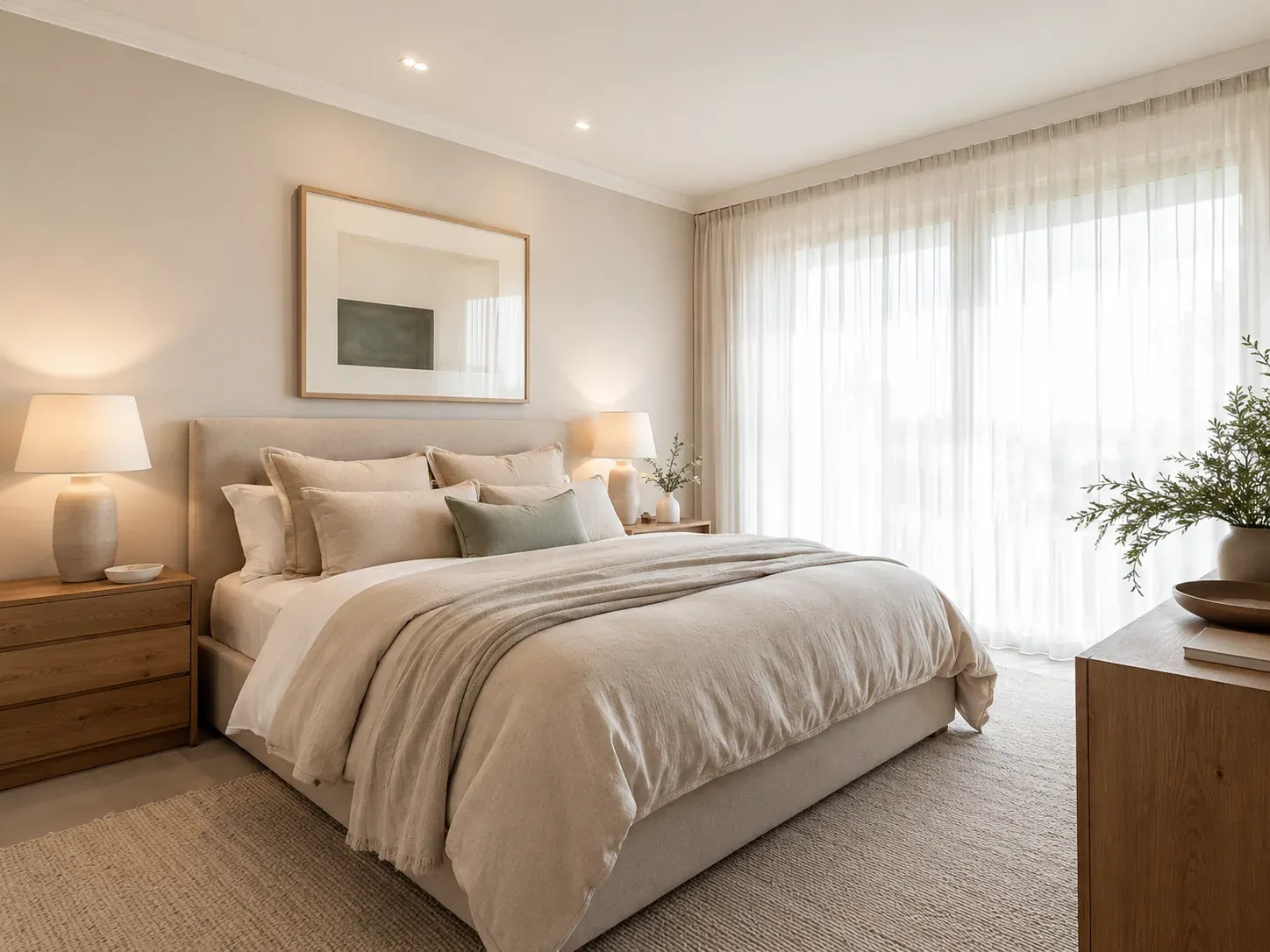
 Before
After
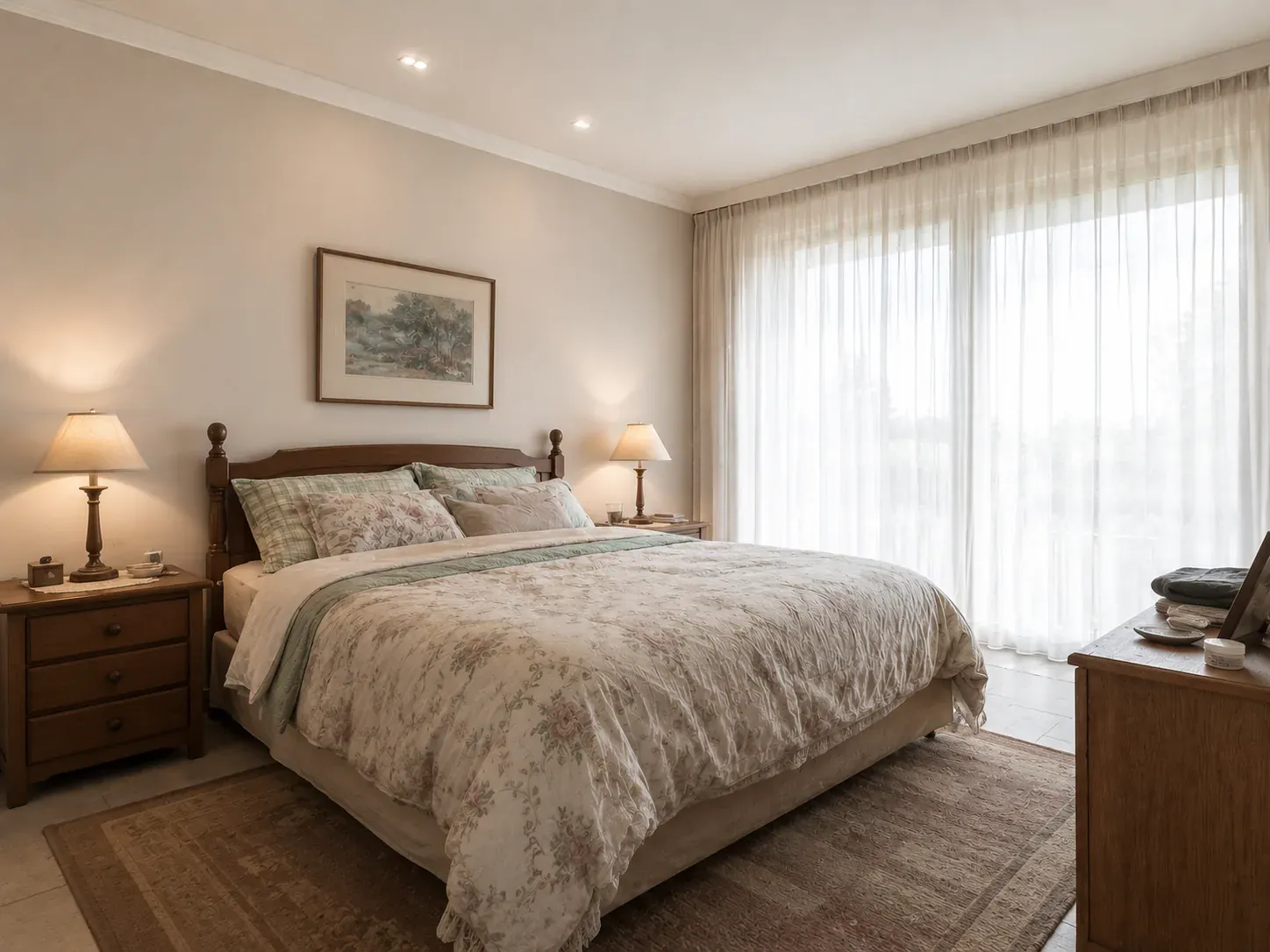
Before
After
How to test a bedroom design before you commit to it
The most expensive mistake in bedroom design is committing to a paint colour, a wardrobe layout, a rug or a wallpaper before you have seen it in the room. The colour swatch on the wall is not the wall. The 5 cm square fabric sample is not the sofa. The Pinterest board is not the room.
Two cheap ways to test before you commit.
The first is to live with a large painted patch (at least 1 metre square) on the wall behind the bed for a full week. Look at it in the morning light, the afternoon light and at night under the lamps you will actually use. Most paint colour decisions get reversed in week one of doing this. The same applies to large fabric samples on the bedhead wall and large flooring samples on the floor under the bed.
The second is a photoreal visualisation of the proposed room before any money is committed. This is what reIMG does. We take a photo of your existing bedroom and render the proposed version with the new paint colour, the new bedhead, the new flooring, the new lighting and the new soft furnishings in place. You see the room before you buy it. We use this approach with interior designers and with property owners about to sell who are considering a virtual staging refresh on a bedroom rather than a physical re-style. The cost of testing the design is a small fraction of the cost of getting it wrong.
For a primary bedroom, the rule is simple: test before you buy. The room you sleep in for the next decade is worth a week of testing.
Frequently asked questions
What is the average bedroom size in Australia?
The average Australian secondary bedroom is around 3.2 m by 3.0 m, and the average master sits closer to 4.2 m by 3.9 m. The National Construction Code (NCC) treats anything under about 6.5 square metres as unusable for habitation, and anything under 8 square metres is considered small in practice. A 10 square metre room is the comfortable floor for fitting a queen bed, two bedsides and a wardrobe without the room feeling cramped.
What size bed do most Australians have?
The queen (153 cm by 203 cm) is the standard, with around 61 per cent of Australian adults sleeping on one according to Bedbuyer’s national survey. The king (183 cm by 203 cm) sits second at around 21 per cent, and the remainder is split across king single, double, single and super king. The queen is the default the Australian housing stock is built around, which is why bedside placement, wardrobe clearance and door-swing calculations in this guide use a queen as the base case.
What paint colour helps you sleep best?
The most cited research on this is a Travelodge survey of 2,000 households, which found people sleeping in blue bedrooms averaged 7 hours 52 minutes, the longest of any colour group. Yellow, green and silver followed within about 20 minutes. Purple bedrooms came last by a wide margin, averaging just 5 hours 6 minutes. The mechanism is well understood: blue is the wavelength your retinal ganglion cells are most sensitive to, and your brain reads a blue field as a calm, low-threat environment. The practical takeaway is that cool, soft, low-saturation colours support sleep; intense, stimulating ones work against it.
How much clearance do you need around a bed?
Allow 60 to 75 cm of walking space on each side of a queen, and at least 90 cm if you can spare it. The far side of the bed and the path to the door are the tightest paths to plan for, because they decide whether the room functions or just looks tidy in photos. Wardrobe doors need their full swing or slide arc clear of bedside tables, and the bedroom door itself needs at least 80 cm of clear arc into the room without colliding with the bed footprint.
What is the right temperature for a bedroom for sleep?
The Sleep Health Foundation recommends a bedroom temperature between roughly 16 and 19 degrees Celsius for adult sleep. The drop in body temperature that triggers sleep onset is easier in a slightly cool room than in a warm one, which is why a bedroom that runs too warm in summer or holds heat at night can quietly cut your sleep quality even when you cannot tell. In an Australian context that usually means cross-ventilation, a ceiling fan, or a reverse-cycle split, plus blockout window treatments to manage afternoon heat gain in west-facing rooms.
What does it cost to redo a bedroom in Australia in 2026?
A cosmetic bedroom refresh (paint, new soft furnishings, lighting upgrades and styling) typically lands between $2,000 and $6,000. A heavier renovation that adds built-in robes, replaces flooring, upgrades lighting and re-paints sits in the $5,000 to $15,000 band per room across most Australian cities. Structural changes (moving walls, adding an ensuite, building out a walk-in robe) push the number into the $30,000 plus territory and cross over into bathroom and joinery costs. Bedrooms are the most cost-effective room in the house to renovate because they have no plumbing and no wet-area waterproofing.
Should every bedroom have a feature wall?
No, and most do not need one. A feature wall earns its place when the room is otherwise visually quiet and the wall behind the bed has the right proportions for a single anchor. VJ panelling, half-panel wainscoting, a wallpaper panel or a deep paint colour all work in that role. The mistake is to add a feature wall to a room that already has busy bedding, statement curtains and patterned art, where it stops feeling like an anchor and becomes one more competing element. If in doubt, leave the walls plain and let the bed be the feature.
What style of bedroom suits Australian homes best?
Most Australian bedrooms read well in one of four directions: coastal (warm white, sandy neutrals, linen and timber, restrained ocean accents); modern Australian (light timber, pale neutrals, soft greens, indoor-outdoor flow); Hamptons (cool whites, navy or sage, panelled joinery, more formal); and Japandi (warm timber, paper-toned walls, intentional minimalism). The geography helps: with most Australians living close to the coast and most dwellings being detached houses with reasonable natural light, the lighter neutral palettes carry the room more easily than the moodier European or American directions. Style is a personal choice, but the country biases the easy wins toward calm, light, naturally textured rooms.