Farmhouse interior style for Australian homes
Farmhouse style for Australian homes in 2026: palette, materials, room-by-room specs, costs, Hamptons differences and the mistakes that date the look.
Why this guide exists
Most farmhouse-style content online is built for someone else’s country. The dominant English-language sources are American (Fixer Upper, HGTV, Magnolia, House Beautiful, Better Homes & Gardens US), and they describe the style around a Texas-and-Tennessee version that Joanna Gaines popularised after Fixer Upper launched in 2013. According to House Digest’s profile of Gaines’s signature elements, the look she became known for leans hard on shiplap, faux beams, antiques, subway tile and white-painted joinery. That vocabulary travels to Australia mostly through Pinterest, Instagram and project-home builder marketing, and the result is a thin online answer to the question Australian renovators and buyers ask constantly: what does farmhouse style mean in a contemporary Australian home, given the country already has its own rural building tradition, and how do you do it without ending up with a Texas postcard in a Toowoomba cul-de-sac.
This guide is the deep answer. It covers what farmhouse style genuinely is and the three lineages it carries (English-European, American modern farmhouse, and the Australian homestead-and-Queenslander tradition), what the 2026 version looks like and how it has moved on from the 2017 to 2020 shiplap-led version, the palette and material vocabulary in detail, how the style reads in a kitchen, bathroom, living room and bedroom, what the exterior asks for in board-and-batten cladding and pitched roofing, what it sits next to (Hamptons, French Provincial, coastal, Scandi), what it costs to do well, and the mistakes that age it fastest. It is written for Australian homeowners, renovators, designers and rural-property buyers who want a clear read on the style rather than a Pinterest feed.
It sits inside the broader interior design styles guide for Australia, where farmhouse is one of the major contemporary directions alongside Hamptons, French Provincial, coastal and Scandi. This page is the deep dive on farmhouse specifically.
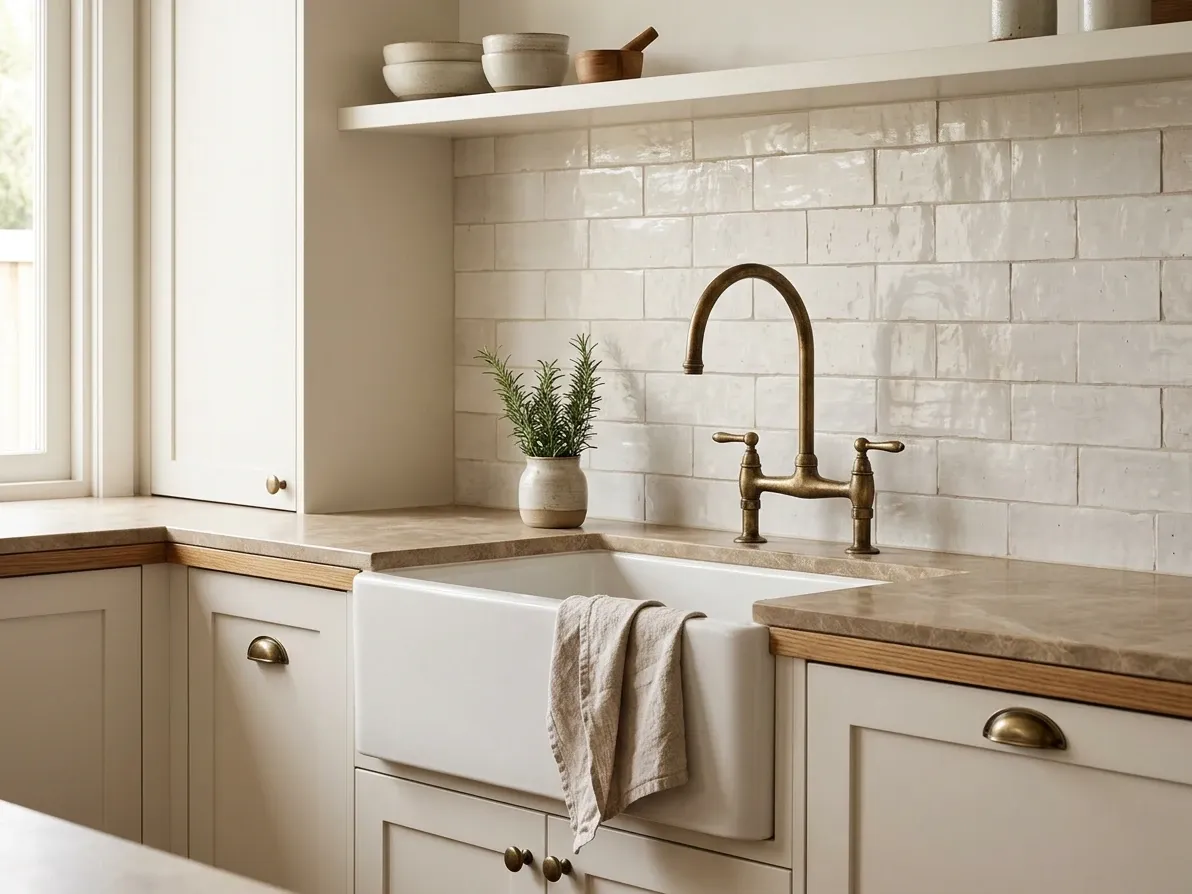
Painted shaker and a fireclay butler sink: the kitchen as the working room.
What farmhouse interior style actually is
Farmhouse interior style is the contemporary expression of working rural domestic architecture. Its underlying brief is straightforward: build rooms that look like they belong on a property where work happens, using honest natural materials, painted joinery, simple practical layouts and durable hardworking finishes that handle daily use and visibly improve with age. According to Livingetc’s farmhouse-style explainer, the style is rooted in functionality and an unfussy charm: pieces that feel handed-down rather than bought-as-a-set, materials that read warm and honest rather than glossy, and an emphasis on the working heart of the house (the kitchen, the laundry, the dining table) rather than the formal living room.
The visible vocabulary in a farmhouse room is consistent across most credible interpretations of the style. Painted joinery in a warm white, soft cream or muted pale colour carries the cabinets and the trim. Timber runs through the floor (wide plank, often lightly distressed or rough-sawn oak, hardwood or pine), through structural elements (visible ceiling beams or rafters, exposed posts), through the dining table and through smaller furniture pieces. Stone is matte and warm rather than polished and cold (honed travertine, soapstone, terracotta tile, sandstone, less commonly honed marble in restraint). Hardware is matte black, oil-rubbed bronze, aged brass, hand-forged iron or a brushed warm nickel. Textiles are linen, cotton, wool and jute in warm neutrals, with restrained accents in muted blue, soft sage, deep forest green, biscuit red or warm terracotta. Woven texture (rattan, cane, basketry, ticking-striped cushions, wool throws) carries the soft layer.
Three concepts sit underneath the style and explain why a well-resolved farmhouse room feels the way it does. Wabi is the appreciation of imperfection, age and use, the same idea that drives Japanese wabi-sabi and that explains why a chipped enamel jug, a slightly worn timber tabletop and a hand-formed terracotta vase belong here in a way that a pristine factory-finished one does not. Provenance is the assumption that objects have stories: the chair that was the grandfather’s, the dresser that came out of a deceased estate, the linens that were inherited. A genuine farmhouse room is collected, not bought; or at least it reads as collected, which is a deliberate design move. Utility is the principle that the room is for working in: cooking, eating, mending, reading, sleeping. Sofas are comfortable rather than sculptural, dining tables are wide and easy to clean, kitchens have generous benches and visible workhorse pieces (a butler sink, a freestanding range cooker, a hanging pot rack), and decoration sits inside the working layout rather than ornamenting it.
Where farmhouse departs from related styles is in its relationship to formality. Hamptons asks the room to read polished and formal; French Provincial asks it to read elegant and ornate; coastal asks it to read relaxed and beach-adjacent; Scandi asks it to read calm and restrained. Farmhouse asks the room to read practical, hardworking and quietly handsome, which is a different brief from any of the others. According to Fat Shack Vintage’s definitive farmhouse decor guide, the style is at its best when comfort, practicality and natural materials are doing the work rather than ornament, and when the room makes obvious sense for everyday life rather than for photographs.
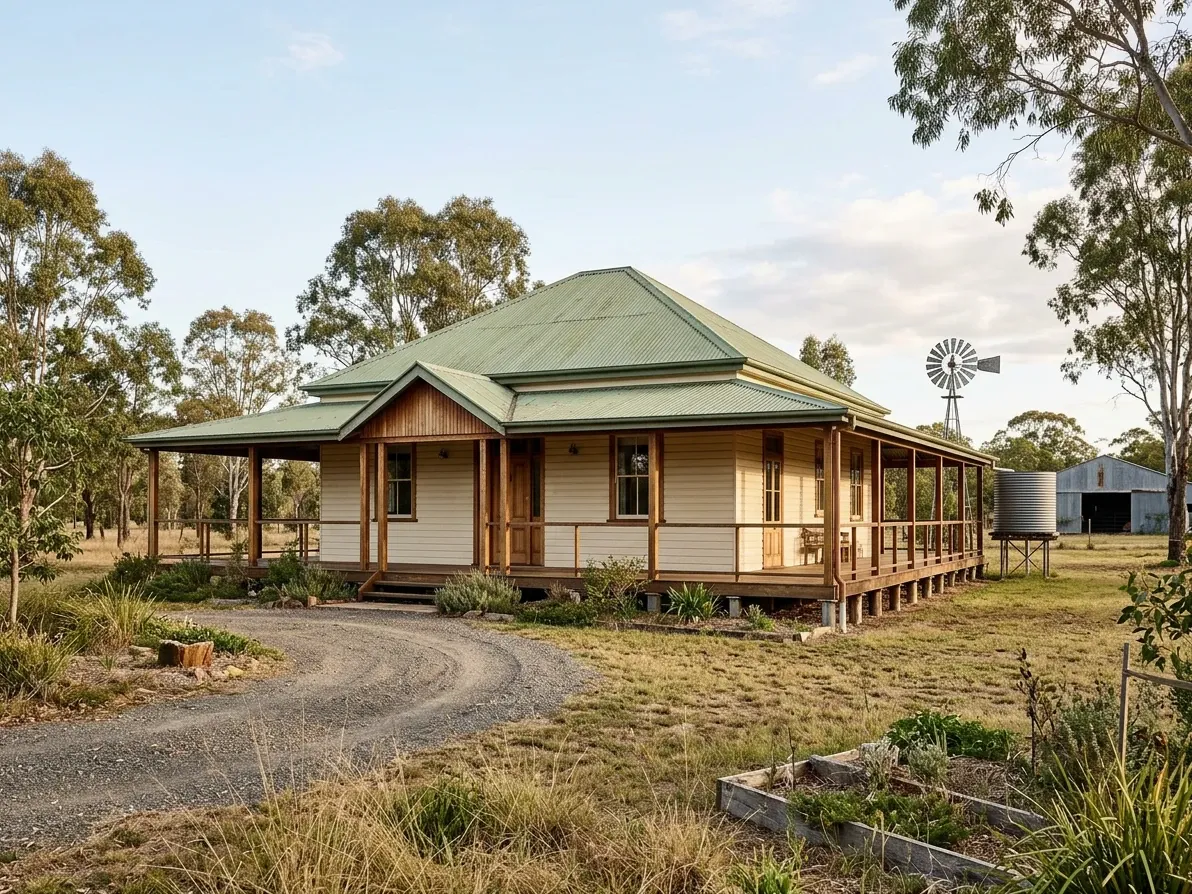
The Australian homestead: corrugated iron, wide verandah, raised floors.
The three lineages that meet in an Australian farmhouse
A farmhouse interior in Brisbane, Bowral or Bendigo in 2026 is carrying three histories at once, and it helps to understand all three before specifying one. The styles around it (Hamptons, French Provincial, coastal, Scandi) each refer to a single coherent place and tradition. Farmhouse is a hybrid by nature.
The European and English farmhouse. The original farmhouse rooms were the everyday spaces of working agricultural properties across the British Isles and Western Europe from the seventeenth to the nineteenth centuries, built from local materials around a working kitchen. The vocabulary that survives from that lineage (a large scrubbed-pine or oak table, an enamel jug, a butler sink, painted timber cabinetry with simple beadboard panels, exposed timber beams, lime-washed walls, terracotta or flagstone floors, a Welsh dresser stacked with everyday china, ticking-stripe cushions, a wood stove or an Aga, hand-forged ironwork) is what most Australians picture under the older sense of the word “farmhouse.” It reads as warm, traditional and weight-of-history; in a contemporary home it sits a step closer to French Provincial than to American modern farmhouse, and it is the lineage that informs English farmhouse and French farmhouse labels still in current use through retailers like Provincial Home Living. According to Provincial Home Living’s farmhouse guide, the practical brief from this lineage is the same one that runs through the contemporary version: comfort, practicality, natural materials and a clear connection to the working life of the home.
The American modern farmhouse. The dominant 2026 reading of “farmhouse” in the search engines, on Pinterest and in builder marketing is the version that Joanna Gaines popularised on Fixer Upper from 2013. According to Homes & Gardens’s profile of her best renovations, Gaines combined traditional country design with contemporary accents and built a national audience on a recognisable mix of white-painted shiplap, exposed timber beams, antiques, subway tile, sliding barn doors and a strong indoor-outdoor connection. According to PureWow’s note on her current direction, the style has since evolved into a moodier and more eclectic vocabulary, with darker richer colours replacing the ubiquitous whitewashed shiplap, plaster walls, rich greens and volcanic ash tiles. This is the lineage that travels best on social media and that most Australian homeowners encounter first; it is also the lineage with the largest gap between the current version and the version most Pinterest boards still feature.
The Australian homestead and Queenslander. Australia has its own farmhouse vernacular, and most overseas sources skip it entirely. According to Shelton Homes’ short history of Queenslander homes, the Queenslander is an indigenous vernacular that traces back to around 1840 in Brisbane and the Darling Downs region, developed for British and European migrants to handle Queensland’s subtropical climate. The defining features (raised on timber stumps for ventilation and flood resilience, wide verandahs on multiple sides, corrugated iron roofs raised in the centre to vent heat, timber tongue-and-groove cladding, casement windows, internal breezeways above doors) were climate solutions first and aesthetic moves second. Beyond Queensland, Australian rural vernacular extends through the verandah cottages of New South Wales and Victoria, the stone farmhouses of South Australia, the timber homesteads of central Victoria and the Riverina, the limestone and rendered-brick homesteads of Western Australia and the timber-and-tin pastoral homesteads of the Northern Territory. All of these share a small core: an attached or wrap-around verandah, a pitched corrugated iron roof, a kitchen-and-living core that opens to the outside, and a working pragmatism in the materials. According to Houzz Australia’s primer on rural Australian home styles, the Australian homestead has a strong horizontal emphasis that mimics the land it sits on and a working relationship with surrounding outbuildings (sheds, shearing quarters, machinery rooms, stables) that informs the architectural language.
A farmhouse interior in Australia in 2026 is at its strongest when all three lineages are visible in the room. The European-English layer carries the working kitchen and the scrubbed-timber-and-painted-joinery aesthetic. The American modern-farmhouse layer carries the cleaner contemporary lines, the open-plan kitchen-living relationship and the indoor-outdoor connection. The Australian homestead layer carries the corrugated iron, the wide verandah, the timber stumps, the durable hardworking materials chosen for the climate. A farmhouse room that draws on all three reads as a confident Australian room. A farmhouse room that copies only the American layer reads as an imported one, and the cul-de-sac mismatch is what produces the postcard feel.
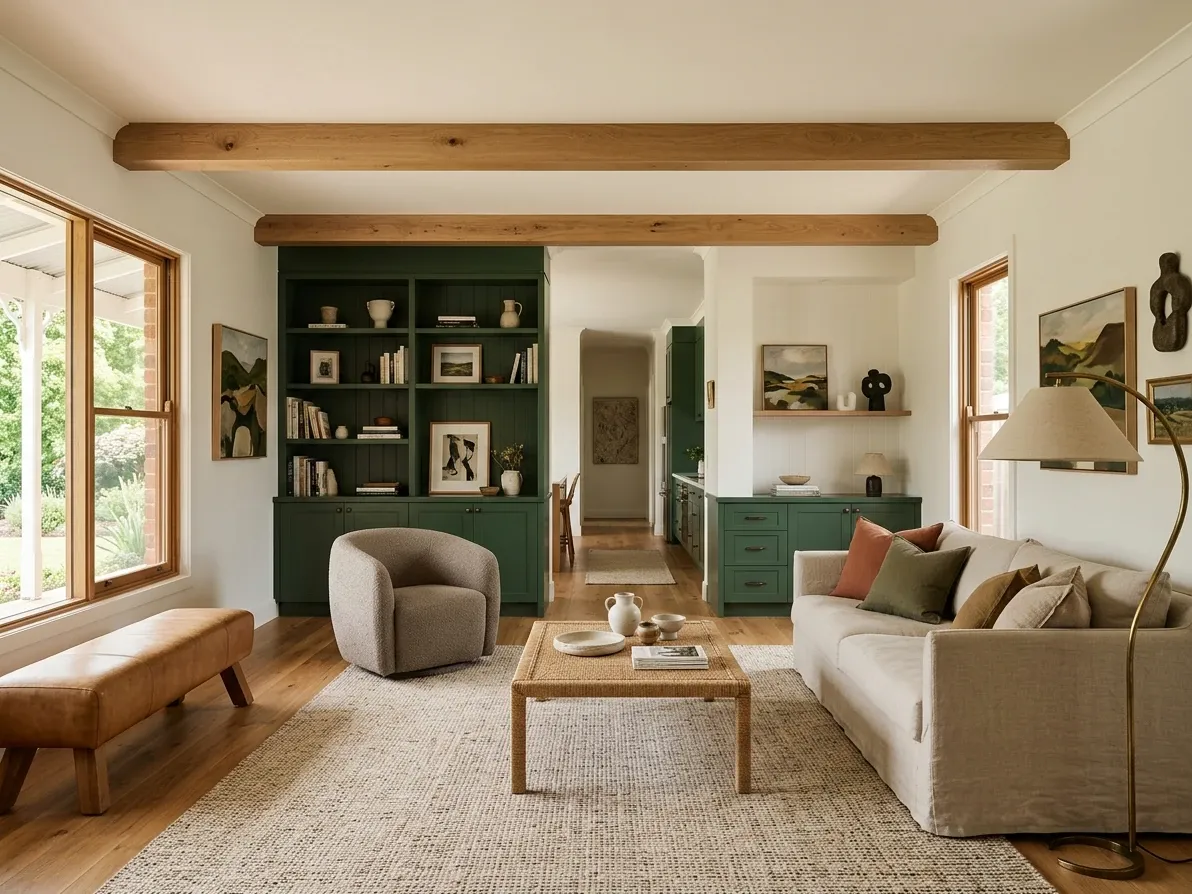
Honey oak and forest green: 2026 farmhouse leans warmer than its 2010s self.
How the 2026 version differs from the 2010s version
The shiplap-everywhere modern farmhouse that the late 2010s built (white-painted shiplap on every wall, a sliding barn door at the laundry, Edison-bulb pendants on chains, a kitchen sign that said Kitchen, a galvanised bucket of cotton stems, a row of identical mason jars) is the version that most Australian Pinterest boards still feature and that most builder marketing still references. It is also the version that is fading fastest from the leading 2026 trend reports. The genuine farmhouse vocabulary that sits underneath it (natural materials, painted joinery, simple architecture, working layouts, indoor-outdoor flow) is not going anywhere; the styled themed layer is.
According to Newsweek’s interview with interior designer Halee Maez on the trend, the late-2010s modern farmhouse has been so over-saturated that it now reads as predictable, and the design conversation has shifted toward warmer, more curated, more personally-collected interiors that feel lived-in rather than styled. According to WonderHowTo’s piece on the organic-modern shift, Houzz, the National Kitchen and Bath Association and Apartment Therapy have all reported weakening demand for traditional modern farmhouse interiors in favour of transitional and organic-modern variants that lean warmer, softer and less themed.
The shift is documented across the leading 2026 forecasts. According to James Hardie Australia’s 2026 Modern Farmhouse forecast, the Australian direction is moving from a cohesive classic-comfort look toward what the forecast calls a “resilient, grounded and nurturing” style: a palette of biscuit reds, deep greens and weathered taupe anchored in honey oak, soft stone and brushed metal, with subtle texture replacing high-contrast accents and a stronger emphasis on resource-smart materials and inclusive layouts. According to Hello Lovely Living’s 2026 modern farmhouse trends piece, the move is away from staged perfection toward rooms that feel collected over time, with deeper colour palettes, sustainable choices and a more personal approach to decorating. According to Architectural Designs’ 2026 home design trends note, warmth and familiarity are leading the conversation across the board, and warm minimalism is becoming the guiding aesthetic.
Pantone’s 2026 Colour of the Year sits cleanly inside this direction. According to Pantone’s announcement, the colour is Cloud Dancer (PANTONE 11-4201), a soft chalky off-white with a tiny hint of warmth: the first time a white has taken the title. According to Homes & Gardens’s profile of the colour, the design philosophy behind the pick is calm, clarity and intentional living, and the recommended palette pairings (soft pastels, neutral tones, light blues, soft greens, natural earthy tones) sit inside the warm-farmhouse base without violating its restraint.
In practical terms, four shifts define the 2026 Australian farmhouse interior against the 2017 to 2020 version.
The palette is warmer and deeper. The cool-grey-and-white version that dominated the late 2010s has given way to warm whites, honey oak, soft stone, brushed brass and a confident use of deeper greens (forest, sage, olive), warm browns (chocolate, mocha, taupe) and earthy biscuit reds. The walls are still mostly painted warm white, but feature walls, painted joinery and built-in cabinetry carry the deeper colours, and the room reads richer for it.
The shiplap is dialled back. According to the Harper House’s white-paint guide for shiplap walls, the considered current direction is one feature wall (the bedroom headboard wall, the entryway, the bathroom feature wall, the back of the kitchen island) painted in a warm white or a deeper accent colour, rather than shiplap on every wall. Vertical V-groove panelling, beadboard wainscoting and tongue-and-groove panel doors are doing the same job with more architectural restraint, and an Australian-influenced version often uses vertical V-groove panelling that nods to the country shed rather than American shiplap that nods to the salt-box.
The styling is less themed. The signs, the cotton stems, the chalk-painted boxwood wreaths, the galvanised buckets, the chicken-wire-and-Edison-bulb pendants and the literal barn-door-on-track installations are being replaced by a smaller and more honest object layer: a small handful of inherited or vintage pieces, working pottery in restrained colours, simple woven baskets used for actual storage, layered art in vintage frames, and growing plants. The room looks lived-in rather than themed.
The architecture earns the style. A 2026 modern farmhouse exterior leans into the style’s building bones (a pitched roof at a generous angle, board-and-batten cladding, weatherboards, a corrugated iron roof, a wide covered verandah, generous double-hung or casement windows with black frames) rather than borrowing the look from a project-home elevation that does not really pull it off. According to James Hardie’s design-team briefing guide for modern farmhouse, the brief that travels best to an Australian architect or designer focuses on a strong roof form, vertical board-and-batten on a key elevation, a deep verandah, generous glazing with thin black framing, and a clear connection between the kitchen-living core and the outdoor space.
Where farmhouse sits next to Hamptons, French Provincial, coastal and Scandi
Farmhouse is the most commonly confused of the five major Australian residential styles, because it shares the white-painted-joinery base and the natural-materials brief with several of them. The differences are real and the working tests are quick.
Farmhouse vs Hamptons. Hamptons is the polished formal version of the same family. Both use white painted joinery, generous natural light and a love of timber, but Hamptons leans deeper into architectural decoration (cornices, wainscoting, shaker doors with raised inner panels, picture-frame glazing, polished darker oak floors, deep skirtings, statement pendants) and treats the room as a coastal estate rather than a working farmhouse. Farmhouse leans the other way (simpler V-groove or beadboard panels, flat-front shaker, wider rougher-sawn timber, matte black or oil-rubbed bronze hardware, working pieces rather than statement furniture) and treats the room as a hardworking farm building. The cleanest cabinet test: a raised-panel shaker with a square mitred frame is Hamptons; a flat shaker, a V-groove board or a tongue-and-groove panel is farmhouse. According to Hudson Furniture’s comparison of farmhouse and Hamptons, the Hamptons family is the more refined of the country-inspired styles and farmhouse is the more rustic. The two blur in the middle (“modern coastal” and “modern farmhouse” share a lot of ground), but the working tests above separate them cleanly enough for most homes.
Farmhouse vs French Provincial. French Provincial is the European-rural cousin of farmhouse, with a different surface vocabulary. French Provincial leans into curved furniture, decorative mouldings, distressed paint finishes, Aubusson rugs, brass and gilt details, and a softer pastel palette of duck-egg blue, mint, sage and custard. Farmhouse leans into straight-lined furniture, simple flat panels, matte painted finishes, jute or wool flatweave rugs, matte black or oil-rubbed bronze details, and a more grounded palette of warm white, honey oak, deep green, biscuit red and weathered taupe. According to Brocante Ma Jolie’s primer on French farmhouse, French Provincial and French chateau, French farmhouse itself sits between French Provincial and country farmhouse and is the most useful reference if a project is genuinely trying to combine both. The shorthand: French Provincial reads like an elegant village house in Provence; farmhouse reads like a working farm building anywhere.
Farmhouse vs coastal. Coastal is built on rattan, jute, whitewashed timber and a sandy-blue palette designed to read seaside. Farmhouse is built on painted joinery, honey or mid-tone oak, ironwork and a deeper warm palette designed to read rural. Both share the white-painted-joinery base and the indoor-outdoor priority, but the material vocabulary diverges quickly. Coastal does not feature visible ceiling beams; farmhouse usually does. Coastal leans heavily on woven plant fibre underfoot; farmhouse leans on wool, jute flatweave or polished timber. A useful working test: would the room read as right in a beach house? Coastal yes, farmhouse usually no unless the farm is on the coast.
Farmhouse vs Scandi. Scandi is the closest sibling on the contemporary side. Both styles use natural timber, painted walls, restrained palettes and considered negative space. Scandi runs lighter, cleaner and more architecturally austere, with very little applied ornament and almost no shiplap-or-beadboard panelling. Farmhouse runs warmer, more textured and more visibly handcrafted, with painted shaker or V-groove panel cabinetry, exposed beams and a stronger lean toward visible ironmongery. According to the coastal style guide, the broader Australian conversation increasingly absorbs Scandi, coastal and farmhouse into a single “natural-materials” bucket, which makes the working differences easy to lose. The cabinet door, the floor, the hardware and the level of architectural detail are the cleanest separators.
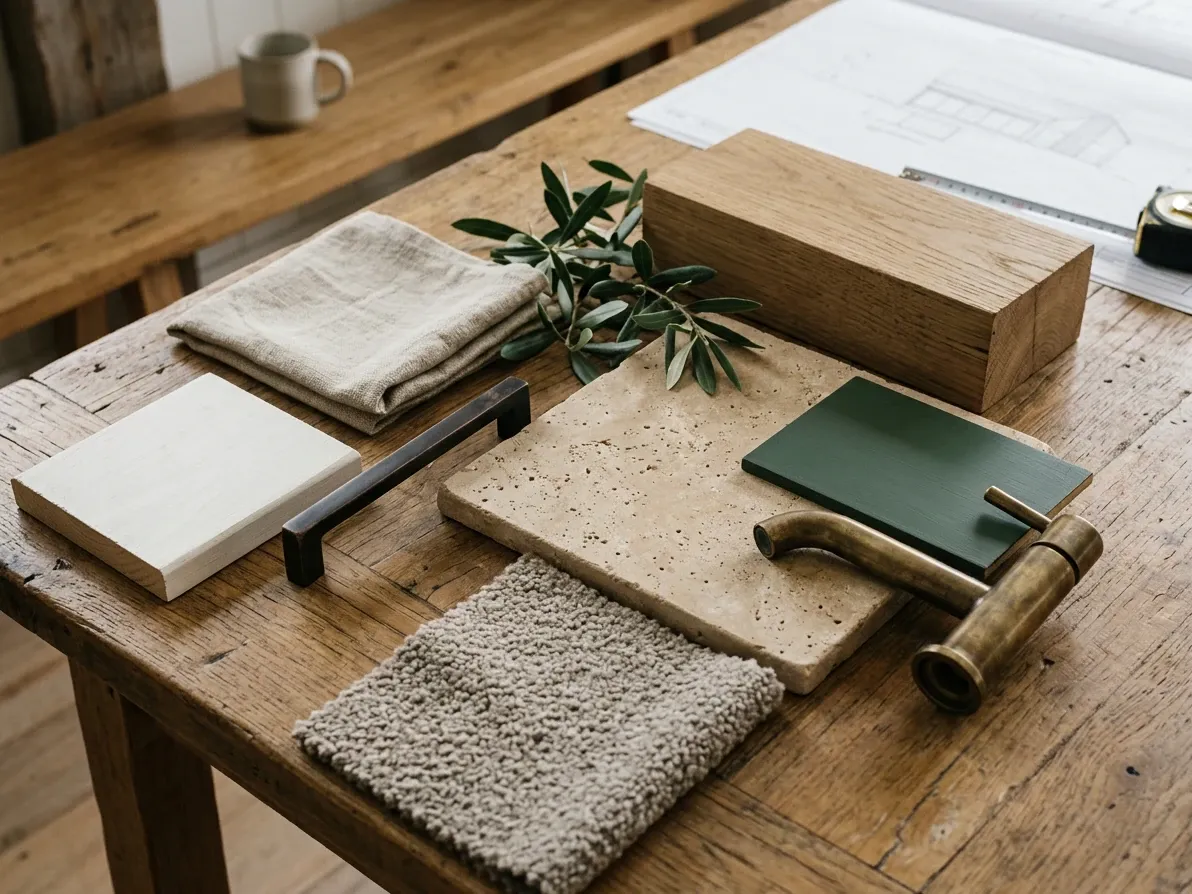
Warm white, oat linen, oil-rubbed bronze, aged brass, honey oak.
The 2026 palette and material vocabulary
The 2026 Australian farmhouse palette is built in three layers: a dominant warm-white base, a timber and warm-neutral middle band, and a confident deeper-colour accent set. The base layer carries walls, ceilings and trim. Warm whites, soft creams, off-whites and milk-paint whites all read in the style; cool blue-white reads closer to Hamptons or Scandi. A favourite working test for a farmhouse white is whether it sits warmly against a honey-oak floor: if the paint reads cool or clinical against warm timber, it is the wrong white for this style.
The middle band carries the timber and the warm neutrals. The dominant timber is oak, leaning honey, mid-tone or lightly distressed rather than pale Nordic or polished walnut. European oak, American white oak and Australian Tasmanian oak all work and read close enough at the timber-tone level; the distinction matters more in solid furniture pieces than in the floor. Beech, ash, hickory and pine read in the supporting layer for furniture and smaller joinery; reclaimed timber (old hardwood floorboards reused in a feature wall, an old fence post repurposed as a beam, milled barn timber as a benchtop or shelving) is one of the strongest moves the style allows and signals the lineage cleanly. Warm-neutral upholstery (oat, warm greige, soft taupe, ivory, cream) carries through linen sofas, slipcovered armchairs, dining-chair upholstery and bedding.
The accent layer is where the 2026 version diverges most from the 2017 to 2020 version. The earlier modern farmhouse leaned on grey-and-white restraint; the current version leans into colour. Deep forest green, sage green, hunter green, olive carry painted joinery (an island, a vanity, a built-in dresser) and a single feature wall most often. Dusky blue, denim blue, deep navy carry the secondary accent role in smaller bursts (cushions, an entry door, a powder-room vanity). Warm browns (chocolate, walnut tone, mocha, espresso) carry through leather seating, timber furniture and accent joinery. Biscuit red, terracotta, rust and mustard or warm wheat carry the warmer accent set for cushions, ceramics, art and rugs. According to James Hardie’s 2026 Modern Farmhouse forecast, the grounded palette of biscuit reds, deep greens and weathered taupe is the defining 2026 direction for the style in Australia.
Hardware and metalwork run matte black, oil-rubbed bronze, aged brass, hand-forged iron or brushed warm nickel. Polished chrome and polished brass both read against the style; the matte and aged finishes carry the working-farm reference cleanly. Tapware in oil-rubbed bronze or matte black with bridge or gooseneck profiles, cabinet hardware in matching matte black or aged brass, light fittings in seeded glass and matte black, and door hardware in hand-forged iron all read in the style. According to Castlery’s modern farmhouse guide, bronze, brass or blackened steel hardware is one of the cleanest single moves to anchor the style in a room that is otherwise contemporary.
Stones lean warm and matte rather than polished and cool. Honed travertine, soapstone, sandstone, terracotta tile, matte engineered stone in a warm tone and honed marble in restraint all read in the style. Polished black marble and polished calacatta marble read against it; the bright white veined polished slab is doing more decorative work than the style is asking for.
Textiles run on linen, cotton, wool, jute and leather. Slipcovered linen sofas, linen cushions in oat and warm greige, ticking-stripe pillowcases, woollen throws in warm neutrals, jute or wool flatweave rugs (not jute coil-boucle of the kind that turns up everywhere in coastal), and a single leather armchair or bench all sit cleanly in the style. Velvet is permitted in restraint (a single armchair in deep forest green velvet reads as current); heavy brocade, glossy silk and shiny synthetics all read against the style.
The 2026 version is more confidently coloured and more confidently textured than the 2017 to 2020 version was, and the result reads warmer, more grown-up and considerably less themed. A useful working test: if the room reads better in a photograph at dusk under warm lamplight than at midday under direct sun, the palette is sitting in the right place.
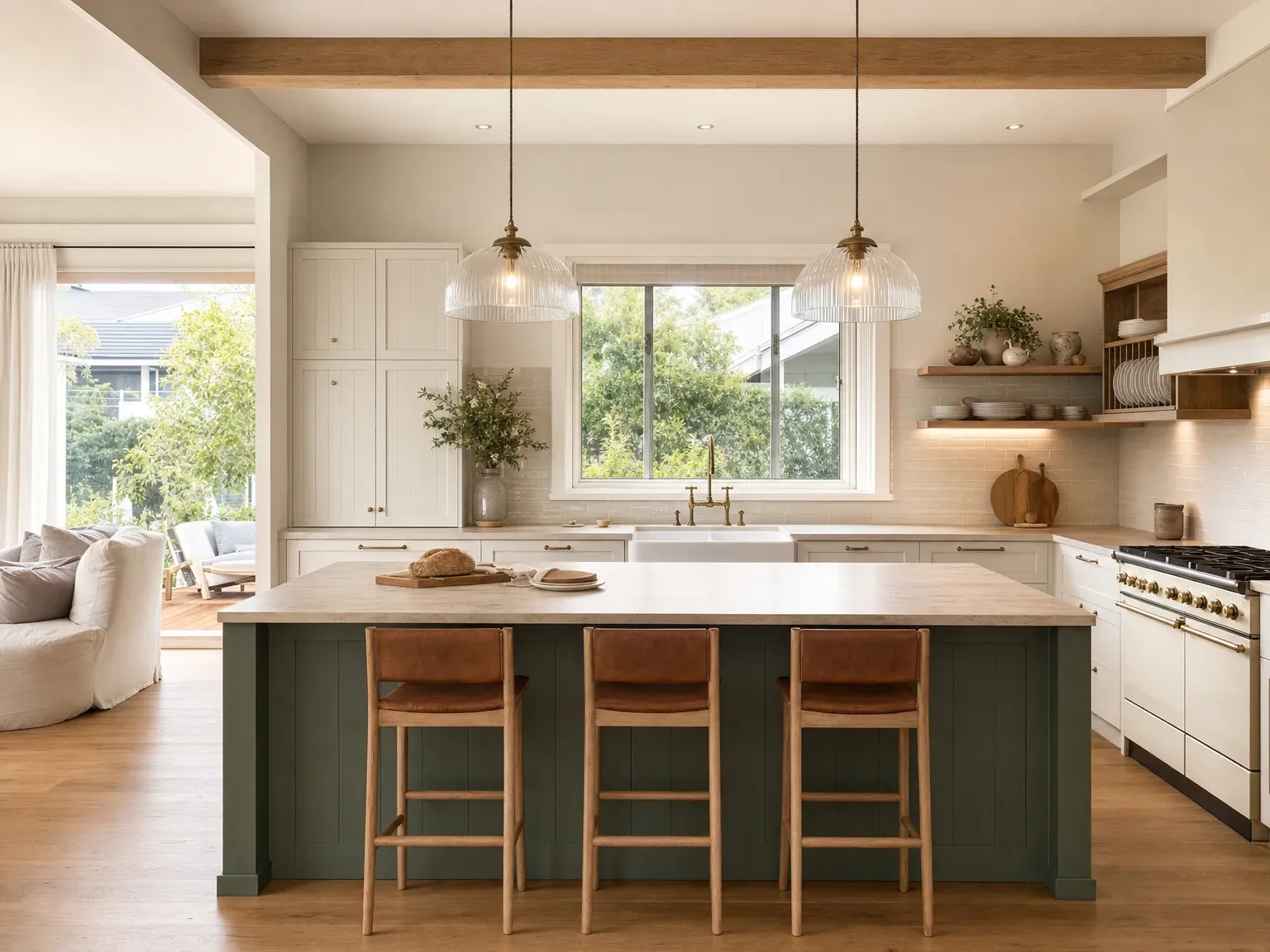
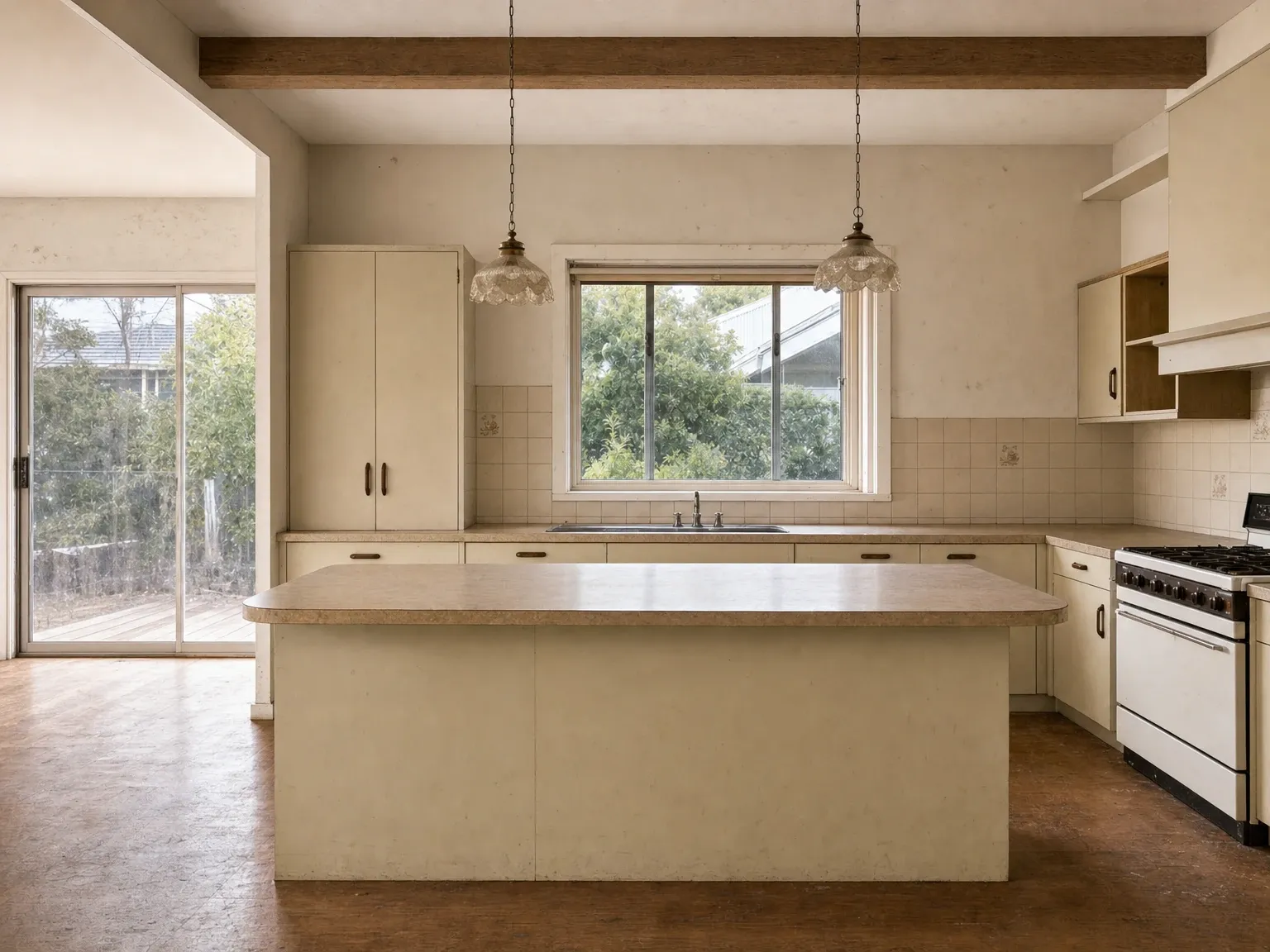 Before
After
Before
After
Inside an Australian farmhouse kitchen
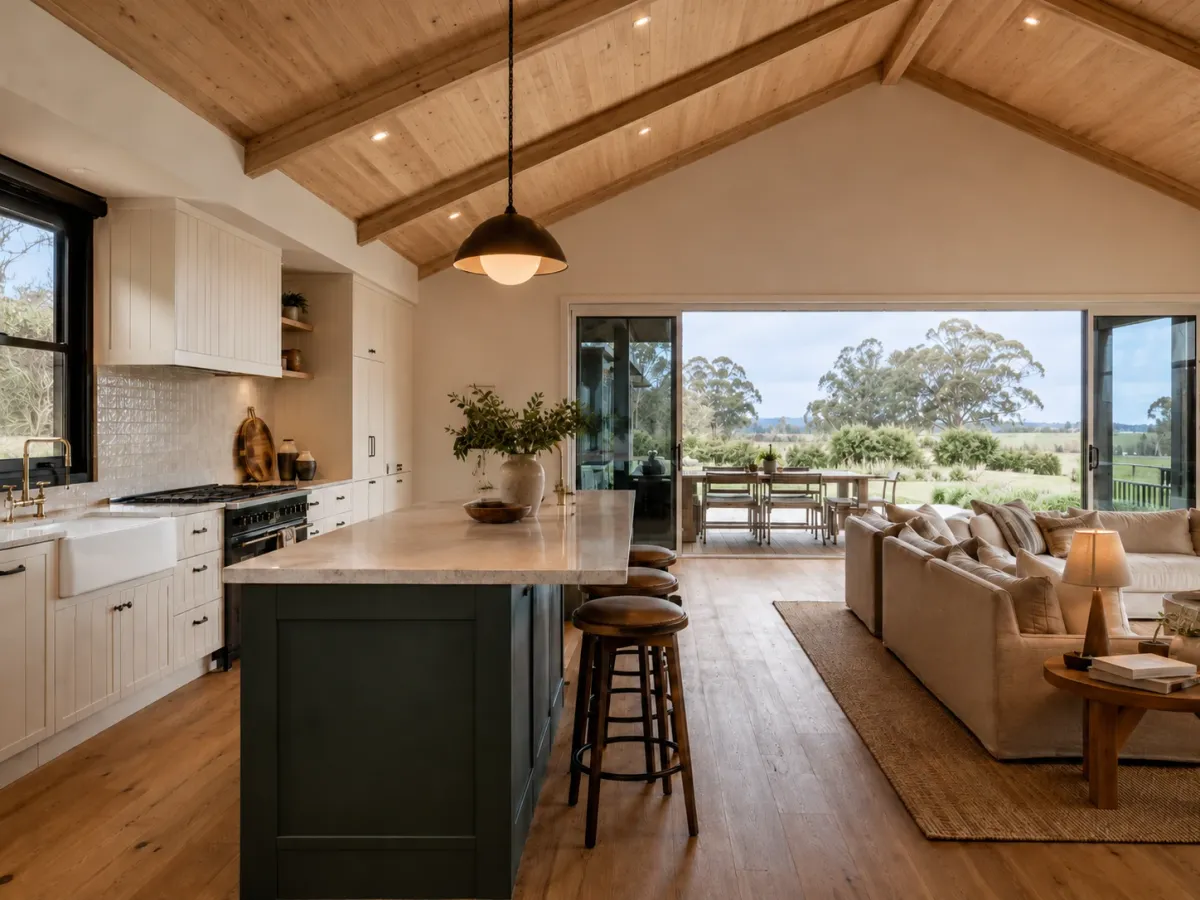
The kitchen is where Australian farmhouse style lands most often, because most Australian farmhouse renovations end up centred on the kitchen, and because the working brief (large island, butler sink, generous bench, durable benchtop, painted shaker or V-groove cabinetry, brass or black tapware, a freestanding range cooker if budget allows, a hanging pot rack or open shelf, a Welsh dresser or a sideboard for everyday china) lines up cleanly with what most contemporary Australian families actually want from the room. According to Innovative Kitchens’ farmhouse kitchen guide, the defining elements are shaker-style cabinetry, a deep apron-front butler sink, natural timber elements and a large central island, and that brief travels cleanly across most price points.
Cabinetry runs in painted shaker, painted flat-shaker or V-groove panel in warm white, soft cream, sage green, forest green, deep navy or dusky blue most often. The most successful 2026 Australian configurations use a two-tone scheme: warm white on the perimeter cabinetry with a deeper accent on the island, or warm white on the upper cabinets with a deeper colour on the lower cabinetry. A single painted feature joinery piece (a built-in dresser at the dining end, a green-painted pantry cupboard, a navy-painted laundry cabinet) carries the colour without committing the whole room. According to Freedom Kitchens’ farmhouse kitchen guide, classic shaker-style doors are the primary choice and are typically finished in crisp whites, muted sage or deep navy, with V-groove panelling and glass-fronted cabinets adding to the authentic feel.
The benchtop runs in a warm tone. Engineered stone in warm white, soft cream, sandy beige or pale honed-marble look is the practical default; honed marble, soapstone, granite in a warm matte finish or solid timber (American walnut, Australian blackbutt or recycled hardwood) is the premium option. The benchtop sits darker than the cabinetry rather than disappearing into it, so the island reads as a piece of furniture; a thicker waterfall-edge or a single-piece slab read as more contemporary, while a thinner traditional edge with a small timber section at the kitchen end reads as more traditional.
The splashback runs simple. Subway tile in a warm white or soft cream, small-format hex or fish-scale tile in matt-glaze white or sage, full-height tongue-and-groove panel painted in the wall colour, full-slab natural stone (travertine, soapstone or matte marble) or matte ceramic tile in a herringbone or running-bond pattern all read in the style. Glossy bright-white subway in a stack-bond layout reads more Hamptons; the hand-glazed irregular finish on small-format zellige or matt-glaze ceramic reads more current and more farmhouse.
The sink is the single most recognisable kitchen-element in the style. The deep apron-front fireclay butler sink (also called a Belfast sink in its British form) sits flush with the benchtop edge and reads as the kitchen’s working centrepiece. According to Vogue Bathrooms’ farmhouse-sink guide, the durable fine fireclay versions are scratch, stain and heat-resistant and handle Australian family kitchen use comfortably; the white finish is the dominant choice but matte black, sage and warm cream are all current. Bridge tapware in oil-rubbed bronze, matte black or aged brass sits over the sink; gooseneck single-handle taps in the same finishes are the contemporary option.
The appliances split into two camps. The traditional choice is a freestanding range cooker in a warm white, sage or deep green enamel with brass detailing (Falcon, Smeg Victoria, Belling, Stoves); the contemporary choice is an integrated cooktop and oven set into a stone-and-timber bench, with a feature rangehood in copper, brushed brass or matte black. Either reads in the style; the freestanding range is the more visibly farmhouse choice.
A modern farmhouse kitchen is not, by default, cheap. According to the Housing Industry Association, the national median for a kitchen renovation in Australia sits at around $30,000 to $35,000, with mid-range builds running roughly $25,000 to $45,000 and premium custom builds running $45,000 to $100,000-plus. A genuine modern farmhouse kitchen sits in the upper half of the mid-range band most often, because the shaker or V-groove cabinetry, the fireclay butler sink, the bridge tapware and the timber benchtop sections all run a step more expensive than a flat-panel polyurethane equivalent at the same overall scope. The look is achievable inside the median for owners willing to use polyurethane-painted shaker doors and engineered stone rather than the fully custom equivalents; it pushes past $80,000 when the cabinetry is solid-timber, the benchtop is honed natural stone or solid timber, and a freestanding range cooker is specified. According to Kitchen Shack’s 2026 cost guide, kitchen renovation prices in Australia average around $42,630 in 2026 with installation included. The article on kitchen renovations on a budget covers the budget-end execution in more detail.
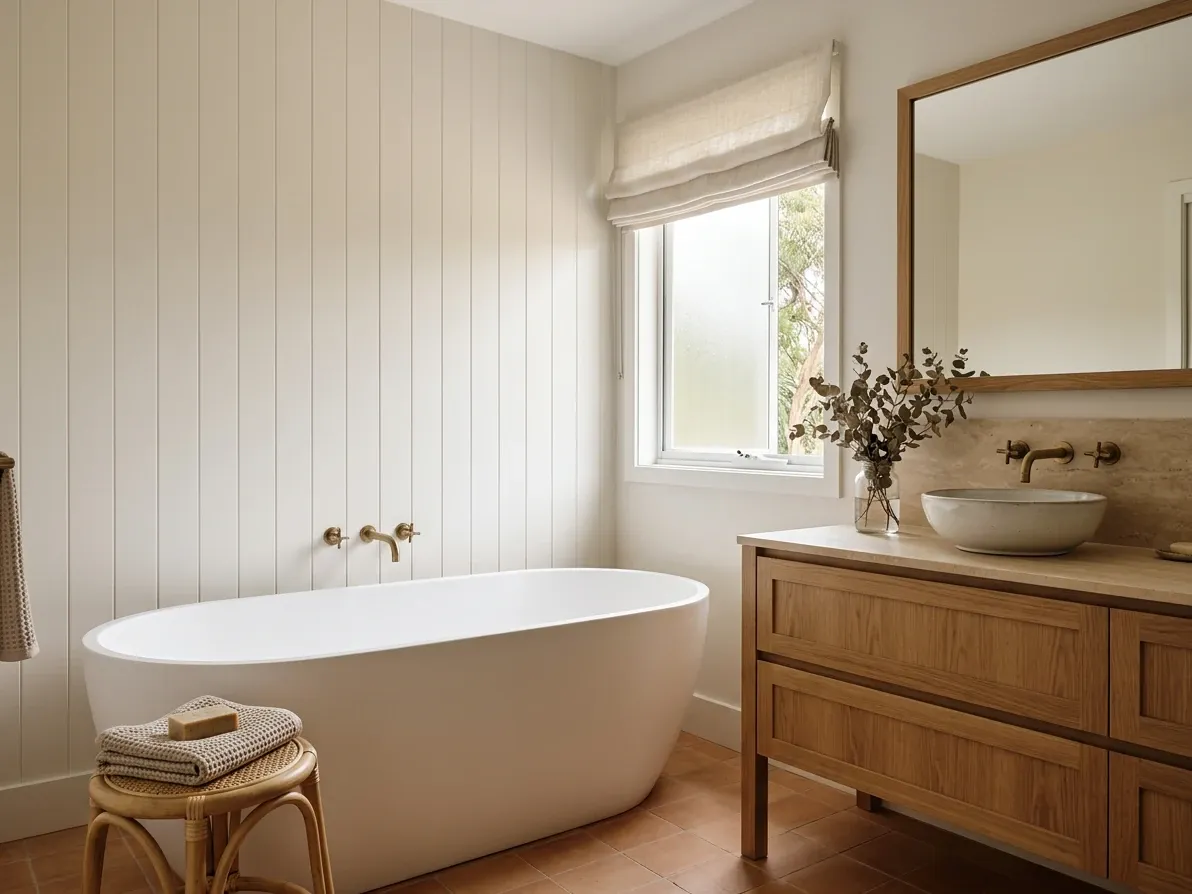
Freestanding bath, V-groove panelling, oak vanity, oil-rubbed bronze.
Inside an Australian farmhouse bathroom
A farmhouse bathroom works on the same vocabulary as the kitchen, scaled to a wet area. The defining moves are a freestanding bath (the clawfoot is the traditional choice, the modern oval or flat-rimmed slipper bath is the contemporary one), a vanity built as a furniture piece in painted shaker timber or natural oak, a tiled feature wall in warm-toned subway, hex or zellige tile, a small-format or honed-stone floor, brass or black tapware and a generous use of timber and woven texture to break up the hard surfaces.
The wall and floor tile choice carries most of the look. Warm-white or soft-cream subway tile in a running-bond or herringbone layout, small-format hex tile in pale sage or warm taupe, zellige tile in a hand-glazed warm white, honed terracotta floor tile, honed travertine wall tile or matte ceramic tile in a pencil-edge profile all read in the style. Bright-white machine-cut subway in a stack-bond layout with grey grout reads more Hamptons or contemporary; the hand-glazed irregular finishes and warmer tones read more farmhouse.
The vanity is built as a timber-look furniture piece, often in painted shaker (warm white, sage green, deep navy, biscuit red), natural oak or reclaimed timber, with an under-mount ceramic basin or a hand-thrown ceramic vessel basin on a stone or timber top. Floating vanity construction reads cleaner and more contemporary; a full-height legged vanity reads more traditional. Both are valid; the choice depends on whether the bathroom is leaning contemporary-farmhouse or traditional-farmhouse. According to AUBarndoor’s modern farmhouse interiors guide, the most successful Australian farmhouse bathrooms keep the joinery as warm timber or warm-painted, the stone as honed and warm, and the metalwork as matte rather than polished.
The tapware runs in oil-rubbed bronze, matte black, aged brass or brushed warm nickel. Cross-handle or knurled-lever profiles read more traditional; clean lever profiles read more contemporary. The shower can be a frameless glass screen with matte-black hardware (more contemporary), an enclosed timber-and-glass shower screen (more traditional) or an open walk-in with a glass screen and an exposed thermostatic shower set in matte black or aged brass.
Texture moves complete the look. A woven cane stool beside the bath, a timber-framed mirror in oak or aged timber (round, arched or rectangular with a top rail), a small-format jute or wool runner on the floor, a single piece of textural ceramic or framed botanical art and a row of small terracotta pots holding fresh herbs or trailing plants all soften the hard surfaces. Plantation shutters or simple linen Roman blinds at the window are the standard window treatments and both sit cleanly in the style.
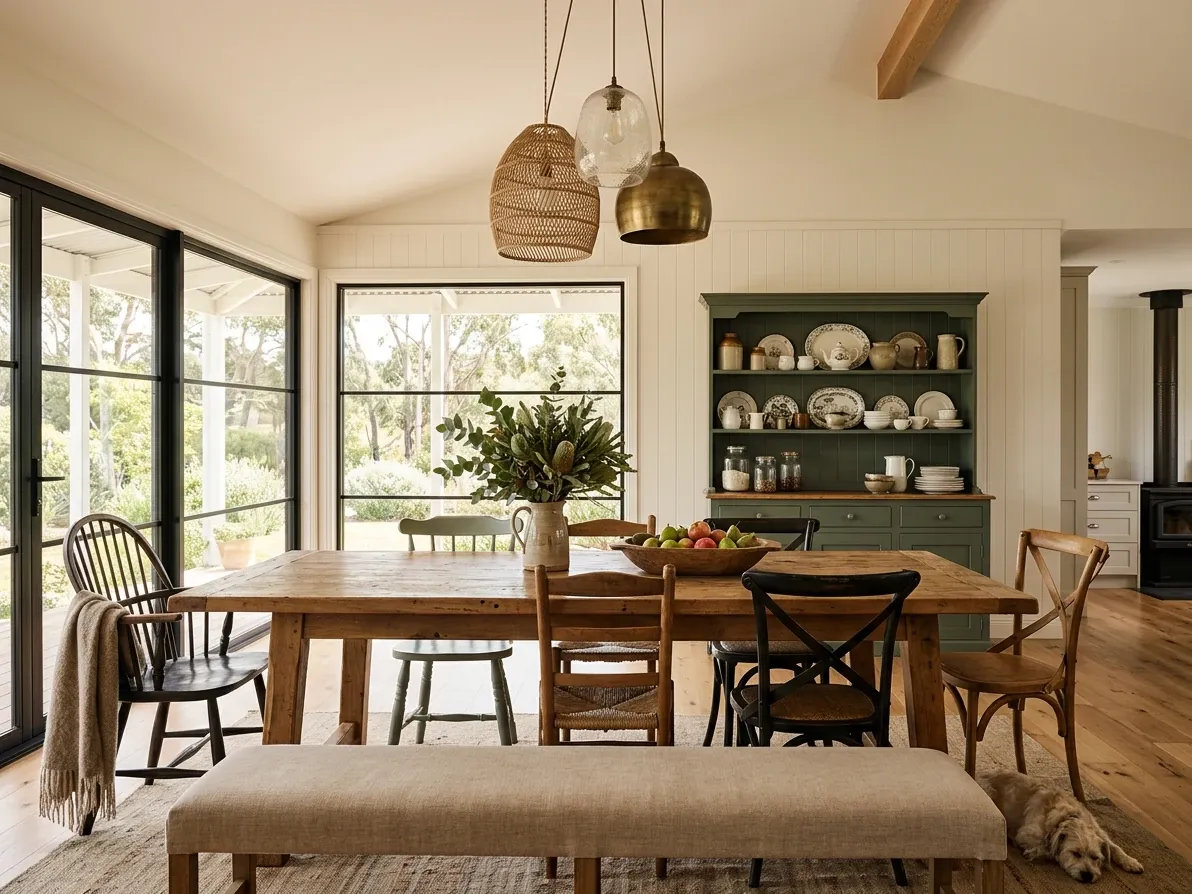
A wide timber table, mismatched chairs, room to actually sit down.
Inside a farmhouse living, dining and bedroom
The living room is where the styling layer does the most work, because the kitchen and the bathroom are largely defined by their fixed joinery and hardware. The defining moves in a farmhouse living room are a slipcovered linen sofa in oat, warm greige or soft white, a single leather or velvet armchair in a warm accent colour, a low timber coffee table (recycled hardwood, oak with a hand-rubbed wax finish, or a thick-slab piece), a jute or wool flatweave rug, exposed timber ceiling beams where the architecture allows it, a stone or brick fireplace as the room’s natural focal point, a Welsh dresser or open timber shelving for working pottery and books, and a layered art wall in vintage timber frames.
The lighting runs on layered warm-white lamps rather than overhead downlights as the primary source. A pendant or chandelier in seeded glass, hand-blown glass, matte black with seeded bulbs, woven rattan or aged brass carries the central light; layered floor and table lamps in ceramic, timber or aged-brass bases with linen or cotton shades carry the working light. According to Castlery’s modern farmhouse living room ideas, texture (bouclé cushions, washed-linen throws, sheepskin on the armchair, a chunky-knit wool blanket on the sofa, a sisal or seagrass rug under a jute or wool one) is what separates a warm farmhouse living room from a flat one.
The dining room runs on a wide hardworking timber table as its centrepiece, with mismatched timber dining chairs (Windsor chairs, ladder-back chairs, X-back chairs, cross-back chairs, plain spindle chairs), a bench seat on one side, a sideboard or Welsh dresser against a wall for everyday china, and a pendant cluster or single statement pendant overhead. The table is the room. According to Abide Interiors’ modern farmhouse decor guide, the dining table is the social heart of a farmhouse home and is built or bought to handle heavy daily use, ageing in rather than ageing out.
The bedroom is the quietest room in the style. A timber four-poster, a hand-forged iron bed frame, an upholstered linen bedhead or a timber slat headboard carries the bed. Bedding runs in washed linen in oat, warm greige, white or soft sage; layered with a single textured throw and a small pile of mixed-texture cushions in restraint. Bedside tables in painted shaker, oak or rattan; bedside lamps with linen shades on ceramic or timber bases. A small inherited rug at the foot of the bed and a jute or wool flatweave underfoot. Walls in warm white or a deeper feature-wall colour (sage, forest, dusky blue, biscuit red) behind the bed; the rest of the room in the warm-white base. According to Home Beautiful’s modern farmhouse interior design guide, restraint in the bedroom is what makes the rest of the house feel earned: the room reads as a quiet retreat rather than as another over-styled set.
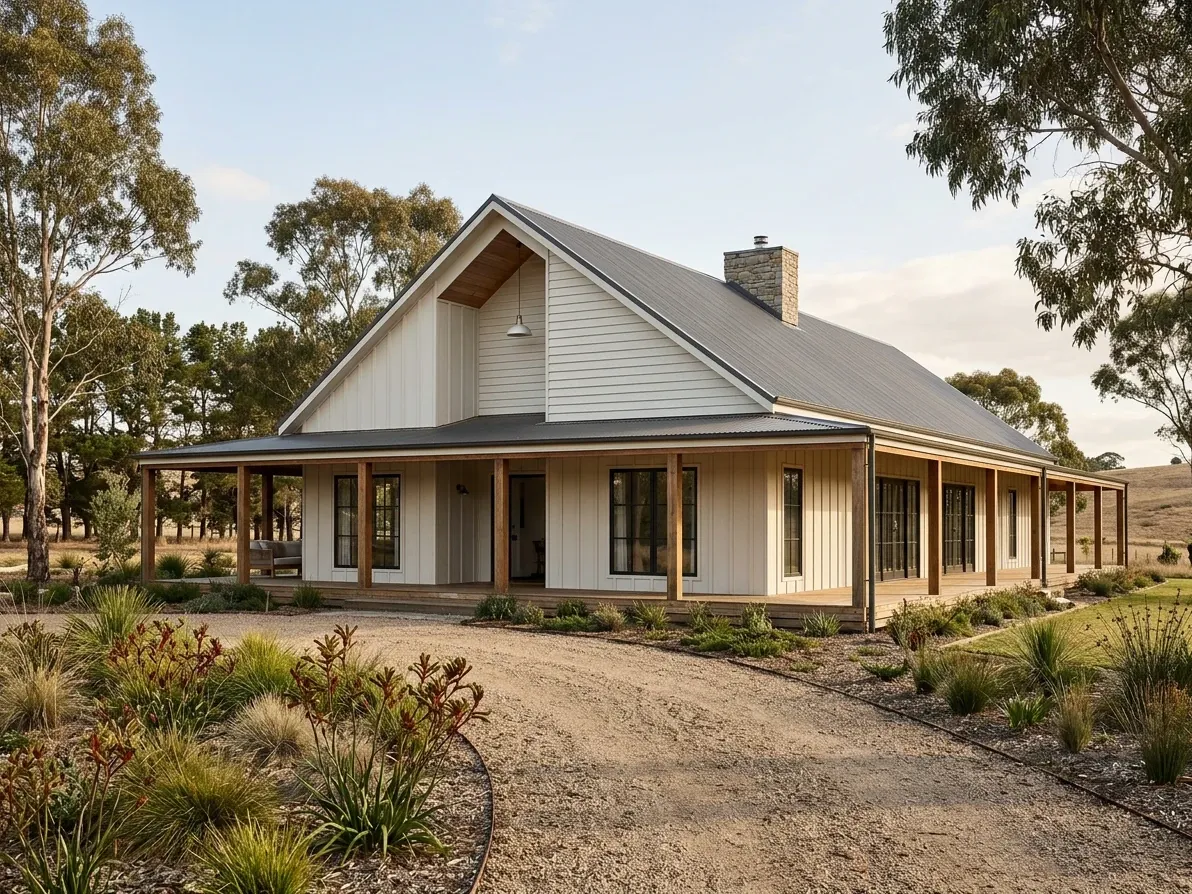
Board-and-batten, deep verandah, Colorbond roof, in the Australian register.
The exterior: where Australian farmhouse meets the homestead
The exterior is where the Australian farmhouse vocabulary diverges most from the American import, because the climate and the building stock are different. A genuine 2026 Australian modern farmhouse exterior leans into the country’s own building tradition.
The dominant roof form is a steeply-pitched gable, often with a secondary gable over the front entry, sometimes intersected by a hip section or a perpendicular gable on a wing. The pitch should read steep enough to handle heavy rain (most rural Australian roofs run 22 to 35 degrees) and generous enough to give the front elevation presence. The roof material is almost always corrugated iron in Colorbond Monument, Surfmist, Basalt, Woodland Grey, Night Sky, Manor Red or a near-black tone; tile reads less farmhouse and more project-home, and Colorbond is what most Australians associate with rural roofs anyway.
The cladding is where the style is most recognisable. The two dominant options are horizontal weatherboards (timber or fibre-cement) painted in warm white, soft cream, sage green, forest green, dusky blue or near-black, and vertical board-and-batten in the same colour set. According to James Hardie’s product guide for modern farmhouse exteriors, vertical board-and-batten is one of the defining moves of the contemporary Australian modern farmhouse, with Hardie’s Oblique cladding, Fine Texture cladding and Axent trim used to build the look in fibre-cement; the timber alternative reads warmer and more traditional but requires more maintenance. A useful 2026 move is mixing the two on a single elevation: horizontal weatherboard on the main wall, vertical board-and-batten on a feature gable or a front-entry section, with both painted the same colour so the texture difference does the work rather than a colour change.
The windows are generous, vertically-oriented, double-hung or casement, framed in thin black or near-black for the contemporary version and white or warm-cream for the more traditional version. Picture windows with thin black frames in the living area, casement windows with timber surrounds in the bedrooms, and a row of clerestory windows above the kitchen-living core all read in the style.
The verandah is the move that anchors the style as Australian rather than American. A wide covered verandah on the front, the back, or wrapping the building on two or three sides is the defining feature of the Australian homestead and Queenslander, and it carries cleanly into the modern farmhouse. A verandah deep enough to comfortably hold an outdoor lounge setting (2.4 to 3.6 metres deep is the working range), with timber posts at considered spacing, a timber or polished concrete floor, a corrugated iron or skillion roof and a generous timber ceiling overhead. The verandah is also a working climate feature, shading the windows from the summer sun and giving the family an outdoor room that works ten months of the year in most of the country.
The chimney is a more occasional but still recognisable feature. A stone or rendered chimney rising from the main living area reads strongly farmhouse, and is increasingly being specified in 2026 builds as a Coonara, slow-combustion or open-fire chimney rather than as decoration. According to Modular WA’s piece on Australian farmhouse homes, the chimney, the verandah and the pitched roof together are the three exterior elements that most strongly read farmhouse in an Australian context.
The landscaping runs to the architecture rather than against it. Drought-tolerant native planting, agave and grass tussocks in a structured native garden, a fenced or rendered pebble-and-gravel forecourt, a working vegetable garden visible from the kitchen, a row of olive or citrus trees along the side fence, and a deep gravel driveway curving toward the verandah all read in the style. Manicured front lawns and clipped boxwood hedging read closer to Hamptons.
How popular is farmhouse style in Australia really
Honest data on farmhouse-style popularity in Australia is harder to find than the search results suggest, because most popularity claims come from US sources or from retailer marketing rather than from independent surveys. The single best Australian dataset is the Houzz 2023 Australia Kitchen Trends Study, which surveyed 473 Australian homeowners about their recently-completed kitchen renovations and reported the style they had chosen. Contemporary came in first at 24 per cent, Modern second at 23 per cent, Hamptons at 11 per cent, Coastal at 7 per cent and Country at 4 per cent, with the remaining 31 per cent spread across French Provincial, Industrial, Mediterranean, Scandi, eclectic and unspecified.
- Contemporary24%
- Modern23%
- Hamptons11%
- Country4%
- Other styles38%
That 4 per cent figure for Country is the closest published proxy for “farmhouse-style kitchens completed in Australia” and is worth keeping in mind when reading the Australian Pinterest boards. The visual prominence of farmhouse interiors online is much higher than the share of Australian kitchens that actually get built that way. The style is a confident minority interest rather than a dominant national choice, and most credible style guides have read its share at roughly this level since at least 2019.
The architectural form of the country is more sympathetic to the style than the interior numbers suggest. According to the 2021 Census Housing release, around 70 per cent of Australian private dwellings are separate (detached) houses, 13 per cent are townhouses and 16 per cent are apartments. Most Australian households live in the building type that the farmhouse vocabulary was designed for, and most of those detached houses sit on enough land to accommodate the verandah-and-pitched-roof exterior that the style asks for. The gap between “could be a farmhouse” and “is a farmhouse” is large.
- Separate houses70%
- Apartments16%
- Townhouses13%
- Other1%
A reasonable read on the 2026 direction: farmhouse is one of the persistent minority style choices in Australian residential design, with a confident foothold in the rural and outer-regional markets, occasional traction in the inner-city renovation market through the more contemporary modern-farmhouse variant, and very limited traction in the high-density apartment market. The leading 2026 forecasts from James Hardie, Sydney Home Renovation and the Houzz product team all read modern farmhouse as a top-tier residential style in Australia for the year ahead, alongside contemporary minimalism, sustainable eco-homes and warm minimalism. The labelled, themed late-2010s American version is fading; the underlying material and architectural vocabulary is not.
The five mistakes that age an Australian farmhouse fastest
The same handful of mistakes turn up across most Australian farmhouse renovations that end up dated within a year or two of completion.
Shiplap on every available wall. According to Medium’s piece on the ten common mistakes in farmhouse decor, shiplap on every wall is one of the most frequent and visible errors. The material reads as a quiet detail when it carries a single feature wall, an entry hallway, a powder-room wall or the bedroom headboard wall; it reads as a themed novelty when it covers every interior wall in the house. The fix is the same as in any other style: use the move where the architecture asks for it, not everywhere by default.
Stylising rather than specifying. A farmhouse interior built around signs, cotton stems, painted boxwood wreaths, mason jars, galvanised buckets, Edison-bulb chandeliers on chains and chalk-painted Live, Laugh, Love quotes ages in 18 months, because the styling layer is doing the work the material layer should be doing. The fix is to invest in the material layer (timber, stone, joinery, hardware, lighting, textiles) and to let the styling layer carry a small, restrained set of considered objects. A farmhouse room reads warm because the materials are warm, not because the shelves are decorated with signage.
The barn door installed where no barn ever lived. The sliding barn-door track has become one of the single most identifiable late-2010s motifs, and it ages a room quickly because the architectural detail does not pull its weight: a sliding barn-door track installed in a project-home corridor reads as an applied motif rather than as a structural solution. The fix is to use the move where it solves a real problem (a wide laundry opening that a hinged door would not handle gracefully, a wet-room screen, a wide pantry entry) and to skip it everywhere else.
Borrowing the Texas version straight to suburban Australia. A modern farmhouse exterior in white-painted weatherboard with a steep gabled roof, a wide verandah and a Colorbond Monument roof reads as confidently Australian in a regional or outer-metropolitan context. The same exterior shrunk onto a 350-square-metre suburban lot in inner Sydney or inner Melbourne reads as a project-home pastiche of an American import, because the architectural form is not earning the style around it. The fix is to let the style follow the lot: full modern farmhouse on a generous block where the exterior can do the work, a quieter farmhouse-influenced interior on a small inner-city lot where a fully-styled exterior would be borrowing rather than building.
Cool grey-and-white palettes left over from the 2010s. The grey-cool-white modern farmhouse of 2017 to 2020 has aged the fastest of any version of the style. The 2026 direction is warmer, earthier and deeper, with biscuit red, deep forest green, warm brown and weathered taupe doing the accent work that grey used to do, and honey-and-mid-tone oak doing the timber work that pale grey-washed oak used to do. The fix is to warm every layer of the palette by one step (warm white over cool white, honey oak over grey-washed oak, oat or warm greige upholstery over flat grey, oil-rubbed bronze or aged brass over chrome) and to let the deeper accent colours carry the punctuation.
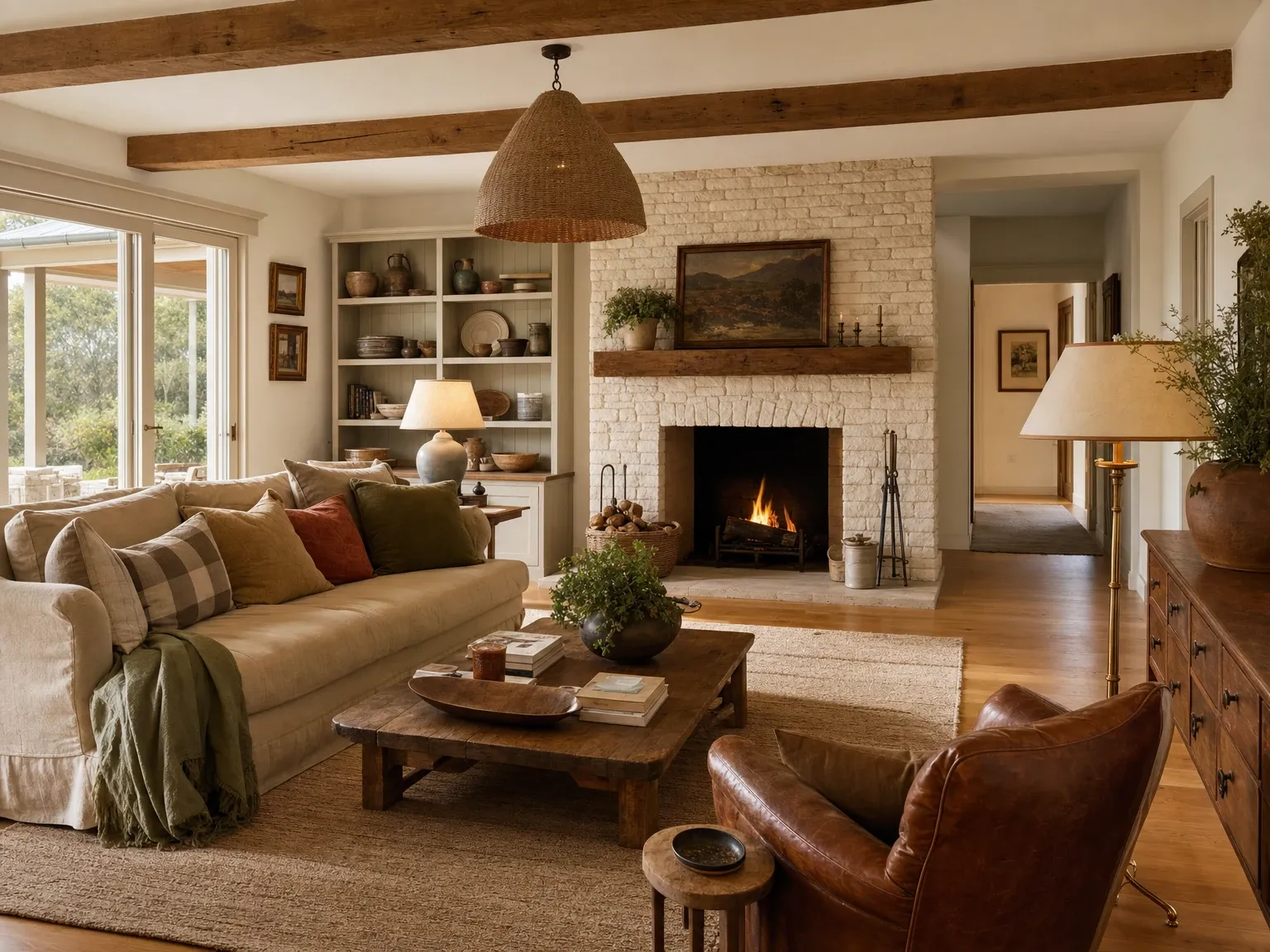
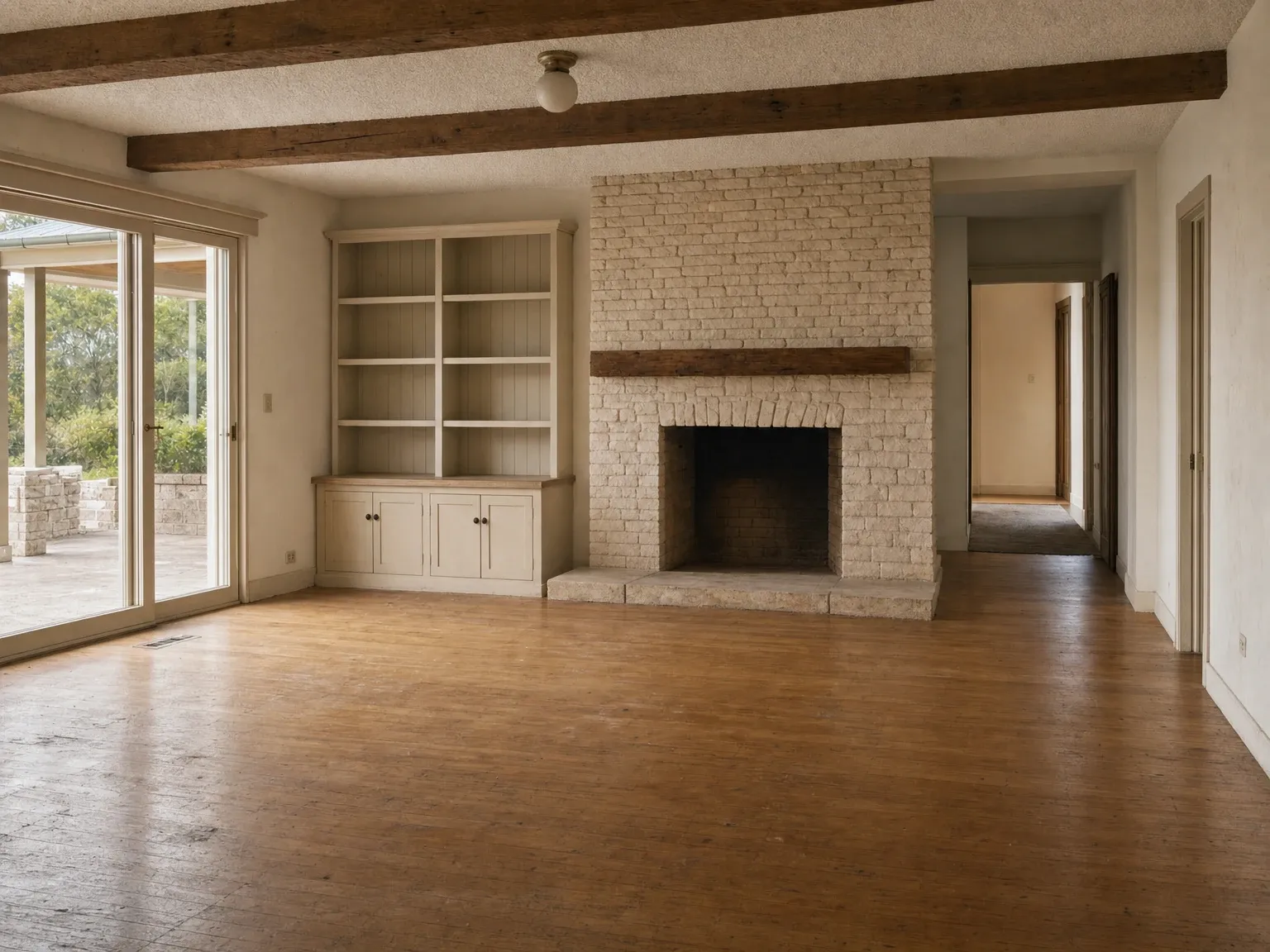 Before
After
Before
After
A note on visualising the style before you commit
Renovators who are considering a farmhouse-style kitchen, bathroom or whole-of-house renovation in Australia have a working tool available that simply did not exist five years ago. AI-powered image-to-image visualisation (the tool reIMG runs in-house, and the broader category covered in the image-to-image AI complete guide) lets a designer or homeowner take a photograph of an existing room and generate a photorealistic version of the same room in a farmhouse specification: warm-white shaker cabinetry, honey-oak floors, a sage-green island, an apron-front butler sink and aged-brass tapware, all rendered into the actual room rather than imagined onto a Pinterest board. The point is not to skip the designer; it is to make the brief tangible before construction money is committed. The visual gap between “modern farmhouse” as a label and the room as it would actually look is one of the most consistent reasons Australian renovations end up off-style, and a few visualisations early in the process closes most of that gap.
Frequently asked questions
What is farmhouse interior style in simple terms?
Farmhouse interior style is a relaxed, practical, materials-led interior look built around natural timber, painted joinery, white or warm-neutral walls, simple plank or shaker cabinet doors, generous everyday workspaces (the kitchen island, the wide table, the laundry bench) and honest hardworking finishes that age in well rather than show wear. It traces three lineages: the original European and English farmhouse rooms of the seventeenth to nineteenth centuries, the American modern farmhouse that Joanna Gaines popularised on Fixer Upper from 2013, and Australia’s own rural vernacular of homesteads, Queenslanders and verandah cottages built for the local climate. The 2026 version is warmer, less themed and less obviously shiplap-led than the 2010s American take, with deeper greens and warm browns layered against the white-and-oak base, and the literal barn-door-and-mason-jar styling dialled right back.
What’s the difference between farmhouse and Hamptons style?
Farmhouse is the more relaxed, more rustic and more utilitarian of the two. Hamptons is the more polished, more formal and more decorated. Both share white painted joinery and a love of natural light, which is why they get confused, but the working tests are easy. Look at the cabinet door first: a shaker panel with deep raised inner trim and a square frame is Hamptons; a simple V-groove board, a beadboard panel, a flat-front shaker with a thinner frame, or a rough-sawn timber face is farmhouse. Look at the floor: a polished mid-to-dark oak in herringbone or wide plank is Hamptons; a wider, paler, lightly distressed or rough-sawn oak (or honed terracotta tile) is farmhouse. And look at the architectural detail: Hamptons leans into deep cornices, picture-frame mullions, wainscoting and panelled doors; farmhouse strips most of that out and lets the timber, the painted brickwork, the iron hardware and the workhorse joinery carry the room. Farmhouse reads like a well-kept working farmhouse you can put your feet up in; Hamptons reads like a coastal estate you would dress up for.
Is modern farmhouse still in style in 2026?
Yes, but in a warmer, less themed form than the 2017 to 2020 American version. Houzz, the National Kitchen and Bath Association and Apartment Therapy have all reported weakening demand for the shiplap-everywhere modern farmhouse of the late 2010s in favour of transitional, warm minimalism and organic modern looks, and James Hardie’s own 2026 Modern Farmhouse forecast for Australia describes the style as evolving toward a resilient, grounded, nurturing palette of biscuit reds, deep greens and weathered taupe anchored in honey oak, soft stone and brushed metal. The genuine farmhouse vocabulary (natural materials, painted joinery, simple architecture, a strong indoor-outdoor relationship) is being absorbed into the wider mainstream rather than disappearing, which is closer to the path Scandi took after 2018. The styled, themed, signed-and-decorated American take is what is fading; the underlying material language is not.
Does farmhouse style suit Australian houses?
Yes, often better than it suits the American suburbs where its current form was popularised. Around 70 per cent of Australian private dwellings are separate houses according to the 2021 Census, which gives most of the country the building stock the style was designed for, and Australia has its own established rural vernacular (the Queenslander, the verandah cottage, the timber homestead, the shed-influenced rural farmhouse) that maps cleanly onto the modern farmhouse vocabulary of pitched roofs, weatherboard or board-and-batten cladding, wide verandahs, generous windows and corrugated iron roofing. The mistake most Australian farmhouse interiors make is borrowing the Texas or Tennessee version straight off Pinterest rather than translating it into the local climate and architectural lineage. A farmhouse interior done well in Brisbane, Albury, Bathurst or Bendigo reads as a confident Australian room rather than as an imported one.
What colours and materials make a farmhouse interior?
The base is warm white, soft white or creamy off-white across walls and trim, layered with honey oak, mid-tone oak or pale Australian hardwood through floors, joinery and beams. The supporting palette runs through soft greige and oat upholstery, painted joinery accents in muted sage, dusky blue, deep forest green, weathered charcoal or biscuit red, and a generous use of woven texture (jute, rattan, linen, cotton, wool). Hardware is matte black, oil-rubbed bronze, aged brass or hand-forged iron rather than polished chrome. Stones lean warm and matte (honed travertine, marble in restraint, soapstone, sandstone, terracotta tile). The 2026 evolution is warmer and earthier than the 2017 to 2020 take: more deep green, more warm brown, more terracotta, fewer cool greys.
What does a modern farmhouse kitchen cost in Australia?
A modern farmhouse kitchen sits at the mid-range to upper end of the Australian kitchen renovation market. The Housing Industry Association reports a typical Australian kitchen renovation at a median of around $30,000 to $35,000, with mid-range builds running roughly $25,000 to $45,000 and premium custom builds running $45,000 to $100,000-plus. A genuine modern farmhouse kitchen, with shaker or V-groove cabinetry, a stone benchtop in a warm tone, a ceramic fireclay butler sink, brushed brass or oil-rubbed bronze hardware and natural timber feature elements, sits in the upper half of the mid-range band most often, because the painted shaker cabinetry, the timber benchtop sections, the fireclay sink and the heritage-style tapware all run a step more expensive than a flat-panel polyurethane kitchen at the same overall scope. The look is achievable inside the median for owners willing to use polyurethane-painted shaker doors and engineered stone rather than the fully custom equivalents; it pushes well past $80,000 when the cabinetry is solid-timber, the benchtop is honed natural stone or thick timber, and a freestanding range cooker is specified.
What’s the worst farmhouse style mistake?
Mistaking the styling layer for the style. The American 2010s version of modern farmhouse leaned heavily on a small handful of literal motifs (white shiplap on every wall, a sliding barn door, a chalk-painted Live, Laugh, Love sign, a galvanised bucket of cotton stems, a chicken-wire pendant, a kitchen sign that said Kitchen) and a generation of Pinterest boards reduced the style to those props. A room covered in those motifs reads as themed and dated within a year. The fix is not to remove every farmhouse reference, it is to lean back into the material layer the style was built on: honest timber, painted joinery, simple architecture, generous working surfaces, ironmongery and woven texture. Done that way, a farmhouse interior reads as warm, lived-in and unmistakably current. Done with signs and shiplap, it reads as a Hobby Lobby aisle.