By hand
Perspective drawings and watercolours. Weeks of an artist’s time for one view. Beautiful, slow, expensive.
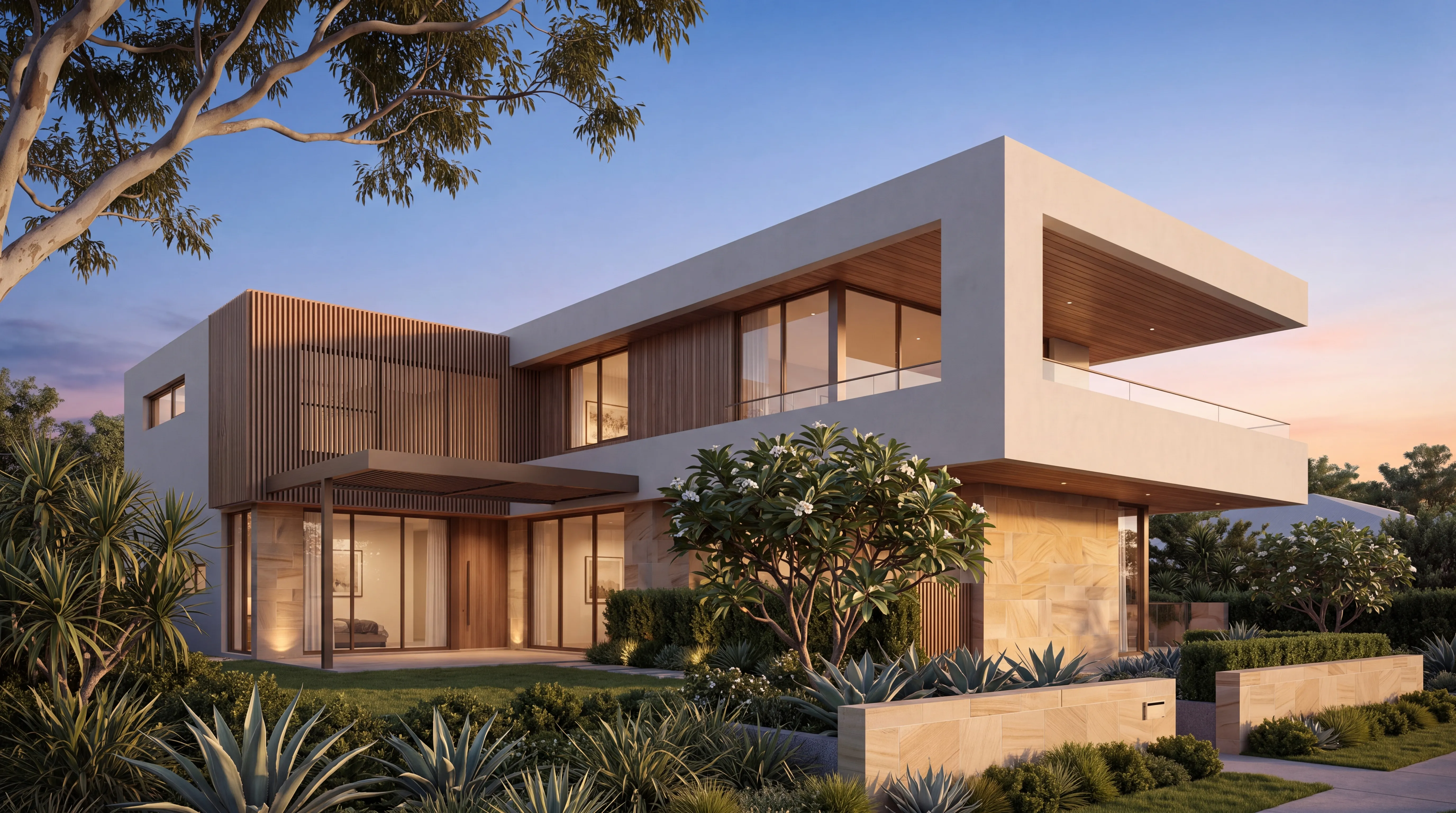
Software does the hours. People make the calls.
We built our own rendering pipeline and we run it ourselves, priced between the AI apps and the studios.
The shift
Perspective drawings and watercolours. Weeks of an artist’s time for one view. Beautiful, slow, expensive.
3ds Max, V-Ray, Lumion. Photoreal at last, and priced by the hour: weeks in the queue for a finished set.
Upload, prompt, wait, judge. Fast and cheap, and you are the one doing the judging. Nothing checks the picture against your design.
Custom tooling, run by our own team. Software speed, human judgement, and every image checked against your model.
The map
Cheap and fast on one side, slow and hand-made on the other. We sit in between.
Do it yourself
Done for you
Commission it
The fine grain
Drop a massing shot into a chat app and you get something good back in a minute. For early ideation it is brilliant.
Look closely and the geometry has shifted: a window moved, a roofline redrawn, an artifact where the balustrade was. Fine on a mood board. Fatal on a building you have to deliver.
The hard part is a set. Same building, same materials, same landscaping, eight different angles. Left alone, generative tools redraw the world every frame.
The studio packages have AI plugins now, and they help. But the labour model is unchanged: hours in expensive software, billed by the hour, judgement still doing the lifting.
The tooling
Internal tooling for exactly those failure modes: shot setup, set consistency, and the check against your model. Clients never touch software. Our team runs it all day.
Shot setup, lighting, rendering, iteration. The hours studios bill for, collapsed into tooling we built and run in-house.
Taste, direction, knowing when an image is right. The part software will never do. A person makes every call on every job.
Our checking tool puts every render up against the model you sent. If the roofline does not sit on the line, it does not ship.
The proof
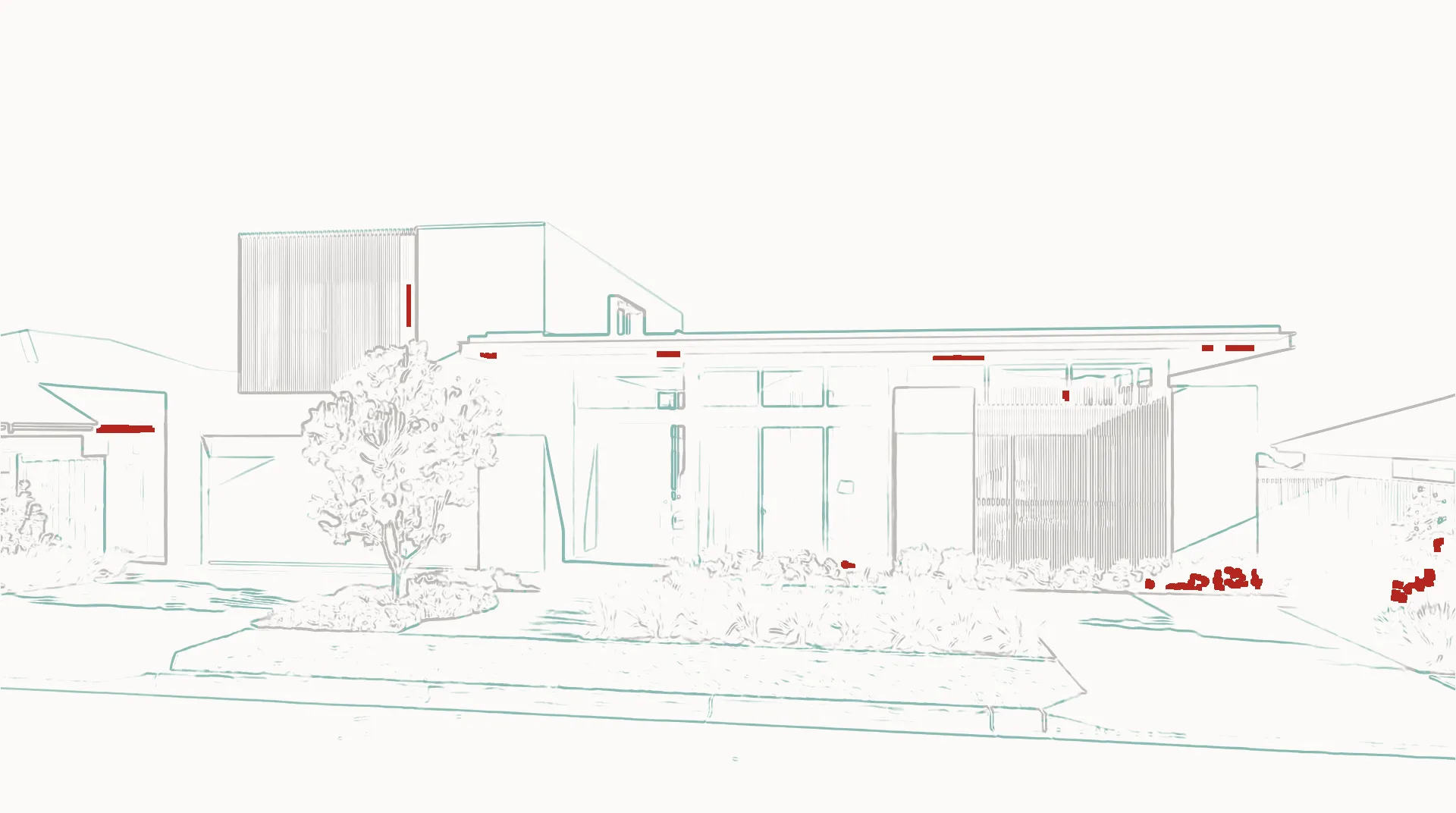
The finished frame's edges against your file. Grey is matched structure. Teal is what rendering is allowed to add — foliage, texture, light. Red is geometry lost or moved: red on a roofline and the image goes back. This one shipped.
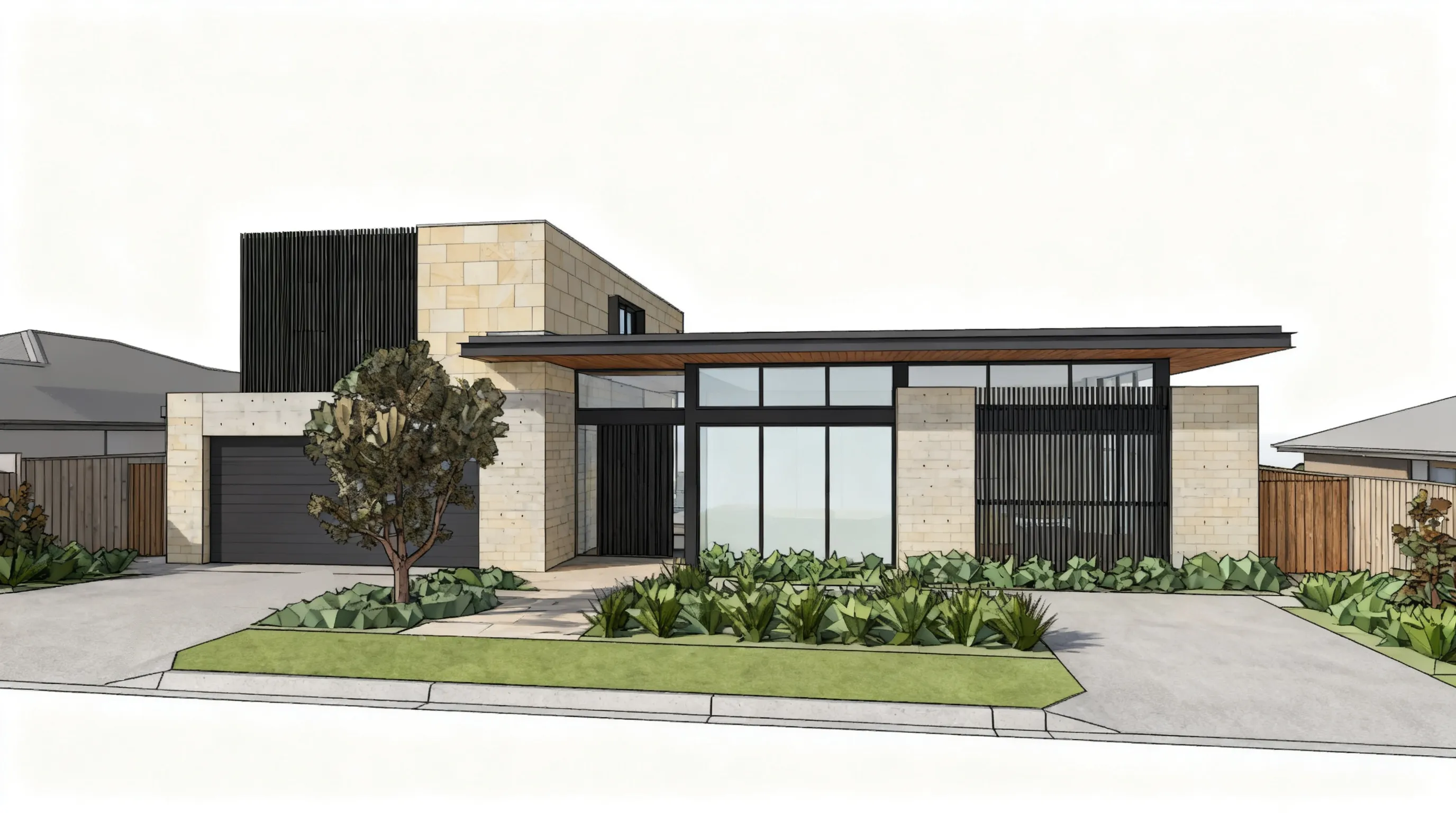
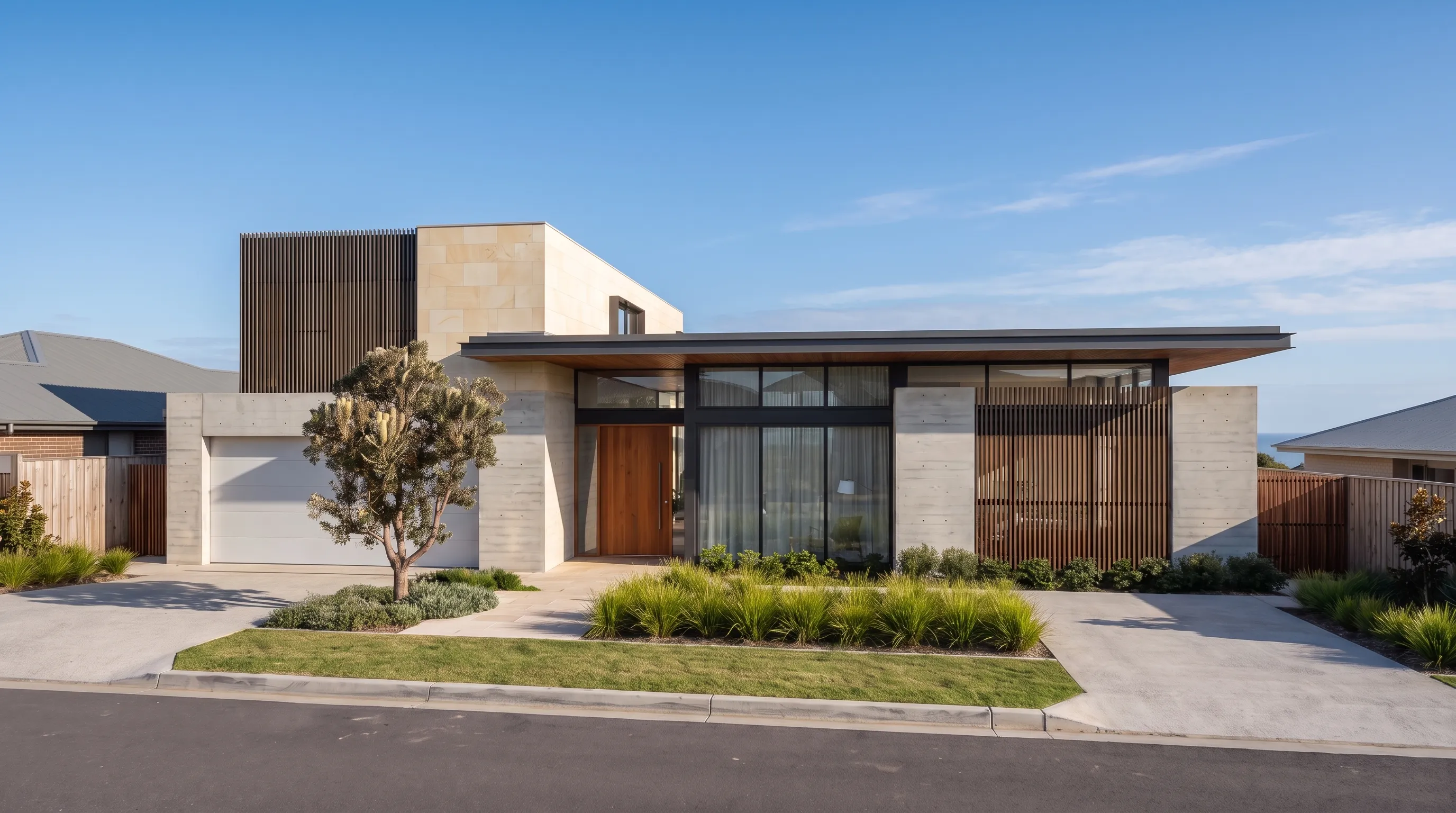
Banksia House as a fully specified SketchUp-style working model on the locked camera A: sandstone cladding, charcoal battens, dark garage door and spotted-gum soffit as textured materials, edge lines on every face, low-poly planting, white sky. The same home as the finished daylight render, pixel-aligned to the clay. The geometry check: the finished frame’s edges measured against the clay model, matched structure in grey, added foliage and texture in teal, the few red marks where nothing landed — 1.7% structural deviation, a pass.
The process
Finished renders, a SketchUp or IFC model, or a PDF of the plans, with a few lines on what it is for. That is the whole brief. There is no software on your side, ever.
What do you want, and what do you have. Ideas and options run from anything. A marketing set runs from a finished model or the renders you already have. You will know on the call, and the exact price and date come back the same day. Nothing starts until you say go.
We set the cameras, the light and the styling, and the pipeline does the heavy rendering.
Every render goes up against your geometry. If it does not match the file, it does not ship.
You mark up the proofs, we revise inside the pack, you sign off. Finals land at full resolution with print, portal and social crops. The images are yours outright.
FAQ
Design changes go to your architect or draftsperson, then the new file comes back to us. A change lands as one of your revision rounds. A real redesign is re-quoted straight, in the open.
We render geometry, we do not create it. Your architect or draftsperson owns the model, and they are better at it than we are. For ideas and options we work from whatever you have. For marketing images the model has to be finished, or the renders already made. If the model still needs building, it is generally best to update the model within the existing architectural pipeline.
Yes. What it does this year was science fiction two years ago. A person still directs every job and checks every image against your model. AI applied to your real geometry, never AI inventing a building.
Days, not weeks. Exploration sets are the quickest. Your quote has the delivery date on it before you commit to anything.
One round on Exploration. Two on Campaign, plus a proof you approve before finals.