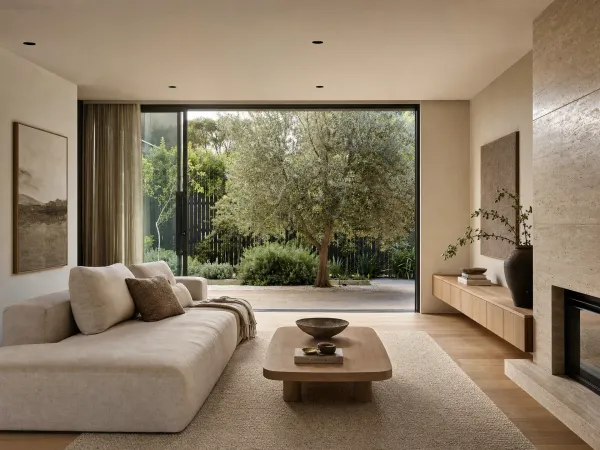
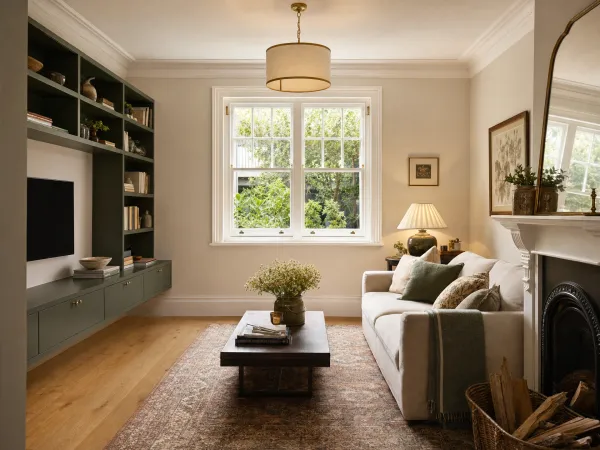
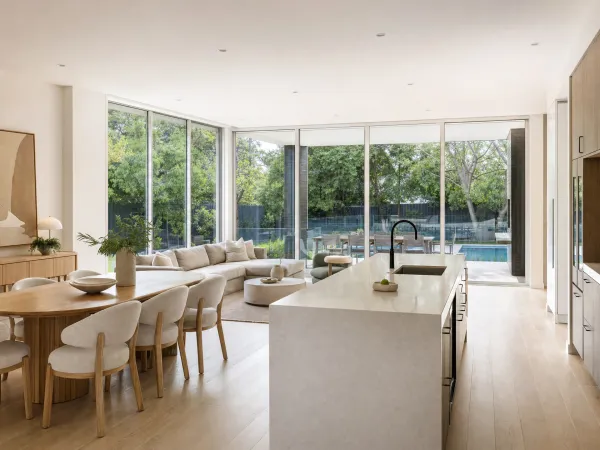
Contemporary interior design for Australian homes
What contemporary interior design actually means in 2026, why it keeps getting confused with modern, and how the Australian read of the style looks.
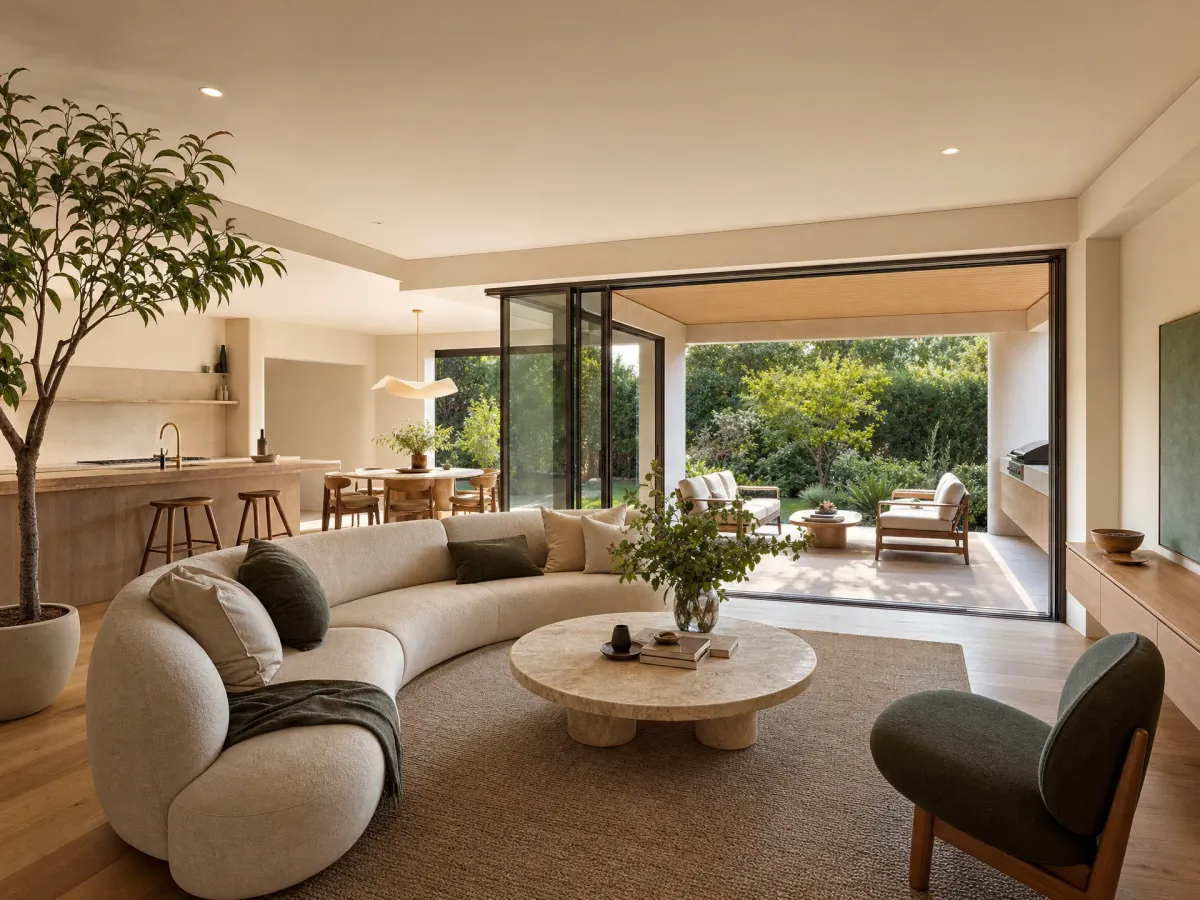
You ask a designer for a contemporary home and you both leave the meeting thinking you agree. Two weeks later, the moodboard arrives. The designer has sent you a calm, curved space in warm whites and clay with a sculptural travertine coffee table, a deep linen modular lounge and a single plant taller than a person. You had walked in picturing a Hollywood Hills box from the 1960s, all glass and steel and an Eames lounger in dark walnut. Neither of you is wrong. You are using the same word for two different things, and the word means whatever the speaker thinks current design looks like. That misunderstanding is the most common single source of friction in an Australian residential brief in 2026, and it is the reason “contemporary vs modern” is one of the most-searched interior design questions on the internet. Contemporary interior design is, by definition, the design of now. What “now” looks like in Australia in 2026 is the question this guide is here to answer.
It sits inside the broader interior design styles guide for Australian homes, where contemporary is the umbrella under which several of the other styles in this site’s library now sit, from warm minimalism to Scandi to the more recent organic modern direction. Mid-century modern, Hamptons, French Provincial, coastal, farmhouse and industrial are all defined styles with closed vocabularies that contemporary can borrow from, sit alongside, or pull pieces out of. Contemporary itself is the open conversation, and the rest of the styles are the chapters of the closed book it reads from.
What contemporary interior design actually is
Contemporary interior design is the prevailing residential aesthetic of the present moment. The definition is harder to pin down than every other style guide on this site because the answer changes every few years; the word “contemporary” refers to a moving target by design. The decorating reference 1stDibs puts it cleanly: “‘modern’ refers to a specific point in time, and what is considered modern will always be modern, while ‘contemporary’ refers to what’s happening now”. A contemporary house finished in 1994 and a contemporary house finished in 2026 will not look the same, because both rooms were designed to read as current at the time they were resolved, and current looked different in each case.
The principles that hold across every iteration of contemporary are not stylistic but structural. The interior reads as deliberately resolved rather than accumulated. The architecture is clean in its lines and considered in its proportions. The material list is edited, repeated and honest. Storage is planned in rather than added later. The styling layer is curated, not loaded. The colour palette is controlled. Negative space is used as part of the composition rather than treated as something to be filled. The room supports the actual life of the people in it. Every one of these holds across the contemporary work being published by leading Australian designers in 2026, just as it held across the contemporary work being published in 2014, in 2006 and in 1998, with each cycle adjusting only the surface inputs (colour, material, form, finish) to match the prevailing taste of the moment.
The surface inputs for the current moment are well-documented in the 2026 trend conversation. The Stylesmiths’ 2026 Australian interior design trends piece calls out a “shift toward homes that feel softer, warmer, and more human”, organic shapes and curves, layered tactility, biophilic elements, deeper jewel-toned accents and a move away from cool grey. Bellcourt Property Group’s 2026 Australia design overview frames the year around earthy colours, indigo as the standout accent, sustainable design as a baseline rather than a premium feature, and curved organic forms replacing sharp lines. King Living’s 2026 interior design trends list and Broadsheet’s panel of designers converge on the same picture: organic curves, warm earthy palettes, natural materials at scale, biophilic detail, indoor-outdoor integration and considered restraint. That convergence is what contemporary means in Australia in 2026.
Contemporary vs modern: the confusion that won’t go away
The terms get used interchangeably in real estate listings, in furniture retail copy and in casual conversation, and the cost of that interchangeability is real. A buyer briefed on a “modern” home arrives expecting either the 1960s glass-and-steel pavilion or whatever they last saw on Houzz, and the listing photo is neither. A homeowner asks for a “contemporary” kitchen and the cabinetmaker quotes a 1995 contemporary kitchen because that is what the word evoked at the start of his career. The two words do not in fact mean the same thing, and the difference is worth holding clearly because every other contemporary-vs-modern decision depends on it.
Modern is a defined historical movement. It runs from the Bauhaus and the International Style through the mid-twentieth-century furniture and architecture conversation (Le Corbusier, Mies van der Rohe, Frank Lloyd Wright, Saarinen, the Eameses, Wegner, Jacobsen) and broadly closes by the late 1970s when post-modernism overtakes it as the prevailing design conversation. Its vocabulary is closed: flat planes and rectilinear lines, an honest expression of structural materials (steel, glass, concrete, plywood, leather), a restricted palette built around primary colours and natural material tones, form-following-function as a design ethic, and an absence of ornament. The Australian arm of the movement was led most prominently by Robin Boyd, Harry Seidler and the Grounds-Romberg-Boyd partnership of the 1950s and 1960s, with houses now considered some of the foundational examples of Australian residential modern architecture. A mid-century modern room designed today and a mid-century modern room designed in 1956 read the same because the style is anchored to a fixed historical reference.
Contemporary is the present. It carries forward many of modern’s instincts (clean lines, edited palettes, honest materials, restraint) because the modern movement was a foundational influence on most of what followed, but it is not bound to the modern vocabulary. The 2026 Australian contemporary house often includes sculptural curves that no modern brief would have allowed, an organic material palette weighted toward microcement and clay and timber rather than concrete and steel, a colour direction built on warm earth tones rather than primary colours, an indoor-outdoor connection through walls of glass that modern architecture pioneered but contemporary has carried much further, and a biophilic instinct (plants, real timber, natural fibre) that the original mid-century movement treated as decoration rather than as a core design element.
The cleanest short answer is this: every mid-century modern interior is modern, but no mid-century modern interior is contemporary, because it refers to a closed historical period. A 2026 contemporary interior may take cues from modern (often does) but will not be a faithful modern interior, because faithfulness to a 1955 reference is the opposite of contemporary by definition. When you brief a designer with one of these words rather than the other, you are pointing at different libraries.
There is a parallel data point worth sitting with. The 2023 Houzz Australia Kitchen Trends Study found that Contemporary was the top style choice for renovated kitchens in Australia (24%), with Modern in second (23%) and the more period-defined styles (Hamptons, Coastal, Country) trailing well behind. Combined, Contemporary and Modern accounted for nearly half of all completed kitchen renovations in the study. That is a useful indicator of how Australian renovators actually think about their kitchens: they want something current and considered, the two largest categories are loose-enough labels that a renovator can self-select into either one, and the distinction between them is precisely what most briefs are unclear about.
- Contemporary24%
- Modern23%
- Hamptons11%
- Coastal7%
- Other styles35%
What contemporary looks like in Australia in 2026
The 2026 Australian read of contemporary is materially warmer, softer in palette and more tactile than the cycle that preceded it. The cool-grey-and-white aesthetic that dominated mainstream Australian residential design from roughly 2012 to 2020 has been replaced, in the work of most leading designers and across most leading trend publications, by a warmer reading built on earth tones, real timber at scale, honed stone, microcement, layered textiles in real fibres and a deliberate softening of furniture forms toward sculptural curves. Castlery Australia’s contemporary interior design guide summarises the current direction as “neutral backdrops, natural elements, sculptural curves and a balance of clean lines and softer organic shapes”, which is a fair single-sentence statement of where the conversation has landed.
The clearest single feature of the 2026 read is the move from sharp lines to organic curves in the furniture layer. Hudson Furniture’s 2026 trend report describes the year as “firmly in the era of the curve”, citing rounded sofas, arched mirrors, oval dining tables and kidney-shaped ottomans as defining pieces. Designer Furniture Gallery’s 2026 trends piece frames the curve moment as a deliberate softening of the rigid geometry that defined the previous cycle, with sculptural form positioned not as a styling moment but as the architecture of the room itself. A 2026 contemporary living room reads as curved before it reads as anything else: the lounge curves, the coffee table curves, the wall art frames the room with an arched mirror or a softly shaped piece, the lighting is sculptural rather than rectilinear. A 2018 contemporary living room, by contrast, was almost universally rectilinear; a 2008 contemporary living room was rectilinear and grey.
The second clearest feature is the material recalibration. Polished concrete has stepped back in favour of microcement, honed stone and limewash. Stark white walls have stepped back in favour of warm whites, oat, greige, sand and clay. Polished chrome has stepped back almost entirely in favour of matte black, brushed brass, gunmetal and aged nickel; on the higher-spec end, warm-aged solid brass is the most clearly identifiable 2026 choice. Gloss lacquer cabinetry has stepped back in favour of matte two-pack and timber veneer. Cool grey has been retired from most leading contemporary work in favour of palettes that lean either warm taupe and oat or muted sage, terracotta and dusty ochre. Manufactured surfaces have stepped back in favour of natural materials used at scale, with timber, real stone, clay tile and linen carrying most of the surface area.
The third clearest feature is biophilic detail at architectural scale rather than as a styling afterthought. Plants in the 2026 contemporary house are tall, structural and few, used as architectural elements (a single fiddle leaf, a single bird of paradise, a strap-leaf yucca) rather than as a scatter of small succulents on a styled shelf. Timber appears as a wide-plank floor, a hero piece of joinery or a feature ceiling, not as a small decorative accent. Real stone appears as a benchtop slab, a vanity top, a fireplace surround or a hearth, used in volumes substantial enough that the material carries the room.
Together these three features (the curve, the warm earth-toned palette, the biophilic instinct at scale) are the surface vocabulary of contemporary in 2026 in Australia. The underlying principles (restraint, edit, considered material list, planned storage) are the same as in any cycle; the inputs have changed.
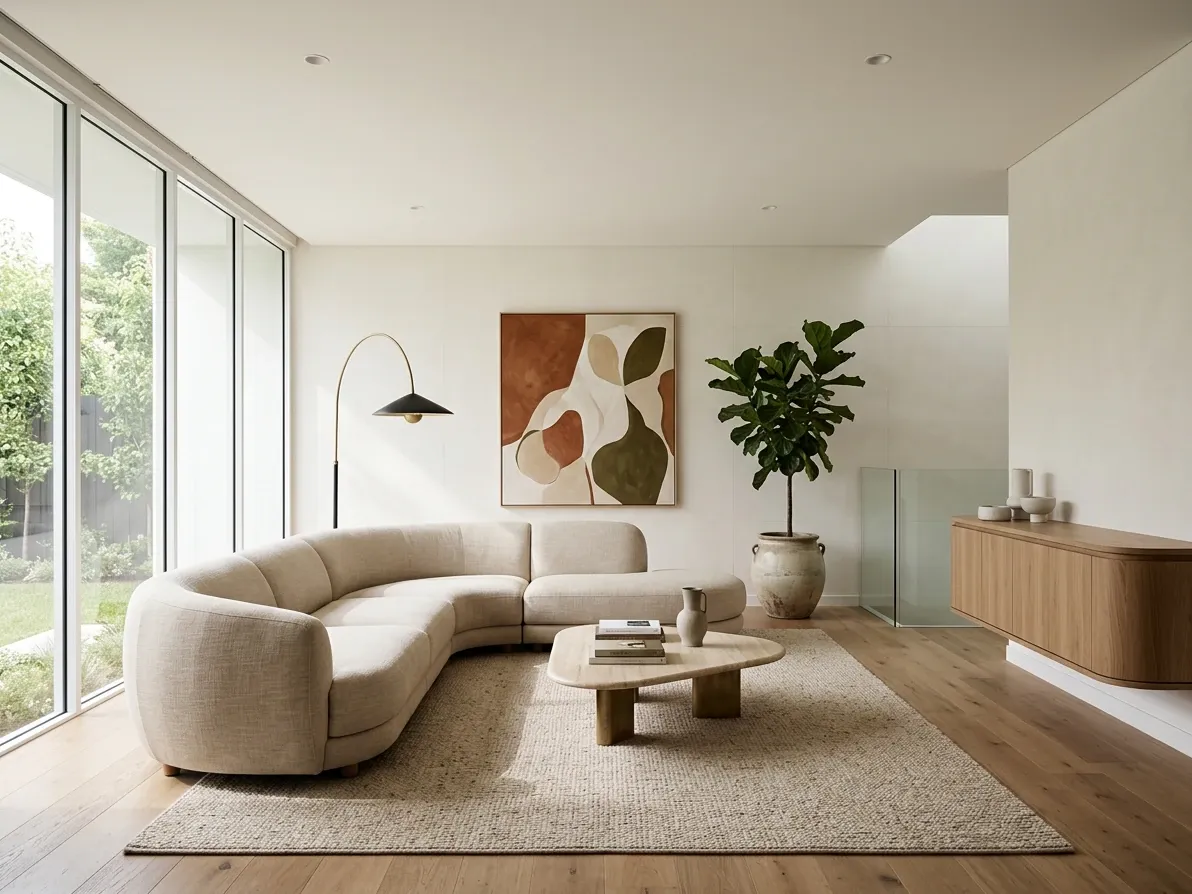
Curved modular lounges anchor the 2026 contemporary living room.
The Australian filter: climate, light and indoor-outdoor life
Imported contemporary content was, until quite recently, written primarily for the northern hemisphere, and a fair amount of it still is. The reference projects in the major design publications often come from cool-climate cities (New York, London, Copenhagen, Berlin), and the colour palettes, lighting choices and material specifications are tuned for that light and that temperature range. Australian light is brighter, warmer-toned and more abundant for most of the year across most of the country; the result of pasting a Stockholm contemporary palette into a Brisbane home is glare and flatness rather than the soft luminous quality the source palette delivers in its native context. The 2026 Australian read of contemporary is partly a deliberate correction of this transplant problem.
Three climate-and-lifestyle filters reshape the international contemporary template for an Australian context. The first is the light. The bias toward warm-toned earthy neutrals over cool greys is partly aesthetic and partly practical: warm neutrals work with the Australian sun rather than against it, and they hold their tone through the day as the light shifts from cool morning blue through warm midday gold to warm evening orange. Pure white and pure grey, by contrast, shift visibly with the light and tend to read as either yellow or harsh depending on the time of day, which is one of the reasons the cool-palette decade now reads as dated in Australian rooms more quickly than it does in northern-hemisphere ones.
The second is the temperature range. Hard, polished, light-coloured surfaces have low thermal mass and amplify the climate they sit in: cold underfoot for half the year in Melbourne or Hobart, hot to the touch through the day in Brisbane or Perth. The 2026 contemporary preference for honed stone, microcement, clay tile, limewash and real timber is partly a thermal calibration: these materials hold and release heat more gracefully, feel comfortable against bare feet in both seasons, and weather the temperature swings without reading as cold or as hot.
The third is the cultural fit. Australian residential life is more relaxed, more indoor-outdoor-oriented and more centred on casual social hospitality than the cultures most international contemporary reference work comes from. A formal hard-edged contemporary living room reads as a hotel lobby in an Australian context rather than as a home; a contemporary kitchen that does not connect to an outdoor entertaining space reads as a compromise rather than as a finished design. The architectural pattern most strongly associated with Australian contemporary in 2026 is the open-plan kitchen-dining-living volume that flows to a covered alfresco through wide stacking glass doors, with continuous flooring across the threshold and the same material language carrying from inside to outside. This is the pattern that most leading 2026 contemporary Australian house projects are built around, and it is the single most identifiable feature of the Australian read.
The deeper architectural heritage matters here too. The Australian vernacular tradition (the Queenslander, the deep-verandah Federation house, the long thin Sydney terrace with its rear courtyard, the West Australian cottage with its passive cooling) was already organised around climate and indoor-outdoor life long before the modern movement arrived. The 2026 contemporary Australian house is, in many ways, the most current expression of an instinct that has been in Australian residential design for more than a century: design for the climate you actually have, connect to the outdoors, work with the light. Contemporary is the present-day vocabulary; the underlying instinct is older.
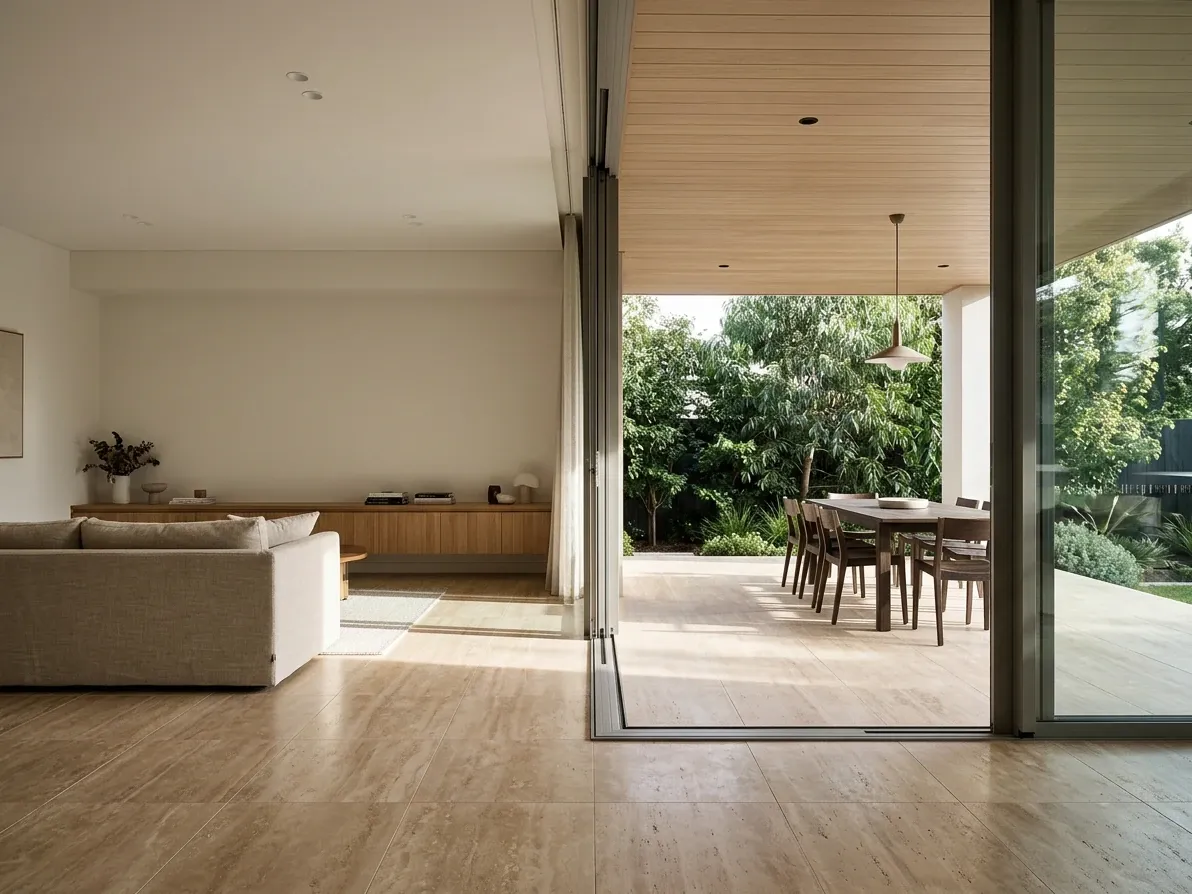
Continuous flooring across the threshold reads as one living volume.
The 2026 contemporary palette and material list
A working contemporary brief in 2026 Australia draws from a short, controlled material and colour list. Pulling more than the working ranges below produces a room that reads as overworked rather than as composed.
The base palette runs warm white, oat or greige, a deeper warm neutral (mushroom, putty, soft taupe), a hero mid-tone timber (oak, blackbutt, spotted gum, walnut), and one tonal accent drawn from the Australian landscape (muted sage, terracotta, dusty ochre, deep indigo, charcoal). Five hues across the whole room, repeated through every space of the house. Cool grey is largely absent. Pure stark white is used sparingly and almost always tuned to a warm white when it does appear.
The hard material list runs one or two stones (honed travertine, honed limestone, honed marble, sintered stone in a stone-look colourway), one or two timbers (mid-tone oak for the joinery, a deeper walnut or a lighter blackbutt as a contrast or accent), one or two surface finishes (microcement, limewash, hand-trowelled plaster) where a feature wall is wanted, one metal finish for tapware (matte black, brushed brass, gunmetal, aged nickel) and one metal finish for cabinetry hardware (the same metal as the tapware in most rooms; a contrasting metal only where the design specifically calls for it).
The soft material list runs real natural fibres throughout: Belgian linen for curtains, slubbed-linen or bouclé for upholstery, wool or jute for rugs at scale, leather as a furniture accent rather than as a hero surface. Manufactured velvet, manufactured leather and high-sheen polyester upholstery all read as dated in a 2026 contemporary scheme; they were standard inputs five years ago and are now noticeable for their absence.
The lighting list runs three layers. Ambient (recessed downlights or a flush ceiling fixture, specified at 2,700 to 3,000K, on a dimmer). Task (under-cabinet, vanity wall sconces, reading lights, bedside lights). Feature (a single sculptural pendant over the dining table or the kitchen island, a piece of art lit, an architectural detail washed). Warm-white globes throughout, dimmers throughout, no single overhead cool-white downlight grid anywhere.
The styling layer is light and considered: a small number of hero pieces with weight and intention, an architectural-scale plant or two, a piece of art with presence, a single statement light. The 2026 contemporary scheme leaves more surface empty than the cycle before it did. The instinct to fill every horizontal surface with a vignette is the most reliable single tell of a contemporary scheme that has been styled by someone reading from a 2015 reference rather than from the current conversation.
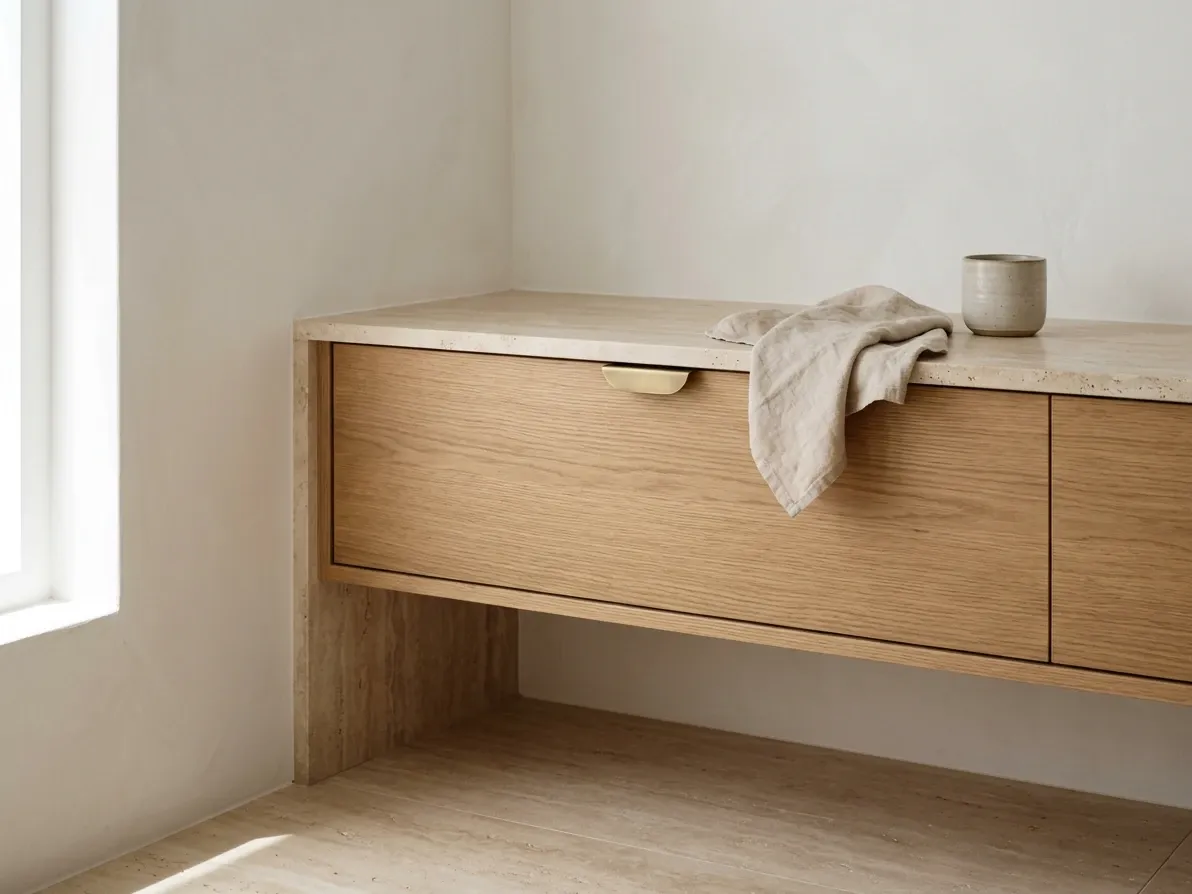
Five hues, two timbers, one stone, one metal. Repeated everywhere.
The contemporary kitchen
The 2026 contemporary kitchen is the most consequential design decision in the house, and the room where the style is most clearly expressed. The architecture is open-plan but zoned, with the kitchen folded into a single volume with dining and living, and with the bench acting as the pivot between cooking and the rest of the room. The island is the structural anchor and increasingly the social anchor: long, bench-height, sometimes shaped with a softly curved edge or a fully rounded waterfall return rather than the squared waterfall edge that defined the previous cycle. Galley Kitchens’ 2026 contemporary feature breakdown calls out curved island benches as one of the five most-requested features in their current briefs, a meaningful shift in a renovation segment that was almost universally rectilinear five years ago.
The cabinetry runs handleless, finger-pull, or with a slim recessed metal pull in the same finish as the tapware. Two-pack matte is the dominant finish at the upper end; melamine or thermofoil in a comparable warm neutral carries the look down into the mid-range. Full-height pantry, integrated fridge and dishwasher, and a tall appliance cabinet for coffee machine, toaster and small appliances are the joinery moves that allow the bench top to stay clear. A clear bench is the single most important visual move in a contemporary kitchen; without it the look collapses regardless of the finish quality.
The benchtop is a single quiet stone, almost always honed rather than polished, in a warm neutral or a soft stone-look colourway (warm white travertine, honed Calacatta, a quiet sintered stone in a travertine or limestone tone). Slab-edge stone (a thicker visible bench edge, 40mm or 60mm) reads as the most current 2026 choice; the 20mm bench with a mitred waterfall continues to ship in volume and is the safer middle-range choice. The splashback is large-format porcelain, a slab in the same stone as the benchtop, or a tactile microcement, in the same warm neutral as the joinery rather than as a contrasting feature.
The tapware is a single coherent metal finish (matte black, gunmetal, brushed brass, aged nickel). The mixer is wall-mounted or a tall pull-out goose-neck rather than the chunkier squared mixers of the previous cycle. Lighting is layered: a sculptural pendant or trio of pendants over the island, recessed warm-white downlights for ambient, under-cabinet strip for task. For the deep read on kitchen styles specifically, see our kitchen styles guide for Australian homes.
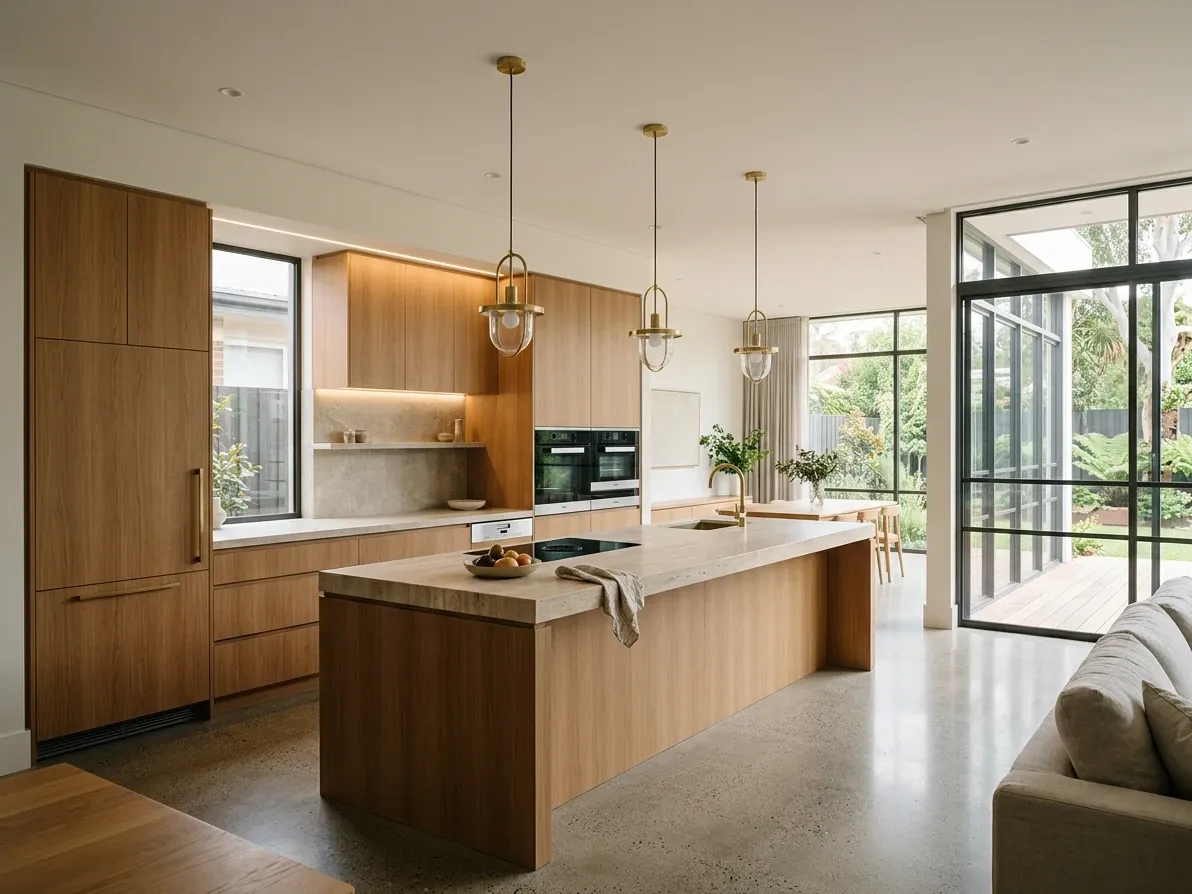
Clear bench, full-height pantry, integrated appliances, single metal finish.
The contemporary bathroom
The contemporary bathroom is where the warm-and-tactile turn is most visible. The 2026 Australian read pulls away from the all-white-and-chrome aesthetic that dominated the previous cycle toward a darker, warmer, more atmospheric room. Banana Bathrooms’ 2026 Australian bathroom trends report and The Blue Space’s 2026 bathroom trends piece both describe the year in language of “calm”, “intentional”, “quietly luxurious” and “tactile”, with greige, terracotta, olive, champagne, bronze and moody charcoal called out as the leading palette directions.
The shell runs large-format porcelain on the floor and wet wall (typically 600x1200mm in standard projects, 1200x2400mm in higher-spec) in a honed stone-look finish, with a wall-hung drawer vanity in a flat-panel finish, a recessed mirrored shaving cabinet, a wall-hung toilet on a concealed cistern, and a frameless or thin-frame walk-in shower screen behind a low hob or a flush waste channel. A single feature surface is allowed and often expected: a hand-trowelled microcement wall, a fluted glass shower divider, a single honed stone slab on the vanity, a kit-kat mosaic feature niche.
The tapware is a single coherent metal finish, matched across every tap, mixer, towel rail, robe hook, shower rail and waste in the room. Polished chrome has effectively been retired from leading contemporary bathroom work in 2026; matte black, brushed brass, gunmetal and aged nickel carry almost the full range of current specifications. Layered warm lighting at vanity height (wall sconces, a backlit mirror) supplemented by recessed warm-white ambient and a low-level kickboard strip is the standard lighting move. For deeper coverage on a contemporary read of the bathroom, see our modern bathroom design guide, which sits at the more architecturally restrained end of the same conversation.
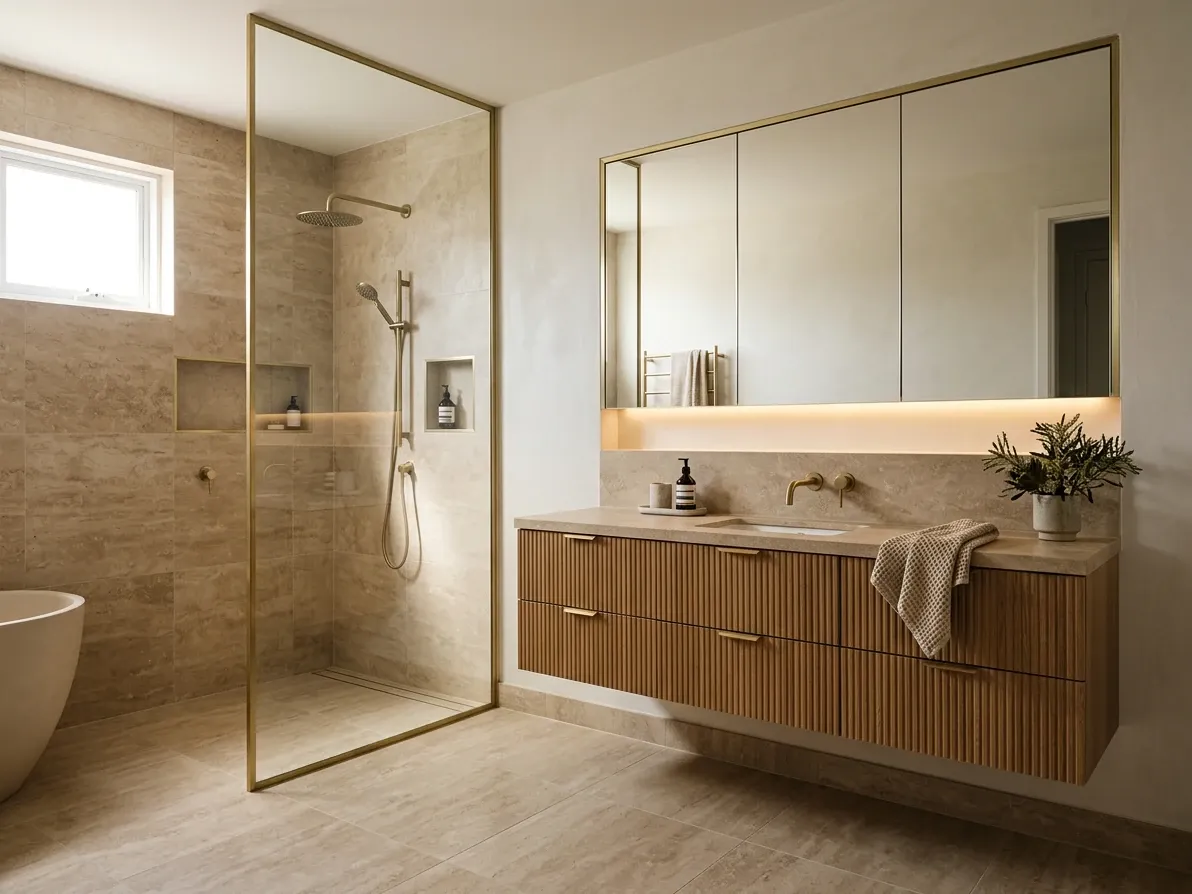
Warm, tactile, layered light, one coherent metal finish.
The contemporary living room
The contemporary living room in 2026 is where the curve sits most visibly. The anchor piece is almost always a sculptural curved sofa or a modular lounge in slubbed linen, bouclé or a warm-toned natural-fibre upholstery; the rectilinear three-seater plus two-armchair arrangement that dominated the previous cycle is now read as dated. Our Furniture Warehouse’s 2026 modular lounge piece describes the modular curved lounge as the dominant Australian living-room move of the year, with families increasingly favouring deep, low, configurable seating over conventional sofa-and-chair sets.
The coffee table is sculptural, often rounded, often in travertine or honed stone, sometimes in solid timber with a live edge or a softly rounded form. The rug is oversized and natural-fibre (jute, wool, sisal) in a warm neutral, sized large enough that the front legs of every piece of seating sit on it. The lighting carries a hero sculptural floor lamp or a feature pendant in the corner, supplemented by warm-white task lighting at reading positions. The wall art is large in scale, often a single hero piece, in muted earth tones or in a quiet abstract; gallery walls of small framed prints belong to the previous cycle. The styling layer is light: a single architectural plant, a stack of two or three art books, a small piece of ceramic on the coffee table.
The media is integrated rather than featured: the TV is mounted on a recessed niche or hidden behind a panel of joinery rather than positioned as the room’s anchor. The fireplace, where the room has one, is often the visual anchor instead, in honed stone, a single rendered surround or a tall vertical slot.
The contemporary bedroom
The contemporary bedroom reads as a quieter room than every other space in the house, which is the point. The architecture runs a single accent wall (often in limewash, microcement or a deeper warm tonal paint) behind the bedhead, full-height built-in wardrobes with handleless or finger-pull doors in a warm neutral finish, wide-plank timber flooring with a wool or natural-fibre rug under the bed, and a layered curtain pad of sheer Belgian linen behind a heavier linen drape.
The bed is the anchor: a low platform frame in a softly rounded timber, an upholstered bedhead in slubbed linen or bouclé, layered linen bedding in oat, white and a single tonal accent. Bedside lighting is via wall sconces or pendants suspended at bedside height (which clears the surface of the bedside table); the bedside surface carries a single book, a small ceramic, and almost nothing else. The lighting is warm-white throughout, dimmable, with a single feature pendant over the bed and ambient warm light from wall-mounted fixtures. For broader bedroom direction, see our bedroom design and decoration guide.
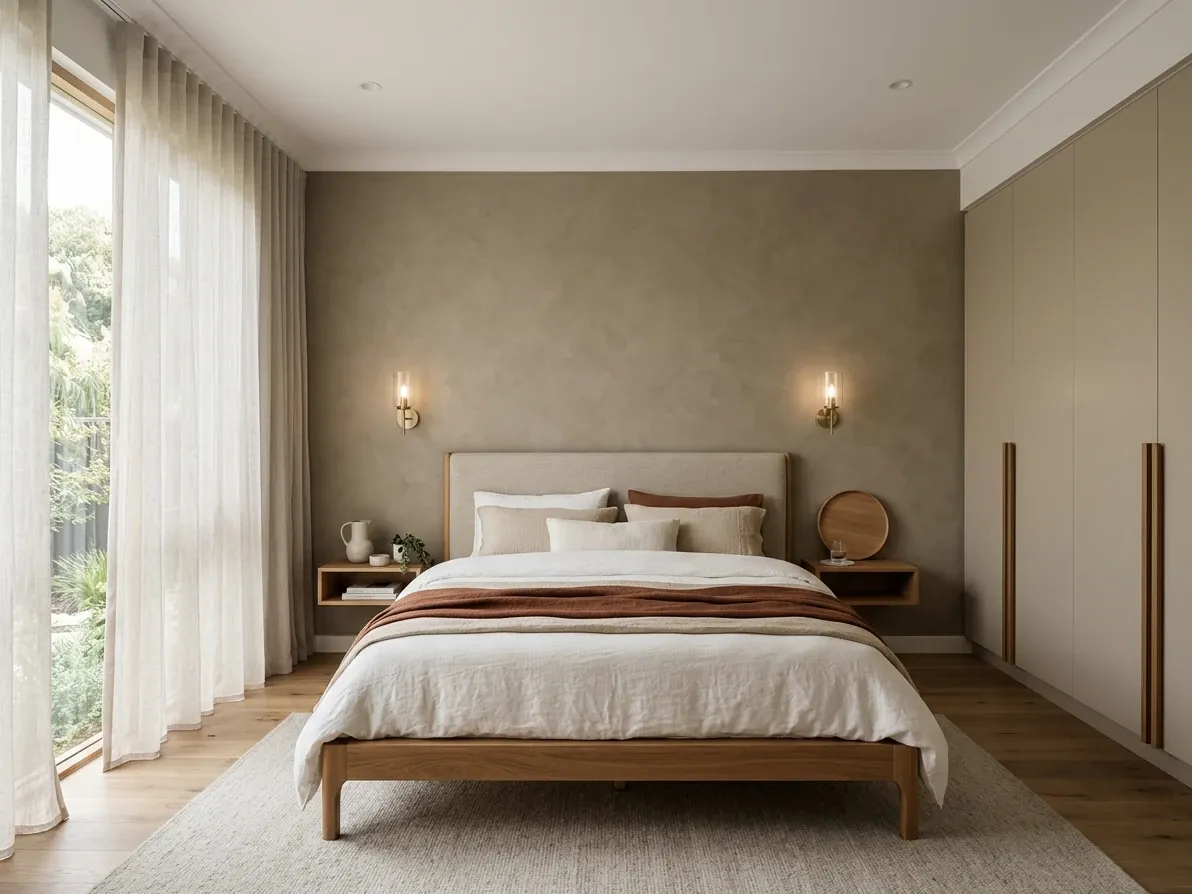
A quieter room: tonal wall, low bed, layered linen.
Indoor-outdoor connection done right
The indoor-outdoor connection is so central to the 2026 Australian contemporary house that it almost reads as a separate room. The pattern is consistent: a long wide opening from the kitchen-dining-living volume to a covered alfresco, through wide-stile stacking glass doors or a full sliding-door run; continuous flooring across the threshold (often a single large-format porcelain or a continuous timber where the joinery can carry it); a covered outdoor ceiling that reads as architecturally continuous with the indoor ceiling; outdoor furniture in matching tonal warmth (timber dining tables, slubbed-linen outdoor lounges, oversized natural-fibre outdoor rugs); and planting at architectural scale around the perimeter of the outdoor room. Done well, the two volumes read as a single 14-metre living space rather than as an indoor room with a separate patio. The architectural move, the furniture move, the material continuity and the planting all need to be in place for the connection to actually work. For deeper coverage on the connected outdoor cooking space, see our outdoor and alfresco kitchen guide.
What it costs to do contemporary well in Australia
Contemporary as a style does not have a single price tag. The look spans from achievable mid-range renovation to high-spec custom architectural work, and most of the price variation comes down to specification rather than to style. A flat-panel handleless melamine kitchen and a flat-panel handleless two-pack kitchen can read as visually identical at first glance; the budget difference between them is significant and entirely about material and finish quality rather than about design intent.
The realistic working ranges in 2026 Australia, for a contemporary specification, are in the same envelope as any other comparably specified renovation. A median Australian kitchen renovation sits between $30,000 and $35,000 according to Housing Industry Association figures, and a contemporary kitchen inside that envelope (flat-panel cabinetry in melamine or thermofoil, single bench finish in a stone-look sintered stone, integrated dishwasher, coherent matte tapware, large-format porcelain splashback) is straightforward to specify. Moving up to two-pack handleless cabinetry, a slab-edge stone benchtop, a full-height pantry, an integrated fridge and a custom curved island typically lands a premium contemporary kitchen between $40,000 and $80,000, with the higher end accounting for solid timber feature joinery, custom curved profiles or specialist hardware.
A median Australian bathroom renovation sits around $26,000 according to HIA figures, with the range running from $8,000 at the simple-makeover end up to $35,000 or more for a full strip-and-rebuild. A contemporary bathroom inside the mainstream range (large-format porcelain, drawer vanity in melamine, single coherent metal finish, layered lighting, frameless shower screen) is achievable; a higher-spec contemporary bathroom (microcement walls, honed stone vanity slab, wall-hung toilet on a concealed cistern, brushed brass tapware, custom recessed niches) commonly lands between $35,000 and $60,000.
The single most important budget rule for a contemporary renovation is the same as for any considered design: put the money where it is permanent and the room cannot be cheaply rebuilt later (architecture, plumbing layout, full-height joinery, stone, tile) and pull the budget back where it is cheap to change later (paint, hardware, soft furnishings, light fittings). Contemporary as a style rewards this discipline more than most because the look is so dependent on architectural cleanliness; a beautifully resolved shell will carry a softer specification on the styling layer, where the reverse is rarely true.
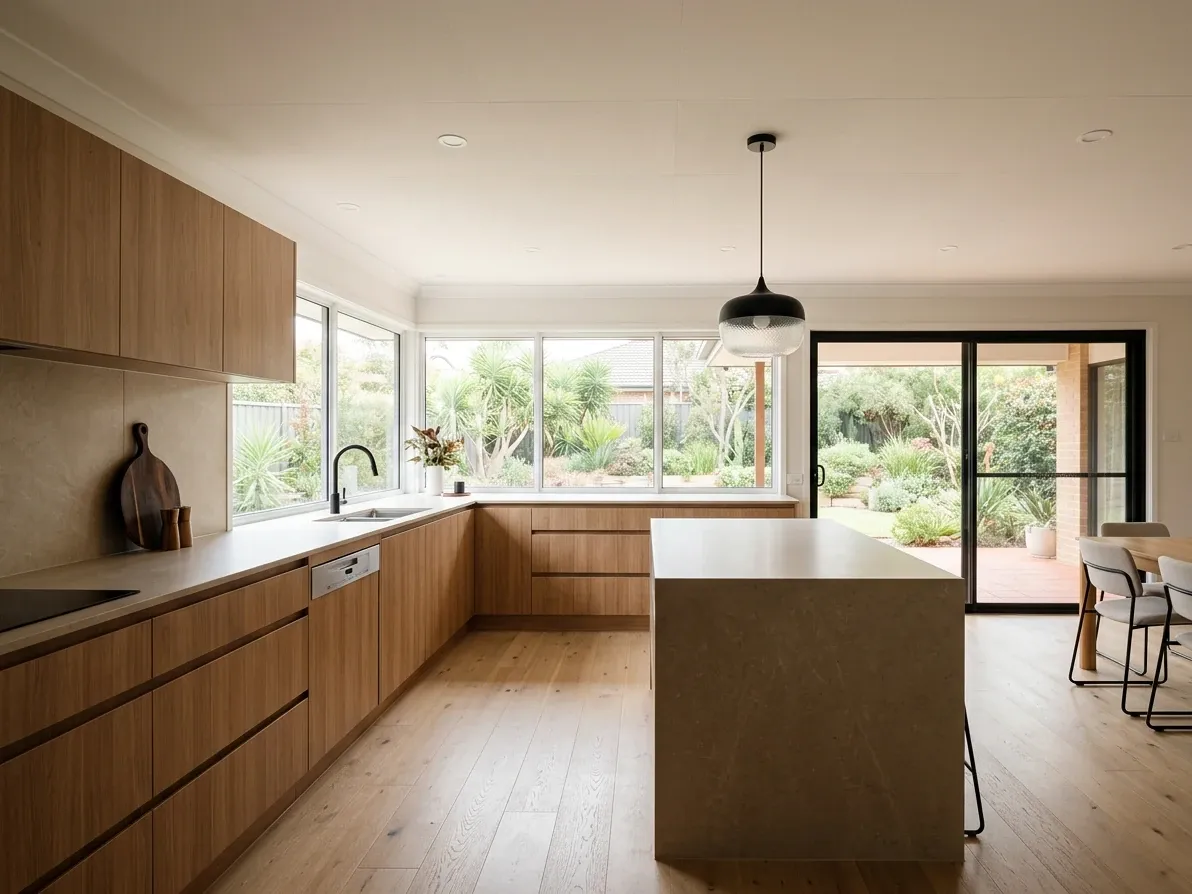
A mid-range contemporary kitchen, the realistic median-budget outcome.
Where contemporary sits next to its neighbours
The closer the neighbour, the more useful the comparison. Contemporary lives next door to a small number of related directions, and being clear about the differences is the most reliable way to brief a designer without ending up with the wrong thing.
Contemporary and modern (covered above) are the most confused pair. Modern is a closed historical movement; contemporary is the current moment. The visual overlap is real, but the two words refer to different libraries.
Contemporary and minimalism share most of their DNA, especially around restraint and edited material lists, but minimalism is a discipline (the rule about editing and concealing) that can be applied to almost any aesthetic, while contemporary is the broader current style of which minimalism is the strictest read. The 2026 Australian contemporary read borrows directly from the warm-minimalist conversation and the two often look visually similar, but contemporary admits a slightly denser, more layered, more materially-warm room than a strict minimalist brief would allow. For the deeper read on the discipline, see the minimalist Australian homes guide.
Contemporary and organic modern are now almost the same conversation in the Australian context. Organic modern (sometimes called modern organic) is the name the furniture-and-retail world has given to the 2026 contemporary read specifically when it leans hard into curves, warm earth tones and natural materials. Castlery Australia’s organic modern guide and King Living’s organic modernism piece both describe a style indistinguishable from the warm 2026 contemporary mainstream. Treat them as overlapping rather than as distinct; if a designer briefs you on organic modern in 2026, they almost certainly mean contemporary as practised in the current style cycle.
Contemporary and transitional sit close, with transitional being the most commonly briefed style for renovators who want something that bridges traditional and contemporary (panelled Shaker cabinetry, restrained colour, neutral stone, traditional architectural detailing softened to a calmer voice). The 2025 Houzz U.S. Kitchen Trends Study found transitional to be the dominant U.S. kitchen renovation style. In Australia, the same instinct has historically been folded into Hamptons or French Provincial rather than published as a distinct transitional category, but the underlying brief (bridging traditional and contemporary) is increasingly being explicitly called out by Australian designers in 2026.
Contemporary and Scandi share an emphasis on edited palettes and natural materials but Scandi is a regional Nordic application of the principle with its own closed vocabulary (pale woods, bright whites, mid-century furniture references, hygge-driven textile warmth). A 2026 Australian contemporary scheme can read as quite Scandi-adjacent when it leans toward oak and warm white, but contemporary is broader and admits a wider range of accent colours, palette directions and material weights than a strict Scandi brief allows. See the Scandi home design guide for the closer read.
Contemporary and mid-century modern share furniture references rather than a brief. A 2026 contemporary scheme often borrows individual mid-century pieces (an Eames lounger, a Saarinen tulip table, a Wegner chair, a Nakashima-style live-edge timber slab) as styling moments, but a fully mid-century-modern interior is a deliberate period piece rather than a contemporary one. The two coexist on the same site but answer different questions. See the mid-century modern Australian guide for the period style read.
How to brief a contemporary renovation without losing the look
The most common single failure mode for a contemporary brief is the one this guide opened with: two people using the word and meaning different things, leading to a moodboard misalignment that surfaces three weeks into design development. The fix is to brief the inputs, not the label.
Brief the palette in five hues, not the word “contemporary”. A warm white, a deeper warm neutral, a hero timber tone, a single tapware metal, a single tonal accent: pin these down at the outset and the room cannot drift far. Brief the material list in the same way: the stone, the timber, the surface finish, the hardware metal. Brief the lighting in three layers: ambient, task, feature, with warm-white globes and dimmers as defaults. Brief the soft layer in fibre: linen, wool, bouclé, natural fibre, leather as accent. Brief the styling philosophy in scale: a small number of large pieces with intention, not an accumulation of small ones.
Reference projects do most of the heavy lifting in a contemporary brief because the style is so visually variable. Three to six reference images, chosen from current Australian sources rather than from a Pinterest folder that has been accumulating for five years, will communicate more in a single moodboard than a thousand words of written brief. The current sources that read most directly as 2026 Australian contemporary are the design pages of Belle, Est Living, The Local Project and Habitus Living for the architecturally-resolved end, and the project galleries of leading Australian contemporary residential architects for the higher-spec end. Avoid older U.S.-centred Pinterest content as a primary reference; it skews the brief toward palettes and material moves that read as cool and dated in an Australian context.
A 3D rendering or photoreal visualisation of the proposed scheme is the single most useful tool for catching a misalignment before construction starts. Contemporary as a style is unforgiving of small inputs being wrong (a tapware finish that reads cooler than expected, a benchtop colour that pulls more yellow than the sample suggested, a cabinetry tone that fights with the timber floor), and the cost of catching these in visualisation is a fraction of the cost of catching them in the finished room. We do this kind of design visualisation for renovators, designers and builders across Australia: an AI visualisation of the proposed scheme shows the kitchen, bathroom or living room as it will actually read with the proposed palette and material list, in the actual room dimensions, before the cabinetmaker quotes from the wrong colour or the tile order goes to the wrong finish.
Frequently asked questions
What is contemporary interior design in simple terms?
Contemporary interior design is the style of right now. It is not a fixed historical movement with a locked vocabulary; it is the current consensus across leading designers, architects and interiors media about what a well-resolved residential interior looks like at the moment you are reading the definition. In 2026 in Australia, the consensus reads as restrained but warm: clean architectural lines, an edited material palette with a strong bias toward natural timbers, honed stone and tactile textiles, a softer colour palette built on warm whites, oat, clay and muted greens rather than the cool greys of the previous decade, sculptural curves in the furniture layer, layered warm lighting, and an integrated indoor-outdoor connection. The style will read differently in 2030, which is exactly the point. Contemporary is a moving target by definition. Modern is a specific historical movement that does not move; contemporary is the present, and the present keeps shifting.
What is the difference between contemporary and modern interior design?
Modern refers to a specific historical design movement that ran from roughly the 1920s to the late 1970s, rooted in the Bauhaus, the International Style and mid-twentieth-century architecture (Le Corbusier, Mies van der Rohe, Eames, Saarinen, Wegner). It has a defined vocabulary: clean rectilinear lines, flat planes, an honest use of materials (steel, glass, concrete, plywood, leather), a restricted colour palette and an emphasis on form following function. That vocabulary is closed; a mid-century modern room in 2026 looks the way it looked in 1956 because the style refers to a particular period and stays anchored there. Contemporary, by contrast, refers to whatever is current. In 2026 in Australia, contemporary leans on much of what modern established (clean lines, edited palette, an honest material approach) but also on things modern did not have a vocabulary for (sculptural curves, warm earth-toned palettes, microcement, the indoor-outdoor lifestyle, sustainability and energy performance as a design driver, biophilic plants and timber at scale). The clean way to think about it: modern is one stable historical chapter, contemporary is the open chapter being written now. The two often visually overlap, which is why they get confused, but the underlying definition is different in kind, not just degree.
Is contemporary interior design the same as minimalism?
No, although they share a lot of DNA. Minimalism is a discipline: edit the room down to what genuinely earns its place, hide the storage, keep the palette and material list short and repeated, treat negative space as part of the design. It is a method that can be applied to almost any aesthetic. Contemporary is a moment in style: what good residential design looks like right now. The 2026 Australian read of contemporary borrows heavily from minimalism’s discipline, especially around restraint, edited palettes and concealed storage, which is why a well-designed contemporary room and a well-designed warm-minimalist room can look almost identical in photographs. The honest answer is that the two are closely related cousins rather than separate species. If you want a single mental model: minimalism is the rule about restraint; contemporary is the current execution of a lot of rules at once, of which restraint is one. A contemporary room can be denser and more layered than a minimalist one would allow, and it admits some pieces (a sculptural curved sofa, a hero piece of art, a textural rug) that a strict minimalist read might call too much. For the deep read on the discipline, see our Minimalist Australian homes guide.
What colours work for contemporary interiors in Australia in 2026?
The dominant 2026 Australian contemporary palette has moved decisively away from the cool grey-and-white of the previous decade toward warmer, more earth-toned neutrals. The current consensus across leading Australian interior publications is built on warm whites, oat, sand, greige and clay-toned neutrals as the base; mid-tone natural timbers (oak, blackbutt, spotted gum, walnut) as the structural warmth; and tonal accents drawn from the Australian landscape (muted sage, eucalypt green, terracotta, dusty ochre, deep indigo, charcoal). The Stylesmiths’ 2026 interiors trends report and Bellcourt Property Group’s 2026 Australia design overview both describe a year defined by “warm, earthy palettes, biophilic elements and tactile materials” rather than the cool, grey-toned restraint that defined 2014 to 2020. Stark pure white has not been abandoned but it has receded; when it appears in a 2026 contemporary scheme it is usually a warm white with a hint of yellow or pink in the base, never the blue-white that read as clinical in the previous cycle. Colour drenching (saturating a whole room in tonal variants of a single colour) is the bolder edge of the conversation but the more conservative end remains a five-hue palette: a warm white, a deeper warm neutral, a hero timber tone, a single metal finish, and one quiet tonal accent.
Does contemporary interior design feel cold?
It can, when it is executed badly or when the brief is taken from imported reference material without translation. Cold contemporary is almost always the result of the same handful of failures: a pure-white-and-grey palette tuned for northern-hemisphere winter light, a hard surface bias (polished concrete, polished tile, gloss lacquer, glass), an absence of soft layers (no curtains, a flat rug or no rug, a single leather sofa), a single overhead downlight grid in cool white (4,000K or above), no real timber and no real plants at architectural scale. The 2026 Australian read of contemporary directly addresses this failure. Warmer earth-toned neutrals replace cool greys, microcement and honed stone replace polished concrete and polished tile, real timber and tactile fabrics carry the soft layer, lighting is layered and warm (2,700 to 3,000K on dimmers), and biophilic elements (full-size plants, timber at scale, real stone) put life back in the room. A 2026 contemporary Australian living room done well is one of the calmest, warmest and most genuinely liveable directions available.
How much does a contemporary kitchen or bathroom renovation cost in Australia?
Contemporary as a style does not have a fixed price tag because the look ranges from achievable mid-range to high-spec custom, but the median budget for a contemporary renovation tends to land toward the upper end of the mainstream range because the discipline rewards better materials, integrated appliances and built-in joinery. According to the Housing Industry Association, the median Australian kitchen renovation in 2025 sat between $30,000 and $35,000, and a contemporary kitchen specified honestly inside that envelope (flat-panel cabinetry in melamine or thermofoil, a single bench finish, integrated dishwasher, coherent matte tapware, large-format splashback) is achievable. A premium contemporary kitchen (handleless two-pack cabinetry, full-height pantry, integrated fridge, slab-edge stone benchtop, custom curved island) commonly lands between $40,000 and $80,000. The HIA puts the average Australian bathroom renovation at around $26,000, with a range from $8,000 to $35,000 or more. A contemporary bathroom inside the mainstream range (large-format porcelain, drawer vanity in melamine, single coherent metal finish, layered lighting) is straightforward; a higher-spec contemporary bathroom (microcement walls, honed stone vanity slab, brushed brass tapware, custom niches) commonly lands between $35,000 and $60,000.
Will contemporary interior design date quickly?
Some parts of it will, some will not, and the parts that date fast are predictable. The architectural shell of a well-resolved contemporary home (good light, sensible plan, full-height joinery, large-format flooring in a quiet stone-look porcelain or warm timber, neutral wall finish) is essentially evergreen because it is not trend-driven. The cabinetry and stone selections (flat-panel cabinetry in a warm neutral, a quiet stone benchtop) are slow-cycle: they read as current for ten to fifteen years before the conversation moves on. The hardware finishes (tapware, handles, light fittings) are medium-cycle: the current matte black and brushed brass moment will give way to whatever 2030 lands on, and refitting these is a one-weekend job rather than a renovation. The accent colour, the soft furnishings and the hero styling pieces (a sculptural curved sofa, a statement light, a bold rug) are fast-cycle: these are the layers that read as “so 2026” in eight or ten years and they should be selected as the parts you expect to change. The way to make contemporary age well is to put the durability where it is expensive to change (architecture, cabinetry, stone) and the trend-led decisions where they are cheap to update (paint, hardware, soft layer).
What does a contemporary Australian home actually look like in 2026?
The 2026 Australian contemporary home is open-plan but zoned, with the kitchen, dining and living folded into a single volume that flows to a covered alfresco through wide stacking glass doors, and with the formal lounge and dining quietly retired from the floor plan in favour of flexible spaces that double as home office, reading nook or family retreat. The kitchen is the most consequential room: a long bench-height island in a single quiet stone, full-height pantry, integrated fridge and dishwasher, handleless or finger-pull cabinetry in a warm neutral, a single coherent tapware metal. The living space carries a sculptural curved sofa or modular lounge as its anchor, an oversized natural-fibre rug, layered warm lighting and a small number of considered hero pieces rather than a styled accumulation. The bathroom reads as a calm hotel-grade space with large-format tile, a drawer vanity, recessed mirror cabinet, layered warm light and a single material moment (microcement, fluted tile, a slab vanity top). The palette across the house is warm and earthy rather than cool and grey, the timbers are mid-tone natural rather than dark-stained, the textiles are real fibres, and there are plants at scale in at least one room. Indoor-outdoor flow, biophilic detail and an honest material list run through every space.