Outdoor kitchen ideas that work in Australia
A practical guide to outdoor kitchen design for Australian backyards. Layout, materials, cost, weatherproofing and the planning rules to get right.
Why outdoor kitchens are bigger in Australia than almost anywhere else
Australians cook outside more than almost any other population on the planet. The climate carries a real cooking season eight to ten months a year across most of the country, the BBQ is the closest thing this country has to a national appliance, and the alfresco area has gone from an afterthought slab off the back of the house to the most-used room in modern Australian new builds.
The Houzz 2023 Australia renovation study found that 57 per cent of renovating households improved an outdoor area, second only to interior rooms at 77 per cent and well ahead of extensions at 18 per cent (source). Grand View Research values the Australian outdoor kitchen market at roughly USD 714 million in 2025 and projects 11.4 per cent compound annual growth through 2033, reaching about USD 1.69 billion (source). The same firm cites a 2020 Trex survey finding that 77 per cent of Australians use their primary outdoor living area almost daily.
So the demand is real, and the question is no longer whether to do it but how to do it properly. The difference between an outdoor kitchen you cook in every weekend for ten years and one that warps, rusts and gets quietly demolished after three is almost entirely a planning question. This guide walks through the decisions in the order they actually need to be made, with Australian numbers, Australian materials and the climate and regulatory realities that don’t apply to the American and British content that dominates the search results.
Decision 1: Covered or uncovered
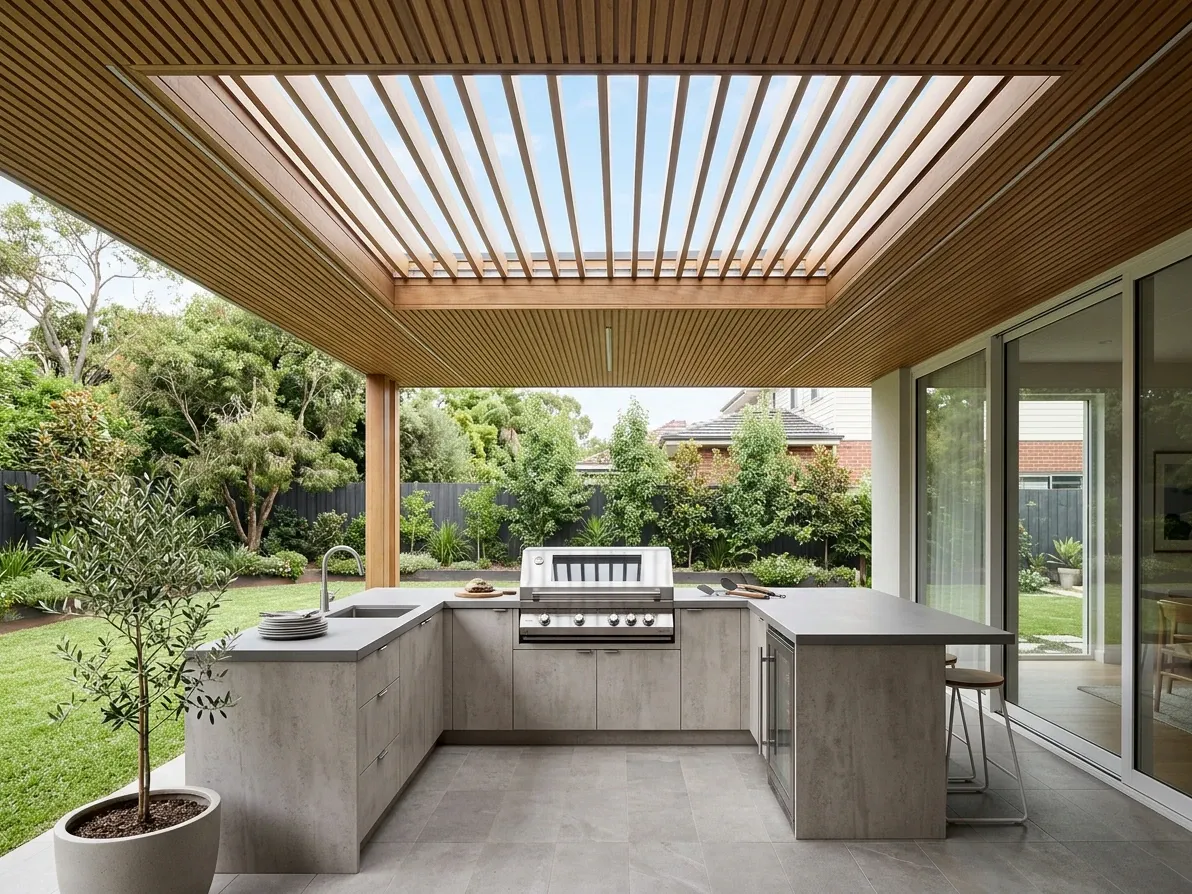
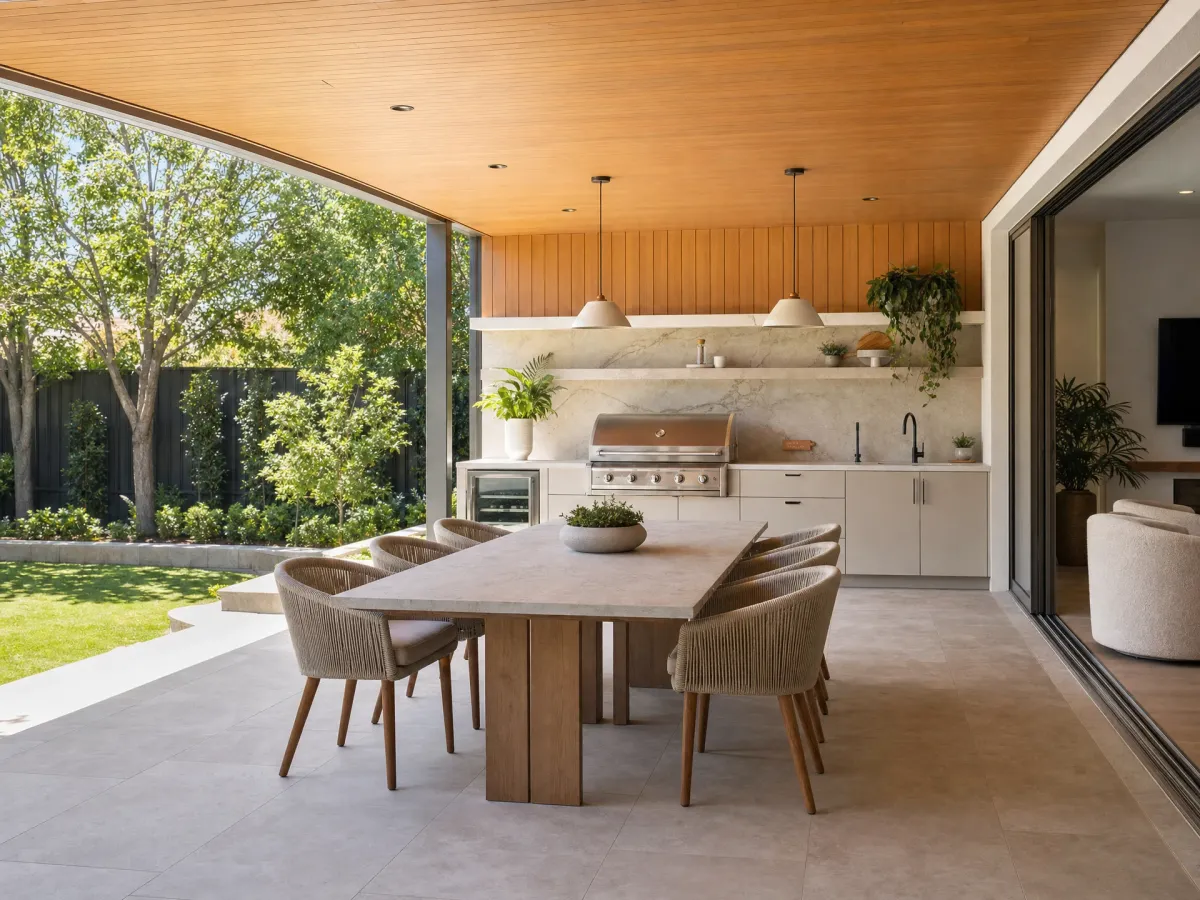
A covered alfresco extends the cooking season to most of the year.
The single biggest decision is whether the kitchen sits under a roof. Everything else follows from it.
A fully exposed outdoor kitchen on an open paved area is the cheapest to build and the simplest to approve. The trade-off is that the cooking season collapses around weather. A summer storm rolls in, the cook moves indoors, the prep bench fills with water. In Brisbane, Sydney and Melbourne the rainfall pattern alone means an uncovered kitchen is genuinely usable for maybe six months of the year. A 38-degree day in February with no shade is the other half of the same problem.
A covered alfresco kitchen, sitting under the existing eave, a pergola, a louvre roof or a built extension, is what almost every Australian outdoor kitchen now becomes. Cover extends the usable season to most of the year, protects the cabinetry and appliances, and lets you sit out there in rain. The cost rises, the approval requirements rise, and the kitchen needs proper ventilation because smoke under a roof behaves like smoke in any other kitchen.
The hybrid sitting between the two is the open-sided cover: a pergola or louvre roof with no walls, which gives shade and rain protection without enclosing the space. Louvred roof systems that open and close (Vergola, Caribbean and similar) let you adjust the cover to the season and the weather. A Whirlpool homeowner reported paying about $18,000 for a 2.6 by 5 metre louvre roof, which is a useful anchor for the upper end of that line item (source).
If the cover is going to come later, build the kitchen with that in mind from day one. The pad orientation, the location of the rangehood rough-in and the slope of the bench all change depending on what is going overhead.
Decision 2: Where it sits in relation to the house
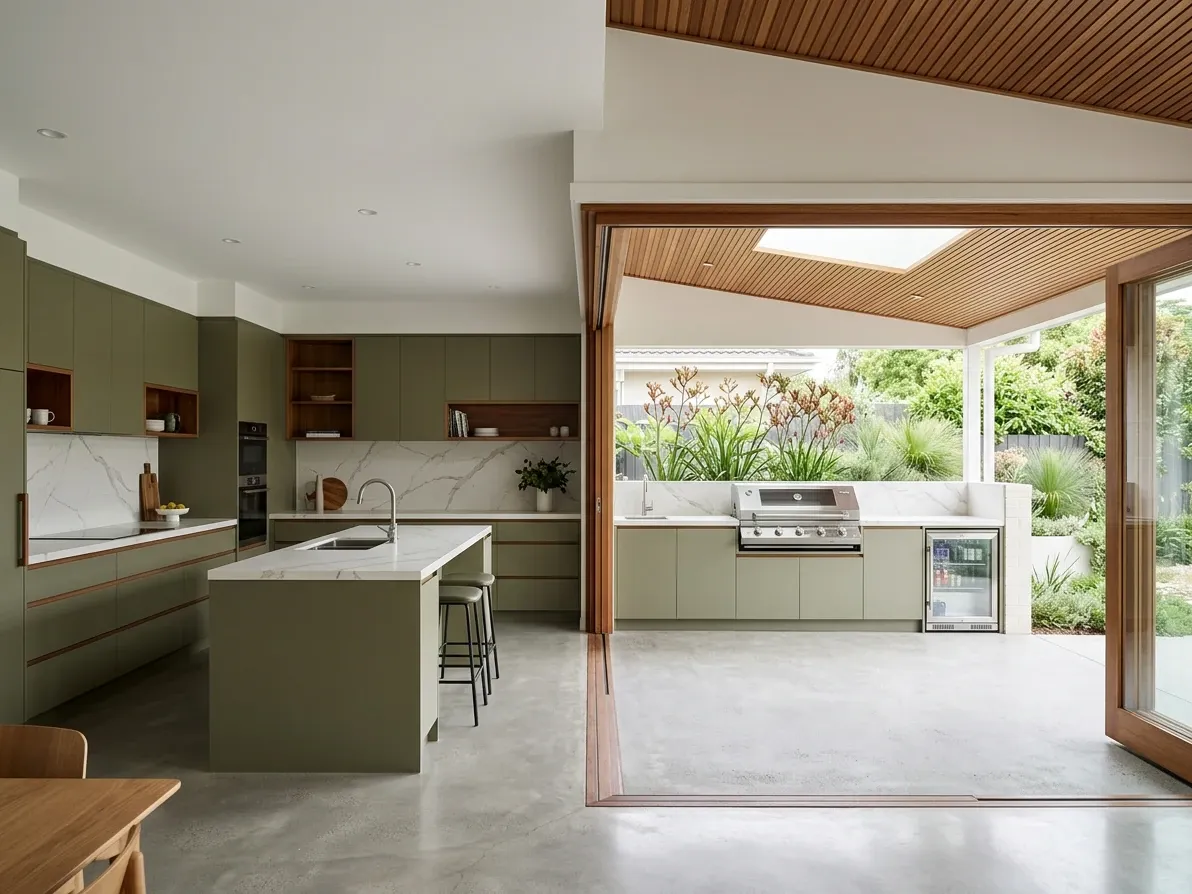
Indoor and outdoor kitchens working as one space, joined by a wide opening.
The closer the outdoor kitchen sits to the indoor kitchen, the more usable it is. The further away, the more it becomes a separate destination that gets used twice a summer and forgotten the rest of the year.
The sweet spot is direct line-of-sight from the indoor kitchen to the outdoor cook zone, ideally through a wide opening (stacker doors, bifold doors, a servery window) so that food, drinks and conversation flow without the cook being marooned. Mike from Eco Outdoor and most Australian alfresco designers all say the same thing: the outdoor kitchen has to feel like an extension of the indoor one, not a separate building (source).
The second consideration is service routing. Gas, water and electrical all need to reach the kitchen, and the bill for that goes up sharply with distance and obstacles. Running services along the existing wall of the house is usually a few hundred dollars in trenching and a few hundred more in licensed connections. Running them through a slab, under a deck, or across a garden bed to a freestanding kitchen at the back of the yard can add $3,000 to $5,000 before you have switched anything on. Stonewood and Trusted Tradie both put the typical services bill at $1,000 to $5,000 depending on how far the trades have to be extended (source).
The third consideration is prevailing wind. East-coast Australian cool breezes are north-easterly to south-easterly through summer (Your Home, the Australian Government guide to passive design). Place the BBQ so the wind blows smoke away from the seating area and away from the indoor opening, not into them. A north-facing alfresco that gets winter sun is the ideal, but a north-facing BBQ with a south-easterly wind blowing smoke into the dining room is not.
Decision 3: Layout
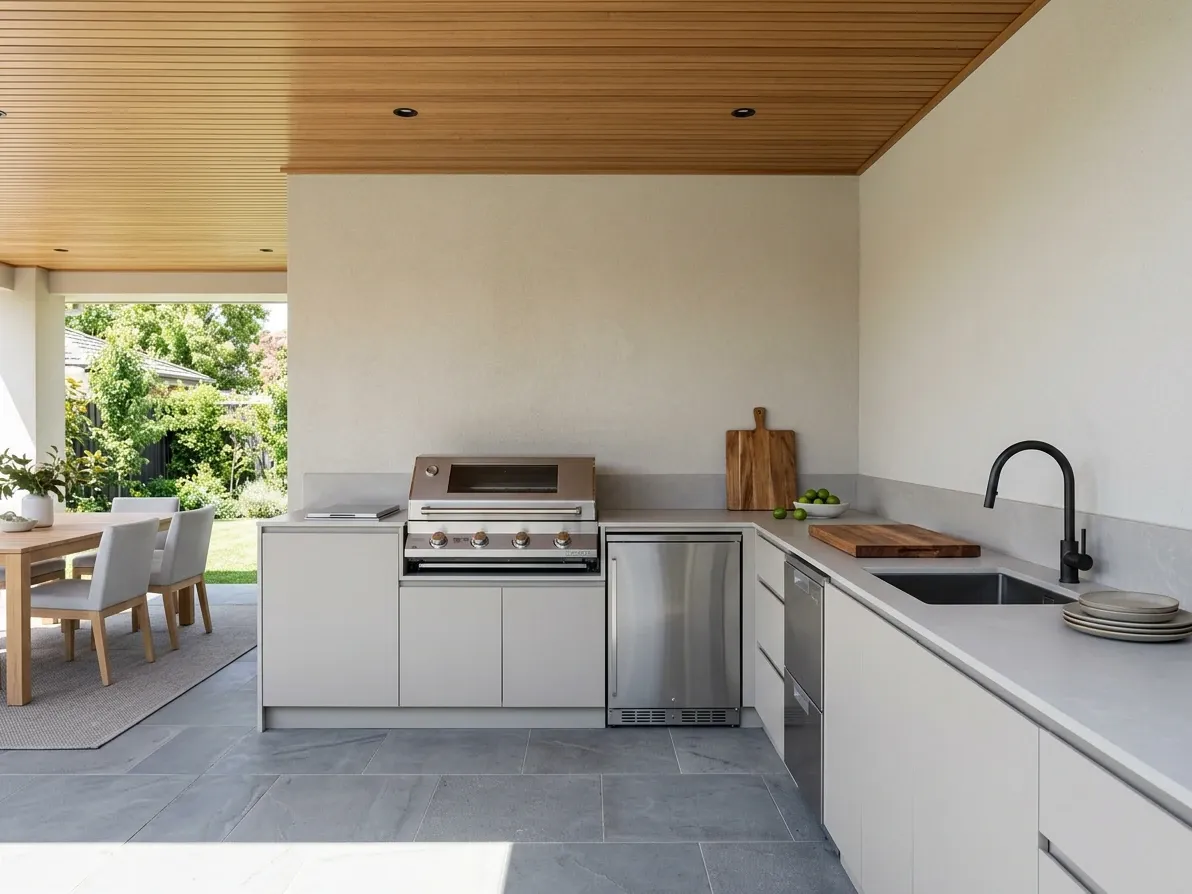
An L-shape opens cooking and prep into two distinct zones.
Outdoor kitchen layouts mirror indoor kitchen layouts but with one extra constraint: most outdoor kitchens have to fit inside an existing alfresco footprint, which is usually deeper than it is wide.
A straight-line layout puts everything along one wall (usually the wall of the house) on a single run of benchtop. It is the easiest layout to build, the easiest to service (one plumbing wall) and works well in narrow alfrescos up to about 3.5 metres long. The BBQ, sink and bar fridge sit shoulder to shoulder. The downside is that there is no separate prep zone, so you are cooking and prepping on the same bench.
An L-shape uses two adjoining walls. The longer leg usually carries the BBQ and rangehood, the shorter leg carries the sink and fridge. It opens up two distinct zones and works well in alfrescos where the BBQ wants to sit against a side wall (often to keep smoke away from the indoor opening) and the sink wants to sit against the house wall (to keep the plumbing run short). L-shapes are the most common layout in mid-range Australian outdoor kitchens.
A U-shape uses three runs. It gives the most bench and storage and works in larger alfrescos (above roughly 4 by 4 metres), but it closes the cook off from the dining area on three sides. Most U-shape outdoor kitchens are actually L-shapes plus an island, which keeps the cook facing the seating.
An island layout puts the BBQ on a freestanding bench in the middle of the alfresco. This is the layout most people actually want, because the cook ends up facing the guests rather than facing a wall. The catch is space. An island needs at least 1.0 to 1.2 metres of clear floor on every side to be comfortable, which means the alfresco has to be at least 3.5 metres wide before an island makes sense. Below that, an L-shape with a return is the honest answer.
A bar-front island variation extends the benchtop on the dining side with a 300 mm overhang and three or four bar stools. This is the single most-photographed outdoor kitchen layout in Australia and works well when the alfresco is wide enough to support it. Stools at 300 mm overhang, 1.2 metres of clearance behind the cook, and the BBQ sized to the bench length, not the other way around.
If you are still deciding between layouts, a 3D floor plan saves the most expensive mistake of all: building a permanent island that turns out to be 200 mm too deep to walk around comfortably.
Decision 4: Materials that survive Australian conditions
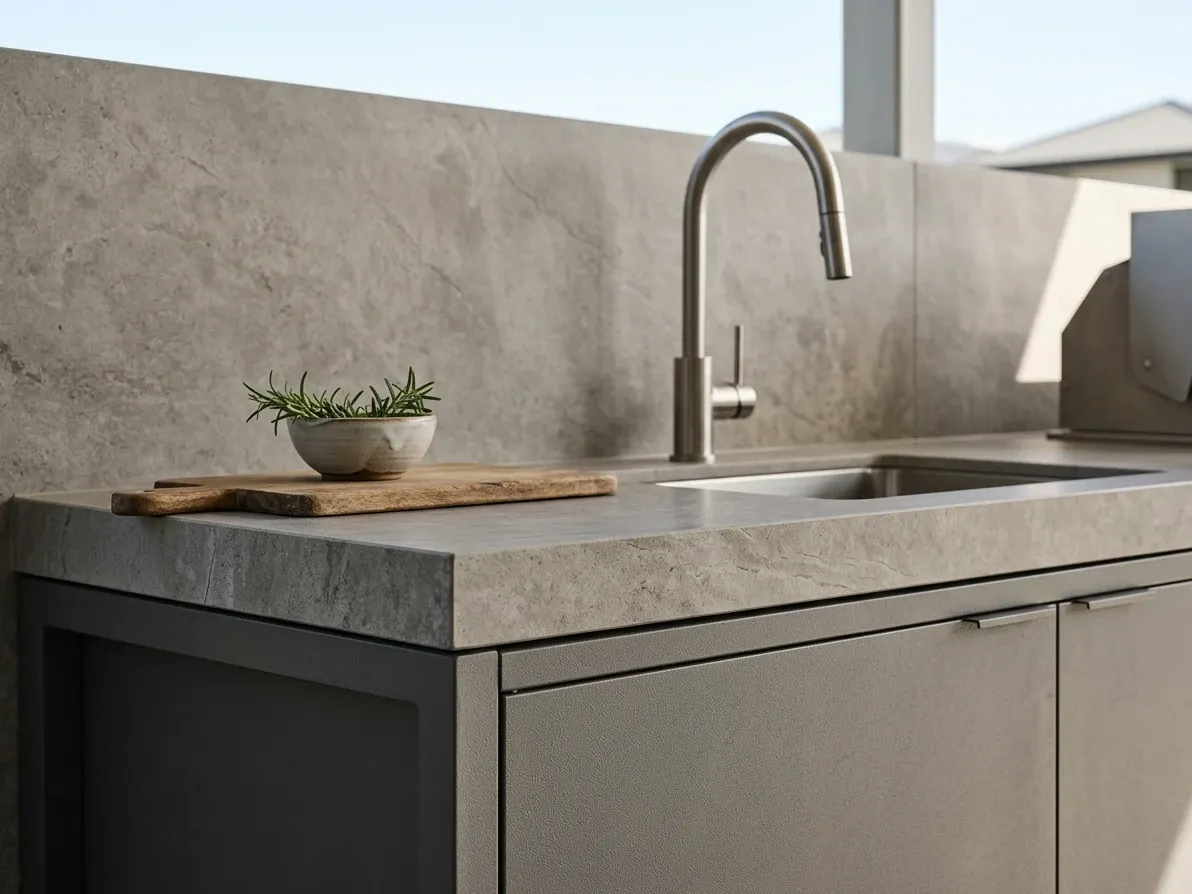
Sintered stone, marine-grade stainless and outdoor-rated finishes do the hard work.
This is the section where most generic outdoor kitchen content is wrong. American and British materials guides assume mild summers and short cooking seasons. Australian conditions (UV intensity, summer heat, coastal salt, sub-tropical humidity, occasional hailstorms) are harsher than almost any other developed market, and standard indoor materials fail fast outside.
For benchtops, sintered stone and porcelain slabs (Dekton, Neolith, Laminam, Asetica) are the dominant choice in 2026. They handle 300-degree heat without damage, do not fade under UV, do not stain from salt air and do not absorb water. Expect $600 to $1,200 per square metre installed for a porcelain slab benchtop on a custom outdoor kitchen (Asetica’s Sydney coastal materials guide is one of the clearer Australian explainers). Natural stone (granite, dolomite) also works outside but stains and patinas more, which some homeowners love and others hate. Engineered stone is no longer an option in any new Australian kitchen, indoor or outdoor: from 1 July 2024, Safe Work Australia banned the manufacture, supply and installation of engineered stone in response to the silicosis crisis. Treat any quote that still includes engineered stone as a red flag.
For cabinetry, the standard kitchen carcass (melamine on chipboard or MDF) does not survive outside. The carcass swells, the doors warp, the fronts peel within a few seasons even under a roof. The three options that hold up are marine-grade 316 stainless steel (best for coastal sites, mandatory inside the salt-spray zone), powder-coated marine-grade aluminium (lighter and cheaper than stainless, good for inland sites), and marine polymer board (HDPE, the material boat builders use). Standard 304 stainless steel works well inland but will tea-stain and pit within a few kilometres of the coast; you need 316 with molybdenum near the surf. HPL (high-pressure laminate) panels on a metal sub-frame are an increasingly popular option for warmer climates because they hold colour and grain pattern under UV.
For flooring, slip resistance is the issue most homeowners under-think. Australian tiles use the P-rating system: P3 is the absolute minimum for sheltered outdoor floors, P4 is what you actually want for an alfresco kitchen, and R11 or above (the European equivalent rating) handles wet pool-surround conditions. Sealed broom-finish concrete is the cheapest competent option. Honed travertine looks beautiful but stains from spilt wine. Decking timber (spotted gum, blackbutt, merbau) works under a covered alfresco but needs to be sealed annually, and the cook bench should never sit directly on it because grease drips will mark the timber within a season.
For tapware and any exposed hardware, marine-grade 316 again, or solid brass with a PVD coating. Chrome over brass plate is the most common cause of “rusting” outdoor tapware in the first three years.
The single most useful filter for any outdoor material is: would a boat builder use this? If yes, it will survive an Australian outdoor kitchen. If no, it probably won’t.
Decision 5: What goes in the kitchen
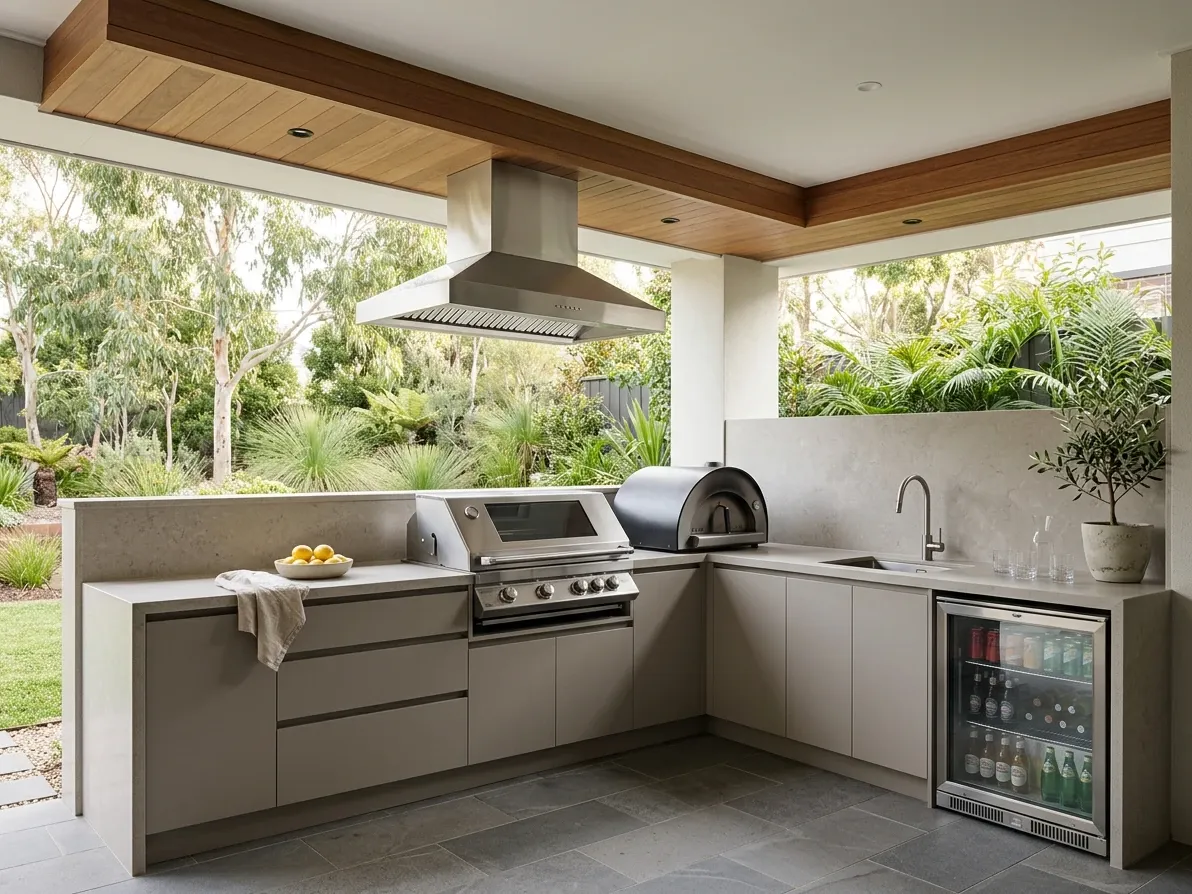
A fully equipped alfresco kitchen with BBQ, pizza oven, sink and rangehood.
The minimum viable outdoor kitchen is a built-in gas BBQ, a benchtop with cupboard storage and ideally a sink. Almost every brief beyond that minimum adds one or more of the following. The right answer is to pick the two or three that match how you actually cook, not all of them.
A built-in BBQ is the centrepiece. Four-burner units suit most households, six-burner units suit households that entertain larger groups or want a wider hood (covered range), and side burners or wok burners add flexibility for stir-fries and curries that BBQs cook poorly. Beefeater, Napoleon, Artusi, BeefEater Discovery 1100 and the Gasmate Galaxy range are the most common built-in BBQs in Australian outdoor kitchens. Built-in costs typically run 30 to 50 per cent above a freestanding equivalent, but the look and the smoke handling are better.
A pizza oven (wood-fired, gas, or hybrid) is the second most-installed appliance. Wood-fired ovens (Alfresco Factory, Forno Bravo) deliver the genuine article but need 45 minutes to come up to temperature and ash management afterwards. Gas pizza ovens (Gozney, BeefEater) are ready in 15 minutes, cleaner and easier to integrate into a built-in bench. The Ninja Woodfire and Ooni Karu range offer compact hybrid options that sit on a benchtop without needing custom joinery.
A side burner or wok burner sits to the side of the BBQ, gives a flat cooking surface for sauces and stir-fries, and uses the same gas line. Useful in households that cook Asian food outside; redundant in households that mostly grill.
A sink and bar fridge convert the kitchen from a BBQ to an actual cooking station. A small undermount sink (450 mm bowl) handles most prep and a 90 to 120 litre outdoor-rated bar fridge holds drinks, marinades and salads without the cook having to run inside. Indoor fridges do not survive outside; they cycle hard against heat and humidity and fail within two years. Buy an outdoor-rated model with a stainless steel skin and an extended temperature range.
A rangehood under a covered alfresco is non-negotiable if the BBQ sits under any kind of roof. Smoke and grease build up under cover the same way they do in an indoor kitchen, and the heat from a six-burner BBQ under a timber pergola is a fire risk over time. Use an outdoor-rated ducted rangehood (not a recirculating one) with rigid ducting vented to the outside. Aim for 1,200 CFM or above and mount the hood 900 to 1,050 mm above the cooking surface (Proline’s planning guide is the clearest reference).
Anything beyond those is optional. Drinks fridges, kegerators, ice makers, warming drawers, dishwashers, teppanyaki plates and built-in smokers all exist and all add cost and complexity. None of them are essential, and each one is an extra appliance to maintain, replace and weatherproof.
Decision 6: Gas, water, power and waste
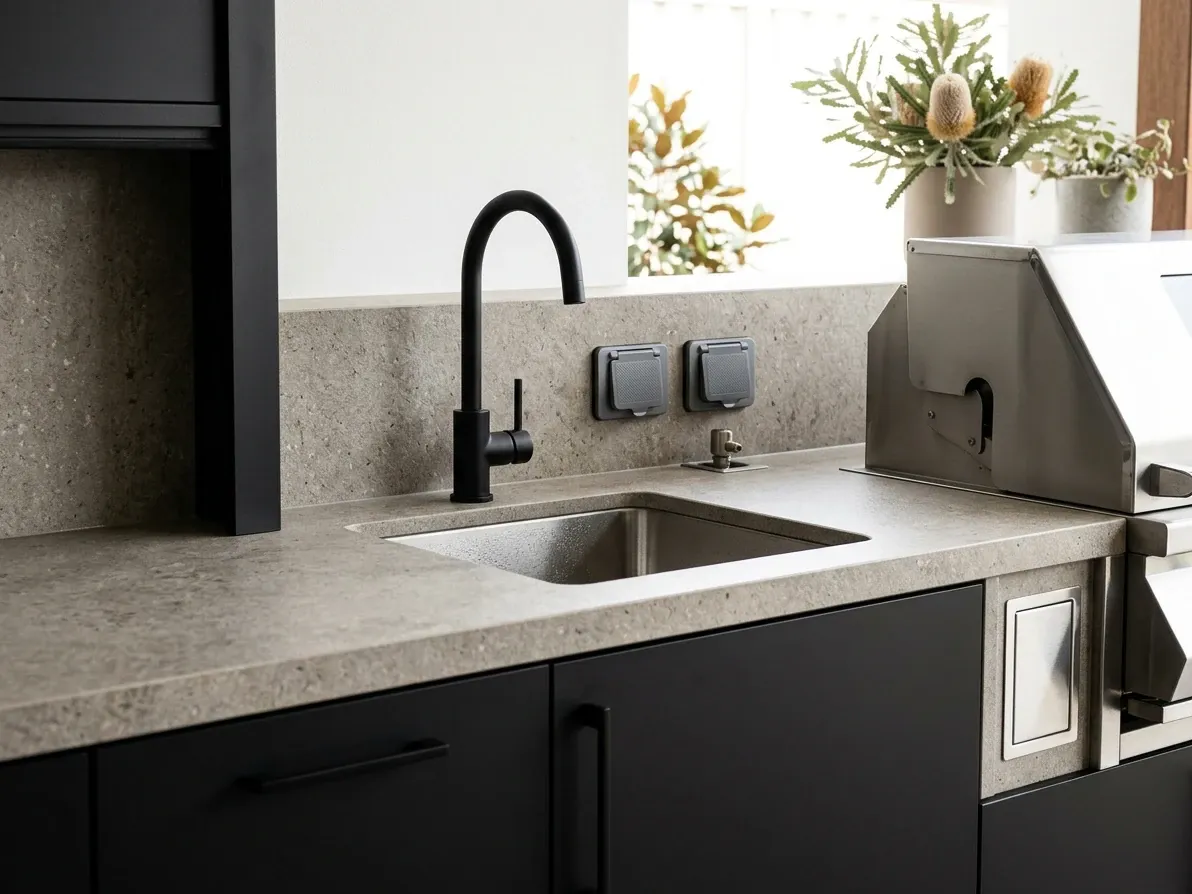
Services planned in early, hidden but obvious in how cleanly they sit.
The services that connect to an outdoor kitchen are where DIY ends and licensed trades begin. Australian law is clear on this.
Gas connections (LPG bottle, mains natural gas or both) must be installed by a licensed gasfitter working to AS/NZS 5601.1, the joint Australia/New Zealand standard for general gas installations (the Victorian Building Authority’s summary is the most accessible reference). Standards Australia published Amendment 2 to the standard in September 2024, so any quote should reference the current version. LPG runs from a 9 or 45 kg bottle, swapped manually or via a swap-and-go service. Mains natural gas runs from the household gas meter and is the more convenient long-term option if the meter is reasonably close; expect a few hundred to a few thousand dollars to extend a gas line depending on length and access. Many BBQs sold in Australia ship as LPG by default but can be converted to natural gas; check at purchase, not after installation.
Plumbing for a sink requires a licensed plumber for the water supply (a cold tap is enough for most outdoor kitchens; hot is a nice-to-have that adds cost) and for the wastewater run. Wastewater has to go to the council sewer system, not the stormwater system, and the run is usually plumbed back to the nearest indoor stack (Brisbane Plumbing & Drainage has a clear explainer). If sewer access is genuinely impossible, a soakaway or greywater system is the fallback, but both have their own approval requirements.
Electrical work needs a licensed electrician and a weatherproof outdoor switchboard or weatherproof power points (IP-rated). Plan four to six general power outlets, all RCD-protected and ideally with USB-C ports, plus dedicated circuits for the rangehood, fridge and any 240V appliances. Lighting deserves its own plan: low-level under-bench LED strips for the bench surface, downlights or pendants over the cook zone, and warmer ambient lighting around the dining area. Motion-sensor or app-controlled zones are increasingly standard in 2026 alfresco kitchens.
If you are building new or doing a major renovation, the cheapest time to install services to the outdoor kitchen is during the slab pour, even if the kitchen itself is years away. Live capped water, gas and drainage stubs sitting in the slab cost a few hundred dollars to add during construction and several thousand to retrofit later.
Decision 7: Budget
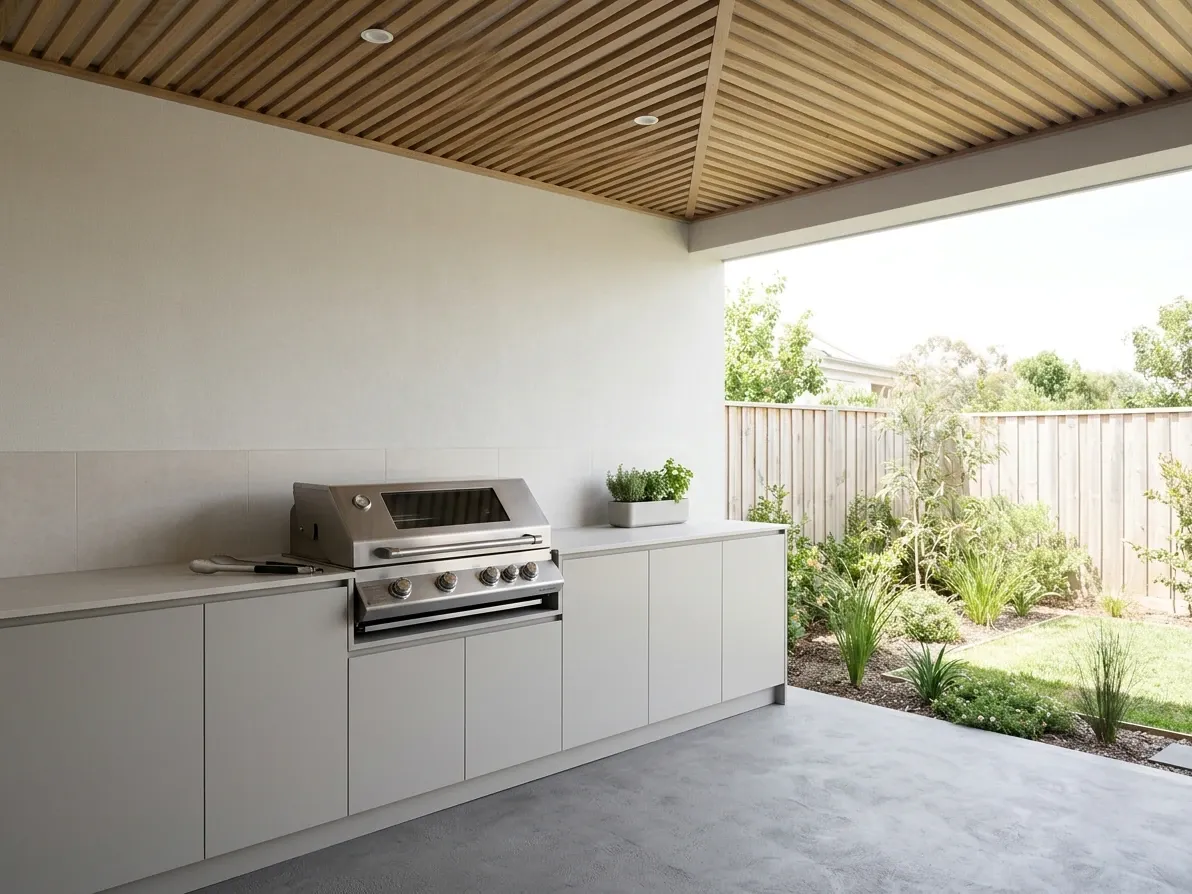
A well-resolved modular outdoor kitchen sits at the entry-level end of the budget.
Australian outdoor kitchen budgets group into four tiers. The numbers below are 2026 prices and exclude the alfresco structure itself (slab, posts, roof) which is a separate building project.
A basic built-in BBQ kitchen with a melamine-or-laminate-faced cabinet, a laminate benchtop and a four-burner BBQ sits at roughly $5,000 to $12,000. Achievable with a flat-pack outdoor kitchen system from Joe’s BBQs, Gasmate, AlfrescoPlus or Bunnings, owner-assembled with a licensed gasfitter for the gas connection.
A mid-range kitchen with custom stainless or HPL cabinetry, a sintered stone or porcelain benchtop, a quality built-in BBQ, a sink with cold water and a bar fridge runs $12,000 to $25,000. This is what most Australian custom alfresco kitchens end up costing, and it is the bracket Eco Outdoor and Emporium Kitchens both quote as the most common (Eco Outdoor’s pricing guide, Emporium Kitchens’ breakdown).
A premium custom kitchen with 316 stainless steel cabinetry, a thick sintered stone or natural stone benchtop, a six-burner BBQ, a pizza oven, a rangehood, a sink with hot and cold water, an outdoor fridge and integrated lighting sits at $25,000 to $50,000. Add an integrated pergola or louvre roof structure ($5,000 to $20,000), a kegerator or wine fridge, a side burner and any high-end European appliance and the project moves into the luxury bracket.
A luxury or showpiece outdoor kitchen with a full chef’s BBQ, an integrated woodfire pizza oven, a smoker, a ducted rangehood, a teppanyaki plate, hot and cold sinks, a dishwasher, multiple fridges and an automated louvre roof can sit above $75,000 and runs past $100,000 for the larger Sydney and Melbourne projects.
Inside any of those tiers, the rough proportions are stable. The BBQ and major appliances take 25 to 40 per cent. Cabinetry takes 20 to 30 per cent. Benchtop takes 10 to 20 per cent. Trades (gas, plumbing, electrical, install) take 20 to 30 per cent. The structure itself (pergola, roof, slab work) is separate from the kitchen budget and usually managed under its own contract.
Build a 10 to 15 per cent contingency into the project budget. Outdoor work in older Australian homes routinely surfaces termite damage, drainage problems, unpermitted prior works or pre-1990 asbestos in eaves and old walls, and any of those will pause the build until they are resolved.
A more detailed breakdown of how Australian kitchen budgets actually move (the same logic applies indoor and outdoor) is in the kitchen renovations on a budget guide.
Decision 8: Council approval
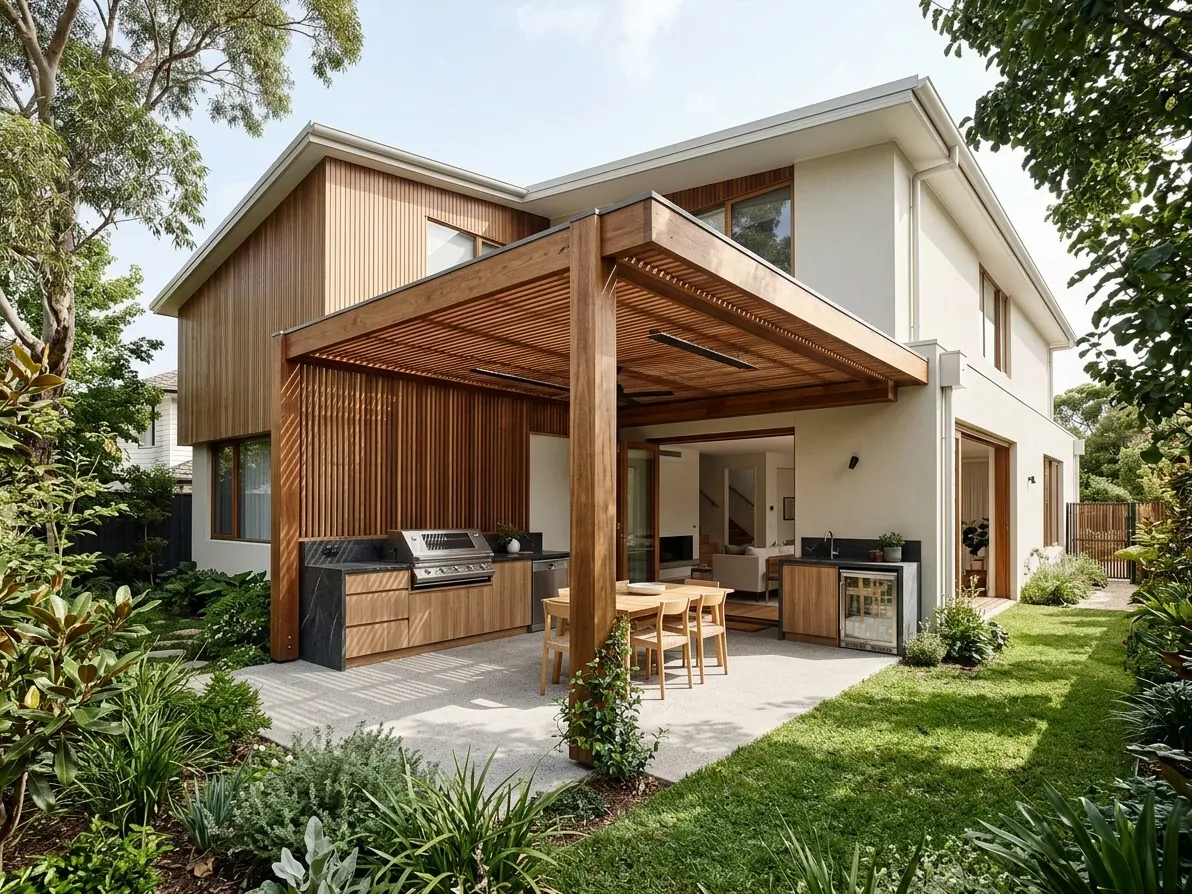
The covered structure is what most often pulls the project into council approval.
Whether an outdoor kitchen needs council approval depends almost entirely on what is permanent. The kitchen itself usually does not trigger approval. The structure around it usually does.
A freestanding kitchen on an existing paved area, with no fixed roof, no new structure and no changes to services, is generally an exempt or low-impact development across most Australian councils. A barbecue and benchtop module sitting on an existing alfresco slab can usually be installed without any planning input.
A built-in kitchen with fixed cabinetry, a permanent gas connection and a covered roof or pergola is a different conversation. The roof, the structure attached to the house and the boundary setbacks are the elements most councils care about. New South Wales has the State Environmental Planning Policy (Exempt and Complying Development Codes) which allows certain pergolas and outdoor structures without a development application if they meet specific dimensions and setbacks (Sydney Renovation Group has a practical NSW summary). Victoria works through Victorian Building Authority planning permits and building permits. Queensland’s Building Code provisions allow Class 10a structures (verandahs, pergolas) without planning approval if they meet defined limits.
The practical rule of thumb: any new structure, any fixed roof attached to the house, any work within boundary setbacks, or any building work above the council’s exempt-development threshold needs approval. Gas, plumbing and electrical work always needs licensed trades regardless of planning permission, and those trades will issue their own compliance certificates which the council, the insurer and any future buyer will eventually ask to see.
The safest sequence is to confirm with the local council before the slab goes in, not after, and to keep every compliance certificate in a folder you can hand to a future buyer. An outdoor kitchen built without the right approvals is not just a fine; it is a problem at sale time that can knock years off the project’s payback.
Maintenance: what an outdoor kitchen actually needs
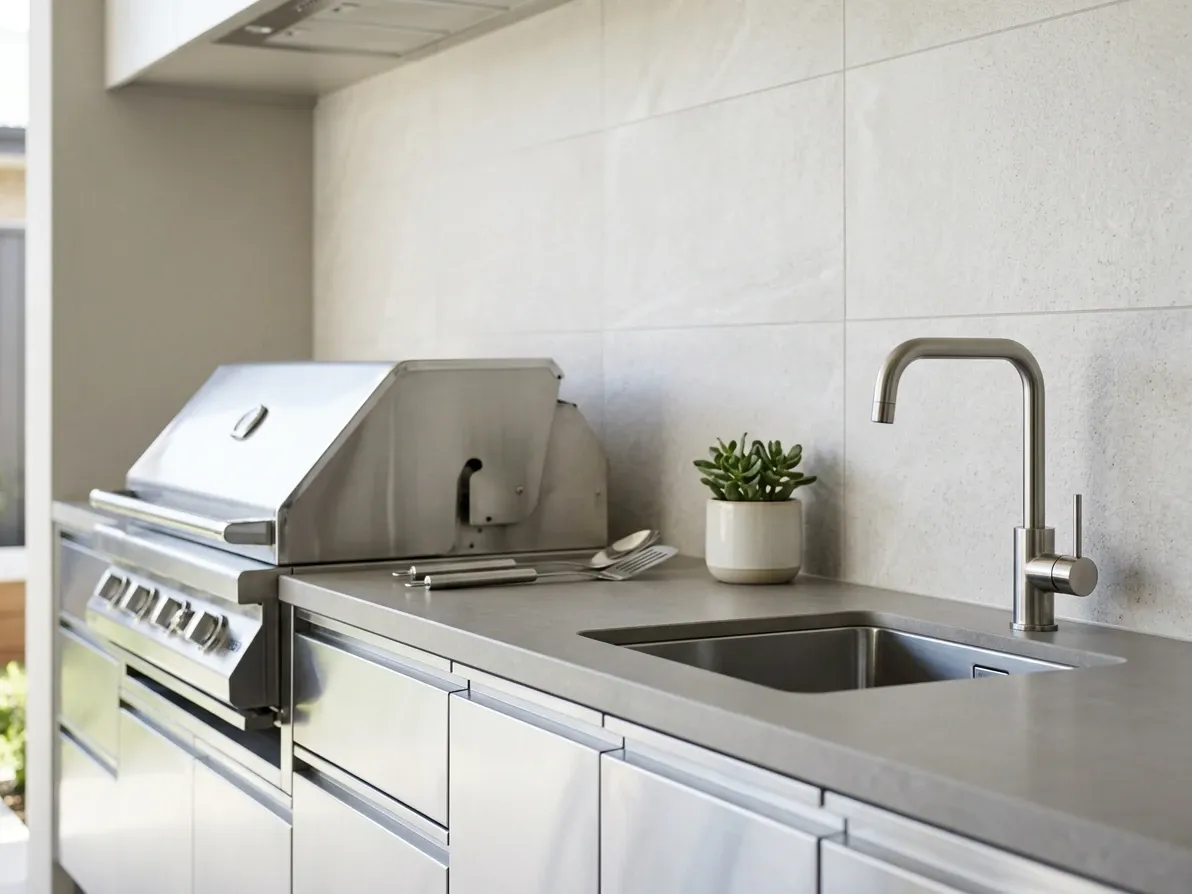
A weatherproof outdoor kitchen looks pristine for a decade with light upkeep.
A weatherproof outdoor kitchen is not maintenance-free. Three habits keep one looking good for ten years.
Wipe down stainless steel weekly with a soft cloth and a vinegar-water mix, then dry it. The most common cause of “rusting” outdoor stainless is salt and food residue left on the surface, not failure of the steel itself. Within a few kilometres of the coast, weekly cleaning is mandatory; inland, fortnightly is usually enough.
Cover the BBQ between uses. A fitted heavy-duty BBQ cover costs $80 to $200 and adds years to the burners, the hood and the firebox. The cover is more important than any other single maintenance item.
Reseal natural stone and timber annually. Sealed travertine, marble or granite benches need a penetrating sealer reapplied every twelve months. Timber decking and any exposed timber framing need an oil or stain refresh annually in full sun, every two years under cover.
Service the gas appliances every two years. A licensed gasfitter can check connections, clean burners and verify the pressure regulator. Spider nests in the gas line are a real failure mode that catches people out.
Drain any plumbing if you are going to leave the kitchen unused through a cold inland winter. A frozen sink trap is a $400 to $800 plumber call-out.
Common mistakes
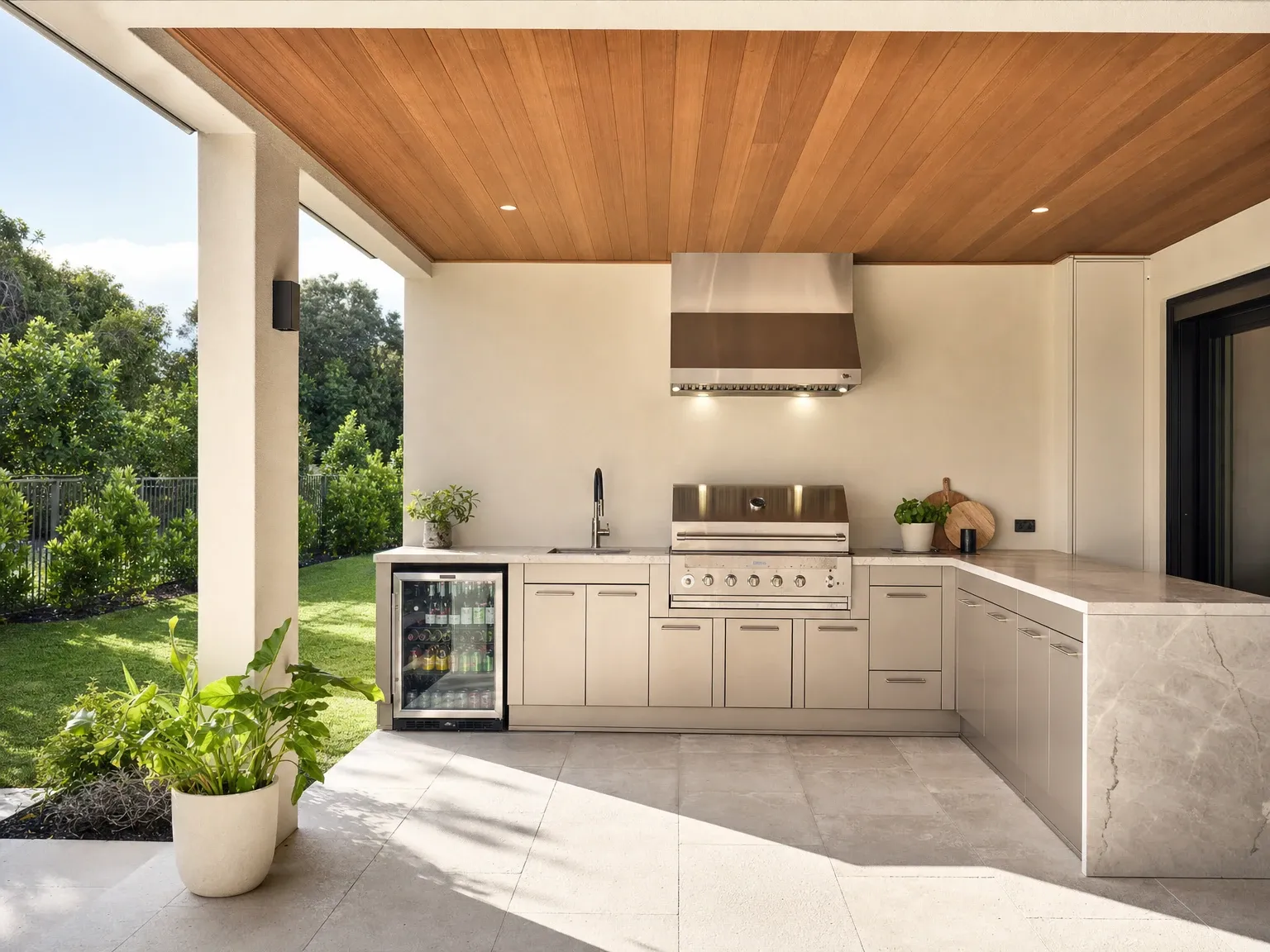
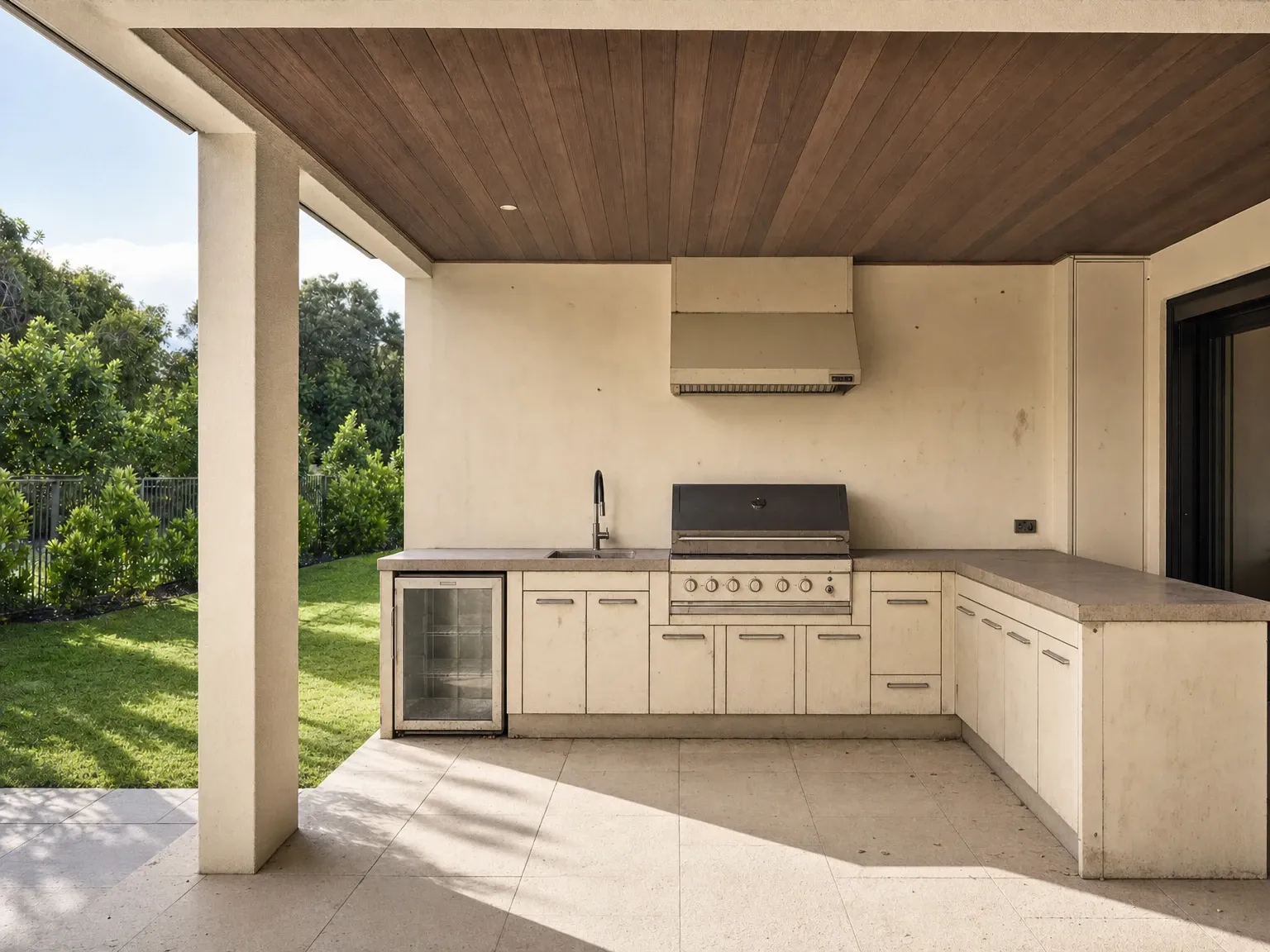 Before
After
Before
After
A handful of mistakes show up in Whirlpool threads, Houzz reviews and the regret reels on YouTube often enough to be worth flagging up front.
Building the kitchen first and figuring out the roof later. The rangehood ducting, the lighting plan and the cabinetry depth all depend on what is overhead. Decide the cover before the kitchen.
Choosing indoor materials because they are cheaper. Engineered stone (where it can still be bought second-hand or unsold stock), standard kitchen carcasses and indoor tapware all fail within a few seasons. The premium for outdoor-rated materials looks expensive at quote stage and is almost always cheaper than replacing them in year three.
Under-sizing the BBQ. A four-burner is enough for a family of four. The moment you start entertaining six or more, a four-burner becomes a queue. Six-burner BBQs are the default in Australian outdoor kitchens above the basic tier for a reason.
Forgetting the rangehood under a covered alfresco. Smoke yellows ceiling linings within a season and the cleaning bill at year three is more than the rangehood would have cost upfront.
Putting the bar fridge in direct sun. Outdoor-rated fridges work hard at the best of times. A fridge sitting in 40-degree direct sun spends every cycle fighting the heat and fails within two years instead of seven.
Ignoring the wind. A north-facing kitchen with a south-easterly summer breeze blowing smoke into the seating area is a kitchen no one enjoys.
Skipping the council check. Outdoor kitchens built without approval show up as encumbrances at sale and can require demolition or retrospective approval at the owner’s cost.
Visualising it before you build
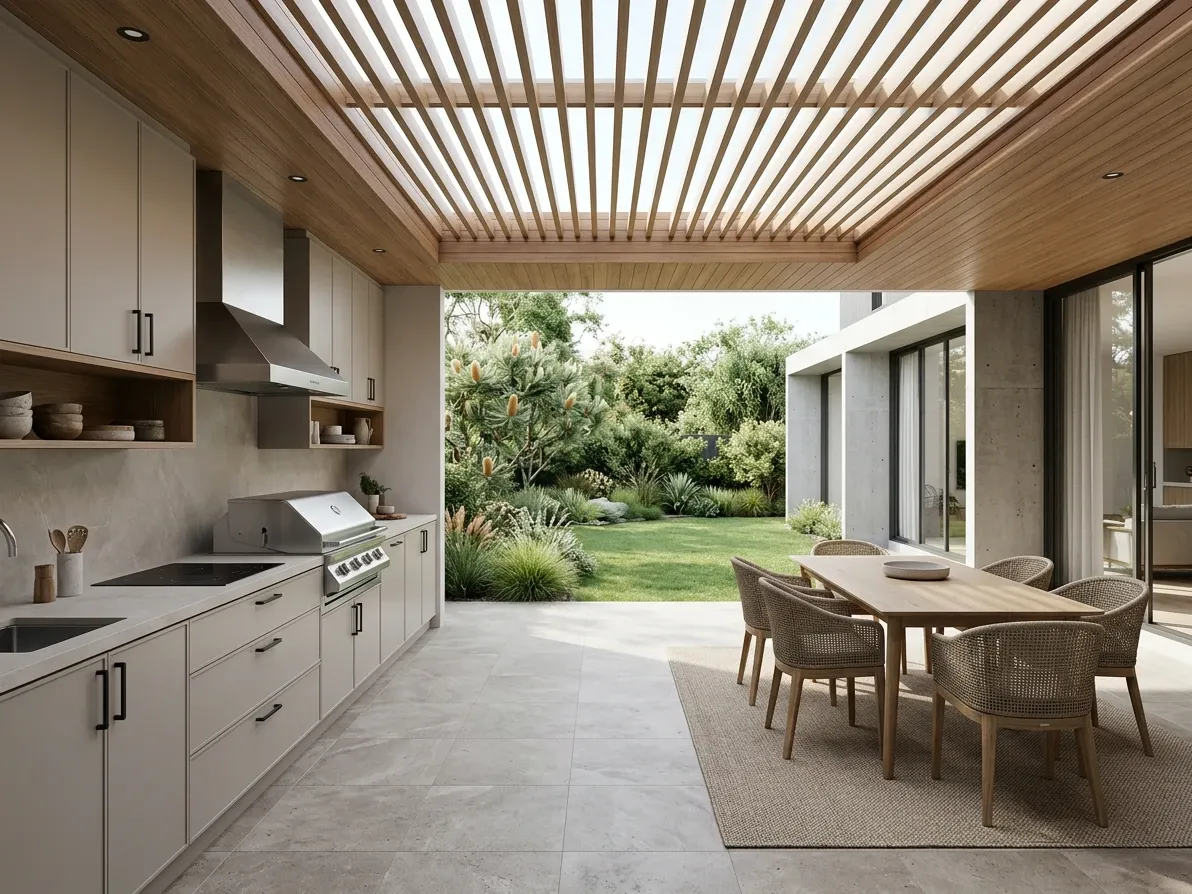
A 3D render tests the brief before any cabinetmaker quotes against it.
Outdoor kitchens are some of the hardest renovations to picture from a plan. The footprint, the roof line, the indoor-outdoor connection, the morning light, the afternoon shade and the relationship to the dining table are all things that exist in three dimensions, not two. Most homeowners who regret an outdoor kitchen describe the same thing: it looked right on paper and wrong once it was built.
A 3D render of the outdoor kitchen, dropped into the actual backyard, at the actual time of day, with the actual roof line, is the single cheapest way to test the brief before the slab is poured. reIMG builds those renders from a sketch, a few site photos and a brief, so the kitchen can be tested as a finished space and revised before any cabinetmaker quotes against the wrong layout.
Frequently asked questions
How much does an outdoor kitchen cost in Australia in 2026?
A built-in BBQ with a benchtop and basic cabinetry sits at roughly $5,000 to $12,000. A complete mid-range alfresco kitchen with a sink, fridge, rangehood and stone benchtop runs $12,000 to $25,000. A premium custom kitchen with luxury appliances and an integrated pergola sits at $25,000 to $50,000 and runs past $75,000 once a pizza oven, drinks station and louvre roof come in. Coastal builds in marine-grade 316 stainless steel and sintered stone sit at the upper end of those ranges. Services (gas, water, electrical) add another $1,000 to $5,000 if the trades have to be extended from the house.
Do I need council approval for an outdoor kitchen?
A freestanding BBQ on an existing paved area generally does not. A permanent built-in kitchen with gas, water and a fixed roof or pergola usually does. Gas connections always need a licensed gasfitter working to AS/NZS 5601, fixed plumbing needs a licensed plumber, and any new electrical work needs a licensed electrician. The roof or pergola is the trigger that most often pulls the project into a building permit or development application. Rules vary by council, so confirm before the slab is poured.
What is the best layout for an alfresco kitchen?
Straight-line layouts work in narrow alfrescos under about 3.5 metres long and keep the build simple. L-shape layouts open up two zones (cooking and prep) and suit corner alfrescos. U-shape gives the most bench area and works in larger alfrescos above about 4 by 4 metres. Island layouts put the cook facing the dining area, which is the layout most homeowners actually want, but they need at least 1.0 to 1.2 metres of clear floor on every side. Plan around the existing roof line, not against it.
What materials hold up best in an Australian outdoor kitchen?
Sintered stone or porcelain slabs for benchtops, marine-grade 316 stainless steel cabinetry for coastal sites and powder-coated aluminium inland, P4 or R11-rated tiles or sealed concrete underfoot, and outdoor-rated stainless or aluminium for any framing. UV-stable, heat-tolerant and salt-tolerant is the test every material has to pass. Standard kitchen cabinetry, engineered stone, untreated timber and decorative laminate all fail outside within a few seasons.
Do I need a rangehood under a pergola?
Yes, if the BBQ sits under any kind of solid roof, pergola, awning or louvre. Smoke and grease build up under a cover the same way they do in an indoor kitchen, and the heat damages timber, paint and ceiling linings. An outdoor-rated ducted rangehood with rigid (not flexible) ducting vented to the outside air is the correct solution. A fully open BBQ with no cover overhead does not need one.
Will an outdoor kitchen add value to my home?
In warm-climate Australian states (Queensland, northern New South Wales, Western Australia and the Northern Territory) a well-built, weatherproof outdoor kitchen is one of the higher-return outdoor upgrades, and Australian builders quote return-on-investment figures in the 60 to 100 per cent range when the kitchen suits the neighbourhood. In cooler southern states the gain is smaller because the cooking season is shorter. The build only pays back at sale if the materials genuinely survive ten years in the sun. A faded, rusting outdoor kitchen subtracts value rather than adding it.
Can I build an outdoor kitchen as a DIY project?
Partly. Flat-pack modular outdoor kitchens from brands like Joe’s BBQs, Gasmate and AlfrescoPlus are designed for self-assembly and a competent owner can install the cabinetry, benchtop and BBQ over a weekend. What you cannot DIY is the gas connection (a licensed gasfitter is mandatory under Australian law), the plumbing connections (licensed plumber) and any new electrical work (licensed electrician). Plan the trades in before you assemble, not after.