IKEA kitchen design: planning, costs, install
How IKEA kitchen design works in Australia: the free planner, the METOD system, real costs, who installs it, and where it beats custom or Kaboodle.
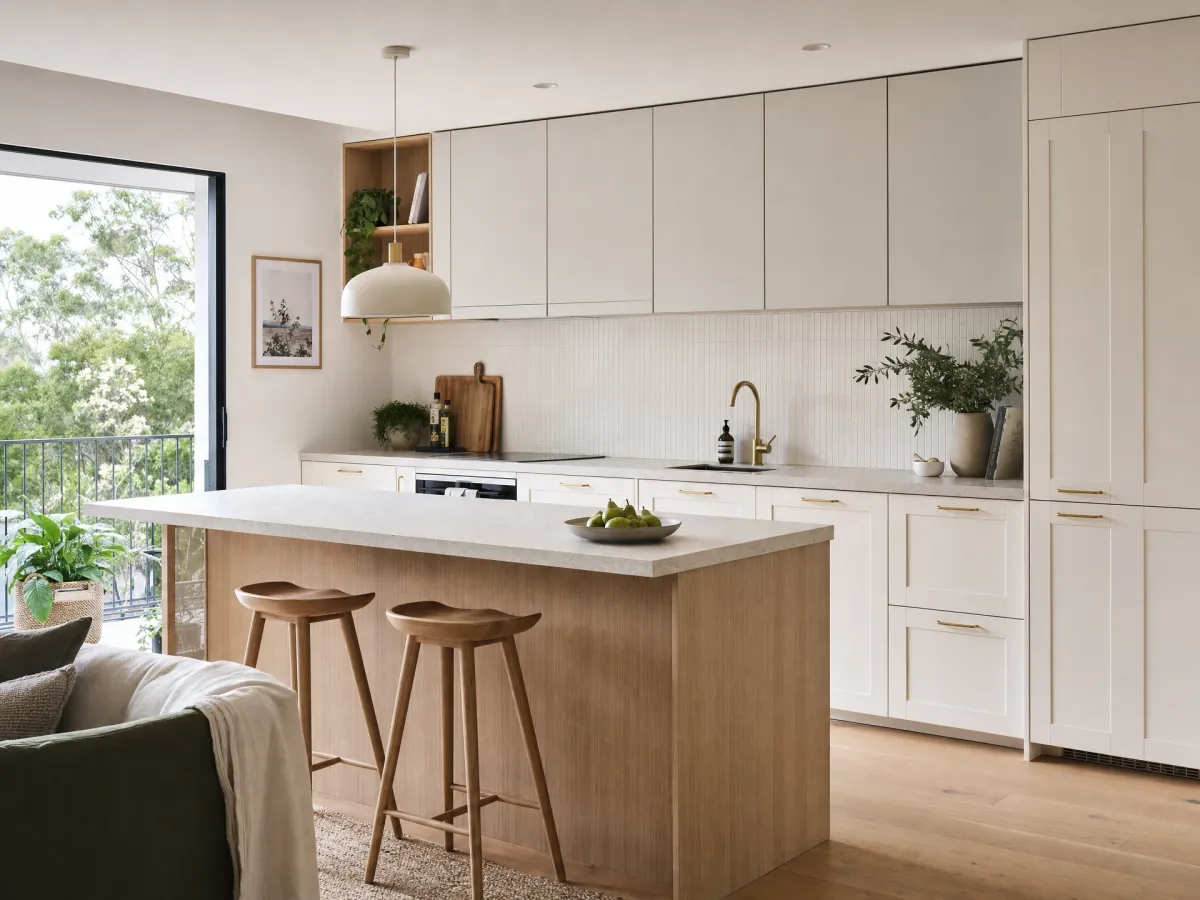
You’ve used the IKEA Kitchen Planner, the 3D model of your future kitchen is rotating on your laptop, the cart total has crept past $9,000, and you still don’t know what happens between hitting ‘add to cart’ and someone actually fitting it in your house. The IKEA marketing answers the first part of that question well. The middle part, the part where the boxes turn into a working kitchen with a plumbed sink and a working dishwasher and a benchtop that is not three millimetres too short, is mostly missing from the official pages and patchily covered everywhere else.
This guide is the version of that middle part, written for Australians. It covers what IKEA actually sells here (the METOD and ENHET systems and the Australian-specific tweaks that matter), the three different ways you can design an IKEA kitchen and which one to pick, how the free Kitchen Planner works and where it trips people up, what an IKEA kitchen genuinely costs in 2026 once benchtops, appliances and trades are in the picture, who installs the thing now that IKEA has outsourced its installation referral to hipages, where IKEA wins or loses against Kaboodle and against a fully custom build, and how long the system actually lasts. It sits alongside the broader kitchen renovation ideas guide and the kitchen renovations on a budget guide, and goes deeper than either on the IKEA-specific decisions.
What IKEA actually sells in Australia
IKEA Australia sells two kitchen systems, and the difference between them matters before you open the planner. The flagship is METOD, a fully modular cabinet system shared with the European market. It is built around a small library of base, wall and tall cabinet frames in a tight range of widths (40, 60 and 80cm are the dominant base widths), a deep catalogue of door fronts that can be specified in dozens of finishes and colours, a hardware system (UTRUSTA hinges and MAXIMERA fully-extending drawers) that runs across the entire range, and a 25-year guarantee on the structural parts of the system. METOD is the version that builds almost any residential kitchen layout including islands, integrated appliance walls, tall pantry runs, and bespoke finished sides. It is what almost every Australian buyer who searches “IKEA kitchen” is actually looking at.
The second system is ENHET, a smaller, simpler kitchen aimed at studios, apartments, granny flats and budget rental refreshes. It has a tighter range of sizes, a much shorter list of finishes, and a 5-year guarantee. Entry prices are noticeably lower: according to CHOICE’s flat-pack kitchen comparison, an IKEA ENHET L-shape corner kitchen starts from $2,038, against $6,042 for the equivalent Kaboodle L-shape at Bunnings. ENHET is the right pick when the kitchen is small, the budget is tight and the room is square. If the kitchen is the main kitchen in a permanent home, METOD is almost always the right call.
One Australian-specific detail is worth surfacing early because it changes how the system behaves on installation day. As Inspired Kitchen Design notes in its comparison of the European METOD and North American SEKTION lines, IKEA Australia ships METOD with thicker, full-width appliance support panels that the European METOD line does not include. Approximately 36 by 96 inches at most door styles, those panels make integrating European-spec appliances (dishwashers, fridges, double ovens) materially easier on Australian METOD than on European METOD. It is a small detail that makes a real difference when your kitchen specifies a panelled dishwasher or an integrated fridge column.
The kitchen system is one thing; the surrounding parts are another. IKEA Australia stocks laminate, solid timber and engineered-stone-style benchtops within METOD; appliances (ovens, cooktops, rangehoods, dishwashers, fridges, microwaves) made under licence by Whirlpool and Electrolux, as covered by Appliance Retailer and the broader appliance press; sinks, taps and waste fittings; and the full set of plinths, legs, cover panels and trims required to finish the cabinets cleanly against a wall. The full kitchen, in other words, can be specified inside the IKEA range. Whether it should be is a question covered later in this guide.
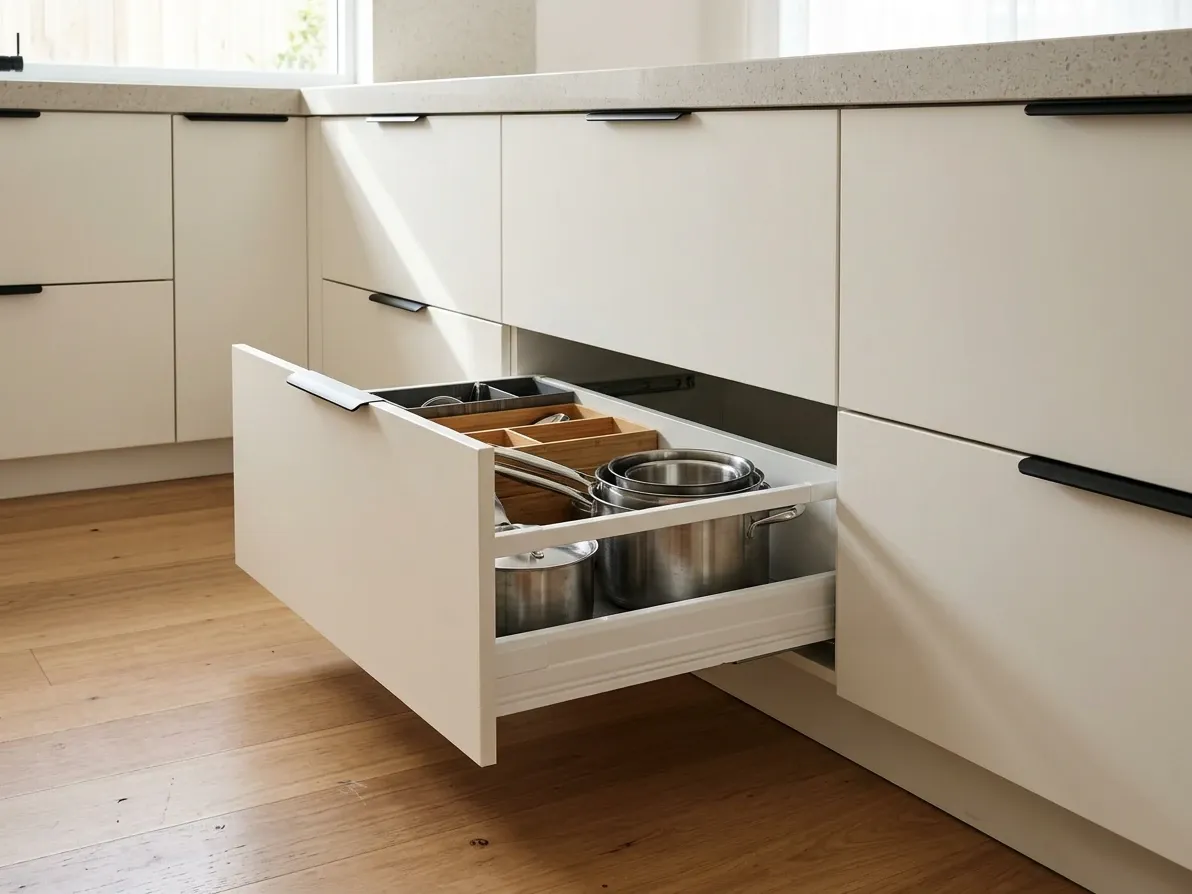
Modular base cabinets with a fully-extending soft-close drawer pulled open.
The three ways to design an IKEA kitchen
There are three official planning paths in Australia in 2026, and the right one depends almost entirely on how confident you are with measurements and software.
The first path is the free IKEA Kitchen Planner, the browser-based 3D design tool. You log in with an IKEA Family account (free, ten seconds to set up), enter your room dimensions, place doors and windows with sill and head heights, drop in METOD or ENHET cabinets from the library, swap door fronts and benchtops, and watch a live total price update as you go. The output is a shopping list complete with product codes, quantities, the leg packs and hinges you need to remember to add back if you delete a row, and a 3D walk-through you can scroll inside. For confident measurers comfortable with software, the free planner alone is enough to design and order a complete kitchen.
The second path is a free virtual planning appointment with an IKEA Kitchen specialist. You book a one-hour screen-share through IKEA’s kitchen planning service page (typically delivered as two one-hour sessions over a fortnight), and a planner walks through your plan with you on the call. They check the dimensions look credible, flag layout problems the planner won’t catch (a fridge that swings into a wall, a sink the plumber will quietly hate), refine the cabinet schedule, and clean up the order list. The session is free, the planner is genuinely useful, and the booking process now sits inside the same flow as the in-store planning service.
The third path is the paid in-home planning service, currently delivered through IKEA’s hipages partnership and at the time of writing offered only in selected Perth postcodes. A planner attends your house for up to three hours including a measuring service, walks the existing kitchen, takes the dimensions on site, and works the plan with you in real time. It is the right call when the room is irregular, when the existing services are in unusual positions, or when you’d rather not take the measurements yourself.
Inside those three paths sit two smaller decisions. Do you want the planning consultation to take place at an IKEA store rather than over a screen-share? Both are available; the in-store version is most useful when you want to see the door fronts and benchtop samples physically rather than on a monitor. And do you want a full interior design consultation alongside the kitchen plan? IKEA offers one through the same service flow, with the cost moving from free to a paid fee depending on the depth of the engagement. For most kitchens, the free planner plus the free virtual consult is the right answer. The paid options earn their place when the room is hard to read, not when the kitchen is small and standard.
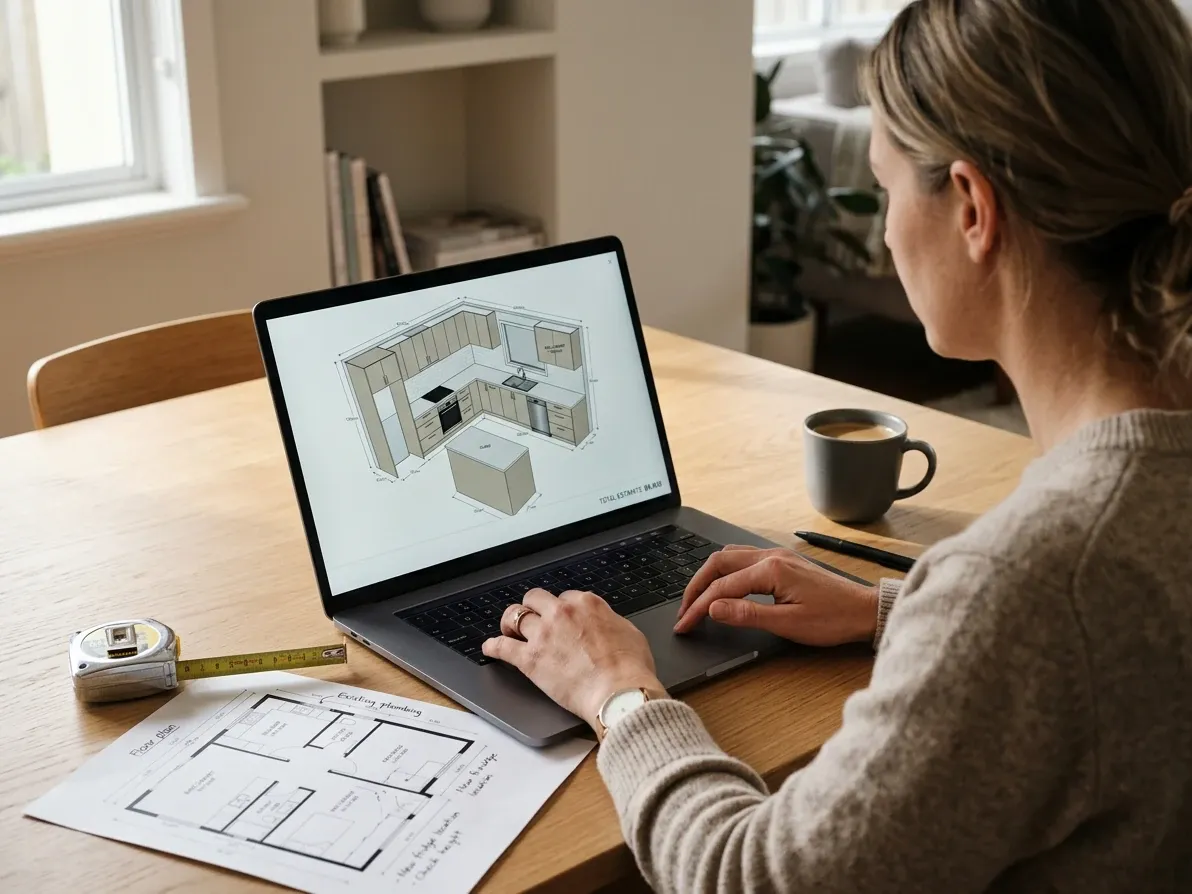
Working through a kitchen plan at home, before committing to the order.
Inside the free Kitchen Planner
The free planner is a competent tool but it lets you make some quietly expensive mistakes, and almost every IKEA kitchen review thread that goes wrong traces back to one of them. Working through the planner deliberately is the difference between an order that arrives complete and an order that turns up missing leg packs.
Start by entering the room shape as it actually is, not as you wish it were. Measure every wall to the millimetre, not the nearest centimetre. Enter doors and windows in their real positions, with the sill heights and head heights filled in (the planner has dedicated fields for both; use them). Mark where the existing water supply and waste come through the wall, where the gas point sits if you have one, and where each electrical circuit terminates. The planner does not enforce these positions, but knowing where they sit prevents you from drifting a sink across the room without thinking about what that costs in the real install.
Pick a layout from the ready-made suggestions if one matches your floor plan reasonably well. The ‘choose a favourite’ flow drops a pre-built layout into your room and lets you adjust from there, which is materially faster than building from scratch. The kitchen layout guide covers which shape (U, L, galley, island, open plan) suits which room; let that decision happen first, then pull the matching IKEA preset.
Switch the view to ‘3D line view’ rather than ‘front 3D view’ as soon as the kitchen has more than a handful of cabinets in it. The line version loads faster, lets you scroll the model without lag, and exposes collisions (a fridge swinging into a wall, a drawer crashing into an oven door, an island bench too close to a back wall for someone to walk past) more clearly than the front 3D view. Switch back to the front 3D view only when you want to check finishes or take a screenshot.
Watch for the order quirks IKEA’s own help pages and the wider planning community keep raising. If you delete every door front before submitting (because, say, you plan to buy custom doors from a third party), the planner will quietly delete the hinges as well. The same happens with METOD legs if you remove the plinths. Worktops often need to be cut to size and added separately rather than relying on the standard sheet. The 90cm-between-worktops and 5cm-against-walls clearances are real construction tolerances, not arbitrary numbers, and overruling them in the planner will produce a kitchen that will not fit on installation day.
Sense-check the cart before you submit. The shopping list at the end of the planner is the actual order, and IKEA orders are heavy with small parts (screws, brackets, plinth clips) that are easy to under-order. A free virtual consult with an IKEA specialist is the cheapest insurance against the order arriving incomplete; book one before you press the final button.
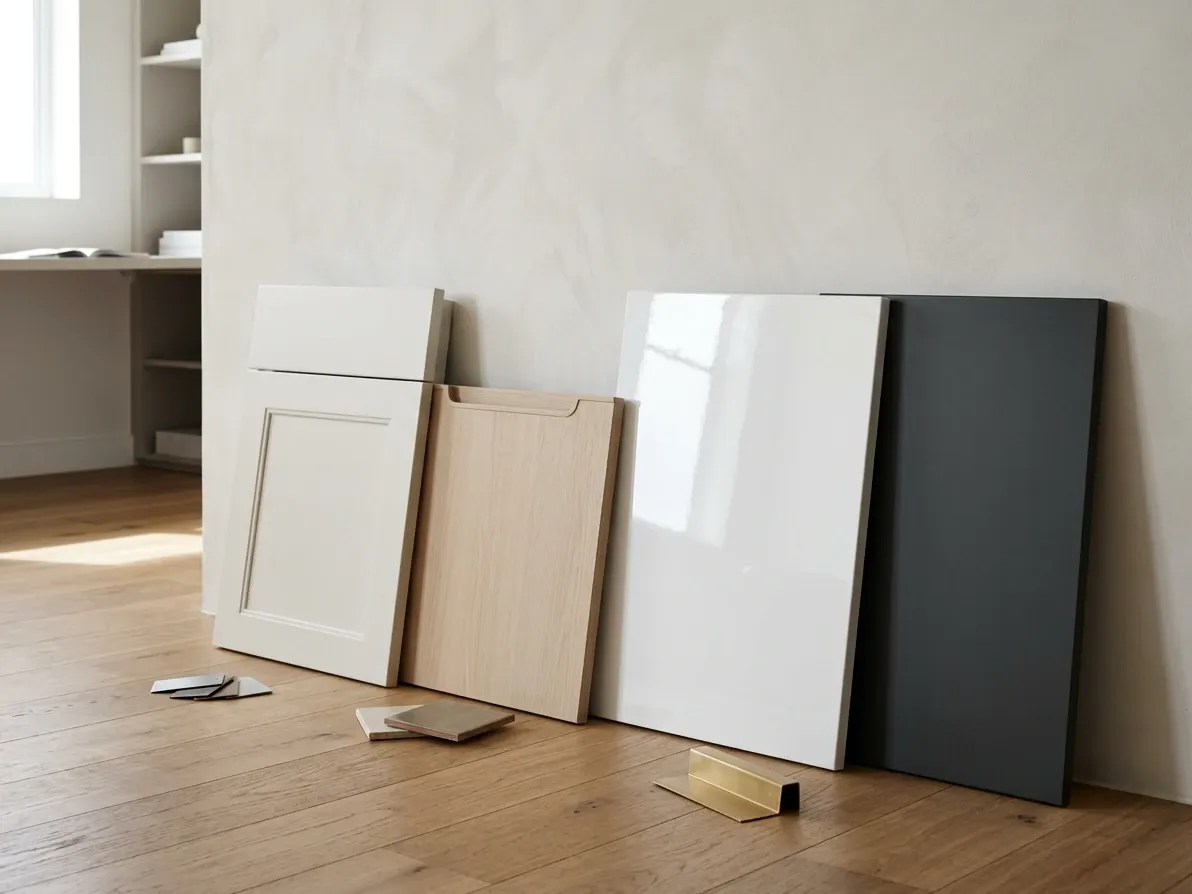
A handful of door fronts: shaker, high gloss, handle-integrated and matte dark.
METOD and ENHET, in plain English
The product names are slightly confusing because IKEA changed its kitchen system a few times. Australian buyers will see two names that are still relevant in 2026, and one historical name that is not.
METOD is the current flagship, introduced globally in 2014 and the system every new Australian IKEA kitchen plan since then sits inside. It replaced an older system called FAKTUM that ran from 2002 to 2014. If you are renovating a kitchen installed before 2014, your existing cabinets are most likely FAKTUM and your new ones will be METOD. The two systems are not cross-compatible; you can use FAKTUM-era doors on METOD frames only with the addition of mounting hardware available through Australian aftermarket specialists like Ren Studio, but in most cases a FAKTUM-to-METOD swap is a full cabinet replacement.
METOD itself is built around a small grammar of components: a frame (the cabinet box), a front (door or drawer face), a hinge or drawer rail (UTRUSTA on doors, MAXIMERA on drawers), an interior fit-out (shelves, dividers, accessories), and the trim parts that finish the run against walls, ceilings and adjoining cabinets. The cabinet widths are standardised in centimetres (40, 60 and 80cm are the dominant base sizes; 30cm and 20cm exist for tight conditions; 90, 100, 120 and 140cm cabinets sit in the wall and tall ranges), and the modular grid is what lets the planner build almost any layout without bespoke joinery.
The door front catalogue is where most of the design decision sits, and it is broader than most buyers realise. BODBYN is the matte shaker front available in off-white, grey and dark grey, the default pick for a traditional or French-Provincial-leaning kitchen. RINGHULT is a high-gloss flat-front door, available in white and a small number of colours, and it is the easiest way to land a contemporary high-gloss look at a budget price. VOXTORP is a smooth flat front with an integrated handle (no visible knob or pull), available in matte white, dark grey, oak effect and walnut effect, and it is the front that reads most cleanly as a designer-led contemporary kitchen. UPPLÖV is a newer matte dark beige with a chamfered edge and an integrated handle. ASKERSUND, KALLARP, EPOQ, STENSUND, NICKEBO and a handful of others fill out the rest of the range with varied colours, finishes and price points. The full catalogue sits on the METOD doors and drawer fronts page.
ENHET, the simpler smaller system, sits at the other end of the range. The frames are narrower, the fronts are limited to a tighter palette, and the system is engineered for fast assembly in tight spaces rather than for the long-life bespoke fit-out that METOD targets. It is the right pick for a granny flat, a studio, a small apartment kitchenette, or a rental refresh. The shorter 5-year guarantee reflects the lighter build.
The thing the catalogue does not say is that IKEA fronts can be replaced by third-party fronts that are cut to the IKEA module sizes. Australian and overseas businesses such as Plum Living and Dendra Door sell flat-pack-compatible fronts in finishes IKEA does not stock (real timber veneers, custom paint colours, fluted profiles), and the METOD frame underneath stays the same. This is the move that gets a high-end designer kitchen aesthetic out of a METOD carcase, and it is increasingly common on mid-range Australian renovations where the budget allows for custom fronts but not custom joinery.
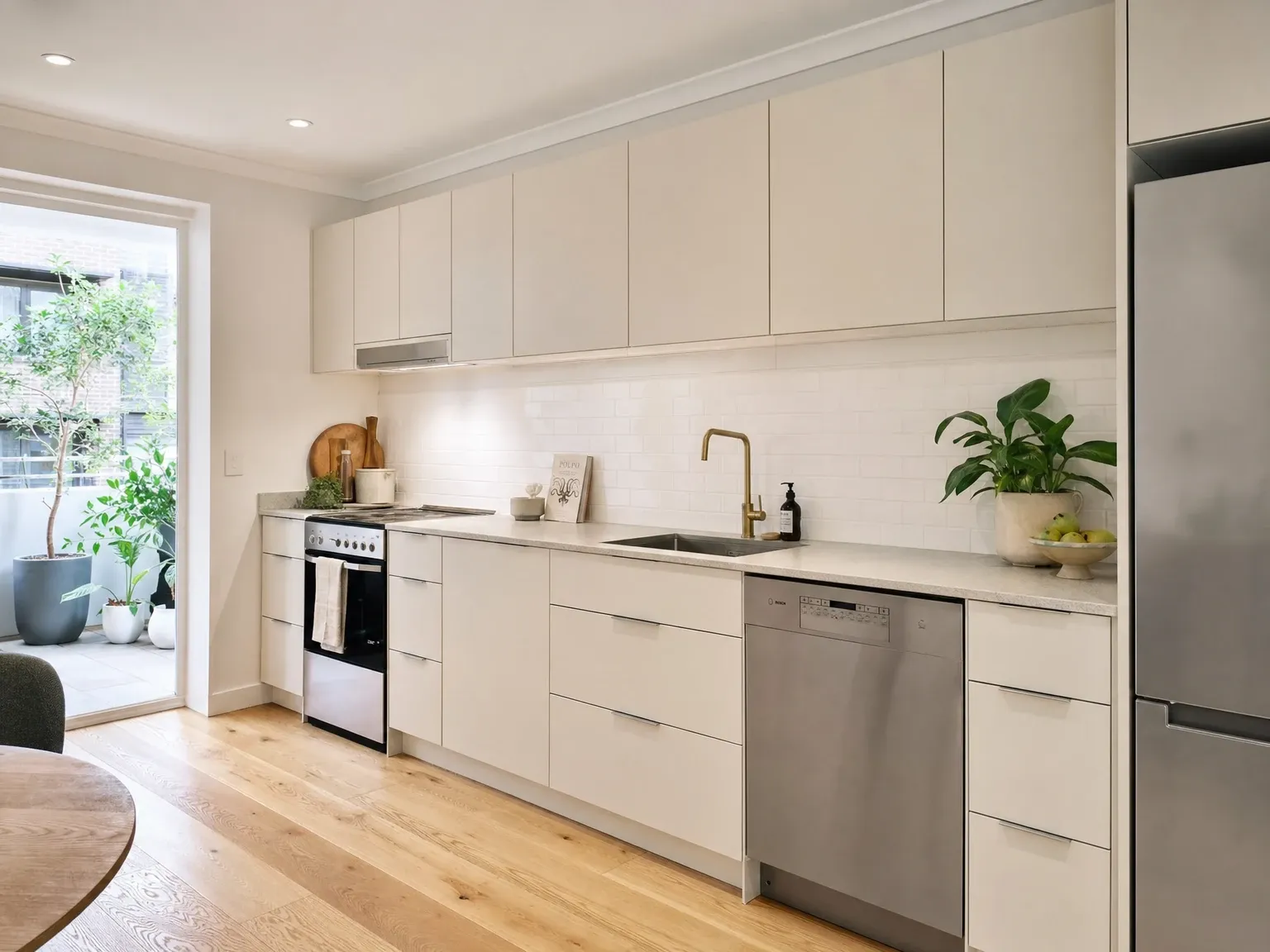
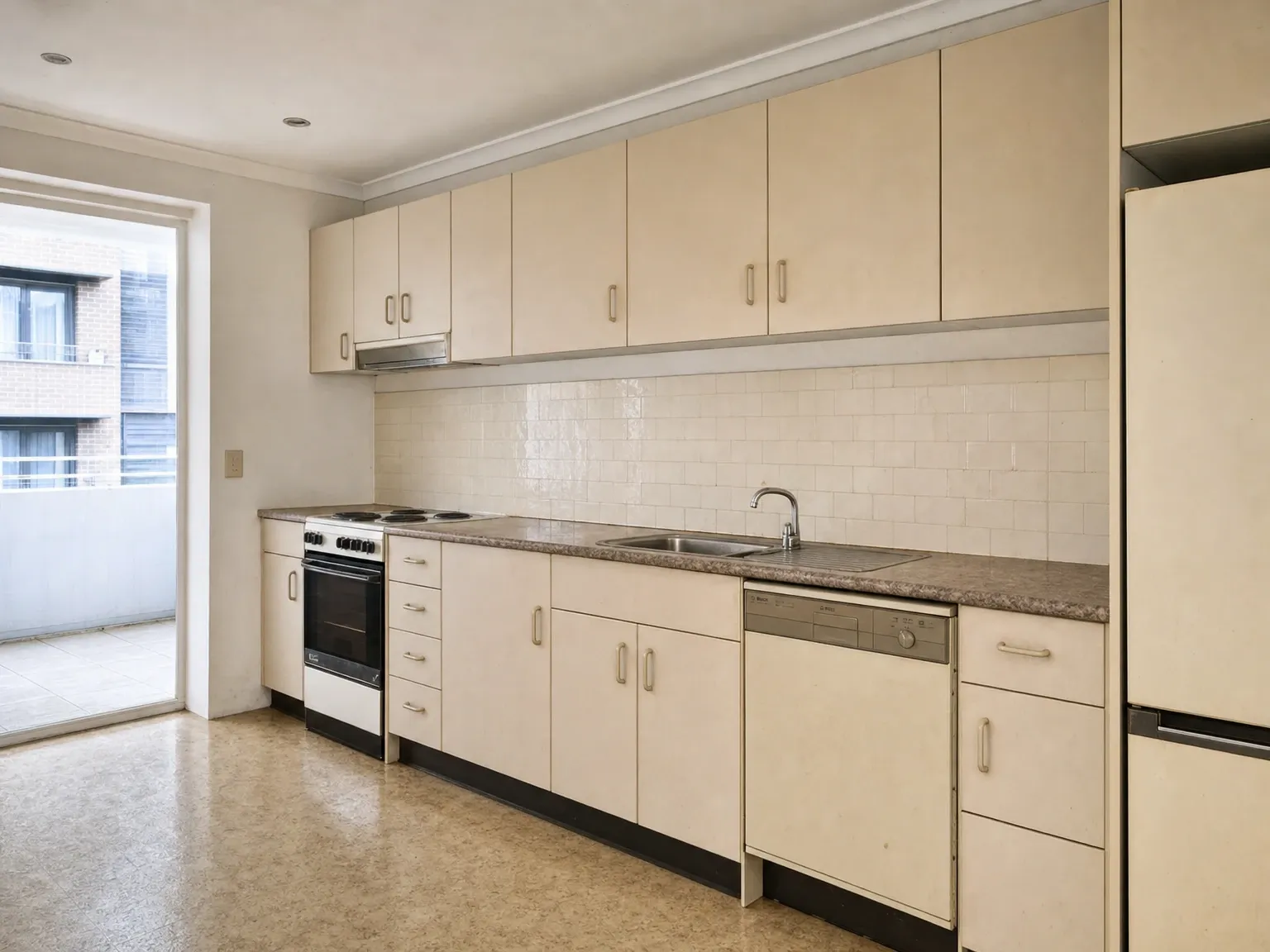 Before
After
Before
After
What an IKEA kitchen actually costs
The honest answer is that the cabinet number on the IKEA cart is not the cost of the kitchen, and treating it as if it is the cost is the single biggest reason IKEA kitchen budgets blow out.
For the cabinets, benchtops and the IKEA installation service alone, Airtasker’s 2025 cost guide reports total ranges between $6,600 and $33,800 depending on size, materials and labour, with the IKEA installation service component sitting at $1,500 to $6,000 on its own. That range is broad because it covers everything from a one-wall ENHET refresh in an apartment to a full METOD kitchen with a long island in a detached house.
Once appliances are added, the project total typically lands between $15,000 and $30,000 for a mid-range Australian IKEA kitchen, with full premium fit-outs (integrated appliances, stone benchtops, custom door fronts) pushing into the $40,000 to $50,000 bracket. Sydney runs noticeably above the national average because tradesperson rates run higher; the same kitchen built in Adelaide or Hobart usually comes in 10 to 15 per cent below the figure it costs in inner Sydney.
- Cabinets and benchtop$10,00050%
- Appliances$4,00020%
- IKEA install service$3,00015%
- Plumber and electrician$1,6008%
- Sundries and contingency$1,4007%
The lines that catch most first-time buyers are not the cabinets but the items around them. Plumbing connections (isolating and reconnecting water and waste, supplying the dishwasher and fridge if it has an ice maker) need a licensed plumber and typically run $800 or more per trip, with extra cost if the layout shifts the sink position. Electrical work (cooktop, oven, rangehood, dishwasher and a half-dozen power outlets) needs a licensed electrician and runs similarly. Tiling the splashback, sealing the joints to walls and benchtops, hanging and adjusting the doors after installation, and removing the existing kitchen all sit outside the IKEA cart and outside the installation fee.
The other line that catches buyers is the benchtop, particularly when the choice is stone. IKEA stocks laminate, timber and engineered stone within METOD, and the laminate range now does a credible job of mimicking stone. If you want a like-for-like fitted stone benchtop, a separate fabricator must template the cabinets, cut the stone and fit it. That move adds three to four weeks of fabrication time and a separate trade to the project, and it materially increases the spend (a 3-metre stone benchtop fitted runs in the $3,000 to $6,000 range as a standalone cost in 2026, depending on the stone). For most IKEA kitchens, the right answer is a credible laminate or the in-house engineered stone unless the kitchen genuinely needs the real thing.
The HIA national median for a complete kitchen renovation is in the $30,000 to $35,000 range, and most well-specified IKEA kitchens land at or below that figure even with stone benchtops and decent appliances. The wider kitchen renovation budget guide covers the line-by-line allocation across cabinets, benchtops, appliances and trades in more detail.
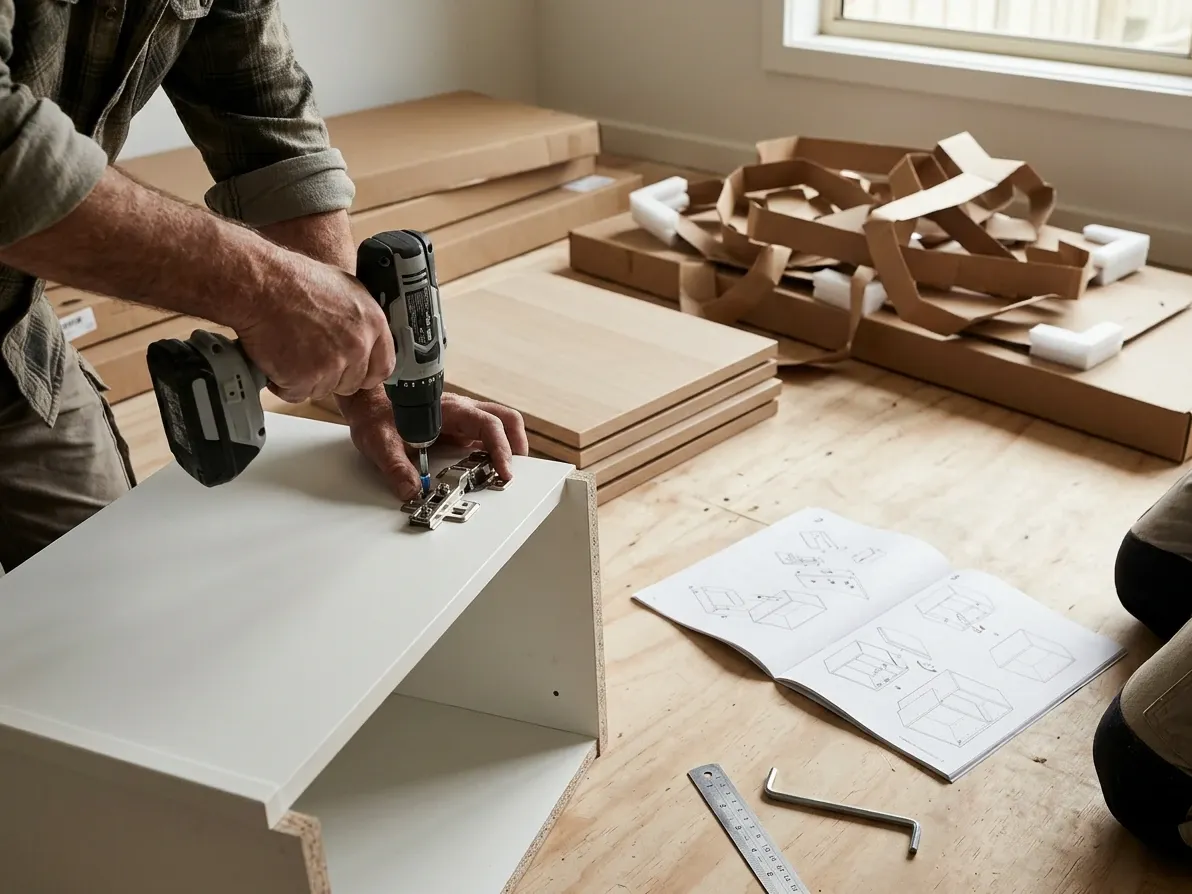
A flat-pack cabinet being assembled on site, mid-install.
Who installs an IKEA kitchen
IKEA Australia does not employ its own kitchen installers. Until a few years ago the company offered installation through a small number of partner contractors; the current arrangement is a referral relationship with hipages, the trades marketplace. The flow is reasonably elegant: you finish your design in the IKEA Kitchen Planner, the plan is sent through to hipages, and a network of approved local installers quote on assembling and fitting the kitchen. The service excludes South Australia.
Outside the hipages referral, three other paths are common. A specialist flat-pack installation business is the most reliable choice in most cases: companies like Flat Pack Builders and FlatPak Connexion handle dozens of IKEA kitchens a year, coordinate the dependent trades (plumbing, gas, electrical, tiling) on your behalf, and know the order of operations cold. A private cabinetmaker or carpenter who can read the IKEA manuals is the second option, common when you already have a regular tradesperson you trust. A confident DIY assembly is the third, with a licensed plumber and electrician brought in for the regulated work; this is the cheapest path and it suits handy owners with the time and tools for a multi-day build, but it is the path that produces the most installer-rescue calls when it goes wrong.
Whichever path you choose, the trades coordination matters more than the carpentry. The plumbing and gas connections must be done by a licensed plumber in every Australian state; electrical work must be done by a licensed electrician; the order in which these trades arrive determines whether the install runs in two days or three weeks. The shape of a smooth IKEA install is: existing kitchen demolished, walls and floor made good, plumbing and electrical roughed in to the new layout, IKEA cabinets assembled and fixed to the wall, benchtop templated and (if stone) fabricated, plumbing and electrical terminated, splashback tiled, doors adjusted, sealants run. A proficient installer working a standard layout usually finishes the cabinet assembly in two to three days; the wider project runs three to four weeks from demolition to a working kitchen on a typical apartment or suburban house.
The trades audience page covers the photo-and-visualisation side of how trades coordinate these jobs visually. The point worth surfacing in the IKEA context is that the installer’s quote will almost always exclude the trades they do not perform themselves: if the quote is purely for assembly and cabinet fit, expect to bring in a plumber and electrician separately. Specialist flat-pack installation businesses tend to include the coordination of those trades in the quote, which is usually worth paying for.
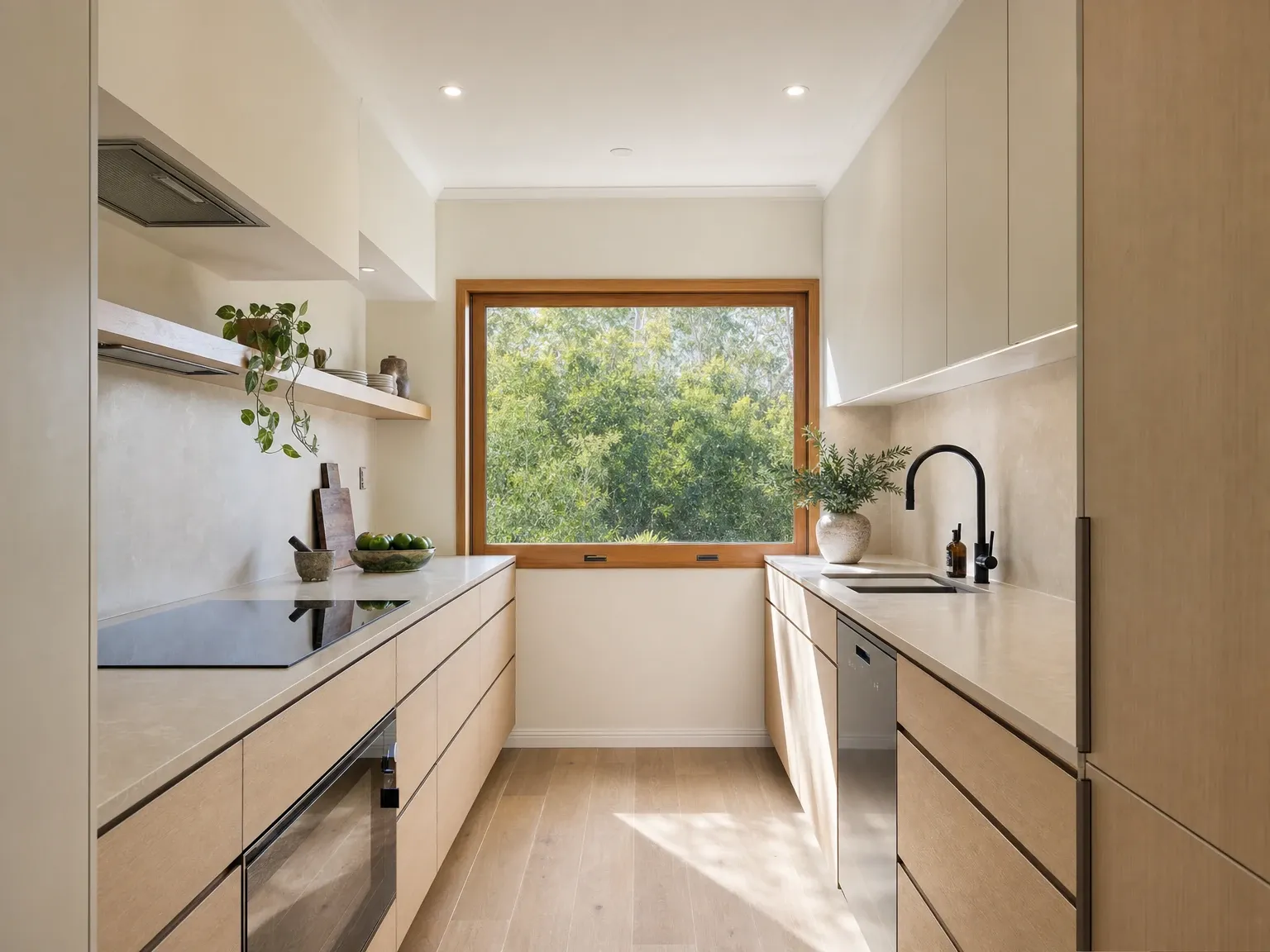
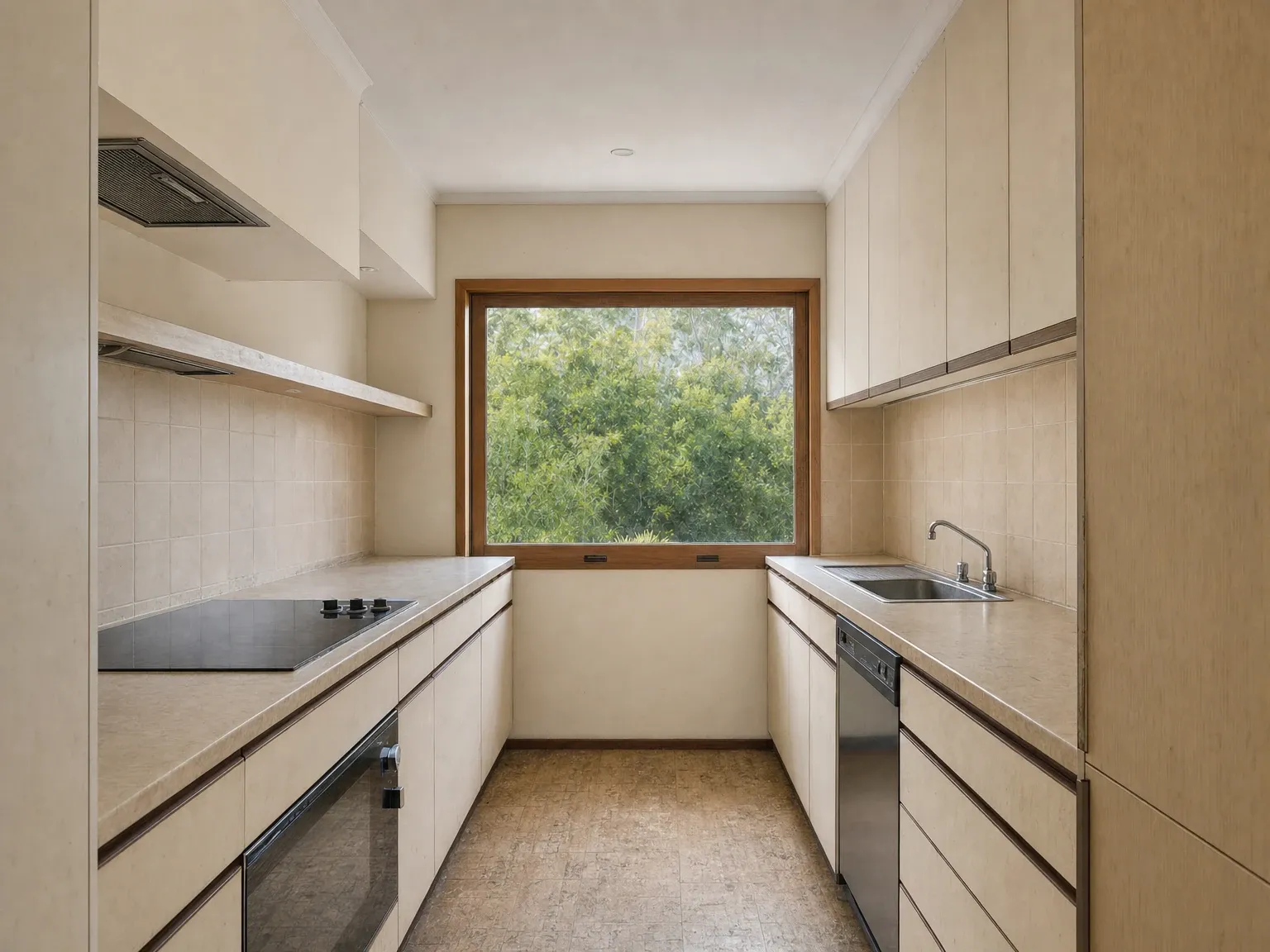 Before
After
Before
After
IKEA versus Kaboodle, and versus custom
Two comparisons matter for almost every IKEA kitchen buyer: IKEA against Kaboodle (the Bunnings flat-pack system that competes directly), and IKEA against a fully custom kitchen built by a cabinetmaker.
Against Kaboodle, the comparison is closer than the headline price gap suggests. CHOICE’s flat-pack comparison finds IKEA and Kaboodle comparable on quality and durability, with IKEA slightly harder to install. IKEA offers more than 15,000 style combinations through the METOD door range; Kaboodle offers fewer combinations but adds a ‘cut-to-measure’ service that lets you adjust widths (not heights) on selected doors and benchtops for an additional fee, which can save the filler panel that a strict modular system would otherwise require. IKEA’s cabinets carry a 25-year guarantee; Kaboodle’s cabinets carry a 10-year structural warranty extended via ‘Lifetime Advantage’ for as long as you live in the home. The IKEA planning service is free in person or virtually; Kaboodle charges $49 for an instore or virtual consultation and $99 for a home visit, both redeemable against the kitchen purchase.
The price gap at the entry level is meaningful: an IKEA ENHET L-shape corner kitchen starts at $2,038, against $6,042 for a Kaboodle L-shape from Bunnings. At the mid-range, the gap narrows substantially once benchtops, appliances and the matching hardware are added, and at the high end the choice usually comes down to which design language the buyer prefers (Kaboodle leans towards Australian-conventional cabinet aesthetics; IKEA leans towards the European modular look that has driven METOD’s design vocabulary for a decade). For most renovating Australians who are flat-pack-curious, the right move is to price the same layout in both systems before committing to either.
Against a fully custom kitchen, the comparison shifts. Custom cabinetmaking in Australia for a mid-sized kitchen typically lands in the $25,000 to $60,000 range for the cabinets alone, with high-end builds running well past that. A custom kitchen will fit your room to the millimetre, hide every junction, allow material choices IKEA does not stock (real solid timber carcases, brass mesh inserts, fluted oak doors), and last 25 to 50 years on the cabinets themselves with light maintenance. The IKEA equivalent typically runs 10 to 15 years in heavy daily use before the heavily-used parts (the drawer fronts at child-height, the seal between benchtop and splashback, the dishwasher panel) start to show wear; well-specified METOD kitchens last considerably longer than that, and reports of IKEA cabinets still going strong a decade after install are common in the renovation community.
The honest framing is this. IKEA wins on price, on speed, on planning convenience and on the cabinet warranty. Custom wins on fit, on materials, on longevity in heavy daily use, and on the bespoke feel a hero kitchen in a forever home benefits from. For an apartment, a rental refresh, a tight-budget house reno, or a kitchen that is already a standard rectangular shape, IKEA is the obvious answer. For a hero kitchen that has to be a focal point of a renovation, that has unusual dimensions, or where the joinery details are intended to be visible craftsmanship, custom usually earns its premium. The two systems are not actually competing for the same buyer most of the time.
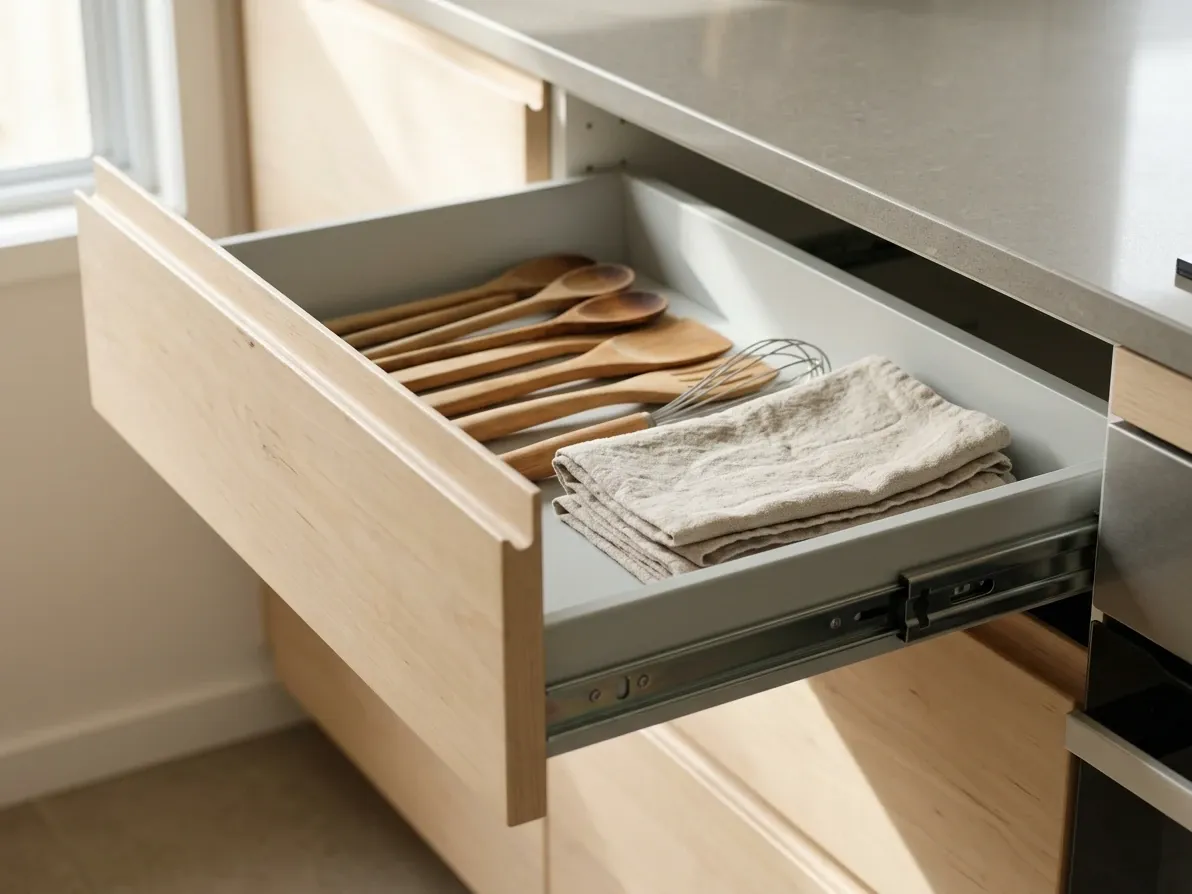
A modular drawer system in good order after years of daily use.
How long an IKEA kitchen lasts
The 25-year guarantee on METOD is the headline number, and it is real. IKEA’s Australian kitchen guarantee documentation confirms the 25-year cover applies to METOD cabinet frames (with the documented exceptions for VADHOLMA and TORNVIKEN), fronts, UTRUSTA hinges, MAXIMERA fully-extending drawers, EXCEPTIONELL push-to-open drawers, tempered-glass and melamine UTRUSTA shelves, legs and plinths, cover panels, deco strips, worktops and most sinks. The guarantee covers defects in materials and workmanship under domestic use, and excludes commercial use, accidents, misuse and normal wear and tear.
Within the same IKEA kitchen, the warranties stack differently across the components. Mixer taps carry a 10-year guarantee. IKEA appliances (ovens, cooktops, rangehoods, dishwashers, fridges) carry a 5-year guarantee, except for the LAGAN and TILLREDA budget ranges, which carry a 2-year guarantee. The ENHET system carries a 5-year guarantee end-to-end, materially shorter than METOD’s 25 years because ENHET is engineered for a lighter duty cycle.
The real-world longevity number runs slightly below the warranty number, as it does for almost every cabinet system. The most-reported failures in Australian METOD kitchens after a decade of heavy use are the EKBACKEN laminate benchtops (swelling, delamination and moisture ingress around joints and behind sinks) and the lighter-finish doors on the most-used drawers, where wear and tear from regular contact starts to show. Custom plywood and hardwood cabinets handle moisture better than IKEA’s particleboard with melamine finishes, and a forever-home kitchen with cabinets that need to last 25 years through three children and a renovation might be better served by a custom build for the carcases and a third-party door front. For most domestic use, the METOD system runs comfortably for 10 to 15 years and often longer with reasonable care, which is well inside what most owners actually want from a kitchen before they refresh it again.
Maintenance is uncomplicated. Wipe finishes with a soft cloth and warm water rather than abrasive cleaners; reseal the silicone joints between benchtop and splashback every few years; check the hinges and drawer rails annually and tighten anything that has loosened. The cabinet system is engineered to be flat-packed once and then left alone; the more you take it apart and reassemble it, the harder it is on the hardware.
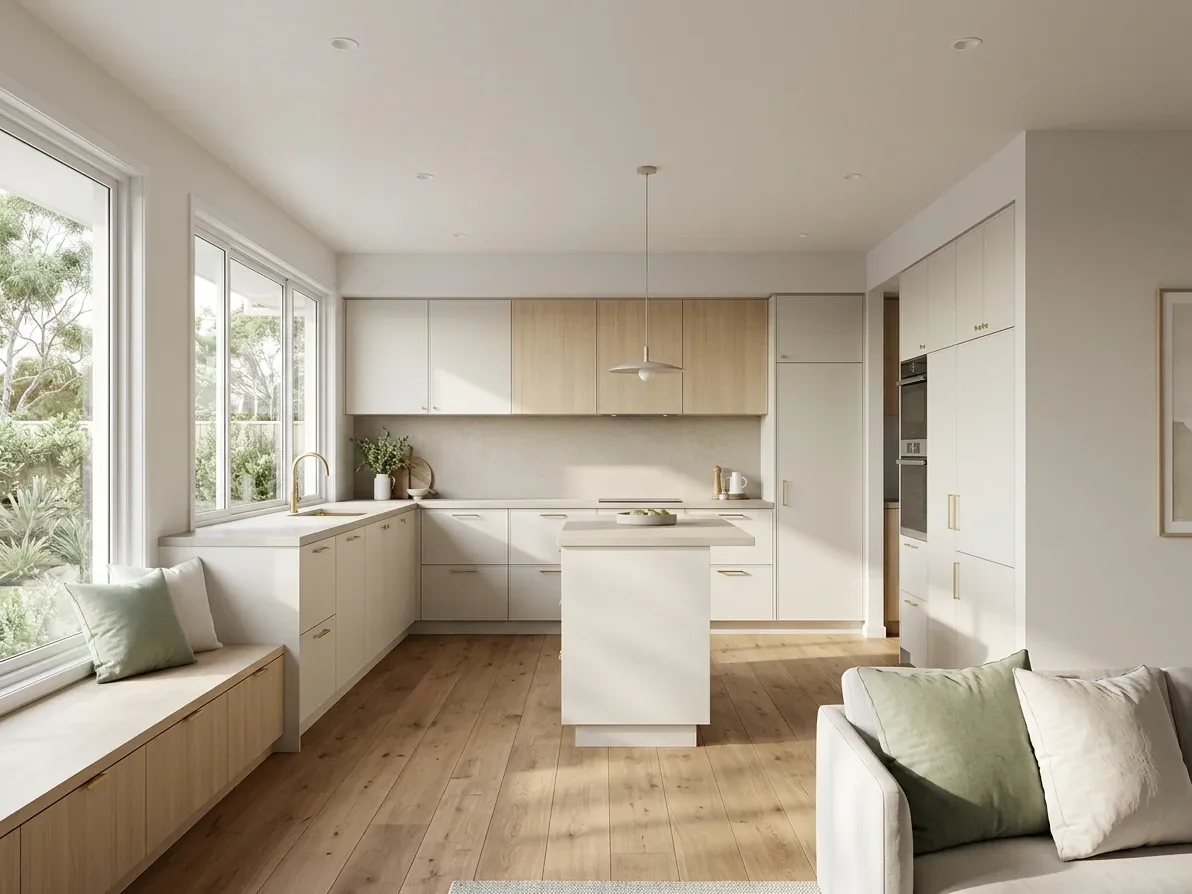
A photoreal render of the same kitchen, before the order is placed.
Visualising your kitchen before you commit
The IKEA Kitchen Planner produces a credible 3D model of the kitchen you have specified, and for many buyers that model is enough to commit to the order. The model has two limits worth being honest about. The first is that it shows the kitchen, not the room: the surrounding walls, floors, lighting and existing features show up as generic placeholder geometry rather than as your actual house. The second is that the model’s 3D render quality, while improving steadily through IKEA’s new 3D kitchen planning experience now live in Australia and 16 other markets, sits closer to a flat-shaded preview than to a photoreal architectural visualisation. It tells you whether the layout works. It does not tell you whether the kitchen will feel right when it is in your room with your light.
For most kitchens that is fine. For a kitchen that costs five figures, that will be in place for ten years, and where the door front choice or the benchtop colour is genuinely difficult to commit to, a photoreal visualisation step before ordering is the cheapest insurance in the project. We build that visualisation step as a service: send us a few photos of the existing space and the IKEA cabinet schedule and we’ll produce a photoreal 3D render of the finished kitchen sitting in your actual room, with the door front, benchtop and lighting you’ve specified. 3D rendering covers the full service. It is not necessary for every kitchen. It is genuinely useful for the kitchens where a $9,000 cart on the IKEA website is harder to commit to than it should be.
The wider point is that IKEA’s own planner is a planning tool first and a visualisation tool second, and treating it as a planning tool is the right approach. Get the layout right, get the cabinet schedule right, sense-check the order with a free IKEA virtual consult, and add a photoreal 3D render only when the design decision genuinely needs one.
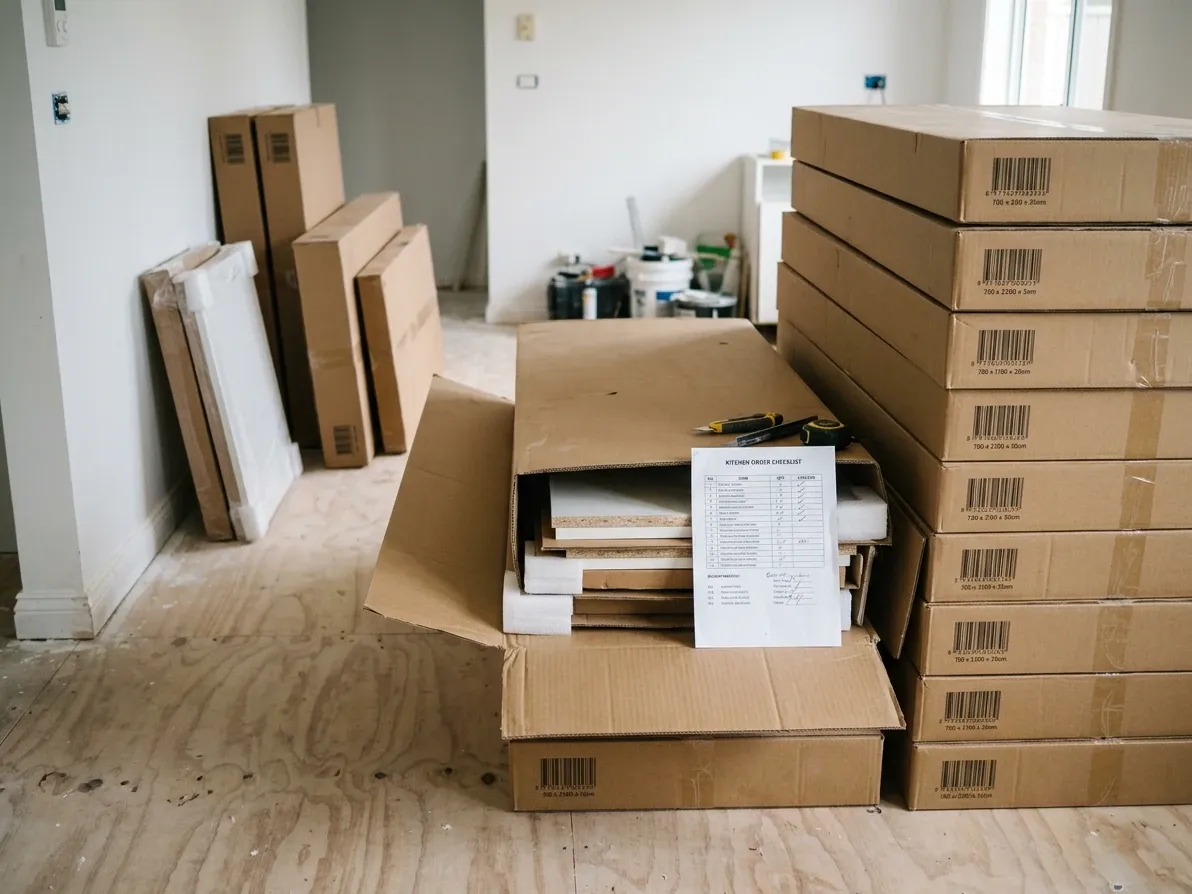
Flat-pack boxes mid-delivery: the moment small order mistakes show up.
Common mistakes when planning an IKEA kitchen
The IKEA kitchens that go wrong almost always do so for one of a short list of recognisable reasons. They are worth naming because they are easy to avoid once you’ve seen them written down.
The first is treating the planner’s cart total as the cost of the kitchen. The cart shows cabinets, benchtops and, if selected, appliances and the install service. It does not show the plumber, the electrician, the tiler, the floor repair, the rubbish removal, the sealants and silicones, or the cost of the bench that needs to be templated and fabricated separately because the run is wider than IKEA’s standard sizes. Build the full budget on a spreadsheet (cabinets, benchtops, appliances, sink and tap, plumber, electrician, tiler, floor, demolition, contingency) before treating the IKEA cart as the cost.
The second is moving the services without thinking about what it costs. The IKEA planner will let you drag a sink five metres across a room. The plumber will not. Service positions (water, waste, gas, power) are real-world constraints, and respecting them in the layout is the difference between a $1,500 plumbing job and a $5,000 one. If the new layout genuinely needs services moved, get a plumber and electrician to walk the existing house with you before you finalise the plan.
The third is under-specifying the order. Hinges that quietly disappear from the cart when door fronts are deleted, plinths that go missing when METOD legs are removed, leg packs that need to be re-added by hand, worktops that need to be sized separately, screws and brackets that ship in the wrong quantities. The free virtual consult with an IKEA specialist catches almost all of these. Booking one before submitting the order is the most reliable insurance against an installation day that stops because a $20 bag of hinges did not turn up.
The fourth is picking a door front and a benchtop without seeing them physically. The IKEA showroom has door front samples and benchtop samples in stock, and the difference between a finish on a monitor and a finish in daylight is sometimes startling. Take the time to handle the samples, particularly for high-gloss fronts (RINGHULT) and matte fronts (BODBYN, VOXTORP) where the reflectivity changes the read of the kitchen completely.
The fifth is over-ambitious DIY. The cabinet assembly is genuinely DIY-friendly for a confident handy person. The plumbing, gas and electrical work is not, and it is illegal to attempt it without the relevant licence. Even DIY-capable owners regularly underestimate how much trade coordination is involved: a kitchen install touches the plumber, electrician, tiler, possibly the gas-fitter, sometimes the plasterer, and the rubbish-removal service, and timing them so they are not standing on each other’s toes is a logistical job in its own right. If the project is the kitchen and you have one weekend you’d like to spend on it, hire a specialist installer.
The sixth, and the one that ages an IKEA kitchen fastest, is choosing the cheapest version of every part. The base METOD frame is the same regardless of the door front and benchtop; what makes an IKEA kitchen read as expensive or as cheap a decade in is the choice of door front, the choice of benchtop, the tap, the rangehood, and the lighting. Spend the budget unevenly: keep the carcase standard, and put the money into the components the eye lands on.
Frequently asked questions
What’s the difference between the free IKEA Kitchen Planner and a paid in-home consultation?
The free IKEA Kitchen Planner is a browser-based 3D design tool you use yourself. You enter your room dimensions, place doors and windows, drop in METOD or ENHET cabinets, swap fronts and benchtops, and get a live total price as you go. A free virtual planning appointment adds an IKEA kitchen specialist to a screen-share over two one-hour sessions to review your plan, sense-check the layout and clean up the order list. The paid in-home planning service, currently offered via IKEA’s hipages partnership in selected Perth postcodes only, sends a planner to your house for up to three hours including a measuring service. For most Australian buyers the free planner plus a free virtual consult is enough. The paid in-home service makes sense when the room is irregular, the measurements are hard to take, or you want a planner to physically check window heights, skirting boards and existing services before you commit to the cabinet schedule.
Is IKEA cheaper than a custom kitchen in Australia?
Yes, materially. A fitted IKEA kitchen in Australia typically sits at roughly $5,000 to $15,000 for cabinets, benchtops and the IKEA installation service, with extra spend on appliances, plumbing and electrical work bringing the total to somewhere between $15,000 and $30,000 on a mid-range project. A semi-custom or fully custom kitchen with stone benchtops and a designer cabinetmaker is more often in the $25,000 to $60,000 range, with high-end builds running well past that. IKEA wins on price and on speed; custom wins on fit, materials and longevity. For an apartment, a rental refresh, or a tight-budget house reno where the floor plan is already standard, IKEA usually makes sense. For a hero kitchen in a forever home, where every dimension is bespoke and the joinery is a focal point, custom often earns its premium.
Who actually installs an IKEA kitchen in Australia?
IKEA does not employ its own kitchen installers in Australia. The official installation service is a referral arrangement with hipages, the trades marketplace: you complete your design in the IKEA Kitchen Planner, the plan is sent through to hipages, and a network of approved local installers quote on assembling and fitting the kitchen. The service excludes South Australia. Outside that referral, three other paths are common: a specialist flat-pack installation business that handles dozens of IKEA kitchens a year, a private cabinetmaker or carpenter who can read the IKEA manuals, or a confident DIY assembly with a licensed plumber and electrician brought in for the regulated work. Whichever path you choose, the plumbing and gas connections must be done by a licensed plumber and the electrical work by a licensed electrician. That is legally non-negotiable in every Australian state.
What’s the difference between METOD and ENHET?
METOD is IKEA’s flagship kitchen system, sold in Australia and Europe (the equivalent North American system is SEKTION). It is fully modular, with a wide range of cabinet widths, depths and heights, a deep library of door fronts (from the matte off-white BODBYN shaker to the high-gloss RINGHULT and the handle-integrated VOXTORP), a 25-year guarantee, and the architectural flexibility to build almost any kitchen layout including islands, tall pantry runs and integrated appliances. ENHET is a smaller, simpler kitchen system aimed at studios, apartments, granny flats and rental refreshes. It has a tighter range of sizes and finishes, a 5-year guarantee, and a noticeably lower entry price. The rule of thumb: ENHET for a compact secondary kitchen or a fast budget refresh on a small footprint, METOD when the kitchen is the main kitchen in the home and you want the full system.
Does IKEA Australia have stone benchtops, or only laminate?
Both. IKEA Australia stocks laminate, solid timber and engineered-stone-style benchtops within the METOD ecosystem, and the laminate range now does a credible job of mimicking stone, timber and concrete at a fraction of the price. For a like-for-like fitted stone benchtop you can also bring in a third-party fabricator to template and fit a stone top over the IKEA cabinets, which is a common move on mid-range projects where the cabinets are flat-pack and the benchtop is custom. The trade-off: stone adds three to four weeks of fabrication time to a project that would otherwise hit the floor in days, and the lifting and templating requires a separate trade. If the benchtop run is wider than IKEA’s standard stock sizes, expect to template and fabricate it separately whichever surface you choose.
How long does an IKEA kitchen take to install?
A proficient installer working on a standard layout will usually finish an IKEA kitchen in two to three days, assuming the room is ready, the plumbing and electrical rough-in is in position, and the order has arrived complete. A DIY assembly by a careful first-timer can take four to five days. The longer pole in most projects is not the assembly itself but the trades coordination around it: the plumber must isolate and reconnect water and waste, the electrician must terminate the cooktop, oven and rangehood circuits, and any tiling, painting or splashback work has to slot in around the cabinet installation. For an apartment or a typical suburban kitchen, three to four weeks from demolition day to a fully functioning kitchen is a realistic end-to-end timeline.
Is the IKEA Kitchen Planner accurate enough to order from?
Yes, with one large caveat: the planner is only as accurate as the measurements and assumptions you feed it. Wall lengths must be measured to the millimetre, not rounded. Door and window positions, sill heights and head heights must be entered exactly. Service positions (where the existing water and waste pipes come through the wall, where the gas point sits, where the power circuits terminate) must be respected, because moving them is a real-world variation that costs trade time and money. The planner will let you drag a sink five metres across a room without flagging anything; the real-world plumber will flag it on day one. Triple-check the dimensions, walk the 3D model in line view rather than full 3D shaded mode (it loads faster and exposes more clearly where things collide), and book a free virtual consult with an IKEA kitchen specialist to sense-check the order before you submit it.