Ensuite bathroom ideas: layout, cost and finishes
A practical guide to ensuite design in Australia. Sizing, layout, fixtures, finishes, costs, the AU rules, and how to picture it before you build.
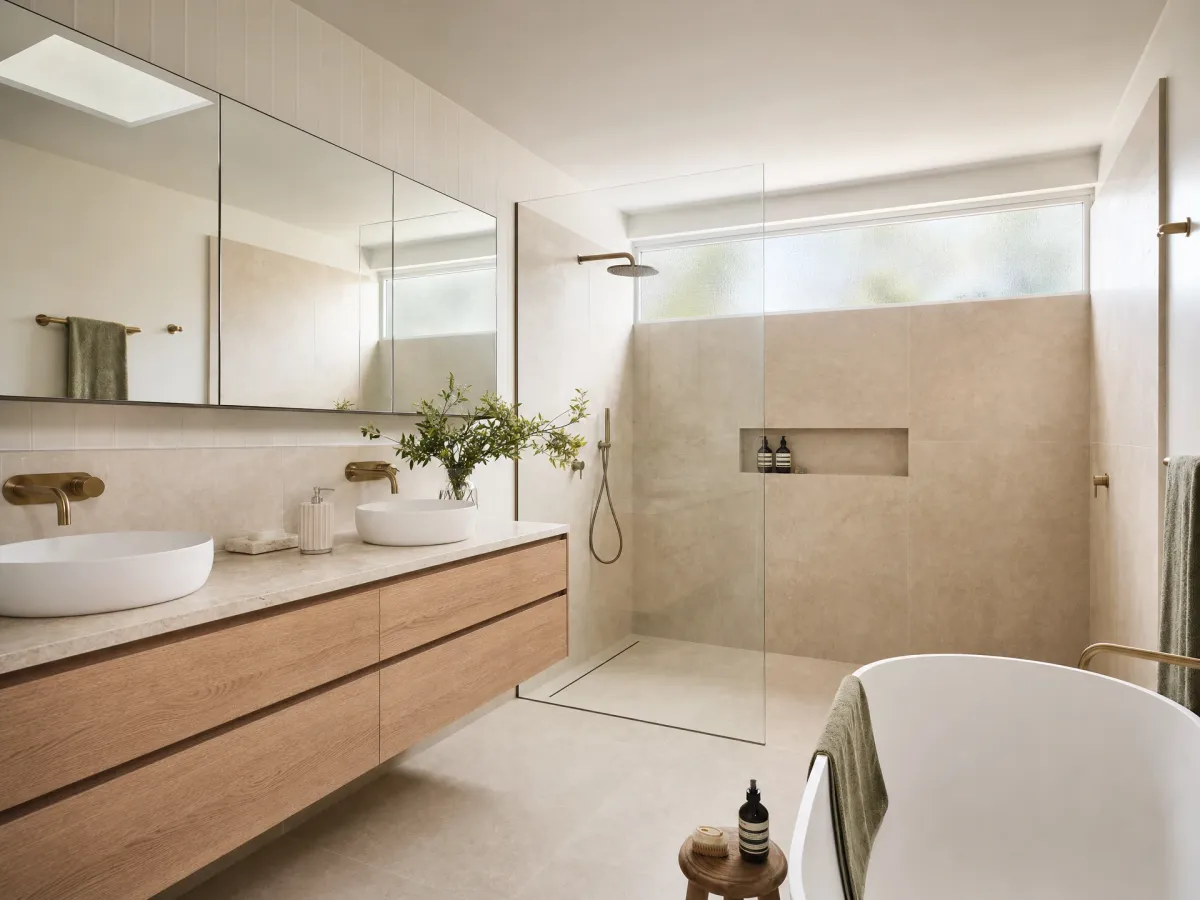
The ensuite is the only bathroom that has to work in the dark
Every other bathroom in the house is shared on a roughly equal schedule. The ensuite is not. It is the bathroom one person uses at 5:45 am while the other is still asleep, the bathroom that has to handle a shower without waking the bedroom on the other side of the wall, the bathroom that gets used by two people at the same time when both are running late and the second person is brushing teeth while the first is wrapping a towel.
That is the test no other bathroom has to pass, and it is the test that separates an ensuite that becomes the most-loved room in the house from one that gets demolished and rebuilt eight years later. Layout, plumbing wall, ventilation, lighting and door type all answer back to it.
This guide walks through the decisions an Australian ensuite renovation actually has to make, with realistic numbers, the AS 3740 and NCC rules the work has to meet, and the things designers, plumbers and homeowners only mention after the build is over. It is written for the renovator deciding between a like-for-like refresh and a full strip-out, the new-build buyer choosing an ensuite layout off a floor plan, and the homeowner converting part of a bedroom or robe into a first ensuite for the master suite.
If you are working with a particularly compact room, the small bathroom design guide covers the dimension-by-dimension trade-offs in more depth. The general bathroom renovation framework sits one level above this article and covers the order of decisions for any Australian bathroom. This piece is the specialist sibling.
What counts as an ensuite in Australia in 2026
In Australian and British usage, an ensuite is a bathroom attached directly to a bedroom (almost always the main one), accessible only from that bedroom rather than from a hallway. American sources call this a master bathroom, and the language shows up in search results from both directions; the room is the same.
A few features mark it out from a main bathroom. It is smaller, often by a wide margin: a typical Australian main bathroom sits at 5 to 7 square metres, while a typical ensuite sits at 3 to 5 square metres. It is shared by one or two people who know each other’s routines rather than three or four with conflicting schedules. The guest bathroom rules (towel rails for visitors, decorative finishes) do not apply, but acoustic isolation from the bedroom does. And resale value depends on it existing more than on what is in it: adding an ensuite where there was none lifts a property’s price meaningfully; upgrading a tired ensuite by one finish-tier rarely does.
- Separate house70%
- Townhouse, semi13%
- Flat or apartment17%
The ensuite hub of a modern Australian master suite usually pulls together three rooms: the main bedroom, the walk-in robe and the ensuite itself. Builders like Simonds and Rawson draw these as a flowing sequence (bedroom into robe into ensuite), which is the layout most buyers now expect on a four-bedroom new build. The conversion playbook from an older home with no ensuite usually annexes a corner of the main bedroom or splits off part of the existing main bathroom, both of which need careful planning around plumbing access.
How small is too small
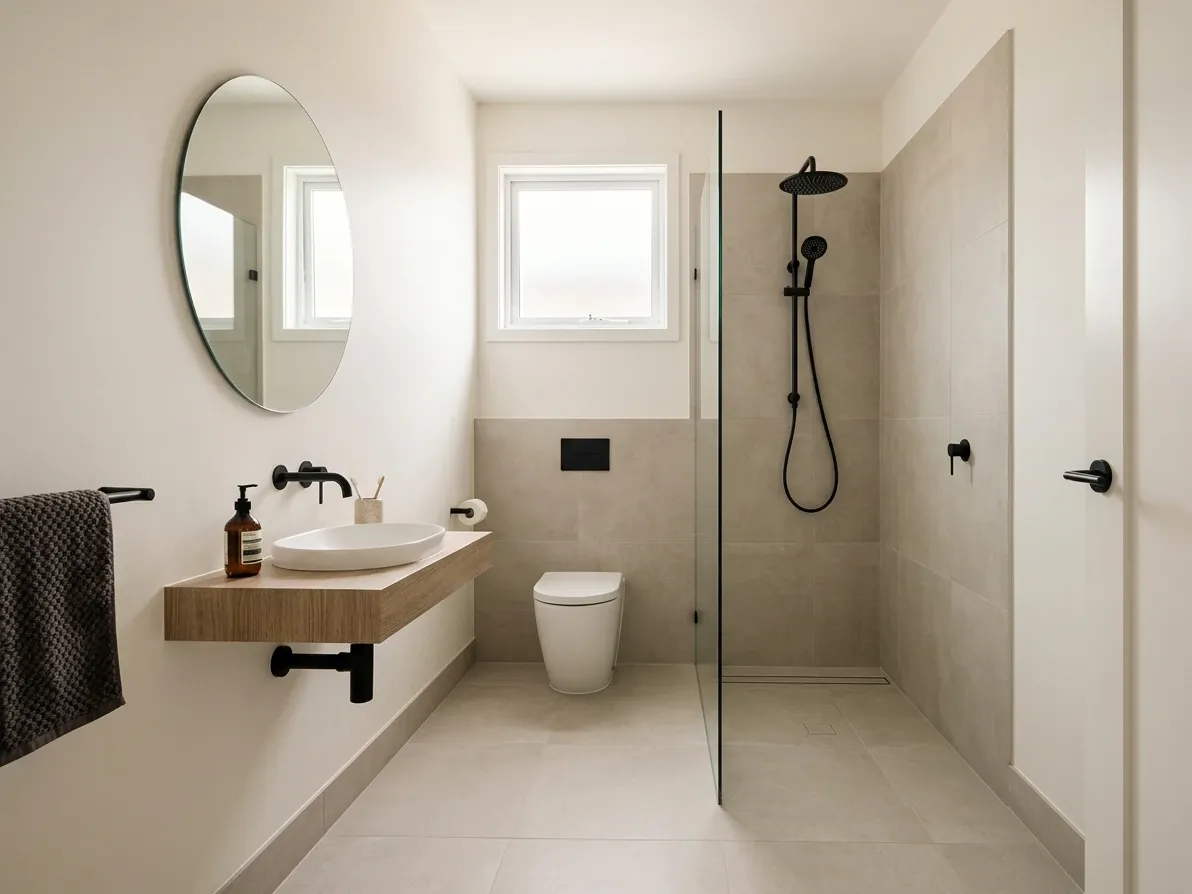
A small ensuite reads as generous when the materials are calm.
The smallest ensuite that genuinely works has roughly 3 square metres of floor and a footprint of about 1.5 metres by 2.0 metres. That is enough for a 900 by 900 millimetre shower, a wall-hung toilet and a 700 to 900 millimetre vanity, with a swing-door entry on the long wall. It is tight. The room reads as a stand-up shower and toilet with a basin against the wall.
A comfortable ensuite sits at roughly 1.8 metres by 2.4 metres, or about 4.3 square metres, which lets you fit a 1,200 millimetre vanity (the smallest size that takes a single integrated basin without feeling cramped) and a 1,000 by 1,000 walk-in shower, with the toilet behind a half-wall or at the end of the room. A 2.0 by 3.0 metre ensuite, around 6 square metres, is where the room starts feeling like an indulgence rather than a function, and where a freestanding bath, twin basins and a separate WC compartment all become possible without crowding.
The constraints are set by three fixtures and the standard Australian door. The minimum comfortable shower is 900 by 900 millimetres, with 1,000 by 1,000 being the size most Australian designers default to when there is room. A 1,200 millimetre walk-in shower is where the room reads as generous. A wall-hung toilet needs 750 to 800 millimetres of clear floor in front. A vanity depth of 450 to 500 millimetres works in a small ensuite without crowding the basin. And the standard Australian internal door at 820 millimetres wide claims about 900 millimetres of swing space when it is hinged inward, which a cavity slider returns to you in full.
If your room is below 1.5 by 2.0 metres, the honest decision is to either take the next decision (move a wall to gain 200 to 300 millimetres) or accept that the room is a powder room with a shower bolted on. Trying to fit a full ensuite into 2.5 square metres produces a bathroom that no one is happy in.
The three layouts that actually work
Almost every Australian ensuite ends up in one of three layouts. Picking between them is largely a function of room shape, where the plumbing wall sits in the existing structure, and where the door has to go.
Single-wall layout. All three fixtures (shower, WC, vanity) line up along one continuous wall, with the door entering on the opposite long wall. This is the cheapest layout to plumb because every drain and supply line sits on the same stack, and it works in long narrow rooms from about 1.6 to 1.8 metres wide. The shower takes one end (usually the far end, away from the door), the toilet sits in the middle, and the vanity takes the door-side end so that the mirror catches natural light from the bedroom-side entry. This is the layout most production-builder ensuites use because it costs the builder the least to plumb. It is also genuinely good design for narrow rooms.
Galley layout. Shower on one long wall, vanity opposite, toilet at one end. The galley reads as more spacious than a single-wall layout because the eye travels the full length of the room rather than stopping at the wall in front of you. It needs at least 2.0 metres of width to leave 800 millimetres of clear circulation between the vanity edge and the shower screen, and it needs a plumbing strategy that handles two wet walls (the shower wall and the vanity wall). The galley is the workhorse layout for ensuites between 2.0 and 2.4 metres wide.
Corner shower with separate WC compartment. The shower sits in one corner with a corner-entry screen, the vanity runs along an adjacent wall, and the toilet sits in a small partitioned compartment behind a half-wall or a separate door. This is the layout that turns up in larger ensuites (above 5 square metres) where the WC compartment buys both privacy and a place to put a freestanding bath against the long wall once the toilet is hidden. It costs more to build because it adds a wall, and the WC compartment needs its own light and exhaust.
A fourth layout, the open wet room, drops the screen entirely and waterproofs the whole floor to a linear drain. It is the most photographed ensuite layout of the past three years and reads beautifully, but it is more expensive because the whole floor has to be graded, waterproofed and tiled to wet-room standard, and a wet room means every surface in the bathroom gets sprayed and dries slowly, which suits some households and frustrates others. Pick a wet room only if the room is genuinely large enough (above 4 square metres) and you have priced the upgrade honestly.
If you are still deciding between layouts, a 3D floor plan of each option is the cheapest way to resolve it. Drawing it on paper does not catch the moment where the shower screen door swings into the vanity drawer.
Plan the plumbing wall first, everything else after
The single biggest cost lever in any ensuite renovation is the plumbing wall. Keeping the existing one saves money. Moving it costs money. A like-for-like ensuite renovation in the same footprint can cost 20 to 30 per cent less than the equivalent finish on a relocated layout, because moving the shower drain, toilet outlet or vanity supply to a different wall means new in-slab plumbing on a ground floor, ceiling penetrations from above on an upper floor, plumber and tiler days, and patching everywhere the old pipes used to be.
In practice, this means the shape of the existing pipework usually dictates the shape of the new ensuite. If the existing toilet sits on the long wall with a 100 millimetre soil stack running down inside the wall, every layout option keeps the toilet within about 1.5 metres of that point. If the shower drain currently exits at one corner, that corner stays a wet corner unless there is a compelling reason to relocate it. Asking the licensed plumber to map the existing stacks and access points before you commit to a layout is a 30-minute exercise that has saved tens of thousands of dollars on more than one bathroom project.
Two technical points worth knowing before any tradie starts cutting. First, the soil pipe (the main waste pipe from the toilet) needs a fall of at least 1.65 per cent (one in 60) for any new run, which limits how far you can move a WC without dropping into the slab or building up the floor. Second, drainage layouts must follow AS/NZS 3500 (the Plumbing Code of Australia) and the work itself has to be signed off by a licensed plumber. Where the existing soil stack ties into the main drain is the constraint behind almost every layout decision.
The corollary: if you have done the plumbing-wall homework, you have done 60 per cent of the design work for the ensuite. Most of the rest is finish selection.
The shower is the workhorse
In a master ensuite, the shower runs every day, often twice. It is the fixture that decides whether the room feels generous or cramped, and it is the fixture that fails first when the waterproofing is wrong. Three decisions matter most.
Size. A 900 by 900 millimetre shower is the smallest size that does not feel claustrophobic for an adult. A 1,000 by 1,000 millimetre footprint is noticeably better and is what most Australian bathroom designers default to when the room allows. A 1,200 by 900 walk-in works in a galley layout where the shower wall is one of the long walls. Above 1,400 millimetres wide, the shower starts reading as a wet-zone rather than a cubicle and a single fixed glass panel without a door becomes a clean option.
Screen. Three types dominate Australian ensuites. Framed screens, with full aluminium framing around every panel, cost least but read as dated next to current finish choices: budget on $400 to $700 installed for a 900 millimetre corner. Semi-frameless screens, with slim aluminium framing on the door edges and top rail only, run $650 to $1,300 installed and are the workhorse mid-range option. Frameless screens, with 10 millimetre toughened glass and no perimeter framing, run $1,200 to $2,500 installed and deliver the open, minimal look that most current ensuite design is reaching for. The trade-off Precision Showerscreens and others note is that frameless screens are unforgiving of out-of-square walls and floors, so a frameless screen on top of an older renovation often needs adjustment work the builder did not quote for.
Drain. A central square waste with a tile-grade gully grate is the standard choice and is the cheapest to install. A linear drain (long strip waste at one wall, usually 600 to 900 millimetres long) makes the fall easier to achieve uniformly across a large tiled floor and lets you use larger-format tiles without awkward cuts to the drain centre. Stormtech is the dominant Australian manufacturer and sits on the Standards Australia committee that wrote the linear-drainage section of the code, so any specification work with linear drains references their compliance documentation. Linear drains cost more than central wastes, but in a wet-room or step-free shower layout they are the only honest choice.
The shower must be waterproofed to AS 3740:2021. Shower walls require a waterproofing membrane to a minimum height of 1,800 millimetres above the finished floor, or 50 millimetres above the shower rose, whichever is higher. The shower floor and a 1,500 millimetre apron beyond the door must be fully waterproofed under the tile bed. Vertical waterstops (aluminium angles set into the floor and waterproofed over) must be installed at the shower entry to stop water tracking out from under the tiles. The HIA’s waterproofing guide is the clearest plain-language reference and references AS 3740 throughout.
Waterproofing is between 5 and 10 per cent of the total ensuite budget and is the line item where saving money produces the most expensive future problem. The 2021 update to AS 3740 was written specifically because waterproofing failures had become the single biggest cause of building disputes in Australian housing.
Vanity choices: one basin, wall-hung, the right depth
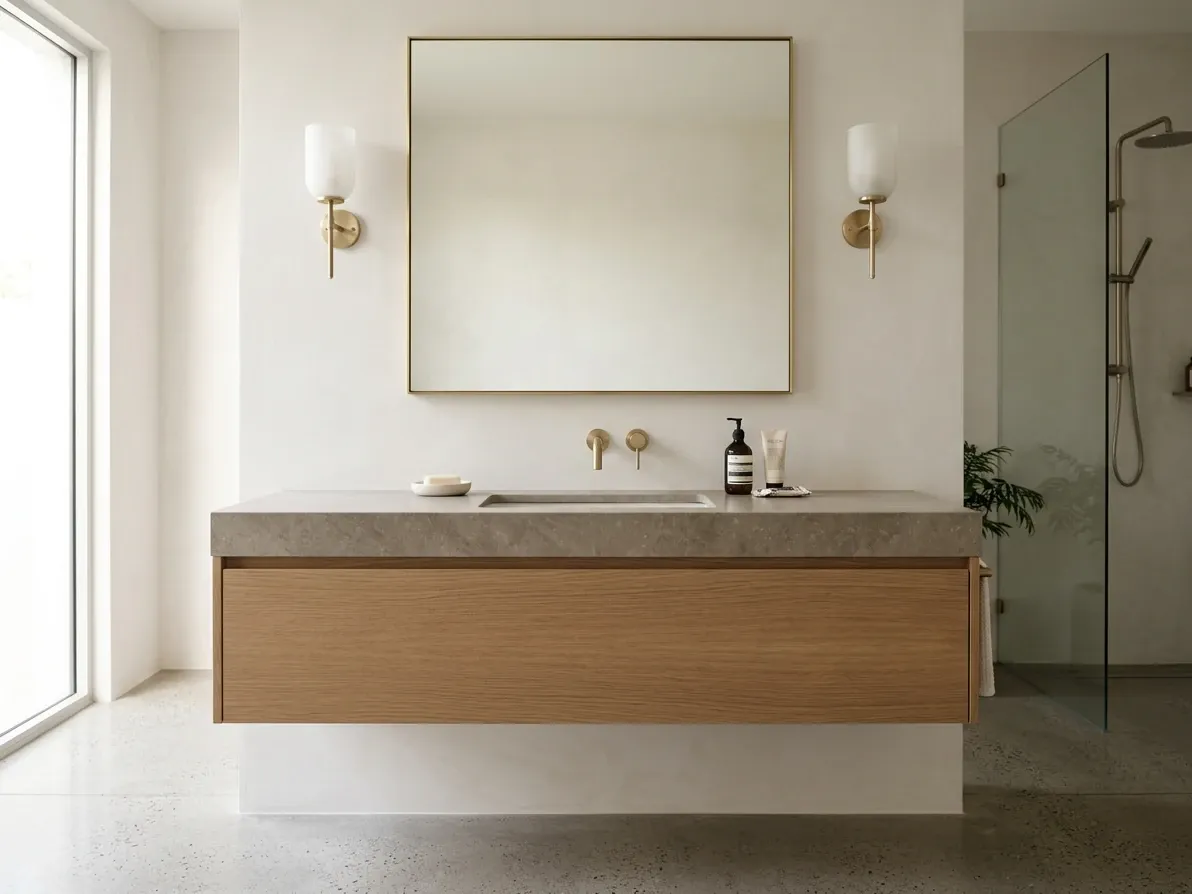
A 1,200 mm wall-hung vanity is the working minimum for a shared ensuite.
In an ensuite shared by two people, the question of one basin versus two comes up early. The honest answer for most Australian ensuites is one. A twin-basin vanity needs at least 1,500 millimetres of width to work without the two basins being so close that splash crosses, and below about 5 square metres of total floor the room cannot accommodate it without something else having to give. A single-basin 1,200 millimetre vanity with generous storage on either side is the choice most designers default to under 5 square metres of total floor. Above 5 square metres, twin basins become genuinely useful and are a feature buyers actively look for.
Wall-hung (floating) vanities are the dominant choice in new ensuites for two reasons that compound. First, the exposed floor under the vanity makes any small room read as larger because the eye sees more floor. Second, cleaning is faster because there is no skirting kickplate to catch hair and there is no base panel to swell from condensation. They cost slightly more to install because the fixing has to be into a solid wall structure (a stud-wall vanity bracket or a recessed steel frame), and the basin waste and supply lines need to run cleanly through the wall rather than down through a cabinet. The Highgrove and Buildmat ranges cover most of the popular mid-range price points.
Two depth choices matter. A 450 to 500 millimetre vanity depth works in any ensuite and is the right answer in compact rooms. A 550 to 600 millimetre vanity gives more drawer space and a more generous bench, which is worth the extra floor footprint above 4 square metres of total room. Top-mounted basins (the basin sits on the bench) are visually striking but use more bench-top space than the basin itself, so they read better in rooms with bench length to spare; an undermount or integrated stone basin keeps the bench surface usable.
For finish, the bathroom vanity guide covers the depth of options across timber-look, matte white, fluted and stone-top vanities. The decision that affects the ensuite specifically is reflectivity: a high-gloss white vanity bounces light around the room and reads larger in a small ensuite, while a matte or timber-grain front absorbs light and reads more grounded, which suits a larger ensuite where the room can carry the visual weight.
Whether to keep a bath
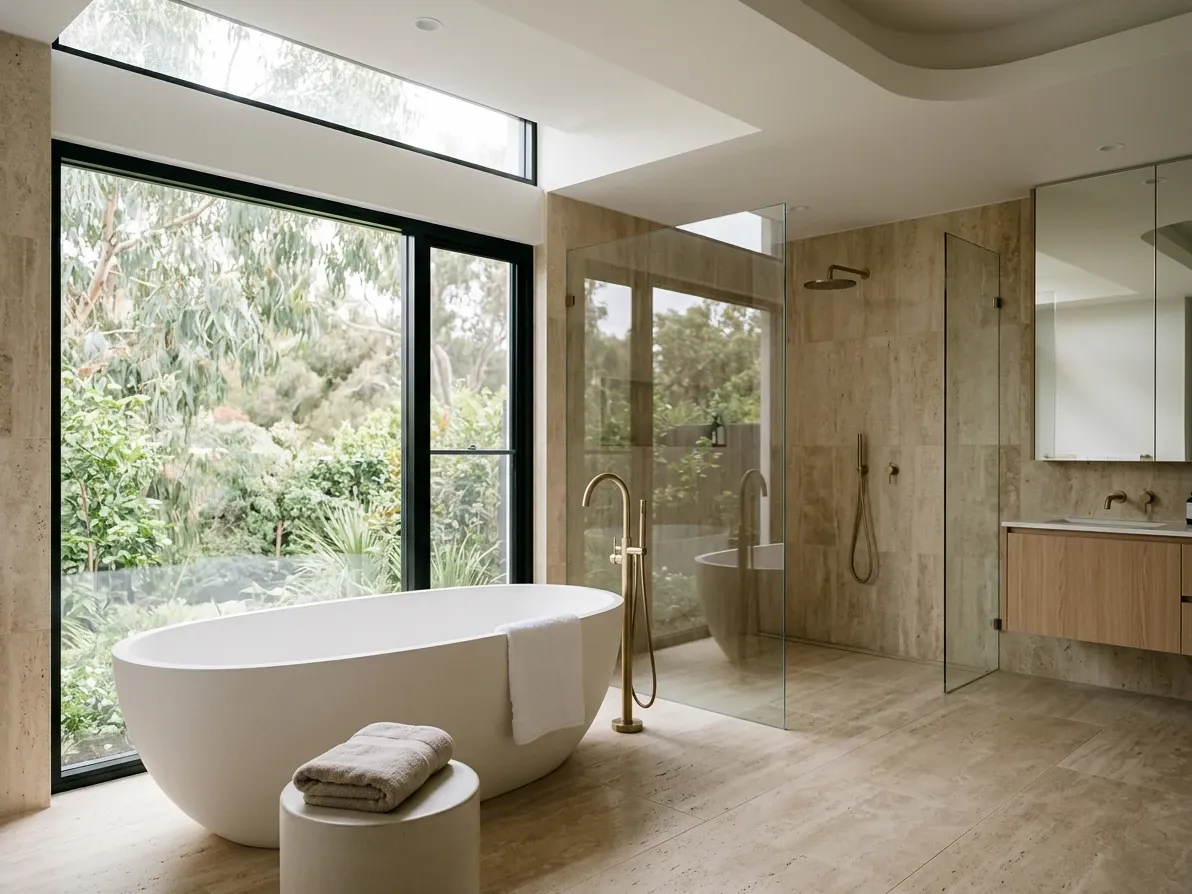
A freestanding bath only earns its place in an ensuite above about 6 sqm.
A bath in an ensuite is the single decision that splits ensuites into two categories of design.
In an ensuite under about 5.5 square metres, a bath rarely earns its place. The bath becomes the dominant object, the layout has to bend around it, and the day-to-day use is overwhelmingly the shower next to it. A walk-in shower delivers more daily value at a lower install cost, frees up the layout for a generous vanity or a separate WC compartment, and reads as more current. In an adults-only household, a shower-only ensuite has no resale penalty as long as the main bathroom in the house still has a bath. Bathroom industry surveys consistently show walk-in showers as the most-specified shower type in Australian ensuites in 2026.
In an ensuite above about 6 square metres, a freestanding bath alongside a separate walk-in shower is the dominant aspirational layout in Australian premium bathrooms. The freestanding bath becomes the sculptural anchor of the room (centred under a window, tucked into a niche, or sitting between the shower and the WC compartment as a visual full-stop), and the walk-in shower carries the daily use. Acrylic freestanding baths start at around $800 and stone-resin or stone-composite models reach $7,000 and above. The bath needs at least 600 millimetres of clear floor on the access side and 300 millimetres on the others to read right and to be cleanable; squeezing those margins makes the bath look like an obstacle rather than a feature.
The shower-over-bath combination, where a single tub serves both purposes, almost never appears in a new ensuite. It belongs to the family bathroom of a 1970s brick veneer that has to keep a bath for resale. In an ensuite, the right answer is to commit either to a shower (small ensuite) or to a shower plus a separate freestanding bath (large ensuite).
Toilet placement and the privacy question
The toilet is the fixture that gets thought about least and matters more than it seems. Two considerations decide where it sits.
The first is sightline from the bedroom. With the door open, a hinged ensuite door swings into the room and the toilet ends up framed by the doorway from the bedroom unless it is deliberately positioned out of the line of sight. Placing the toilet behind the door swing, at the far end of the room, or in a partitioned WC compartment all solve this. The single-wall layout above puts the toilet in the middle of the row, which lands it in the bedroom sightline; a half-wall or a small recess wall blocks it without needing a separate door.
The second is acoustic separation. The toilet is the noisiest fixture in the room, and the ensuite shares a wall with the bedroom. A double-stud wall with insulation on the bedroom side, or at minimum a full-height plasterboard wall with acoustic insulation between, keeps the bedroom genuinely quiet. The standard internal wall on a builder-grade new build does not.
A wall-hung pan with the cistern concealed inside an in-wall frame is a small but worthwhile upgrade in any new ensuite. It uses less floor footprint than a floor-standing close-coupled pan, cleans more easily because there is no pedestal and gap behind the bowl, and looks tidier from any angle. Geberit and R&T are the dominant in-wall cistern brands in Australia and both are watermark-certified. The extra build cost is around $400 to $800 over a floor-standing equivalent and reads as worth it on inspection day even in a budget ensuite.
The flush-actuator plate sits on the wall above the cistern and is one of the small specification choices where the finish difference shows. A brushed brass or matte black plate paired to the tapware feels considered. A white plastic plate in an otherwise sharp ensuite reads as a missed cue.
Tiles, palette and the things that get specified together
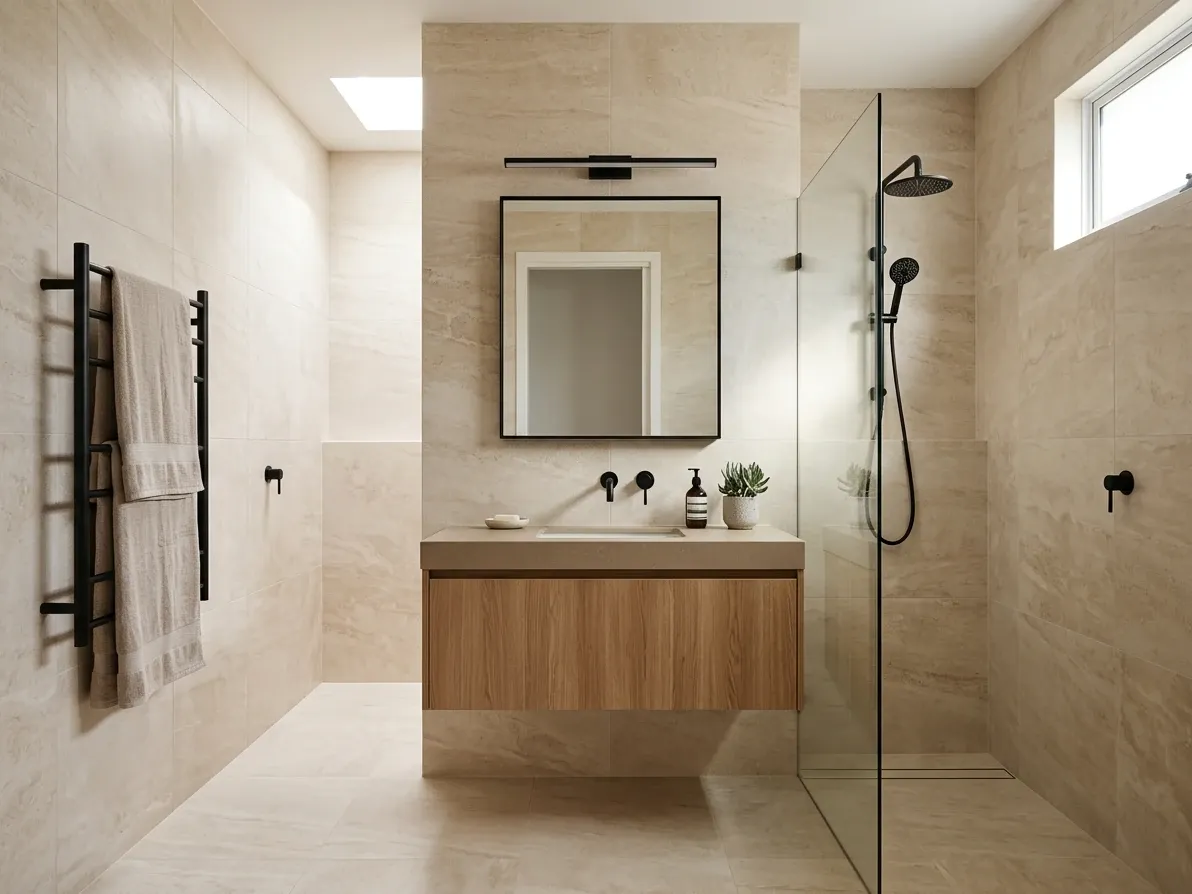
Floor, wall and tapware get specified together, not one at a time.
Three palette decisions get specified together in the ensuite because they have to balance against each other: floor tile, wall tile and tapware finish. Choosing one without the others is the most common cause of a finished ensuite that does not read the way the sample boards suggested.
Floor tiles work hardest in an ensuite. They are walked on wet, every day, and they have to grip enough that an adult stepping out of the shower does not slip. The Australian tile slip-rating system is the P-rating: P3 is the minimum for any wet area, P4 is the safer specification for a shower floor or wet-room floor, and R-rated tiles (European equivalent) above R10 are the same range. Honed natural stone reads beautifully but is high-maintenance against soap film and water-spotting. Porcelain in a stone-look or terrazzo-look finish is the dominant material in Australian ensuites in 2026: durable, fully waterproof, available in large formats that minimise grout lines, and now visually close enough to natural stone that the trade-off has narrowed sharply. The bathroom tile ideas guide covers the format and pattern options in more depth.
Wall tiles can be the same as the floor (the calm, current approach, with one continuous material from floor to ceiling) or can split into a feature wet-wall and quieter side walls. A feature tile behind the vanity or in the shower zone, with a calmer companion tile on the remaining walls, gives a focal point without overwhelming the room. Floor-to-ceiling tile reads more current than half-height tile with a paint band above, which has dated quickly over the past five years.
Tapware finish is the choice that ties the room together. Matte black is still the most-specified finish in Australian ensuites in 2026 and continues to be the most flexible: it pairs with white, grey, timber, terrazzo and warm stone palettes without clashing. Brushed brass has grown sharply over the past two years and is now the dominant warm metal, particularly with timber-grain vanities and travertine-look tile. Brushed nickel is the maintenance-friendly choice that hides water-spots better than either of the above. Chrome is increasingly the choice of homeowners who want longevity over fashion: it costs less, lasts longer, and the early-2020s pendulum away from it is starting to swing back. Mixed-metal pairings (matte black tapware with brushed brass towel rails and door hardware, for example) are now an established choice rather than a clash if the warm metal repeats in two or three places rather than appearing once. Faucet Strommen’s industry note covers the current finish landscape from a manufacturer perspective.
The tapware finish drives the door handle, towel rail, hook, robe-hook and flush-plate decisions automatically. Pick the tapware first and the rest follows.
For aesthetic direction beyond palette, the modern bathroom design guide covers the wider warm-minimalism direction that ensuites largely follow in 2026.
Lighting, ventilation and the things that get missed
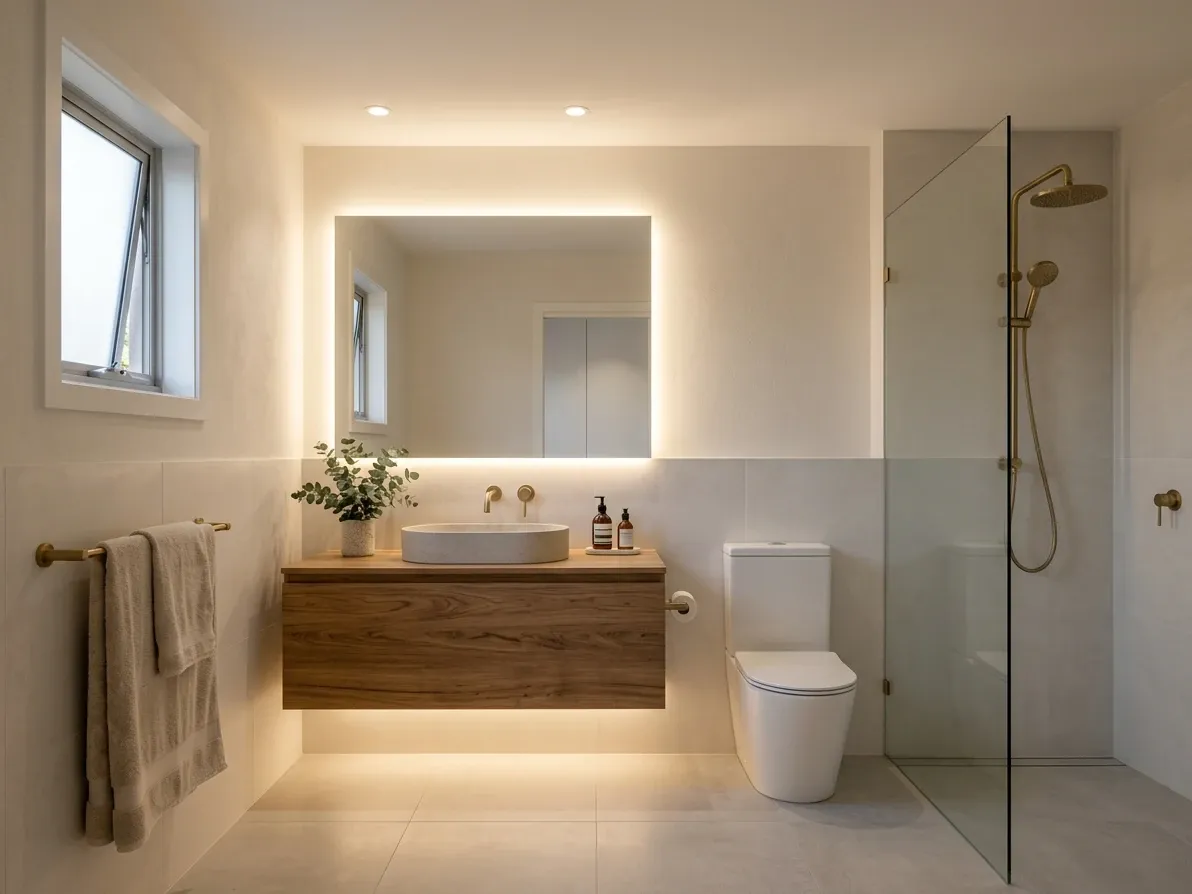
Layered lighting: ambient, vanity-height, and a low accent under the bench.
Three systems decide whether an ensuite is genuinely pleasant to use day to day. They are the ones that builders get wrong most often because they cost the same to install regardless of quality, and the cheap version passes inspection.
Lighting in an ensuite has three layers. Ambient ceiling lighting on a dimmer (not on the same switch as the exhaust fan) sets the room. Vanity lighting at face height, either as a wall sconce on each side of the mirror or as a backlit LED mirror, eliminates the harsh under-eye shadow that a single downlight directly above the basin creates. Accent lighting under a wall-hung vanity, in a niche, or under a step-down to the shower adds depth and gives a usable low-level glow for late-night visits without turning the main light on. The Australian/New Zealand Wiring Rules AS/NZS 3000 define electrical zones around baths and showers that constrain where lights, switches and power points can be placed; a licensed electrician handles this, but knowing the zones exist explains why the switch sits outside the door on most ensuites rather than inside it.
Ventilation is the single most under-specified element in Australian ensuites. The NCC requires either a window equal to at least 5 per cent of the floor area, or a mechanical exhaust fan extracting at 25 litres per second ducted directly to the outside air (NCC Housing Provisions Part 10.6). The fan must run for ten minutes after the light is turned off, or run continuously, under AS 1668.2. The detail that builders cheat is the “ducted directly to the outside air” requirement: a fan that ducts into the roof space (not through it to a soffit or eave vent) condenses moisture in the roof, rots the ceiling joists, and produces mould inside the cavity within five years. Insist on rigid (not flexible) ducting from the fan straight through to an external vent, and on a fan that genuinely moves 25 litres per second under load, not the cheapest unit on the shelf. This is a small line item that ages the room more than any finish choice.
Heating. Underfloor heating is the single most-loved upgrade in any Australian ensuite. Electric in-screed mat systems run $80 to $150 per square metre installed, plus a thermostat at $200 to $400; a typical 5-square-metre ensuite installs for around $600 to $900 fully wired. Running costs are modest at around $30 to $50 per winter for a thermostat-controlled 4-hour-per-day schedule (Comfort Heat publishes the most useful running-cost calculations). It is the cheapest comfort upgrade per dollar in an ensuite, and stepping out of a hot shower onto a 28-degree floor in a Melbourne winter is the one feature every renovator who specifies it then wishes they had put in every wet room in the house.
A heated towel rail is the second small upgrade that pays back daily, and a touch-sensor demister built into the vanity mirror is the third.
What an ensuite actually costs in Australia in 2026
Australian ensuite renovation budgets group into four reasonably consistent tiers. The numbers below are 2026 prices for a 4 to 5 square metre ensuite, exclude the cost of building the room from scratch (an addition or wall move is a separate building project), and assume work is done by licensed trades. They reference the Housing Industry Association average and a cross-section of current builder cost guides.
A cosmetic refresh at $8,000 to $12,000 keeps the layout, the tiles and the cabinetry, and changes tapware, lighting, vanity top, mirror, towel rails and toilet seat. It does not touch the waterproofing and is suitable for an ensuite that is functionally sound but visually dated.
A budget renovation at $15,000 to $25,000 strips the room out, replaces the waterproofing, retiles the floor and walls in a quality ceramic, fits a flat-pack or off-the-shelf vanity, a semi-frameless shower screen, a built-in BBQ-grade exhaust fan, and mid-range tapware. It is a competent, current-looking ensuite without bespoke joinery.
A mid-range renovation at $25,000 to $35,000 is where most Australian ensuite renovations land. Custom or semi-custom wall-hung vanity in a stone-look or timber finish, frameless shower screen, porcelain slab tiles (large-format, low-grout), a wall-hung WC with concealed cistern, a heated towel rail, underfloor heating, and a considered tapware suite in matte black or brushed brass.
- Tiling and labour30%
- Vanity and screen22%
- Plumbing and electrical20%
- Tapware and fixtures15%
- Waterproofing and prep13%
A premium renovation at $40,000 to $65,000 covers a relocated layout (new plumbing wall, soil-stack alteration), bespoke stone vanity, a freestanding bath alongside a generous walk-in shower with a linear drain, a separate WC compartment, designer tapware, considered lighting design, and full smart-home integration of lighting, heating and ventilation.
Sydney and Melbourne metro typically run 15 to 25 per cent above the figures above for an equivalent finish, as Hipages and What’s the Damage both report. Brisbane sits near the national average. Adelaide and Perth typically run 5 to 10 per cent below.
Two budget rules. First, the per-square-metre rate for an ensuite is higher than for a main bathroom, because the fixed costs (waterproofing, demolition, plumber attendance, electrician attendance) are spread across less floor. A 3 square metre ensuite will not cost 60 per cent of a 5 square metre main bathroom; it will cost 75 to 85 per cent for the same finish, because the fixed costs do not scale down. Second, the project needs a 10 to 20 per cent contingency on top of the quoted price, because there is always something behind an existing wall that the quote did not account for.
Adding an ensuite where there is none
The conversion brief is its own design problem. The most common Australian approach is to annex a corner of the main bedroom (usually 1.5 by 2.0 metres in one corner, with a new internal wall), or to convert part of an oversized walk-in robe, or to extend a small main bathroom and split it into a main bathroom plus an ensuite via an internal wall and a new door from the bedroom.
The decisive question is plumbing access. If the new ensuite can sit on an existing wet wall (the back of the main bathroom, for instance), services are short and cheap. If the new ensuite is on the opposite side of the house from any existing plumbing, the job needs new in-slab drainage on a ground floor or a new vent stack on an upper floor, which adds $5,000 to $15,000 of plumbing before the room itself starts. The same plumber visit that maps the existing stacks for a renovation maps the practical conversion options for an addition.
The second question is structural. Cutting a new opening from the bedroom into the new ensuite is fine if the wall is non-load-bearing. If it is load-bearing, a structural engineer needs to size a new beam over the opening. A builder can usually tell you which one a wall is at a quick inspection; an honest answer here saves an expensive surprise mid-project.
A bedroom-to-ensuite conversion that adds 3 to 4 square metres of new wet area typically lands between $30,000 and $60,000 in 2026 prices, with the high end driven by long plumbing runs and structural alteration. The lift in property value usually exceeds the build cost when the home was previously a one-bathroom property, often by a wide margin in metropolitan markets. The lift drops sharply on a third or fourth bathroom because the buyer pool no longer values the addition as highly.
The Australian rules an ensuite has to meet
Five compliance items affect the build of every Australian ensuite. None of them are optional.
Waterproofing, AS 3740:2021. The whole shower floor and the shower walls to 1,800 millimetres above the finished floor must be waterproofed. The remaining bathroom walls must be waterproofed to at least 150 millimetres. A waterstop angle is required at the shower entry. Membranes must be visually inspected before any tile bed is laid over them. Particleboard sheeting is no longer permitted as a substrate. The standard was updated in 2021 in response to the building-defects crisis around bathroom waterproofing failures (the ABCB summary covers the change in plain English).
Electrical, AS/NZS 3000. Lights, switches and power points must sit outside the defined wet zones around baths and showers. Outlets within bathroom zones must be RCD-protected. A licensed electrician handles this; the homeowner just needs to know that lights, switches and power points cannot be placed wherever the design wants, and that the constraint is real.
Ventilation, NCC Housing Provisions Part 10.6 and AS 1668.2. A window of at least 5 per cent of floor area, or a mechanical exhaust fan extracting 25 litres per second ducted to outside air, is required. The fan must run for ten minutes after light-off or run continuously. Ducting must run to outside, not into the roof space.
Water efficiency, WELS. All tapware, showerheads and toilets sold in Australia must carry a WELS rating label under the Water Efficiency Labelling and Standards Act. Showerheads in new work are capped at 9 litres per minute (a 3-star WELS rating or better). Tapware must carry the WaterMark and be lead-free under current product standards.
Livable Housing, NCC 2022 Volume Two Part H8. New homes built under the updated standard (commenced in Victoria 1 May 2024 and in Queensland phased to 1 May 2025; not adopted in NSW) must have at least one bathroom on the entry level with a step-free, hobless shower, reinforcement for future grabrails, and a level threshold at the entry door. The ensuite is often the bathroom that takes the step-free shower because it is on the same level as the main bedroom. The standard is mandatory for new houses where adopted; it is a worthwhile design discipline for any new bathroom because it reads as more current and ages better than a stepped hob.
The work itself, every line of it, has to be done by licensed trades. Plumbing by a licensed plumber, gas by a licensed gasfitter, electrical by a licensed electrician. DIY tile-laying on a sound waterproof membrane is legal in most states; DIY waterproofing or DIY plumbing is not, and the insurance and resale consequences of either are severe.
Common ensuite mistakes
After a decade of Australian builder write-ups, designer notes and homeowner regrets, five mistakes recur often enough to be worth naming explicitly.
The fan that ducts into the roof. The exhaust fan goes in, the building inspector signs off the ventilation, and within five years the roof cavity has mould, the ceiling is staining, and the ducting has fallen off the back of the fan. Specify rigid ducting from fan to external vent, and confirm with the installer that it has been mounted that way before the ceiling lining goes up.
The hinged door that hits the vanity drawer. The door swings into the room, the door swing claims 900 millimetres of floor, and the bottom vanity drawer cannot open with the door open. A cavity slider returns the floor and removes the problem; on a renovation where the wall cannot take a pocket, a barn door on a wall-mounted track is the next best fix.
The single basin that is too small for two people. A 600 millimetre vanity with a 400 millimetre basin reads as fine in the showroom, then in two-people-at-the-same-time use the basin spills over, splashes the tap and the wall, and is too small to fit anything in. A 1,200 millimetre vanity with a 500 millimetre basin and a generous bench around it is the working minimum for a shared ensuite even when only one basin is fitted.
The toilet in the bedroom sightline. With the door open, the toilet is the first thing the bed sees. A 1,000 millimetre privacy wall at the toilet position, or a partitioned WC compartment, fixes it. The two-minute exercise of standing in the bedroom doorway and asking what the ensuite shows from there is one of the easiest ways to catch the problem at design stage.
The cheap waterproofer. The single most expensive sentence a renovating homeowner can read is “we can save you a few hundred on the waterproofing”. Every dollar saved here costs three to four figures in rectification when the membrane fails. The HIA’s defect data, collected over years, shows waterproofing failures as the single biggest cause of bathroom-related insurance and rectification claims in Australia. Spend on the membrane, the waterstop, and the installer who certifies the work. The visible tile sits on top of it and only looks good for as long as what is under it holds.
Picture it before you build
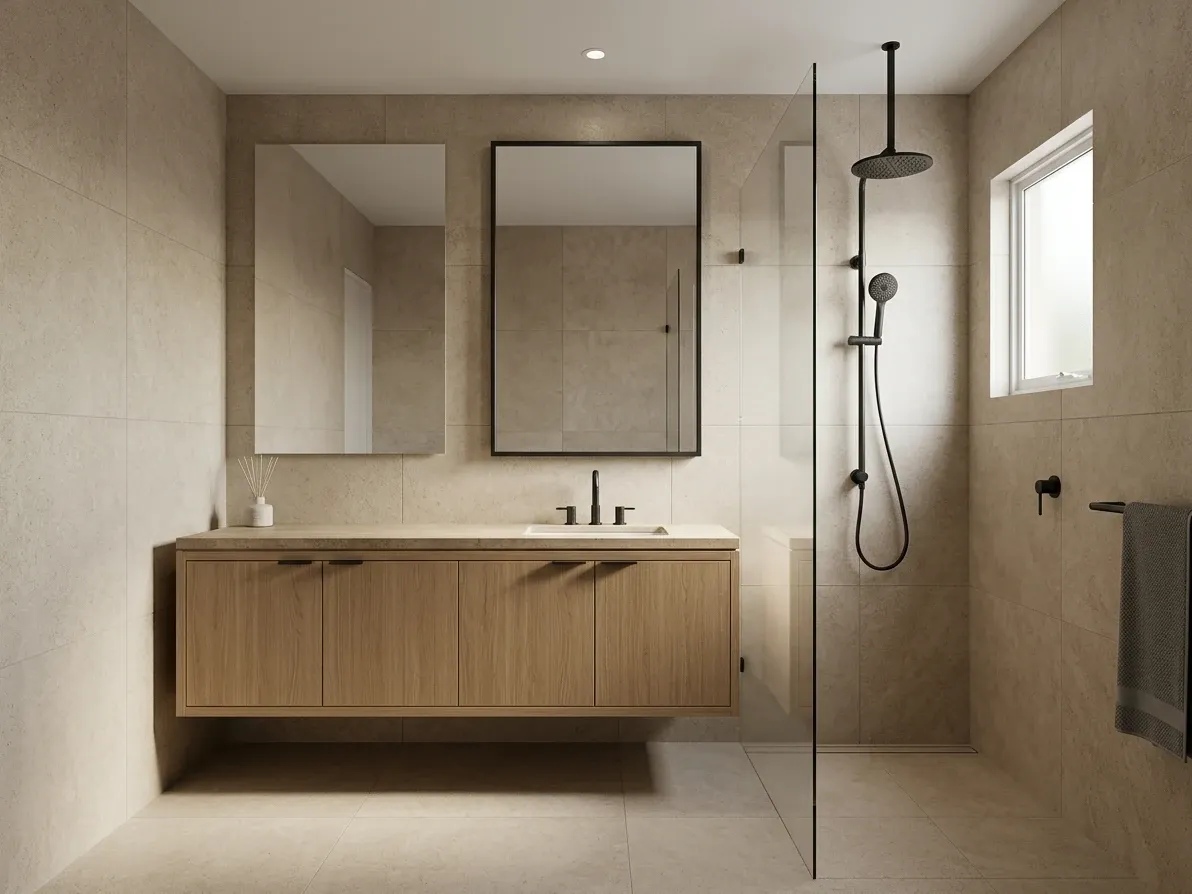
A pre-build render is the cheapest moment to catch a finish that does not work.
The hardest part of any ensuite project is that the finished room only exists once the work is done. Tile samples on a benchtop, a tapware finish in a magazine spread, a vanity in a showroom: none of them tell you what the actual room will feel like at 6 am with the actual light coming in through the actual window above the actual freestanding bath. The cheapest way to find out that warm beige reads pink under your downlights is to find out before the tiler arrives.
A few visualisation steps work. Build a Pinterest board of 30 to 50 reference ensuites in the direction the design is heading, then notice what is consistent across the ones that genuinely resemble your room. Order large physical samples (300 millimetre tile pieces, a full vanity-front colour chip, a single tap in the actual finish) and sit them in the existing ensuite at the time of day you most often use it. Use the free 3D bathroom planners from Reece, Beaumont Tiles or Highgrove if you are buying their product, and accept that the planner only knows about products that brand stocks. For a brand-agnostic photoreal visualisation of your specific room in your specific home, services like reIMG turn a phone photo and a brief into a finished image in 24 hours for $100 to $150 a render. It is the cheapest discovery step in the whole project, and the cheapest moment to find a problem.
The ensuite is the most personal bathroom in the house, used twice a day by the people who pay for it, looked at by no one else. Spend the planning time before you spend the money. The rest of the room will follow.
Frequently asked questions
How much does an ensuite cost to renovate in Australia in 2026?
A cosmetic refresh of an existing ensuite sits at roughly $8,000 to $12,000. A full strip-out with basic finishes runs $15,000 to $25,000. A mid-range ensuite with a frameless screen, a wall-hung vanity and porcelain slab tiles sits at $25,000 to $35,000 and is where most Australian ensuite renovations land. Premium ensuites with relocated plumbing, designer tapware, a freestanding bath and considered lighting start at $40,000 and run past $65,000. Per square metre rates run higher than a main bathroom because the fixed costs (waterproofing, plumbing rough-in, demolition) are spread across less floor. Adding an ensuite from scratch to a bedroom that has none typically costs $30,000 to $60,000 depending on whether you can access existing plumbing or have to run new wet-area infrastructure.
What is the minimum ensuite size in Australia?
A working ensuite with a shower, toilet and vanity starts at about 1.5 by 2.0 metres (3 square metres), which is the floor most Australian builders will sketch. A comfortable ensuite sits at 1.8 by 2.4 metres (about 4.3 square metres), which is enough to fit a 1,200 mm vanity, a 1,000 by 1,000 mm walk-in shower and a separate WC without the room feeling tight. Below 1.5 by 2.0 the room becomes a stand-up shower and toilet with a basin tucked beside it, and starts crossing into powder-room territory. The Australian standard door is 820 mm wide; with a hinged door swinging in, you lose another 900 mm of floor for swing. A cavity slider gets that back.
What is the best layout for a small ensuite?
The single-wall layout puts the shower, toilet and vanity along one continuous wet wall, with the door on the opposite long wall. It is the cheapest to plumb because every drain and supply line sits on one stack, and it works in rooms 1.6 to 1.8 metres wide. The galley layout puts the vanity opposite the shower with the toilet at one end, and reads as more spacious because the eye runs the full length of the room. It needs at least 2.0 metres of width to leave 800 mm of clear circulation between the vanity and the shower screen. A cavity slider or pocket door instead of a hinged door clears another 900 mm of swing space and is the single highest-value move in a tight ensuite.
Do I need council approval for an ensuite renovation?
A like-for-like renovation that keeps the existing footprint, plumbing and waterproofing line usually does not need council approval, though every plumbing and electrical job needs licensed trades. You will need approval if you move plumbing through a new wall, add a window, or alter structure. Apartments are different: in NSW, strata classifies any bathroom work that touches waterproofing as a major renovation under the Strata Schemes Management Act, which needs a special resolution from the owners corporation and adds six to twelve weeks before work can start. Always confirm with your council or owners corporation before quoting. Cutting an ensuite into a bedroom from scratch almost always triggers a building permit because you are adding a new wet area.
Walk-in shower or shower over bath in an ensuite?
Walk-in shower, in almost every case. A separate bath rarely earns its place in an ensuite under about 5.5 square metres because the bath becomes the dominant object and crowds the rest of the layout, which is the opposite of the calm feeling an ensuite is aiming for. A walk-in shower delivers more day-to-day value, costs less to install than a bath plus shower, and resells well in adults-only households. Keep the bath in the main bathroom if you have one. The exception is a generously sized master ensuite (above about 7 square metres) where a freestanding bath as a sculptural anchor next to a separate walk-in shower is the dominant aspirational layout in mid-range and premium Australian ensuites in 2026.
Is matte black tapware still on trend in 2026?
Yes, matte black is still the most-specified tapware finish in Australian bathrooms in 2026, but warm metals have caught up sharply. Brushed brass, brushed nickel and gunmetal are the finishes growing fastest, and mixed-metal pairings of matte black with brushed brass are now a deliberate choice rather than a clash. Matte black pairs with nearly every palette and the cheap-PVD fingerprint problem of five years ago has largely been solved in better-quality lines. The trade-off is maintenance: matte shows water spots and toothpaste splatter more than chrome, brushed nickel or brushed brass. If wiping every other day annoys you, brushed nickel is more forgiving day to day.
Does adding an ensuite add value to a home?
Yes, in most Australian metro markets a second bathroom or ensuite is one of the higher-return renovations available. Domain property data quoted by Sydney specialists puts the lift at $50,000 to $100,000 in middle-ring Sydney suburbs when a one-bathroom home is converted to two, and the return often exceeds 100 per cent of the build cost on that transition. The return drops sharply on a third bathroom in a two-bathroom home, because the buyer pool no longer values the extra room as highly. Ensuites attached to the main bedroom (rather than separate guest bathrooms elsewhere in the house) carry the biggest premium because the master-suite layout is what most family and downsizer buyers are looking for.