Boho interior design for Australian homes
What boho interior design means in Australia in 2026: the lineage, the warm 2026 palette, room-by-room playbook, climate fit, and the mistakes to avoid.
Why this guide exists
Boho interior design is the most misunderstood style in the contemporary Australian conversation. Most Australian homeowners encounter the word through the Instagram and Pinterest version that peaked between 2017 and 2020, which leaned heavily on mass-produced macrame, fringed everything, signage, dreamcatchers and a particular kind of staged styled clutter that lost the plot of the original style. That version is what most “boho” search results still surface in 2026, and it is the version most Australian readers reasonably want to either escape or do better. There is a deeper, considered, calmer version of the style underneath the social-media layer, and it sits cleanly inside the warm earthy direction the 2026 design conversation has settled into.
This guide is the long answer for Australian readers. It covers what boho interior design genuinely is and where the word actually comes from, the three eras the modern style is built on (the French Bohémien counterculture of the 1800s, the global hippie revival of the 1960s and 1970s, and the warm modern boho of 2026), the palette and material vocabulary in detail, how the style reads in a living room, bedroom, kitchen, bathroom and outdoor space, where boho sits next to coastal, Hamptons, Scandi, French Provincial, mid-century modern, Japandi and maximalism, what it costs to do well at three budget tiers, why it is unusually well suited to the Australian climate and house stock, and the mistakes that age a boho room fastest. It is written for Australian homeowners, renters and designers who want a confident answer rather than another Pinterest board.
It sits inside the broader interior design styles guide for Australia, where boho is one of the major contemporary directions alongside Hamptons, French Provincial, coastal, farmhouse, Scandi and mid-century modern. This page is the deep dive on boho specifically.
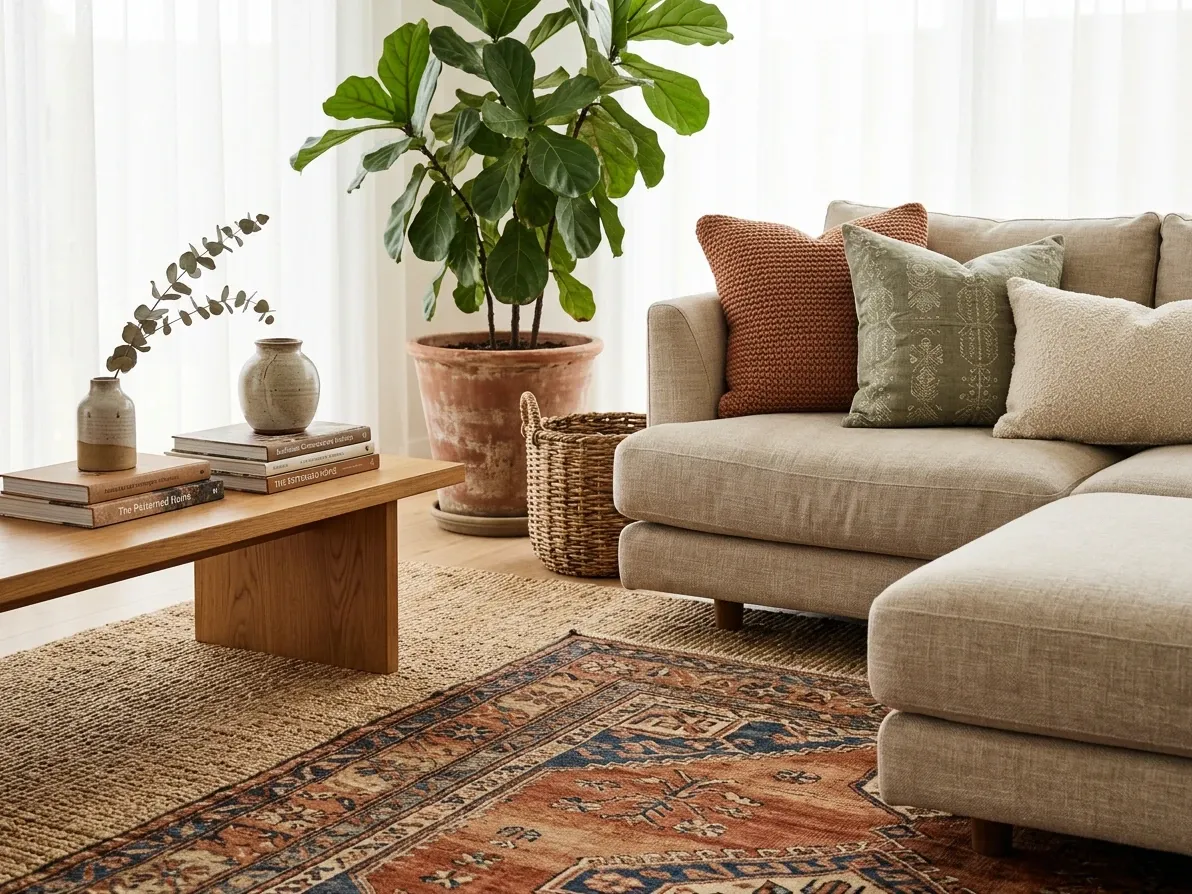
A vintage kilim layered on jute, linen cushions, one good plant.
What boho interior design actually is
Boho is short for bohemian, and the word carries its history. According to Wikipedia’s entry on the bohemian style and the Pearl Source’s history of the style, the term originates with French Bohémien, a label applied to the Roma population of France who were mistakenly believed to have come from Bohemia, in what is now the Czech Republic. From the early nineteenth century onward, Bohémien also described the unconventional, often impoverished community of artists, writers, musicians and intellectuals who concentrated in Parisian neighbourhoods like Montmartre after the French Revolution stripped artists of their old aristocratic patronage. Forced to live cheaply, they furnished their garrets with second-hand market finds, worn rugs, draped textiles, books, plants and souvenirs collected from elsewhere. The aesthetic that came out of that life (layered, collected, comfortable, unpretentious, slightly worn-in) became the aesthetic the word still carries.
The contemporary reading of boho interior design holds that brief surprisingly well. According to Decorilla’s bohemian interior design guide and Apartment Therapy’s boho style explainer, a boho room is eclectic, lived-in, layered, plant-rich and collected. It mixes textures, eras and cultural references; it leans on natural materials over synthetic ones; it treats vintage, handmade and inherited pieces as features rather than fillers; and it is not afraid of pattern, colour and visible imperfection. Where minimalism strips away to the essential, boho adds in layers, but every layer is meant to mean something to the person living there.
The visible vocabulary is consistent across most credible interpretations of the style. Natural fibre textiles carry most of the soft layer: linen, cotton, wool, jute and bamboo. Rattan, cane, bamboo and wicker carry chairs, baskets, planters, light shades and bedheads. Timber runs warm and honest rather than polished and cool, often with visible grain and a hand-finished look. Vintage rugs (Moroccan Beni Ourain, Turkish kilim, Persian, Indian dhurrie or anything with a story) ground the room, and a stack of layered rugs in one space is a defining boho move. Plants are everywhere: trailing pothos and devil’s ivy on shelves, a tall monstera or fiddle leaf fig anchoring a corner, a row of small succulents on the windowsill, hanging planters above a daybed. Vintage and handcrafted objects carry the styling layer: a ceramic vase made by a friend, a brass tray from a market in Marrakech, a stack of art books, a hand-knotted basket, a singing bowl, a piece of art bought from an emerging artist. Mixed patterns are welcomed rather than avoided: paisley next to ikat next to stripe next to floral, held together by repeating colours. Light is layered and warm, with a mix of pendants, floor lamps, table lamps, candles and the occasional string of fairy lights, rather than relying on a single overhead fitting.
Three concepts sit underneath the style and explain why a well-resolved boho room feels the way it does. Provenance is the assumption that the objects in the room have stories: where they came from, who made them, what they meant before they got here. A genuine boho room is collected, not bought. Layering is the deliberate practice of stacking textures, patterns and pieces from different eras and cultures so the room reads as accumulated over time rather than completed in one shopping trip. Imperfection is the appreciation of objects that are slightly worn, hand-made, asymmetrical or visibly old, on the principle that they read warmer and more human than their machine-finished equivalents.
Where boho departs from related styles is in its relationship to rules. Hamptons asks the room to look formal and polished; French Provincial asks it to look elegant and decorative; coastal asks it to look beach-relaxed and sandy; Scandi asks it to look calm and architecturally restrained; mid-century modern asks it to look graphic and sculptural. Boho is the style that explicitly refuses to be tidy in those ways. According to Robern’s profile of the style, the defining principle of boho is that there are no rules, only intentional choices that express the person living there. That is also why it is the easiest style to do badly: the absence of rules makes it the easiest to drift into clutter, and the brief to mix patterns and objects makes it the easiest to over-style.
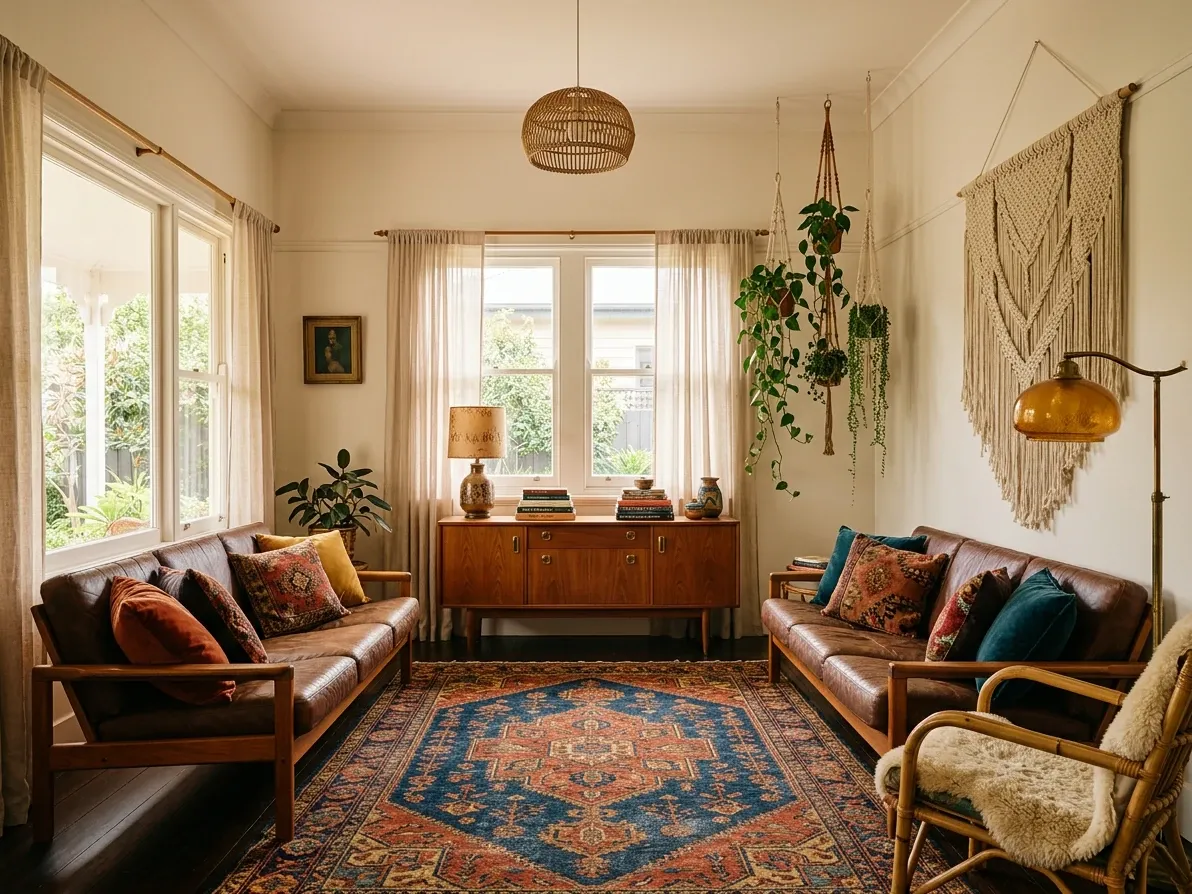
The 1970s revival room: collected, layered, vintage warm.
Where the style actually came from
Three distinct eras inform what an Australian reader pictures under the word “boho” in 2026. Understanding all three is the difference between a room that reads as a current 2026 modern boho space and a room that reads as a 2018 Pinterest board.
The original French Bohémien era (early 1800s to early 1900s). According to Wikipedia’s entry on bohemianism, the bohemians were a counterculture that emerged in France after the French Revolution dismantled the old patronage system that had supported artists and intellectuals. Deprived of wealthy backers, many writers, painters, poets and musicians fell into poverty and adopted an itinerant, frugal lifestyle, concentrating in cheap Parisian quarters like Montmartre and the Left Bank. By the middle of the nineteenth century the term had loosened into a broader cultural label for any artistic or intellectual person who lived unconventionally, dressed in worn or eclectic clothing and decorated their living quarters with second-hand finds, worn fabrics, books and souvenirs of travel. The visual residue of that era is still in the modern style: vintage rugs, layered textiles, books as decor, an open and slightly bare ceiling, and a domestic atmosphere of collected belongings rather than coordinated furniture.
The 1960s and 1970s global counterculture revival. Boho returned in force during the post-war hippie movement, this time amplified by international travel. According to Living Spaces’ history of boho versus boho chic, the 1960s and 1970s adopted the bohemian impulse and layered global craft traditions onto it: Moroccan rugs, Indian block-printed textiles, Turkish kilims, Mexican folk art, hand-woven baskets from West Africa, batik fabrics from Indonesia, macrame wall hangings, tie-dye and embroidered cushions. The palette ran rich and saturated (deep jewel tones, earthy browns, mustard yellow, terracotta, burnt orange, deep teal), and the rooms were unapologetically maximal. This is the version of boho that most people over forty remember from their parents’ or grandparents’ homes, and a quieter modern reading of it is what most 2026 boho rooms are actually trying to recreate.
The 2010s Instagram and Pinterest era. Between roughly 2014 and 2020, boho dominated social media. The version that travelled best on Instagram was visually busy, heavily styled, and built around a small handful of mass-produced motifs: a wall of macrame, pampas grass in a Kmart vase, a stack of fluffy cushions on a velvet bed, fairy lights strung above a bedhead, a feather dreamcatcher, “good vibes only” signage, and an aerial flatlay shot of artisanal coffee and a marble notebook. According to Living Etc’s 2026 boho revival piece, this version is now what the design conversation explicitly distances itself from. The signs, the dreamcatchers, the chalk-painted slogan blocks and the pampas-everywhere look are the parts of boho that read most dated in a 2026 home.
The 2026 modern boho. What is taking over the 2026 conversation is sometimes called modern boho, sometimes boho-chic, sometimes organic modern, sometimes warm minimalism and sometimes (the term Living Etc currently prefers) just bohemian. It pulls the original collected-and-layered brief back to the centre and quiets the prop-shop layer. The palette warms (terracotta, sage, olive, ochre, warm white, honey timber) and pares back (one or two accent colours per room rather than every colour on the wheel). The furniture lines simplify (cleaner sofas, organic curved forms, vintage timber pieces). Plants stay, often growing larger and fewer rather than smaller and more numerous. Pattern stays, but mixed more selectively. The result reads as a calm collected adult home rather than a styled photoshoot.
A modern boho room in Australia in 2026 is at its strongest when it leans into the warm 1970s revival and the original collected-French sensibility, and explicitly avoids the 2018 Instagram version. The defining shift is honest: the 2018 boho asked you to buy a look, while the 2026 version asks you to collect one.
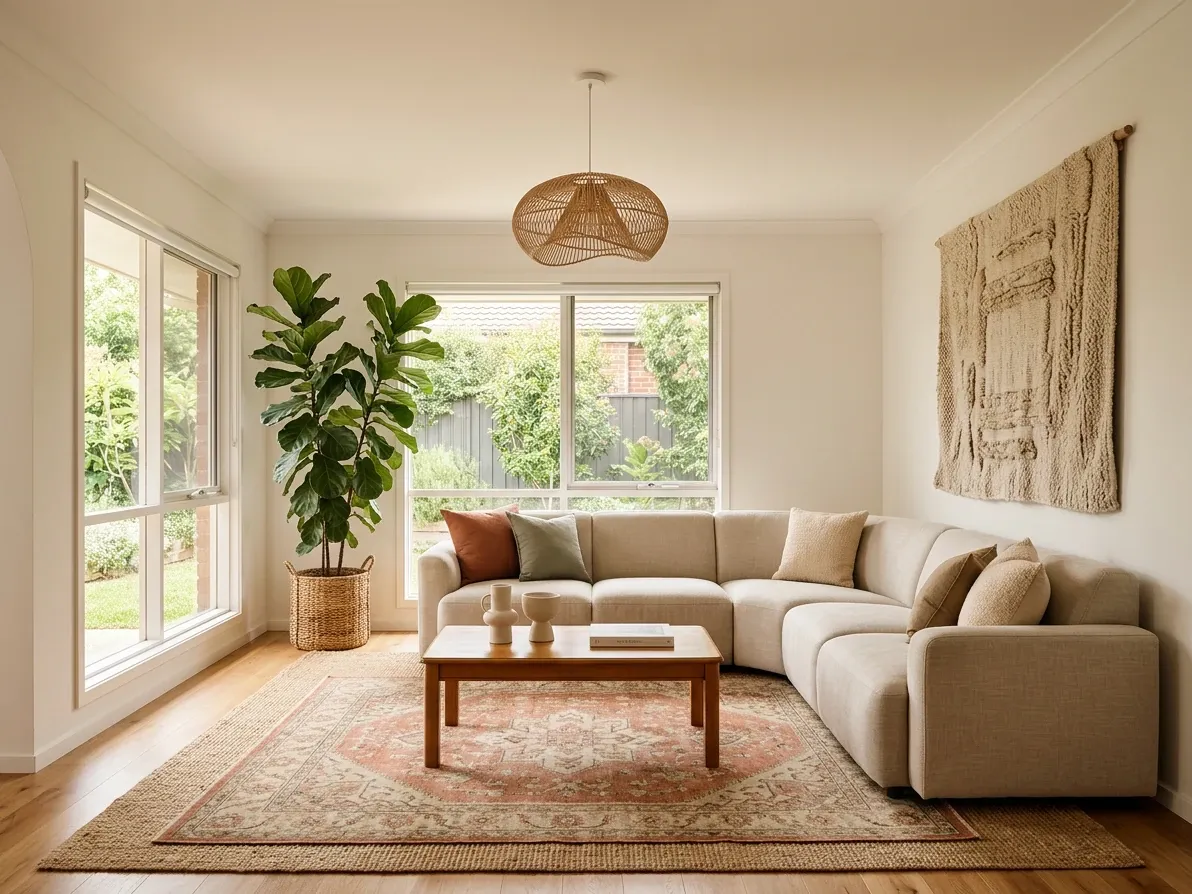
2026 modern boho: quieter base, bigger plants, one statement piece.
How the 2026 version differs from the 2018 version
The single most useful thing to know about boho in 2026 is which version of the style you are aiming for, because the gap between the warm considered current version and the busy mass-produced 2018 version is wider than for almost any other style. Six specific shifts define the 2026 Australian modern boho interior against its late-2010s predecessor.
The palette is warmer and quieter. The high-contrast white-and-saturated-jewel-tone boho of the late 2010s has given way to a warm earthy base (warm white, oat, sandy beige, soft cream) layered with one or two confident earthy accents (terracotta, sage green, olive, ochre, rust, deep forest green, warm brown). Big bursts of pink, turquoise and cobalt blue are out; restrained warm earth tones are in. According to Bellcourt’s 2026 Australian interior design trends report, the broader Australian direction in 2026 is moving toward warm earthy palettes, with brown, beige, terracotta and soft green replacing the cool greys that defined the 2010s. That direction sits cleanly inside boho’s natural colour story.
The macrame is dialled back and matured. According to the Isabella Strambio 2026 macrame and fibre trends piece, the current direction in macrame and fibre art is away from intricate 2018-era pieces toward cleaner lines, geometric shapes, three-dimensional textures and oversized statement pieces rather than walls of identical mass-produced hangings. One large hand-knotted piece behind a daybed reads as current; a wall of seven matching dreamcatchers does not.
The furniture is calmer and more curved. According to Decorilla’s modern boho living room guide, the new direction leans on curved sectionals, rounded ottomans, organic-shaped armchairs and lower seating, rather than the angular silhouettes that dominated the 2010s. A boucle curved sofa anchoring a vintage rug reads as current; a leather chesterfield with twenty mismatched cushions does not.
The plants are bigger and fewer. The 2018 boho room had every spare surface stacked with succulents and small cacti, often in identical concrete-finish planters. The 2026 version goes the opposite way: one or two large statement plants (a six-foot fiddle leaf fig in a woven basket, a mature kentia palm in a terracotta pot, a trailing devil’s ivy from a high shelf), with the smaller plants pulled back to a handful of considered placements. The room breathes.
The pattern mixing is more selective. Where 2018 boho welcomed every pattern at once, 2026 boho mixes more carefully. The current direction holds that mixed patterns work best when they share at least one colour (the kilim and the cushion both carry terracotta, the rug and the throw both carry deep green) or when the scales contrast clearly (one large-scale floral plus one small-scale stripe). Random pattern stacking now reads cluttered; thoughtful pattern stacking reads collected.
The styling is less themed. The mass-produced 2018 styling layer (dreamcatchers, pampas grass, “good vibes” signs, fairy lights everywhere, identical concrete planters, fringed everything) is replaced by a thinner more meaningful object layer: actual vintage pieces, handmade ceramics with provenance, family heirlooms, art bought from real artists, and growing real plants. According to Joyfulicity’s note on boho decor mistakes, the room benefits from having clear hero zones surrounded by deliberately quiet negative space, rather than every surface competing for attention.
Pantone’s 2026 Colour of the Year sits cleanly inside this direction. According to Pantone’s announcement and Cloud Dancer 2026 design analysis from ARC Surfaces, the colour is Cloud Dancer (PANTONE 11-4201), a soft chalky off-white. It is the first white Pantone has named in this role, and the supporting design narrative emphasises calm, clarity and intentional living. That base note pairs particularly well with the modern boho palette, where warm whites carry the walls and the earthy accents carry the joinery and the textile layer.
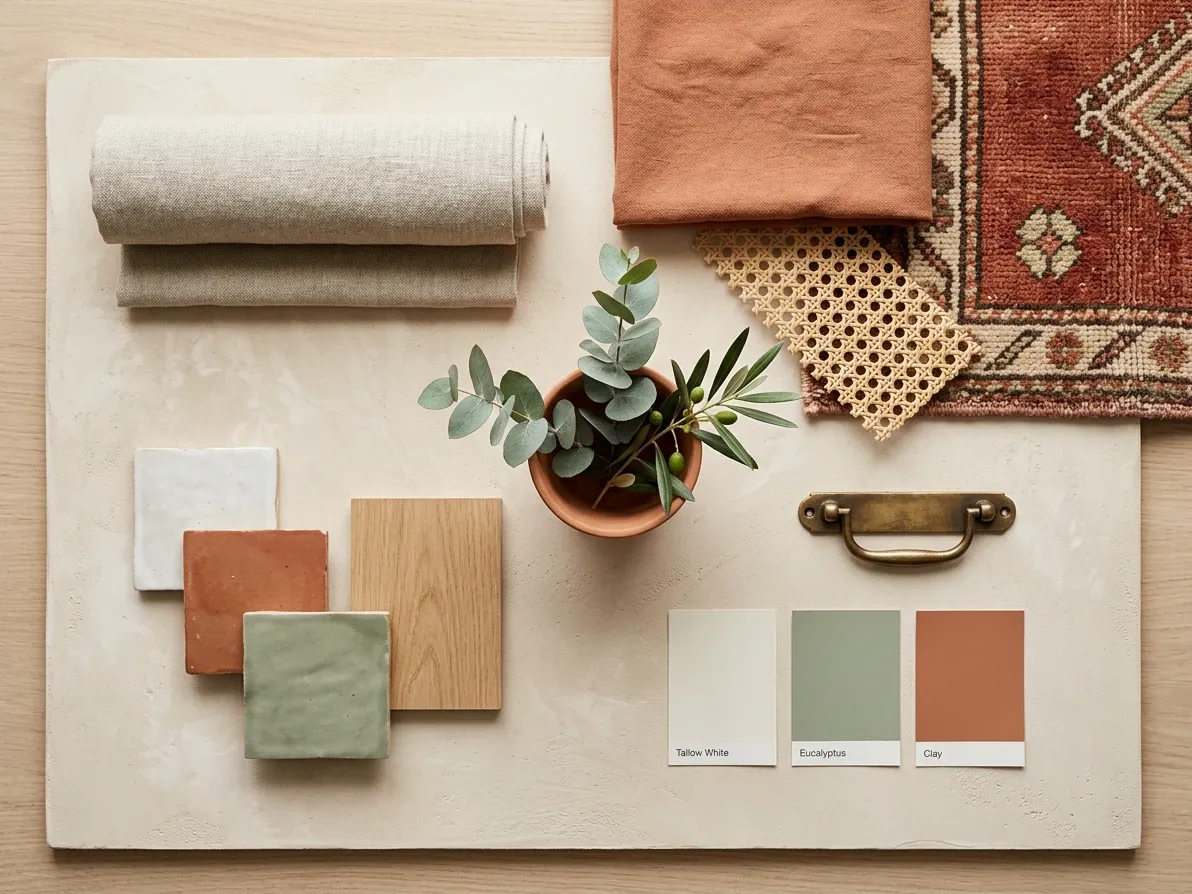
Warm whites, honey timber, terracotta and one earthy accent.
The 2026 boho palette and material vocabulary
The modern boho palette is built in three layers: a dominant warm-neutral base, a middle band of earthy tones and natural materials, and a confident accent set. The base layer carries walls, ceilings and the largest surfaces. Warm whites, soft creams, oat, sandy beige and pale linen all sit in the style; cool blue-whites read closer to Hamptons or Scandi and tend to undermine the warmth boho relies on. A useful working test for a boho white is whether it sits warmly against honey timber and terracotta: if the paint reads cool or clinical, it is the wrong white.
The middle band carries the timber, the natural fibres and the supporting palette. The dominant timbers run honey, mid-tone or lightly distressed, with European oak, American white oak, Australian Tasmanian oak, beech and ash all reading in the style. Reclaimed timber (an old hardwood door used as a benchtop, an old beam repurposed as a mantel, a vintage timber sideboard) is a defining boho move and signals the collected aesthetic cleanly. Rattan, cane, bamboo and wicker carry the secondary natural-material layer: rattan headboards, cane-front cabinetry, wicker baskets, bamboo light shades, woven pendants. Jute, sisal, seagrass and hemp carry the rug and basket layer.
The supporting palette warms toward earth: terracotta, rust, ochre, warm wheat, mustard, biscuit red, sage green, olive green, forest green, eucalyptus green, warm brown, walnut, chocolate, warm taupe, soft caramel. The accent set adds restrained jewel tones in small doses: deep emerald, rich teal, indigo, deep purple, burnished gold and aged brass. The 2026 direction holds that a single room should commit to one or two of these accents rather than all of them. Three accent colours start to read busy; one accent colour reads tightly considered; two reads richly collected.
Hardware and metalwork run warm and matte. Aged brass, oil-rubbed bronze, hand-forged iron, blackened steel and brushed warm nickel all read in the style. Polished chrome reads cold against the warmth boho relies on, and polished gold reads more Hollywood Regency than collected-traveller. Tapware in aged brass or matte black with traditional or simple gooseneck profiles, cabinet hardware in aged brass cup pulls or simple matte black knobs, light fittings with rattan or seeded glass shades, and door hardware in hand-forged iron all read in the style.
Stones lean warm and matte. Honed travertine, terracotta tile, sandstone, lime-washed plaster, warm engineered stone, honed marble in restraint and matte ceramic tile all sit in the style. Polished black marble, polished calacatta and polished granite all read against it; the cool reflective surface fights the warm earthy base the style is built on. A glazed splashback in a small format hand-glazed tile (zellige, hex, fish-scale) in warm white, terracotta or sage green reads cleanly boho.
Textiles run on linen, cotton, wool, jute, hemp, leather and silk. Slipcovered linen sofas, cotton or linen cushions in warm neutrals and earthy tones, wool throws in restrained patterns, jute or wool flatweave rugs as the base, vintage Persian or Moroccan rugs layered over them, leather poufs or armchairs, and the occasional silk velvet cushion in an accent jewel tone all read in the style. Heavy synthetic fabrics, glossy polyester and microfibre all read against it; the natural-fibre brief is one of the most important parts of getting the style right.
 Before
After
Before
After
Inside an Australian boho living room
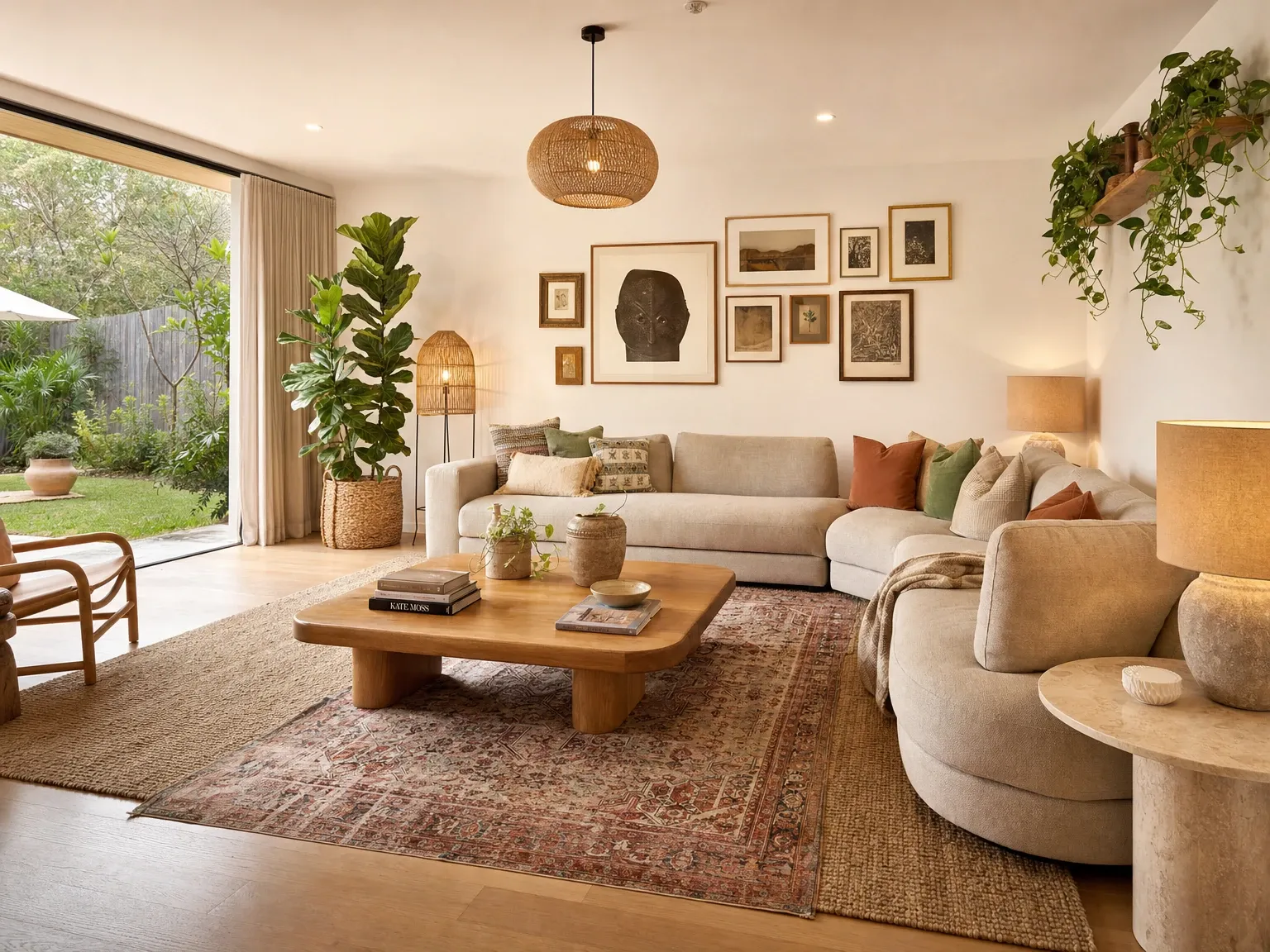
The living room is where most Australian boho rooms land hardest, because the style’s defining ingredients (a vintage rug, a generous sofa, a collected gallery wall, a couple of statement plants and warm layered light) all sit in a living room with very little friction. According to Lantern Lane Designs’ boho living room round-up, the goal of the room is to encourage relaxation and informal community, and the design choices follow from that brief.
Walls run warm white, soft cream or a light oat-neutral in most living rooms, with a single feature wall optional. Common feature-wall moves are a textured lime-washed or limewash-effect paint in a sandy or terracotta tone, an exposed brick wall (especially where the building genuinely has one), a tongue-and-groove vertical timber panel wall in warm white or sage, or a feature wallpaper in a botanical, paisley or block-printed pattern. The 2018 move of painting four walls a saturated jewel tone (a deep teal living room, a rust-orange feature wall) reads loud and dated; the 2026 move is a quieter base with the colour carried by the textiles, the rug and the joinery.
Flooring runs warm timber, terracotta tile or polished concrete most often, with the rug doing the heavy decorative work. Wide-plank engineered oak in a honey or warm mid-tone is the most common Australian floor that boho lives well on. Concrete works in inner-city apartments and warehouse conversions. Terracotta tile is the strongest Mediterranean-leaning option and reads beautifully in subtropical Queensland and northern New South Wales rooms.
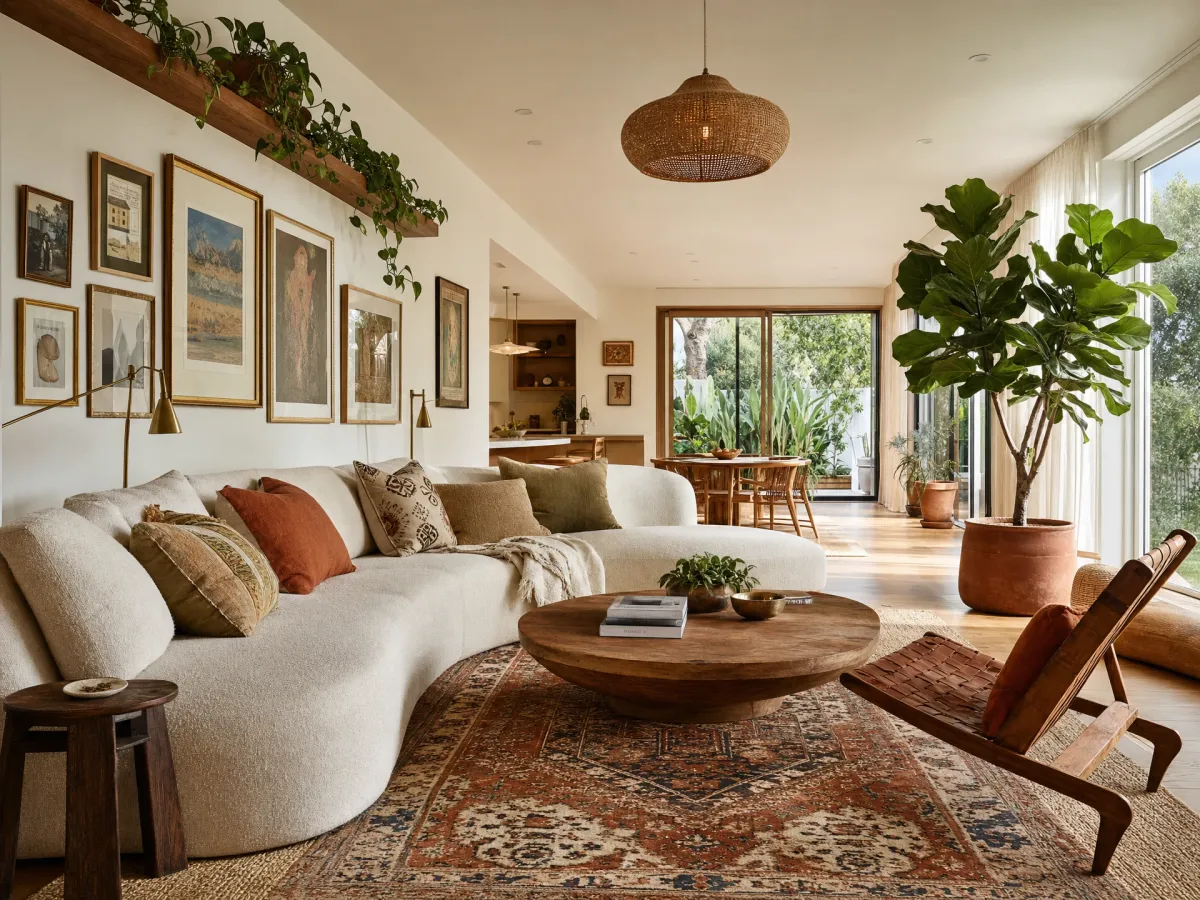
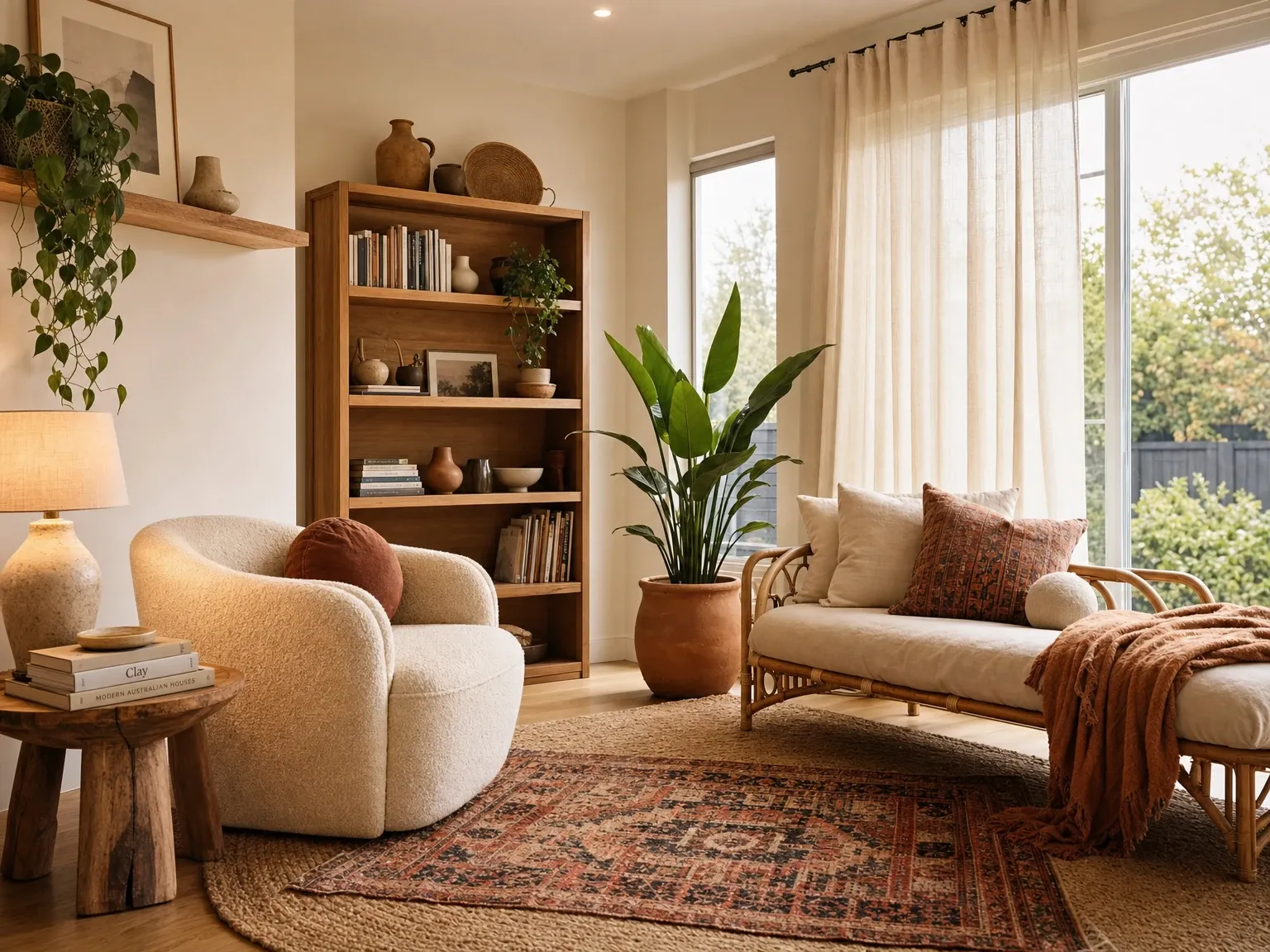
The rug layer is the single most important boho move in the living room. A vintage Moroccan Beni Ourain, a Turkish kilim, a vintage Persian, an Indian dhurrie or a flatweave wool rug with a tribal or geometric pattern sits over a larger natural-fibre base rug (jute, sisal or seagrass) in the most considered configurations. The layered-rug move is a defining boho gesture and signals the collected aesthetic the style is built on; the smaller patterned rug on top adds the colour and the personality, while the larger base rug grounds the room and protects the floor.
The sofa runs generous, comfortable and slightly lower than mid-century or Hamptons standard. A slipcovered linen sectional in oat or warm cream, a deep boucle curved sofa, a leather chesterfield (in restraint), a velvet sectional in deep forest green or rust, or a vintage timber-frame sofa with thick linen cushions all read in the style. The cushion layer is where most of the mixed pattern lives: kilim cushions, block-printed Indian cushions, embroidered Moroccan cushions, ticking stripes, mud-cloth cushions from West Africa, and the occasional jewel-tone velvet cushion all stack reasonably together, held by a repeating colour or two. According to Apartment Therapy’s designers’ boho-room piece, the rule of thumb is that mixed patterns work best when they share at least one colour or when their scales contrast clearly.
Plants carry the natural layer. A large fiddle leaf fig, monstera, kentia palm, ficus or rubber plant in a terracotta pot or a woven basket anchors a corner. Trailing pothos, devil’s ivy or string of pearls from a high shelf or a hanging macrame planter adds movement. A rubber plant, ZZ plant, peace lily, philodendron or snake plant carries the supporting layer. According to the Girl with a Shovel’s boho plant guide and Smart Plant Store’s boho-chic plant list, the move that distinguishes a current boho room from the 2018 version is that the plants are bigger and fewer, rather than dozens of identical small succulents.
Lighting is layered and warm. A statement pendant in rattan, woven jute, seeded glass or aged brass sits over the main seating area, with two or three table lamps in ceramic, brass or rattan-base form scattered across console tables and side tables, and one floor lamp (a rattan tripod, an aged brass arc lamp or a simple linen-shaded floor lamp) anchoring a quieter corner. Bright overhead downlights read clinical and undermine the warmth the style relies on; replacing them with warm-temperature dimmable bulbs is one of the cheapest moves that lifts a boho living room immediately.
The gallery wall is the boho living room’s single most identifiable styling move. A mix of framed botanical prints, abstract paintings, vintage portraits, woven textile pieces, hats or baskets used as wall hangings, hand-woven wall hangings and the occasional macrame piece read cleanly in the style. The current best practice is to lean into mixed frame materials and finishes (timber, brass, black, vintage gilt) rather than a uniform set, and to anchor the layout around at least one larger central piece rather than a uniform grid of identical squares.
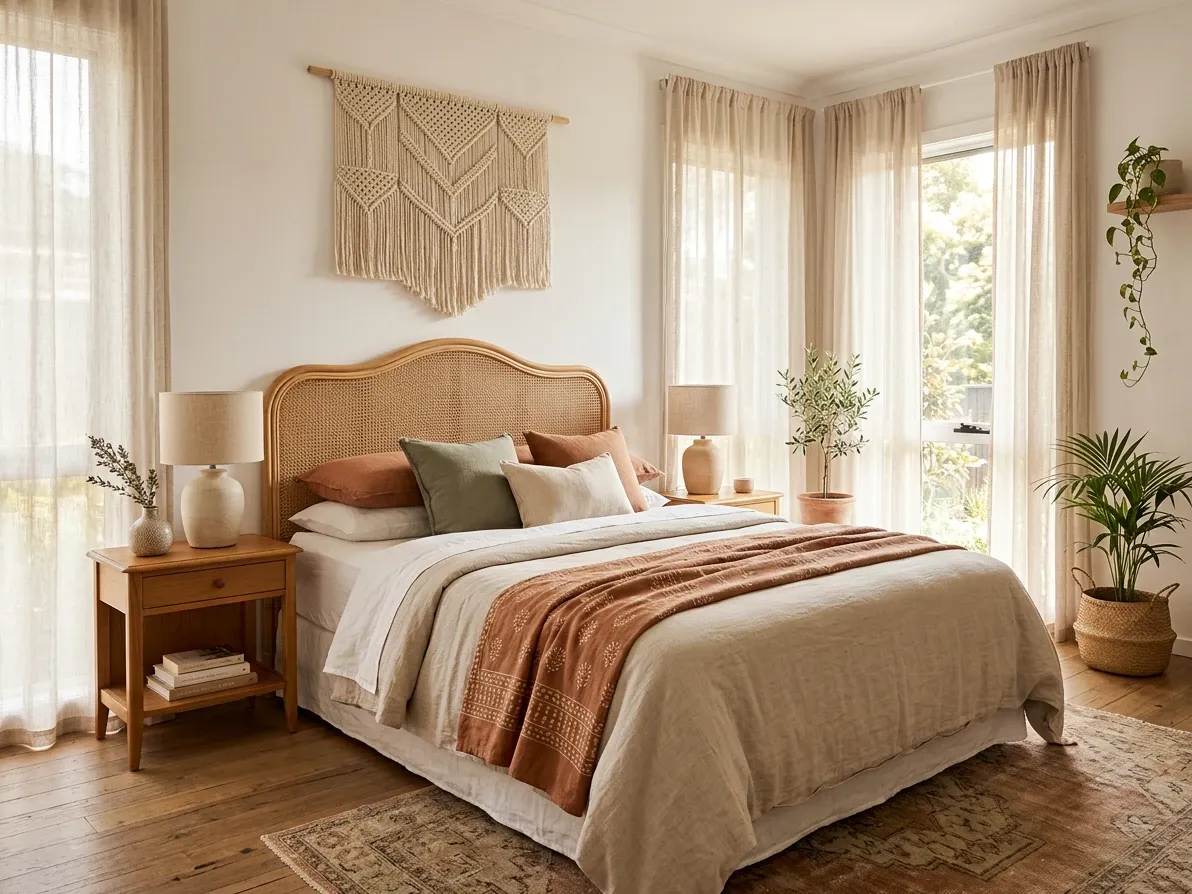
One statement piece above the bed beats a wall of small macrame.
Inside an Australian boho bedroom
The boho bedroom is the single most-searched room type in the style, and it is also the room where the 2018 Instagram version did the most damage to the style’s reputation. The current 2026 version pulls back to a calmer base and puts the personality into the bed itself, the textiles, the plants and the wall above the bed.
The bed is the room’s hero. A rattan or cane bedhead, a low timber platform bed in honey oak or warm walnut, a four-poster timber bed dressed in white linen or natural cotton, or an upholstered headboard in oat linen or warm boucle all read cleanly in the style. According to TLC Interiors’ boho bedroom guide and Sienna Living’s boho bedroom piece, the rattan or cane bedhead is the single most identifiable boho move in the bedroom and signals the style cleanly with one purchase.
The bedding layer carries the pattern and the colour. The base usually runs natural: a warm white, oat or soft cream linen quilt cover or duvet, with a contrasting throw in deep terracotta, sage green, mustard, rust or a deep ikat or block-print pattern. A folded Moroccan blanket or a kantha quilt at the end of the bed adds texture and pattern, while two larger sleep pillows in plain natural linen and two or three smaller accent cushions (a kilim cushion, an embroidered Indian cushion, a tassel-edged linen cushion) carry the personality.
Walls run quiet to let the bed and the textile layer carry the room. Warm white, soft cream or oat are the dominant choices; one feature option is a sandy or terracotta lime-washed wall behind the bed, or a vertical tongue-and-groove timber panel painted in a soft sage. The wall above the bed is the strongest gallery-wall opportunity in the house, and the considered 2026 move is one large piece rather than a wall of small mass-produced macrame: a single oversized macrame, a hand-woven wall hanging, a botanical print, a vintage tapestry or a piece of abstract art. According to the Cool List’s 2026 boho bedroom round-up, the current direction is toward one statement piece above the headboard rather than a cluttered gallery.
Window treatments run linen, cotton or rattan. Floor-to-ceiling sheer white linen curtains pulled to one side, a Roman blind in natural linen, simple rattan or bamboo roller blinds, or a layered combination of sheer linen and a heavier linen blockout all read cleanly. Heavy patterned drapes with pelmets read against the style; the brief is soft layered diffused daylight rather than the formal heavy-window treatment of Hamptons or French Provincial.
Bedside tables run timber, rattan or vintage brass. A rattan-front nightstand, a small vintage timber side table, a stack of vintage hardback books topped with a brass tray, or a low timber stool repurposed as a bedside table all read in the style. The top of the bedside table is the single most important styling vignette in the bedroom: a small ceramic vase with a single sprig of greenery, a small candle in a vintage holder, a stack of two or three books, a small ceramic dish for jewellery and a warm-tone table lamp in ceramic or brass. The temptation to add more is one of the 2018 boho mistakes; restraint reads more current.
Plants carry the soft natural layer. A medium-sized monstera, a hanging pothos or devil’s ivy trailing down from a high shelf, a small palm or a fern in a corner basket, and a single small plant on the bedside or windowsill is plenty for a bedroom. According to the Cool List 2026 boho bedroom piece, the move that signals current boho more than any other in the bedroom is restrained plant placement rather than a wall of identical small succulents.
Floor treatment runs the same logic as the living room: a warm timber or terracotta base, with a vintage Persian, Moroccan or Turkish rug under or beside the bed. A jute or sisal base rug layered with a smaller patterned rug works just as well.
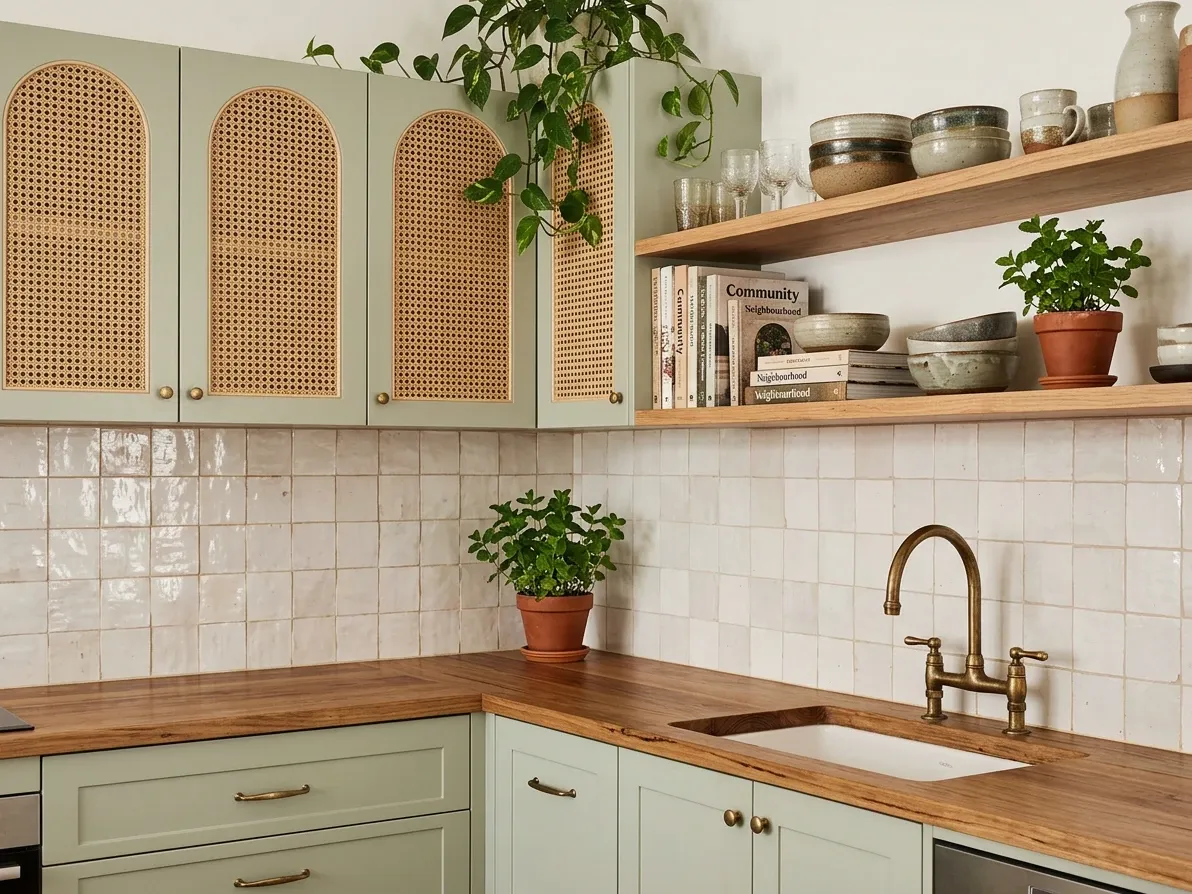
Cane-front cabinetry, open shelves, collected everyday ceramics.
Inside an Australian boho kitchen
A boho kitchen is rarer than a boho living room or bedroom because the kitchen’s working brief (durable surfaces, easy clean, integrated appliances) sits in tension with boho’s collected, hand-styled brief. The two reconcile best when the kitchen itself runs structurally simple and warm, and the boho personality lives in the open shelving, the splashback, the tapware and the styling layer rather than in the cabinetry.
Cabinetry runs warm white, soft cream, sage green, olive or terracotta in shaker, flat-front or simple panelled profiles. Cane-front or rattan-front cabinet doors are the strongest single boho move in a kitchen and signal the style cleanly with one detail. A two-tone configuration (warm white perimeter with a terracotta or sage green island, or a base run of warm cream cabinetry with cane-front upper cabinets) is the most successful 2026 boho kitchen layout. Solid timber cabinetry in honey oak or beech reads beautifully but pushes the budget significantly higher.
Benchtops run warm engineered stone in a sandy beige or honed-marble tone, honed natural stone in a warm hue, terracotta tile, butcher-block timber or polished concrete. The defining boho-kitchen benchtop move is something with warmth and matte texture; a polished bright-white slab fights the style. According to Homes and Gardens’ boho kitchen guide, the warmth of the benchtop is the single most important boho-kitchen decision after the cabinet colour.
The splashback is the strongest boho-kitchen surface. Small-format hand-glazed tile (zellige, hex, fish-scale) in warm white, terracotta, sage green or a soft natural ochre reads cleanly boho. Patterned encaustic or Moroccan tile in muted earth tones works beautifully but should be used in restraint (the splashback only, not the whole floor as well). A full-slab honed natural stone splashback in a warm marble or travertine is the premium option.
Open shelving is a defining boho-kitchen move. A run of timber open shelves above the bench, holding everyday ceramics, vintage glassware, a small terracotta pot of fresh herbs, a stack of cookbooks and a few hand-thrown jars carries more boho personality than any cabinet ever can. The styling rule is that the items on the shelf are the ones that get used: chipped Heath ceramics mugs, a French enamel coffee pot, a stack of handmade plates, a Moroccan tea glass, a jar of olive oil. According to HGTV’s 22 boho kitchen ideas, open shelving with collected ceramics is one of the most identifiable boho kitchen moves.
Tapware runs aged brass, oil-rubbed bronze or matte black with a gooseneck or bridge profile. A polished chrome mixer fights the style. The sink runs white or cream fireclay butler-style, undermount stainless in restraint, or a hand-glazed ceramic in restraint. A copper or brass sink is the strongest boho move but pushes premium.
Plants carry the soft layer. A trailing pothos above the upper cabinets, a small terracotta pot of basil on the windowsill, a hanging planter near the sink, and a tall potted palm or fiddle leaf in a kitchen corner all sit cleanly in the style. The styling layer leans on collected ceramics, a vintage timber breadboard or two, a hand-woven basket on the bench for fruit, and an Indian or Moroccan runner on the floor in front of the sink.
A boho kitchen sits in the lower half of the Australian renovation cost band most often, because the structural moves are relatively modest. According to the Housing Industry Association, the median Australian kitchen renovation sits around $30,000 to $35,000; a structural boho kitchen with painted shaker or simple flat-front cabinetry, engineered stone benchtops, hand-glazed tile splashback and aged brass tapware lands comfortably inside that band. The premium version with solid-timber cabinetry, cane-front cupboard doors, honed natural stone benchtops and a feature copper sink pushes well past $60,000.
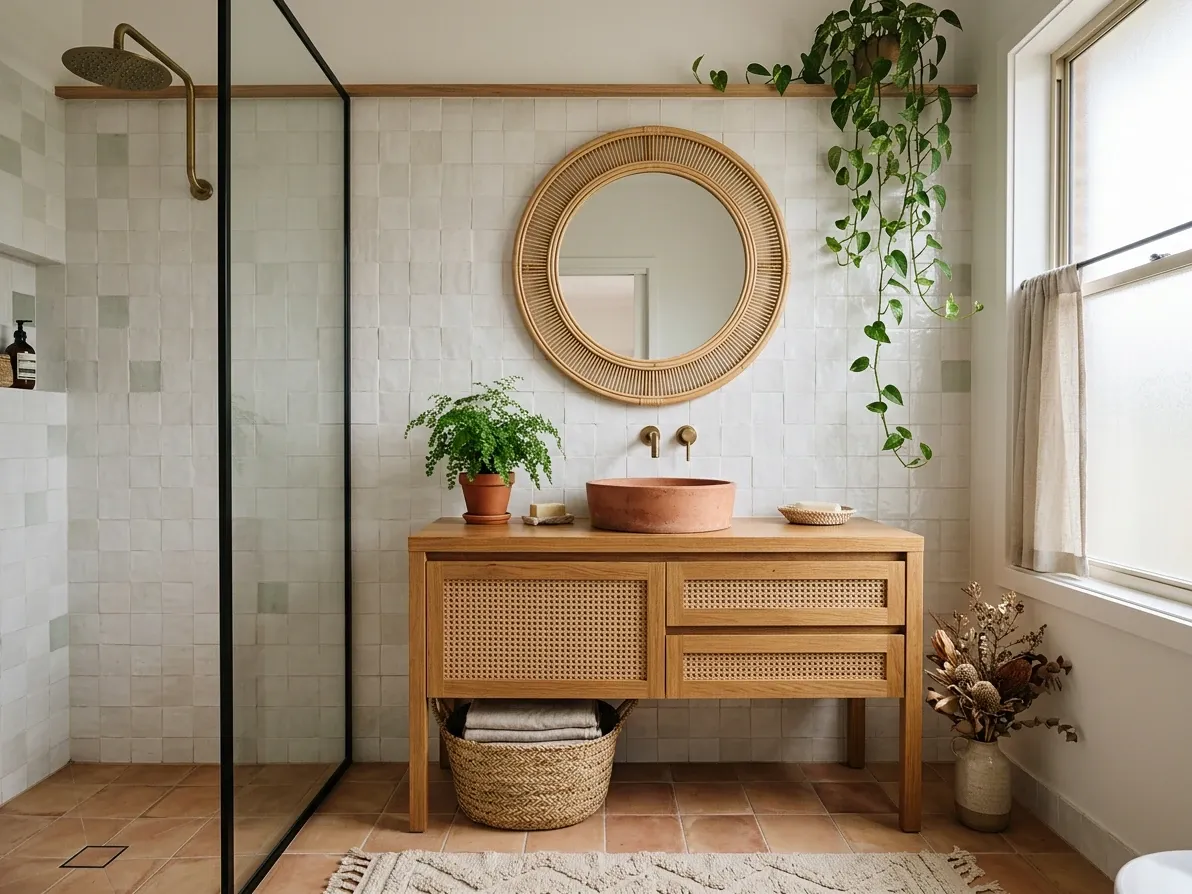
Terracotta tile, rattan mirror, brass tapware, real plants.
Inside an Australian boho bathroom
The boho bathroom plays to the style’s natural strengths: warm earthy tile, terracotta, lime-washed plaster, brass tapware, rattan storage, plants that thrive in humidity, and a deeply collected styling layer. According to the broader boho bathroom direction in 2026, the style sits beautifully in family bathrooms and ensuites that are renovated for warmth rather than for clinical luxury.
Tile runs warm and matte. Terracotta floor tile, honed travertine, sandstone, matte-finish ceramic in a warm cream or sandy beige, small-format hex or fish-scale tile in soft sage or terracotta, zellige tile in handcrafted irregular finish, or encaustic patterned tile in muted earth tones all read cleanly in the style. Polished bright-white tile, large-format porcelain in cool grey and high-gloss black tile all read against it.
Vanity runs timber, cane-front or warm-painted. A solid-timber vanity in honey oak or walnut, a cane-front vanity in warm white, a freestanding vintage timber sideboard repurposed as a vanity, or a simple shaker vanity painted in sage green or terracotta all read cleanly. A stone basin in honed travertine, terracotta or hand-glazed ceramic sits on top in the strongest boho bathroom configurations.
Tapware runs aged brass, oil-rubbed bronze or matte black, with a traditional or simple gooseneck profile. Showerheads in matching aged brass or matte black, with a separate hand shower on a brass slider, are the strongest boho move. A polished chrome mixer fights the style.
The shower screen runs black-framed steel glass or no screen at all in a wet-room layout. A frameless shower screen with stainless or chrome hardware fights the style; the slim black steel frame reads boho or industrial-boho cleanly.
The mirror is one of the strongest boho-bathroom styling moves. A rattan-framed round mirror, an arched timber mirror in warm honey oak, a vintage gilt mirror in restraint, or a large arched brass-framed mirror all read cleanly. The rectangular frameless mirror that dominated the 2015 to 2020 bathroom reads against the warmth boho relies on.
Plants carry the soft layer. Bathrooms with adequate light handle ferns, pothos, philodendron, peace lilies, snake plants and the occasional small palm beautifully, and the humidity helps rather than hurts. A hanging plant in a macrame planter above the bath, a small fern on the vanity and a trailing pothos from a high shelf all read in the style.
Styling runs collected. A vintage timber stool repurposed as a bath caddy, a stack of hand-woven baskets for towels and toilet paper, a hand-thrown ceramic vase with eucalyptus or olive branches, a small brass tray on the vanity holding three or four ceramic pieces, and folded linen or cotton waffle towels in oat, warm white or terracotta all read cleanly. The styling layer should look as if it accumulated over a couple of years of considered buying, not as if it was bought in a single trip to a homewares store.
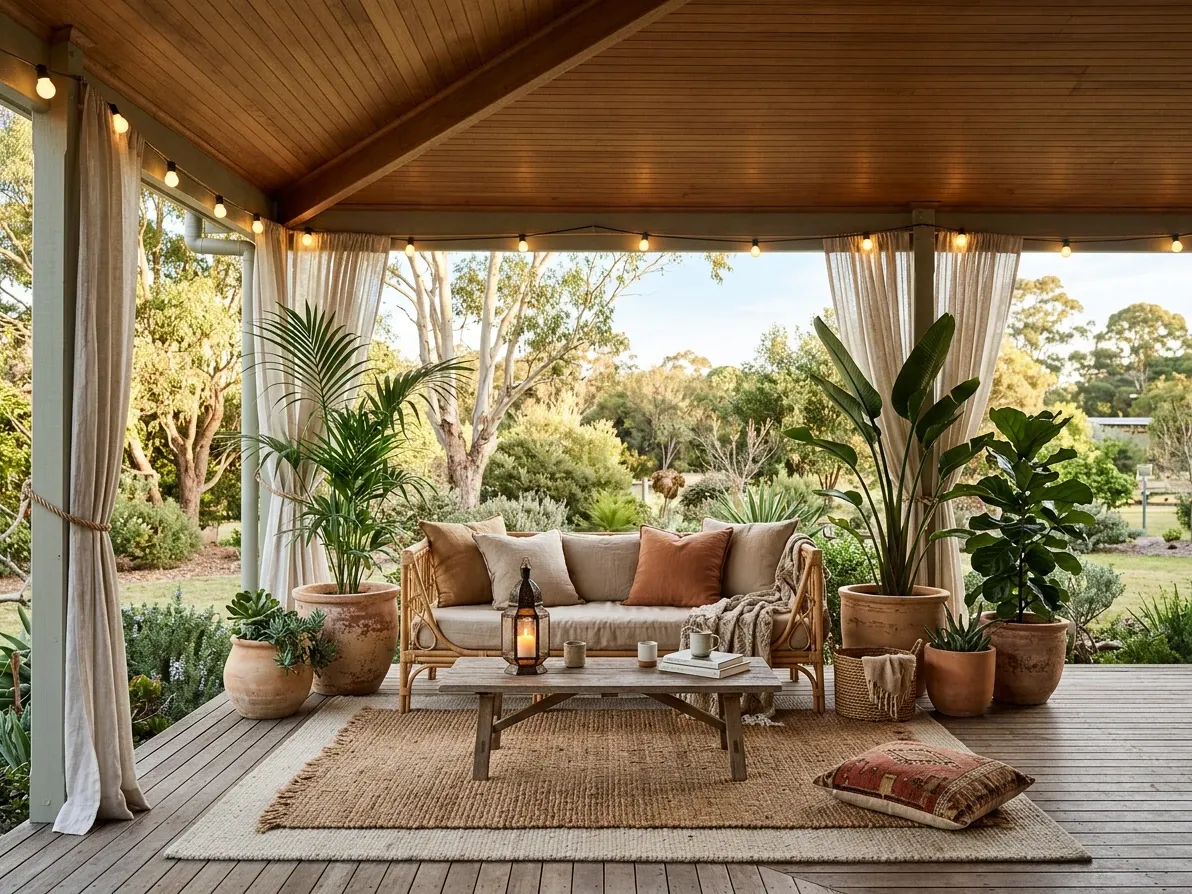
Australian boho on the verandah: rattan, festoons, plants, layers.
How boho lives outside
One of boho’s strongest plays in Australia is what happens beyond the back door. The style’s reliance on natural materials, woven texture, layered textiles and plants translates beautifully to a verandah, a covered deck or an outdoor room, and the wide outdoor-living tradition that already exists in Australian residential architecture gives the style a natural home there. According to Carpet Court’s Byron Bay boho luxe inspiration piece, the Byron Bay coastal-boho aesthetic that already reads as globally identifiable Australian sits in exactly this territory: a covered deck or verandah dressed in rattan, woven texture, white linen and indoor-outdoor plants.
The structural moves are honest. A timber-decked verandah or covered alfresco with a warm timber ceiling, a string of warm-white festoon lights running along the verandah edge, a low rattan or cane sofa with thick linen cushions, a layered rug in jute or wool flatweave (an outdoor synthetic-fibre rug that mimics jute is acceptable in covered areas), two or three large potted plants (a kentia palm, a fiddle leaf fig if covered enough, a strelitzia, a frangipani in tropical regions) and a low timber coffee table is the core configuration. The styling layer carries vintage Moroccan lanterns, hand-woven baskets, ceramic planters, linen cushions, throw blankets for cool evenings and a low daybed or hammock for the lounging brief.
The relationship to the indoor space matters. The boho move is to read the outdoor room as a continuation of the living room rather than as a separate styled zone: similar palette, similar materials, similar plant logic. Stacking doors, cafe doors or French doors that open the inside fully to the outside are the strongest architectural move; a row of large casement or louvre windows that visually connects the two spaces is the considered alternative. The traditional Australian verandah with its deep eaves, timber posts, painted weatherboard wall behind and corrugated iron ceiling reads as one of the best architectural settings the style has anywhere in the world.
Where boho sits next to coastal, Hamptons, Scandi, French Provincial, mid-century and Japandi
Boho is one of the most commonly confused styles in the Australian conversation because it shares ingredients with several major styles without being any of them. The working tests are quick.
Boho vs coastal. Coastal is built on a sandy-blue palette, rattan, jute, whitewashed timber and a clear seaside reference. Boho is built on a warm earthy palette, mixed cultural references, layered patterns and vintage objects with no required sea reference. The two genuinely blur in the Byron Bay coastal-boho variant and in tropical Queensland homes, and the modern coastal direction documented in the coastal style guide absorbs a lot of boho’s natural-material vocabulary. The cleanest separator is the rug: a vintage Moroccan or Persian on layered jute reads boho; a sea-grass under a white linen sofa with no patterned rug reads coastal.
Boho vs Hamptons. Hamptons is the formal cousin of every relaxed natural-material style. It uses white painted shaker joinery, deep cornices, polished oak floors, statement pendants and a coastal palette of crisp white, navy blue and seagrass. Boho refuses every one of those moves: matte timber, no architectural decoration, layered pattern, warm earthy palette and a collected aesthetic. The Hamptons cabinet (a raised-panel shaker in a square mitred frame) and the Hamptons floor (a polished mid-tone oak in herringbone) are the two cleanest separators. Detail at the Hamptons style guide.
Boho vs Scandi. Scandi is the closest cousin on the calm-natural side. Both styles use natural timber, white walls, plants and a clean reading of negative space, and both treat objects with provenance with respect. Scandi runs lighter, cleaner, more pale and more architecturally restrained, with very little applied pattern. Boho runs warmer, more visibly layered, more confidently patterned and more visibly handcrafted. The single cleanest test: does the room have a vintage patterned rug as its hero? Boho yes, Scandi no. Detail at the Scandi style guide.
Boho vs French Provincial. French Provincial is the European-rural elegance cousin. It uses curved furniture, decorative mouldings, distressed paint, a softer pastel palette (duck-egg blue, mint, sage, custard) and ornate gilt or brass details. Boho uses simpler furniture, no carved mouldings, no pastels (warm earth instead) and aged brass rather than gilt. The cleanest separator: is the dominant furniture line curved-and-carved or flat-and-simple? French Provincial yes to the first, boho yes to the second. Detail at the French Provincial style guide.
Boho vs mid-century modern. Mid-century modern is built on graphic teak furniture, low slung sofas, splayed legs, a small palette of accent colours and minimal pattern. Boho is built on mixed-era collected furniture, layered patterns and visible handcraft. The two pair beautifully in real homes (an Eames lounger anchoring a boho gallery wall above a vintage kilim is one of the most loved configurations on Pinterest), but the styles are distinct. Mid-century is graphic and architectural; boho is layered and collected. Detail at the mid-century modern guide.
Boho vs Japandi. Japandi is the calm cousin of the warm-natural family, built on the Japanese principle of wabi-sabi (appreciation of imperfection) plus Scandi restraint. It shares boho’s appreciation of vintage, handmade and imperfect objects, but commits to a much quieter palette and far fewer objects. The 2026 modern boho direction shares more with Japandi than the 2018 Instagram boho ever did; the two blur most in bedrooms and reading nooks where the calm-natural brief dominates.
Boho vs maximalism. Maximalism is the style that pushes past boho’s restraint: more colour, more pattern, more layers, more objects, more ornament, deliberately over the top. According to the comparison from Decolide, boho leans relaxed and slightly restrained while bohemian maximalism pushes deliberately into excess. The boho-maximalist hybrid is one of the most identifiable 2024 to 2026 directions and reads beautifully when committed to, but it asks the room to be richer, denser and louder than a quiet modern boho room.
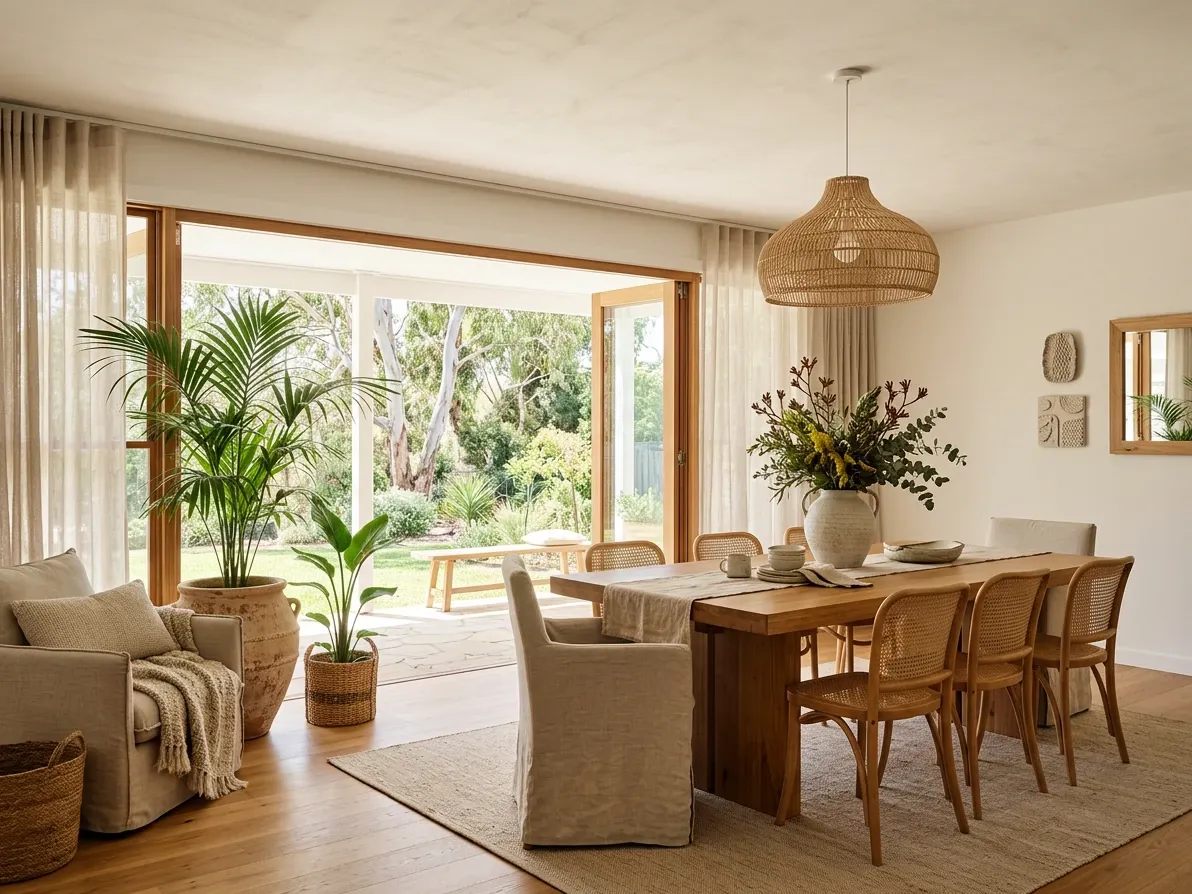
Linen, plants and indoor-outdoor flow: boho’s natural home.
Why boho fits Australian houses and climate
Boho is better suited to Australian homes than almost any other imported interior style. Three reasons line up cleanly.
The climate fits the materials. Boho relies on natural-fibre textiles (linen, cotton, jute, hemp) and indoor plants from tropical and subtropical climates (monstera, fiddle leaf fig, devil’s ivy, philodendron, kentia palm). Both of those handle Australian summers comfortably without specialist climate control. According to Bondi Resortwear’s note on Australian-climate-suitable fabrics, linen, cotton and bamboo are the textiles that perform best in hot and humid Australian conditions because they breathe, dry quickly and absorb less heat than synthetics. Boho’s natural-material brief is exactly the brief Australian homes have always asked for.
The dwelling stock fits the room sizes. According to the Australian Bureau of Statistics 2021 Census, approximately 70 per cent of Australian private dwellings are separate houses, with townhouses and apartments making up most of the remainder. The separate house with garden views, generous wall space for art, room for tall plants and a verandah for indoor-outdoor flow is the building stock boho asks for. The style works in apartments as well, but it asks for a particular configuration there (large windows, decent ceiling height, a wall for the gallery wall, a corner for the statement plant) that not every apartment delivers.
- Separate houses70%
- Apartments16%
- Townhouses13%
- Other1%
The cultural temperament fits the style. Boho’s brief (collected, relaxed, lived-in, indoor-outdoor, plant-rich, hospitable) lines up cleanly with the laid-back hospitable domestic culture Australia already broadly favours. The Byron Bay coastal-boho aesthetic that has globalised over the past decade is one of the more identifiable Australian style exports, and the Australian outback palette of ochre, terracotta, sandy beige, eucalyptus green and warm white is one of the strongest natural matches the boho colour story has anywhere.
The single climate qualifier is the cooler southern Australian winter. A boho room dressed for endless summer with sheer linen curtains, no draught seal, a single thin throw and a tile floor reads beautifully in February but feels miserable in July in Melbourne, Hobart, Canberra or the Snowy region. The fix is honest: a heavier wool throw added in winter, layered rugs over the tile or timber floor, a heavier linen drape behind the sheer panels, and proper draught-sealing on doors and windows. The style adapts cleanly to a Tasmanian winter as long as the seasonal layering is taken seriously.
What boho actually costs
Boho is the lowest-cost imported interior style in the contemporary Australian market, and that is one of its defining features. The base ingredients (natural-fibre rugs, vintage timber furniture, second-hand sofas, ceramics, plants, linen cushions, woven baskets, terracotta pots) are widely available across price tiers, and the style genuinely improves with second-hand and vintage pieces. There is no formal architectural decoration to commission, no shaker joinery to build, no polished oak herringbone floor to lay. The cost lives in the soft layer, and the soft layer is forgiving.
A useful working tier is three bands.
The entry-level boho fit-out (roughly $1,500 to $4,000 per room). A vintage rug from Gumtree, Facebook Marketplace or a local op shop ($150 to $400). A second-hand sofa or armchair reupholstered in linen ($400 to $1,200). A few jute baskets, terracotta planters and small ceramic vessels from KOO, Spotlight, Bunnings or Big W ($100 to $300). A handful of cushions in linen and cotton in warm neutrals and one accent colour ($150 to $400). Three or four plants from Bunnings or a local nursery ($100 to $250). A simple rattan pendant or floor lamp ($150 to $400). A small gallery wall built from prints, vintage frames from op shops and a single statement piece ($200 to $600). This tier delivers a genuine boho room and is well within the reach of most Australian renters and first-home owners.
The mid-range boho fit-out (roughly $5,000 to $15,000 per room). A new linen-slipcovered sectional or a quality vintage sofa, a small handmade Persian or Moroccan rug or a quality flatweave, solid-timber vintage side tables and a coffee table, two or three larger statement plants in considered baskets or terracotta pots, an aged brass or rattan pendant, two or three ceramic table lamps, a curated set of cushions in mixed linen, cotton and embroidered fabrics, and a considered art layer with two or three larger pieces. Most of the boho rooms photographed in Australian editorial publications sit in this tier.
The premium boho fit-out (roughly $15,000 per room plus). A hand-knotted vintage Persian or Moroccan rug in good condition ($3,000 to $10,000 plus), a designer linen sofa or a fully reupholstered antique sofa, a few authentic vintage timber pieces (a 1960s Danish sideboard, a 19th-century Indian cabinet, a hand-carved bench), original art from emerging or established Australian artists, an oversized hand-woven wall hanging, statement plants at six feet plus in considered terracotta or carved-timber pots, and a curated styling layer of authentic ceramics and travel finds. This tier is essentially boho’s premium luxury reading and reads as the photographed Bohemian homes from Belle, Vogue Living and The Local Project.
According to the 2025 Houzz Australia renovation report and aligned trade-publication analysis, 75 per cent of Australian homeowners plan to decorate their homes in the next two years and 38 per cent plan a major renovation, so the soft fit-out tier (the entry-level and mid-range boho bands) sits cleanly inside the work most Australians are already doing.
 Before
After
Before
After
Visualising a boho home before you commit
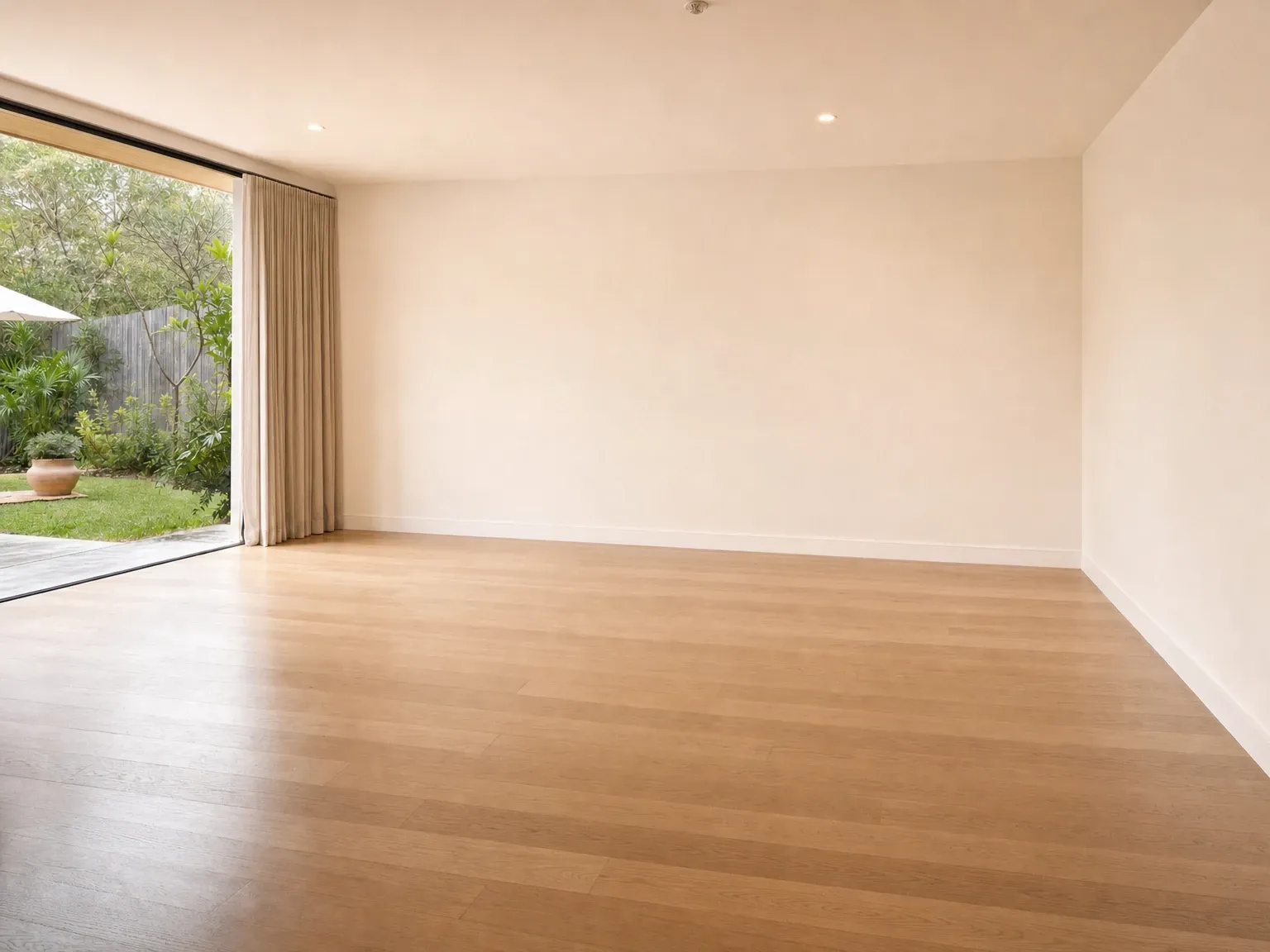
One of the practical challenges of boho specifically is that the style depends so heavily on the soft layer (rugs, cushions, plants, gallery walls, ceramics) that a wireframe or floor plan tells you very little about whether the room will land. A bare-walls render of a boho-intended space looks like a generic empty room; the style only resolves once the textiles, the patterns, the plants and the styling layer go in.
This is the gap reIMG was built to close for Australian renovators, designers and home buyers. The interior design service generates photorealistic visualisations of a finished room from a rough brief, a floor plan or a photo of the existing space, so a homeowner can see what a boho living room or bedroom will actually look like before committing to the rug, the sofa, the cabinetry colour or the wall treatment. The virtual staging service does the same thing for empty rooms being prepared for sale, including the boho-and-modern-coastal direction Byron Bay and northern New South Wales agents already favour. Seeing the room resolved as a photo, with the rug, plants, cushions and gallery wall in place, is the cheapest way to commit to a direction with confidence.
The mistakes that age a boho room fastest
Six specific mistakes account for most badly-aged Australian boho rooms.
Buying the prop-shop version. The 2017 to 2020 Instagram boho aesthetic (mass-produced macrame, dreamcatchers, pampas grass in identical vases, “good vibes” signs, fairy lights as primary lighting, identical concrete planters) is the single fastest-aging configuration the style has. According to Realty Times’ six boho design mistakes piece, the fix is to lean into the style’s collected brief: vintage, handmade, inherited and second-hand pieces with actual provenance, rather than mass-produced identical motifs.
Treating every surface as a styling opportunity. The 2018 boho room had every shelf, table and windowsill loaded. A 2026 boho room has clear hero zones (the gallery wall, the daybed corner, the plant shelf, the coffee table) surrounded by deliberately quiet negative space. According to Joyfulicity’s boho mistakes piece, without that breathing room every layer competes and none of them read.
Ignoring colour harmony in the pattern mix. Mixed patterns work when they share a colour, contrast clearly in scale, or both. Mixed patterns fail when they share neither and the room reads visually noisy rather than richly collected. The fix is to choose two or three colours that repeat across the room (a warm terracotta, a sage green, a warm cream) and to lean into them across the cushions, rug, throw, art and ceramics.
Choosing fake plants for ease. Real plants are central to the style; mass-produced silk and plastic plants read as fake from across the room and undermine the natural-material brief the style is built on. According to the Girl with a Shovel’s boho plant guide, low-maintenance real plants (pothos, devil’s ivy, snake plants, ZZ plants, philodendron) are the right answer for renters and time-poor owners.
Defaulting to one big rug instead of layering. The single-rug-on-bare-floor configuration reads as undifferentiated. The two-rug layered configuration (a larger jute or sisal base under a smaller vintage Persian or kilim) is one of the most defining boho moves and reads richly collected at very little additional cost.
Going full pampas grass. Pampas grass became the 2019 signature boho object on Australian Instagram. The 2026 direction has explicitly moved past it. According to Living Etc’s 2026 bohemian revival note, the style’s current direction is away from the pampas-grass-in-a-Kmart-vase configuration toward fresh greenery, considered larger plants, and dried flora used in restraint rather than as a defining motif.
Frequently asked questions
What is boho interior design in plain terms?
Boho interior design (short for bohemian) is a layered, collected, plant-rich interior style built on natural materials, mixed patterns, vintage and handcrafted pieces, and a warm earthy palette. It traces its name to French Bohémien, the nineteenth century counterculture of artists, writers and travellers who furnished cheap garrets with second-hand furniture, worn rugs and souvenirs from elsewhere. The modern reading carries the same instincts: rooms that look collected rather than bought as a set, where rattan, jute, linen, timber, plants and ceramics layer over each other and the things on the shelves have actual provenance. The 2026 version is warmer, calmer and more curated than the busy social-media boho of 2017 to 2020, with terracotta, sage, warm whites and honey timber doing more of the work than fringe, macrame and signage.
Is boho still in style in 2026?
Yes, but in a quieter, warmer form. The hyperactive Pinterest boho of the late 2010s (a wall of macrame, every surface stacked with cacti and dreamcatchers, every cushion fringed) is fading. What is taking its place is sometimes called modern boho, organic modern or bohemian minimalism, and it leans warmer, more textural and considerably less themed. Pantone named the soft warm white Cloud Dancer its 2026 Colour of the Year and the broader 2026 forecasts (Houzz, Apartment Therapy, James Hardie Australia, Bellcourt) all describe a shift toward earthy palettes, curved organic furniture, natural fibres and lived-in collected rooms. That direction sits comfortably inside boho’s core vocabulary, which is why the style is genuinely current rather than dated.
What’s the difference between boho and boho-chic or modern boho?
Traditional boho is the unrestrained version: vibrant jewel tones, a riot of layered patterns, heavy fringing, lots of texture and very little restraint. Boho-chic and modern boho are the curated versions: the same natural materials, plants and global references, but pulled into a more disciplined palette (warm whites, soft creams, earthy neutrals with one or two earthy accents), cleaner lines on the furniture, and a stronger respect for negative space. Modern boho often sits inside what designers also call organic modern or warm minimalism, and it is the version that ages best in a contemporary Australian home. Bohemian maximalism is the opposite trajectory: more pattern, more colour, more layers, deliberately pushed past restraint.
Does boho suit Australian homes?
Better than almost any other imported style. Boho’s three central ingredients (natural fibre textiles, indoor plants and indoor-outdoor flow) line up cleanly with the Australian climate, the dominant detached-house stock and the laid-back domestic culture the country already favours. Linen, cotton, jute and rattan handle Australian summers comfortably; tropical and subtropical plants (monstera, fiddle leaf fig, devil’s ivy, philodendron, kentia palm) thrive in most of the country with minimal care; and the wide verandah, the casement window and the open-plan kitchen-living-outdoor flow common to Australian houses give the style the daylight, the air movement and the visual breathing room it needs. Byron Bay’s coastal-boho variant is already a globally recognisable Australian aesthetic, and the Australian outback palette (ochre, terracotta, sandy beige, eucalyptus green) lands inside the boho colour story without effort.
What colours and materials define a boho room?
The base is a warm neutral: warm white, soft cream, oat, sandy beige or pale linen. Over that, the middle band carries the natural materials (honey or mid-tone timber, rattan, cane, jute, linen, cotton, terracotta) and the supporting palette warms toward earth (sage green, olive, forest green, terracotta, rust, ochre, mustard, biscuit red, warm brown). A confident accent set adds restrained jewel tones (deep emerald, rich teal, indigo, deep purple, burnished gold or aged brass). Hardware leans warm and matte: aged brass, oil-rubbed bronze, hand-forged iron or warm brushed nickel rather than polished chrome. Stones lean warm and matte (honed travertine, terracotta tile, sandstone, lime-washed plaster) rather than cool polished marble.
How do I do boho without it looking cluttered?
Use the 70/30 rule. Roughly seventy per cent of the room sits in a calm base layer (warm white walls, a single dominant timber or natural-fibre rug, restrained upholstery, considered negative space), and the remaining thirty per cent does the boho work (the layered cushions, the plants, the macrame piece, the vintage rug, the gallery wall, the patterned throw). The single most common mistake in Australian boho rooms is treating every surface as a styling opportunity. A genuine boho room has clear hero zones (the daybed corner, the gallery wall, the dining table centrepiece, the plant shelf) and deliberately quiet space around them. If the room reads as visually noisy rather than collected, the boho layer is doing too much work and the base layer is doing too little.
Is boho an expensive style?
No, and that is one of its defining features. Boho is one of the most budget-friendly interior styles available because the dominant materials (jute, rattan, linen, cotton, timber, terracotta, plants) are inexpensive, vintage and second-hand pieces carry the style better than new furniture does, and the look genuinely improves with mismatched and inherited objects. The entry into boho is a vintage rug from Gumtree or Facebook Marketplace, a few jute baskets from KOO or Spotlight, two or three plants from Bunnings and a set of cotton or linen cushions from Adairs. The premium version uses solid-timber furniture, hand-knotted Persian or Moroccan rugs, larger statement plants and authentic vintage pieces, and pushes the budget up, but the style does not require it the way Hamptons or French Provincial does.
What’s the biggest boho mistake?
Buying the prop-shop version. The version of boho most heavily promoted between 2017 and 2020 (a wall of mass-produced macrame, identical concrete-finish planters, a pink neon sign that says good vibes, a fringed pampas-grass stem in a Kmart vase, a single feather dreamcatcher above the bed) reads as themed rather than collected, and ages within a season. The fix is to lean into the style’s actual brief: collected objects with provenance, a restrained palette around one or two confident accent colours, mixed patterns held together by colour repetition, real plants rather than fake ones, and at least one piece in every room that was inherited, bought second-hand or made by hand. A room that follows that brief reads as a current 2026 boho room. A room that follows the 2018 Instagram version reads as a Kmart aisle from five years ago.