Real estate photography, the full picture
What real estate photography actually costs in Australia in 2026, what good listing photos look like, and the editing step that separates a top campaign from an average one.
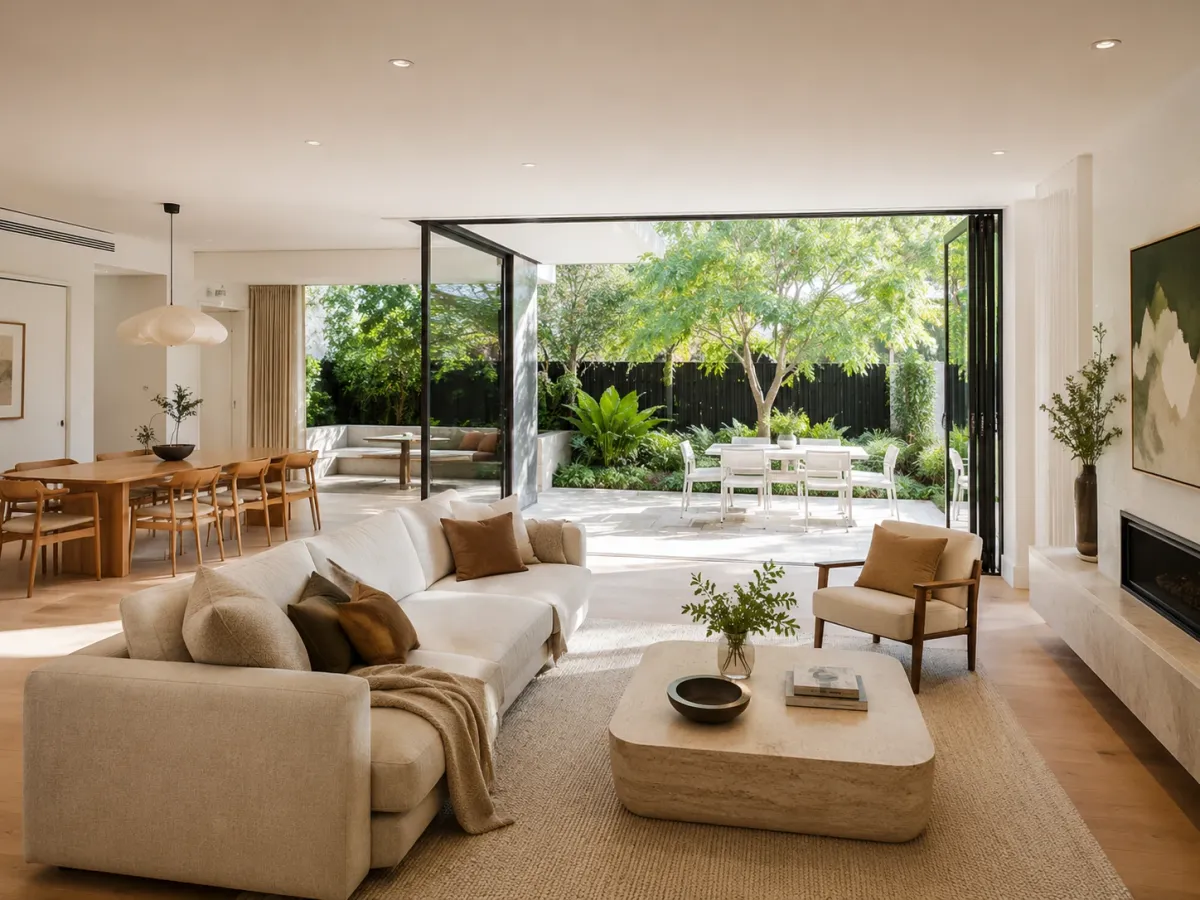
If a buyer cannot picture themselves living in your listing within the first three or four photos, they scroll. The listing photo set is no longer the marketing layer of a property campaign. It is the campaign. Realestate.com.au’s own data shows that 9 in 10 properties that sell on the platform attract buyer engagement there first, and that eventual buyers view roughly 28 times more images per listing than people who do not end up buying. The photos are how a serious buyer qualifies in or out before they ever fill in an enquiry form.
This guide is for two audiences. For sellers and agents commissioning a real estate shoot in Australia, it covers what good looks like, what it costs city by city, what to ask for, and where the editing step lifts an average campaign into a premium one. For photographers reading from the other side, it covers the technical settings and on-site choices that consistently separate a $200 commodity shoot from work that earns repeat instructions. Where US-centric guides default to MLS conventions, this one is grounded in what realestate.com.au and Domain actually need and what Australian buyers actually do once they land on a listing.
Why listing photos do most of the selling
Australian buyers form a view of a property before they read a single line of copy. The imgix analysis of buyer behaviour found that property shoppers spend roughly 60% of their viewing time on the images before reading the description, and that 85% of buyers rank photos as the single most important factor in evaluating a listing online. REA Group’s PropTrack Buyer Impact Model, independently reviewed by Deloitte and built on more than 1.3 million Australian sales from August 2023 to November 2025, takes the same finding further: of 25 behavioural signals the model tracks, image engagement is among the strongest predictors of an eventual purchase.
The Australian market shape makes this matter more, not less. Homes sold faster nationally in early 2026 than they did a year earlier. The median time on market across the three months to April 2026 was 27 days, down from 29, leaving a listing less time on portal feeds to convince a buyer to stop scrolling. A first image that does not earn the second image earns nothing.
What the photos are doing, in order: catching the scroll, qualifying buyers in, generating saves and shares (both heavily weighted in REA’s engagement model), and earning the inspection booking. They are not selling the property. They are selling the inspection. Once a buyer is standing in the room, the photos have done their job.
What buyers actually do with the photos
The behaviour data is uncomfortably specific. Eventual buyers spend nearly seven cumulative hours on a listing before they purchase, across multiple sessions, and view 28 times more images than people who never end up bidding. That ratio is the clearest argument there is for a deep, complete photo set: a buyer who is interested will cycle through every image, often more than once, and the moment they hit a gap (no laundry shot, no second bedroom, no outdoor area), they extrapolate the worst.
The hierarchy of attention on a portal listing is consistent across the buyer research:
The hero image carries disproportionate weight because it is the only photo visible at thumbnail size. Floor plans rank just behind the photos in buyer-stated importance, with around 81% of buyers calling them important or essential and roughly 80% looking at the floor plan before opening the gallery. The written description trails both. Video and walk-throughs lift engagement but do not displace the still images as the qualifying tool.
The practical implication for an Australian listing: the gallery has to cover every room at least once, in the order a buyer would walk through them, with no awkward gaps. Skipping the second bathroom, the laundry, or the outdoor area is not minimalism. It reads as something to hide.
What good Australian real estate photography looks like
Stripped to its essentials, a good listing photo set is a sequence of clean, bright, undistorted images that show a property as it is on a calm day, with the rough edges tidied and nothing important left out. The aesthetic conventions that have settled in the Australian market over the last few years are tighter than they used to be:
Verticals are vertical. A wide-angle lens at an oblique angle to a wall will lean every door frame and skirting board outwards if it is not corrected, and uncorrected verticals are now the single fastest tell of an amateur shoot. Every modern editing workflow corrects them by default.
White balance is neutral. The yellow-tungsten cast that used to be normal in Australian listings has gone. Whites read as white, walls read true, and the temperature stays consistent across rooms. The only warm colour in the frame should be a deliberate practical lamp or a fire, not a wash across the whole image.
Windows are not blown out. Through-window views are visible (the backyard, the city skyline, the trees, the pool) because they are part of what is being sold. Achieving that takes either HDR bracketing, flash blending, or both. A photo with white squares where the windows are reads as careless even to a buyer who could not explain why.
Rooms read as spacious without lying about size. A 14mm to 24mm lens on full frame (or roughly 10mm to 16mm on APS-C) is standard. Going wider than that gives the model-village look that buyers now recognise on sight and discount.
Composition is at light-switch height. Shooting at standing height makes ceilings dominate and floors recede; shooting too low does the opposite. Light-switch height, somewhere around 1.1 to 1.3 metres, holds the room’s proportions correctly and is the convention most Australian providers shoot to.
The aspect ratio is 4:3 because that is what realestate.com.au and Domain expect; other ratios crop badly in the portal feeds, and a photo that crops awkwardly on the platform that gets the engagement is a wasted shot.
The shoot: equipment, settings, technique
The technical baseline for residential work in Australia is consistent enough across providers to summarise tightly. A full-frame DSLR or mirrorless body, a sharp wide-angle zoom in the 16–35mm range (the Canon RF 15–35mm and Nikon equivalents are the most common), a sturdy tripod, and either a bracketing-capable camera or a portable speedlight rig.
Settings cluster tightly because the constraints do. Aperture sits at f/8 for almost every interior, sometimes pulling to f/11 in deeper rooms with foreground objects to keep front-to-back sharpness. ISO stays at 100 for clean interiors with the tripod doing the work. White balance and focus are both manual to keep the bracket consistent. Shutter speed is whatever the exposure demands, anywhere from a fraction of a second in bright rooms to several seconds in dim corridors.
Where providers diverge is in how they handle the dynamic range problem. There are three settled approaches:
HDR bracketing. The camera fires three to seven exposures at two-stop intervals, the frames are merged in Lightroom or Aurora HDR, and one composite is produced per shot. It is fast on site, fast in post, and the default for volume work in the $150 to $300 package tier. The downside is the over-cooked look if the HDR processing is heavy-handed, with halos around windows and a faintly cartoonish wall tone.
Flash (single or multi-light). A speedlight bounced off the ceiling or a wall lights the interior, the window exposure is metered separately, and the photographer hand-blends them. It is the cleanest interior look at the high end but slow on site and slower to edit, so it lives in the $400-plus package tier and in agency campaigns where time is less constrained than budget.
Flambient (flash plus ambient). The hybrid: an ambient bracket plus a flash frame, hand-blended in Photoshop. It carries the colour-accuracy advantage of flash and the dynamic-range advantage of bracketing, at the cost of the longest edit time of the three. It is the dominant approach in higher-end Australian residential work and almost universal in editorial-grade architecture photography.
The right choice depends entirely on the volume and price tier. A photographer running two listings a day at $250 each cannot afford the time flash requires; one shooting a $1,500 architectural campaign cannot afford the look HDR sometimes produces. Both choices are correct in their lane.
Preparing the property: the part most owners skip
The single largest variable in how a finished photo looks is not the camera or the photographer. It is what is on the bench when they arrive. A pro shoot of a cluttered house produces clean photos of a cluttered house. No amount of editing fully rescues a kitchen with eight appliances out, a lounge room with three remote controls visible, or a bathroom with shampoo bottles on the vanity.
The preparation checklist Australian photographers actually use, the night before and the morning of:
In the kitchen: clear every benchtop completely. The kettle, toaster, knife block, fruit bowl, dish rack, and tea-towels go in a cupboard. One small styled object per surface, no more (a vase of fresh greenery, a wooden board with two pieces of fruit). The bin is gone. Tea-towel is folded over the oven handle, ideally a fresh one with no logo. Cords are unplugged where possible.
In the bathrooms: every personal item is hidden. Toothbrushes, deodorant, soap, shampoo, hair products, towels in use. The toilet lid is down. A fresh white towel is on the rail. The bath mat is straight. The mirror is wiped.
In the bedrooms: every bed is made fully, with the bed straight on its base, the pillows squared, and the cover even on both sides. The bedside tables are cleared except for one styled item: a lamp, a book, a small plant. Wardrobes are closed.
In the living areas: the cushions are plumped and squared. Throws are folded, not draped. Remote controls, magazines, kids’ toys, pet beds, and visible cords are gone. The TV is off. Curtains are open and tied back; blinds are at consistent heights across windows.
Outside: lawns are mown two to three days before so they are even but not freshly clipped. Cars are off the driveway. Bins are off the kerb. The pool is clean and the cover is off. Children’s toys, hoses, and gardening tools are away. Furniture cushions are out and squared.
The hour spent on this list before the photographer arrives is worth more than any other hour in the campaign. The home staging research from Brisbane bears it out: a study tracking 144 staged properties in the city found that 49% sold in the first week, 66% by week two, and 87% within the first four weeks, markedly faster than the regional baseline. Staging and preparation feed directly into how the photos read, and the photos feed directly into how fast the property sells.
What real estate photography costs in Australia
Pricing is unusually transparent in Australia because most providers publish their packages. The shape of the market, drawn from current city-by-city pricing on the major published price lists:
In Sydney, a daylight package of six edited images starts at around $295, with twilight packages from around $370. Premium Sydney providers (eight to twelve images, drone, video, twilight, floor plan, agent profile shot) push into the $700 to $1,200 range.
In Melbourne, ten daylight photos sits around $198 with twilight twelve-image packages around $330 at the provider Aspect Property Photography; other Melbourne studios bracket either side of that.
In Brisbane, ten daylight photos starts around $165 and rises to about $440 for a dusk shoot.
In Adelaide, a basic ten-photo package starts at around $95 with twilight around $210, the cheapest of the capitals.
In Perth, twelve daylight photos starts around $145 with twilight around $260.
These are the entry-tier published packages. Add-ons stack on top in the same shape across every city: a 2D floor plan is typically $80 to $150, a 3D floor plan or virtual tour is $150 to $350, a property video walk-through is $200 to $500, drone aerials are $150 to $300, day-to-dusk editing is $25 to $50 per image, virtual staging is $30 to $90 per room, and minor item-removal editing is $5 to $20 per image. A full premium campaign for a higher-value home commonly runs $800 to $1,500 in photography alone before video and drone are added.
The payment mechanism in Australia is vendor-paid advertising (VPA), invoiced upfront before the first home open and held in trust. A mid-tier Perth VPA package runs $3,000 to $5,500 and a premium package exceeds $10,000; Sydney and Melbourne sit higher. Photography is one slice of the VPA pie alongside the realestate.com.au and Domain listings (the largest line item), the signboard, the floor plan, and increasingly social and video ads. The vendor pays, not the agent, and most vendors save more on time-to-sale than the photography line costs them.
Day to dusk, virtual staging, and the editing layer
The technical shoot is half of the equation. The other half is what happens in post. A daylight exterior, edited well, looks like a daylight exterior. A daylight exterior taken at the wrong time on a cloudy Tuesday and edited into a blue-hour twilight scene looks like a property advertised by someone serious. The editing layer is where Australian campaigns now win or lose.
The settled editing services in the Australian market:
Sky replacement swaps a blown-out or grey sky for a clean blue gradient with realistic clouds. It is the most common edit on every campaign and usually included in the base package. The trick is matching the new sky’s colour temperature and direction of light to the rest of the image; a sky that does not match casts that fall on the building betrays itself instantly.
Day-to-dusk (virtual twilight) converts a daytime exterior into a blue-hour scene: the sky becomes a graduated indigo, windows are warmed with interior glow, the lawn and landscape pick up soft accent lighting, and the building’s exterior is cooled to match the hour. It avoids the weather risk, overtime, and second-visit cost of a real twilight shoot, and runs around $25 per image as an à-la-carte add-on at most editing providers. Used on the hero exterior, day-to-dusk consistently shifts thumbnail engagement upwards. The visual contrast of cool sky and warm windows is what the human eye reads as ‘premium’ before anything else.
Virtual staging adds furniture, art, and styling to an empty room. The use case is twofold: a vacant property where the cost or logistics of physical staging do not justify it (off-market sales, smaller apartments, regional properties), and a furnished property where the existing furniture is dated, mismatched, or wrong for the buyer the campaign is targeting. Virtual staging in Australia typically runs $30 to $90 per room and turns around within 24 to 48 hours. Done well, it is indistinguishable from physical staging in the final image. The line that flags a bad virtual stage is always the same: furniture that does not sit on the floor properly, with floating legs or wrong shadows.
Object removal takes care of the residual mess that no amount of pre-shoot tidying can fix: power lines crossing an exterior, a neighbour’s car parked over a fence, an air-conditioning unit on the side wall, a satellite dish on the roof, a TV remote left on the lounge, a bin missed in the yard. A good editor finds the items, masks them out, and rebuilds the background. The cost is small and the lift on the finished image is large.
Day-to-dusk on the hero, virtual staging where the rooms are empty or mis-styled, sky replacement everywhere, and object removal on every shot where it matters: that is what now separates a generic listing from one that looks campaign-ready. It is also exactly the editing layer reIMG runs as a service. Agents and photographers send the daylight RAWs and get back a clean, twilight-corrected, decluttered, staged-where-needed final set within 24 hours. Most Australian campaigns leave this layer to chance. The ones that do not are the ones that earn the click.
DIY, phone, or professional: the honest comparison
For an agent, a professional shoot is not in question. The maths is settled and the buyer’s expectation is set. The question matters more for private sellers, rental listings, off-market campaigns, and small-business owners shooting their own showrooms or product placements.
A modern phone in good light, on a small tripod, with the HDR mode on and the wide-angle lens (the 0.5x lens on the iPhone or Samsung equivalents, not the digital zoom) produces an interior image that is usable for a private sale or a rental listing. It will not match a professional camera for dynamic range, lens correction, or low-light performance, and it will not produce the wide rooms or controlled twilight that an agent campaign needs. But for a $400-a-week rental advertisement on realestate.com.au, it can clear the bar.
The points where a phone gives up its lead are predictable. Anything dim (late afternoon interiors, basements, hallways) produces noise that the phone’s processing tries to mask and ends up over-smoothing. Any window with a real exterior view will blow out, because the phone cannot bracket reliably for HDR the way a camera can. Exteriors at twilight are impossible without dedicated editing. Wide rooms with deep perspective distort visibly because the lens correction is approximate. A good photo of an empty bathroom is achievable; a good photo of a furnished living room with a window view is much harder.
For an agent campaign, the answer is almost always to hire. The cost is one to two percent of the typical commission on a Sydney or Melbourne sale and produces a campaign that has to compete with every other listing in the suburb shot to the same standard.
Common mistakes that quietly kill a listing
The mistakes are mostly invisible to the seller and the agent because they read as “fine” on first glance. Buyers feel them as a vague reluctance to enquire.
Too few photos. A high-quality listing in Sydney or Melbourne is now expected to carry at least ten images across every selling room and the outdoor area. A listing with six photos against neighbours running fifteen reads as either rushed or hiding something.
Photos that lean. Uncorrected verticals on door frames and skirting boards are the single fastest visual tell of an amateur shoot. Every modern editing workflow corrects them, and a listing that does not has either skipped the editing layer or done it badly.
Blown-out windows. A buyer reading a listing for an apartment with a city view expects to see the city view. White rectangles where the windows are signal a careless shoot.
Mid-day exteriors on the hero. A flat, midday, blue-sky exterior with hard shadows is a wasted hero. Day-to-dusk editing of the same shot produces a thumbnail that pulls roughly three times the click-through, per HomeJab’s published data, for $25 to $50 of editing.
Empty rooms left empty. A vacant property is harder to sell because buyers cannot scale the space. Virtual staging at $50 a room solves the problem at a tenth of the cost of physical staging.
A cluttered shoot. Every cup, cord, remote control, dish-rack, and pet toy visible in the photos works against the property. The hour the seller spends preparing the home is worth more than the photographer’s hour.
No floor plan. A listing without a floor plan is missing the second-most-important visual buyers look for. The $80 to $150 a 2D floor plan adds is the highest-marginal-return spend on the entire campaign.
A bad order. The image sequence should walk the buyer through the property the way they would walk through in person: hero exterior, main living, kitchen, dining, master bedroom, other bedrooms, bathrooms, outdoor area, secondary outdoor area, twilight or wide exterior to close. A gallery that opens with a laundry shot has been put together by someone who has not thought about how a buyer reads it.
What a good Australian listing looks like in 2026
The convergence is clear. A 4:3 aspect ratio at 2000×1500 pixels or higher in JPEG, eight to fifteen edited images covering every room, a hero exterior with day-to-dusk editing where the property and the angle warrant it, sky replacement across every outdoor shot, neutral white balance and corrected verticals throughout, a 2D floor plan as the third or fourth image, virtual staging on any empty room, a clear gallery sequence that walks the property, and editing that quietly removes the bin, the neighbour’s car, the trailing cord. None of those steps are expensive on their own. The cost of doing the campaign properly is a fraction of the cost of doing it badly.
The good news for sellers and agents in 2026 is that almost every step is a service you can buy at a published price. The good photo set still requires a person to walk into the room with a camera and make choices, and that person costs $300 to $1,500 depending on the city and the property. Every other step (the sky, the dusk conversion, the staging, the clean-up, the object removal) is editing work that runs in the background once the shoot is done.
The listings that win this year are the ones where every one of those steps has happened. The ones that lose are the ones where the photographer left, the agent uploaded the gallery on the day, and nobody touched the editing layer between camera and portal. The gap between those two campaigns is now larger than the gap between two pieces of real estate.
Frequently asked questions
How much does real estate photography cost in Australia in 2026?
A standard residential package sits in the $150 to $400 range across most Australian capitals, depending on city, number of images, and whether twilight or drone work is included. Premium packages with extensive twilight, drone, video, floor plans, and same-day editing run $600 and above. Sydney is the most expensive market, Adelaide and Perth the cheapest. Photography is usually paid by the vendor as part of vendor-paid advertising (VPA), not by the agent.
How many photos should a listing have?
Eight to twelve is the standard residential package and matches what realestate.com.au and Domain expect. Larger or higher-value homes push to fifteen or twenty. The right number is whatever covers every selling room and outdoor area once without padding. Repeating the same kitchen from three angles makes a listing feel padded, not premium.
What’s the difference between HDR, flash, and flambient?
HDR (high dynamic range) takes several bracketed exposures and merges them in software so windows and dim interiors are both readable. It is fast, cheap, and the default for most volume residential work. Flash lights the room directly to control colour and contrast. Flambient is the hybrid: flash plus ambient frames, hand-blended in Photoshop. It produces the cleanest, most accurate look but takes longer on site and longer to edit, so it is reserved for higher-end listings.
What is day-to-dusk editing and is it worth it?
Day-to-dusk (also called virtual twilight) converts a daytime exterior into a blue-hour scene: deeper sky, warm window glow, lifted landscape lighting. It costs around $25 to $50 per image as an add-on and avoids the weather risk and overtime of a real twilight shoot. The hero exterior is where it earns its keep. Reported click-through uplifts vary, but the consistent pattern is more thumbnail engagement and longer time spent on the listing.
Can I shoot my own listing photos on a phone?
Modern phones produce surprisingly clean interior images in good light, and for a private sale or a rental listing the result can be passable. They fall down in low light, wide rooms, and exterior twilight, where a wide-angle lens, bracketing, and proper editing pull ahead by a wide margin. For an agent campaign, a phone shoot leaves money on the table, because the listing is competing for attention against properties shot professionally. The maths almost always favours hiring a photographer.
Who pays for the photography, the agent or the seller?
The seller, almost always, through vendor-paid advertising (VPA). VPA is invoiced upfront before the first home open and covers photography, the realestate.com.au and Domain listings, the signboard, the floor plan, and often video and social ads. A typical Australian VPA package runs $3,000 to $10,000 depending on the campaign tier. Photography is usually $300 to $800 of that, with the balance going to portal listings.
Do I need a floor plan as well as photos?
Yes. Buyer research from REA Group and others consistently shows that floor plans rank just behind photos and the written description in importance, that about 80% of buyers look at the floor plan, and that a meaningful share will not book an inspection without one. A 2D floor plan adds around $80 to $150 to a campaign and is the highest-impact addition you can make for the cost.
How long does the shoot take and when do I get the photos back?
Most Australian residential shoots take 45 minutes to 90 minutes on site. Standard turnaround is next business day; many providers offer same-day for an additional fee. Twilight and drone work adds an hour on a separate visit if a real twilight is shot rather than edited in. Editing including sky replacement, lawn greening, and minor clutter removal is usually included; virtual staging and day-to-dusk are priced per image.